Mobile game reputation recovery: the 4-phase, 180-day playbook

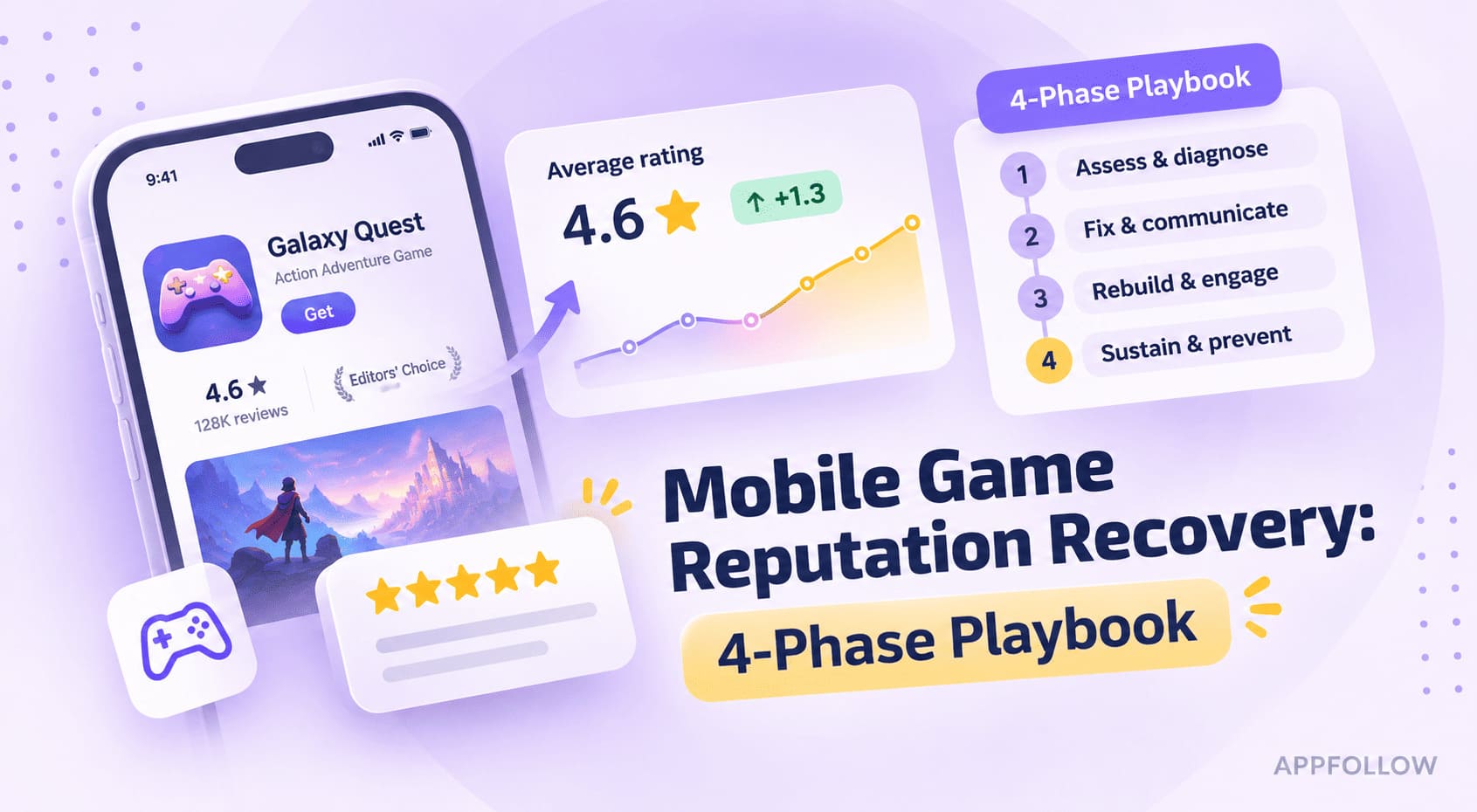
Table of Content:
- TL;DR: the 4-phase recovery framework
- Key insights: what reputation damage looks like in the data
- What actually causes reputation damage in mobile games
- Choose your recovery scenario
- The 4 phases of mobile game reputation recovery
- The six recovery signals to track daily
- Store-specific recovery tactics: App Store vs Google Play
- Two public cases: one non-recovery, one fast recovery
- How AppFollow supports the recovery playbook
- Frequently asked questions about mobile game reputation recovery
The apology has shipped. Now what?
Most reputation advice stops at the apology. This is the part after it: what you ship on Day 3, what you measure on Day 30, and how you tell a stalled recovery from a slow one before another quarter goes by. Mobile game reputation recovery runs about 180 days when it goes well, and it fails in predictable places.
The cost is not the star average by itself. A game sliding out of the fours loses store conversion and featuring eligibility together, and it loses them in every market at once. That last part catches teams out: a game carrying reviews across thirty countries does not have one reputation problem, it has a headline number hiding several. Assume both stores, several markets, and more review volume than anyone is reading by hand.
That is the environment this playbook is written for.
We run this playbook with game studios during live crises, and the pattern holds across causes. A monetization change that players read as a value cut behaves differently from a 12-hour outage, and organized review bombing behaves differently again. What stays constant is the sequence: stabilize, turn sentiment, recover the rating, then make the habits permanent.
One correction before we start, because the rest of the article depends on it. Neither store publishes a "rolling 30-day rating." Google Play says only that the displayed rating is weighted towards more recent ratings, and Apple lets you reset the overview rating when you ship a new version. The 30-day average in this playbook is a metric you compute to watch your own trajectory, not a number the store is showing your players. Teams that confuse the two spend Phase 2 waiting for a mechanic that does not exist.
If you have not decided whether to apologize publicly at all, start with when to apologize in the App Store. If your rating dropped after a specific update and you are inside the first 30 days, the faster route is our game rating drop triage playbook. This article picks up where both end.
TL;DR: the 4-phase recovery framework
Four phases, 180 days, six signals. Each phase has one job, and skipping one adds months rather than weeks.
- Phase 1, Days 0 to 14: stabilize. Reply first, ship nothing new, and accept that the rating keeps falling. You are buying information and goodwill, not points.
- Phase 2, Days 14 to 45: turn sentiment. Ship the promised fix by Day 30 and say so loudly. Sentiment turns here while the star average still looks bad.
- Phase 3, Days 45 to 90: recover the rating. New reviews start outweighing crisis reviews. Conversion follows the rating, as our app rating impact analysis sets out, and search position follows conversion.
- Phase 4, Days 90 to 180: make it permanent. The crisis cadence becomes the operating cadence, which is the only part of app store crisis recovery that pays you back later.

The counter-intuitive phase is the second one, and it is where most mobile game reputation recovery projects stall. Across 51.5 million reviews and 22,800 gaming apps tracked between January 2025 and January 2026, sentiment moved two to three weeks before headline star ratings did, per our gaming sentiment benchmarks. So the star average is the last thing to tell you the recovery is working, and the first thing your leadership will ask about.
Key insights: what reputation damage looks like in the data
Mobile game reputation recovery starts with one uncomfortable fact: a crisis is visible in review text before it is visible in your rating, because the rating is an average and averages move slowly. That single lag explains most of the bad decisions teams make in the first month.
Here is what our benchmark data supports, and where it stops.
- Sentiment leads the rating by two to three weeks. That is the measured pattern across 22,800 gaming apps between January 2025 and January 2026, per our gaming sentiment benchmarks. Practical consequence: judge Phase 2 on sentiment and review topics, and judge Phase 3 on the rating.
- Replying moves the rating more than it moves sentiment. In the same dataset, games that reply to reviews average 3.61 stars against 3.18 for games that do not, while sentiment barely separates the two groups at 62.4 against 61.9. Replies are not a mood-repair tool. They are a rating-repair tool, and they work partly because reviewers can revise a review after a reply, which Apple states explicitly. That revision window is what our Reply Effect metric measures.
- The reply-rate band that correlates with recovery is 30 to 50 percent, not 100 percent. Games replying to 30 to 50 percent of reviews average 3.77 stars against 3.25 for games replying to under 1 percent, a 0.52-star gap, per our gaming reply-rate benchmarks. Global gaming reply rate is 24.8 percent, and even AppFollow clients average 52.4 percent. Treat a 60 percent crisis-window target as top-decile effort, not a baseline.
- Know your starting line. Global average gaming rating is 3.48, with Google Play at 3.44 and the App Store at 3.75, while platform-featured games average 4.34, per our average mobile game rating benchmarks. A game falling from 4.3 to 3.9 has lost its featuring profile, which is a different problem from a game falling from 3.6 to 3.2.
What our data does not support, and what we have therefore cut from this playbook: any claim about how many weeks faster a replying team recovers, and any figure for extra stars lost to silence. Those numbers circulate widely. We cannot reproduce them, so we will not print them.
Yaroslav Rudnitskiy, Senior Professional Services Manager - ASO guru: "Every reputation crisis we have helped through starts the same way. Review volume jumps several times above normal and the complaints converge on one topic within a day. The rating has not moved yet, because the average lags. Watch the topic concentration, not the star."
Concentration is the signal worth naming. Normal negative reviews spread across bugs, difficulty, pricing and device issues. A crisis collapses them into one theme, and the moment your top complaint topic holds more than half of new negative volume, you have a reputation event rather than a bad week.
What actually causes reputation damage in mobile games
Six root causes cover almost every case we see, and the cause determines your first move rather than your timeline. Most of app reputation management is knowing which of the six you are looking at before you say anything in public. When someone asks why is my app rating dropping, the answer is rarely the update itself. It is what players believe the update revealed about your intentions.
- Monetization changes read as retroactive value cuts produce the loudest and longest crises, because they feel like a broken deal rather than a bug; our playbook on monetization and paywall complaints covers how the complaint pattern forms.
- Balance patches produce sharp, narrow anger that usually resolves once the affected cohort sees data or a revert, and they follow the same shape as any bad update that hits your ratings. Those three are about perceived intent, which is why they take the longest to clear. The next three are about an incident or an outside force, and they behave differently.
- Outages and extended downtime are the most binary: frustration spikes hard, then evaporates once service is stable and compensated.
- Security and account incidents carry legal obligations that outrank your communications plan, and they need counsel before they need copy.
- Content or IP collaborations read as tone-deaf are cultural rather than technical, so no patch resolves them.
- Organized app review bombing originates outside your game entirely, which makes it the one case where doing less publicly is the correct move.
Those app rating drop causes look similar in a dashboard and completely different in review text. The discriminating check takes ten minutes: pull the reviews from the 48 hours around the sentiment break, group them by topic, and read the top cluster rather than the newest reviews.
Not every crisis fits 180 days. Calibrate before you commit to this timeline. A short outage or a single mistuned patch usually closes inside 60 days. A data breach, a child-safety incident, an open regulatory investigation, or coordinated multi-market review bombing needs 12 to 18 months, and the brand impression can outlast the rating recovery by years.
In rare cases teams delist and relaunch under a new bundle ID to start with clean reviews. That is a real option, and it is the last one. Use the severity-by-loudness matrix in our apology decision framework to place your crisis before you pick a phase.
cta_free_trial_purple
Choose your recovery scenario
The four phases are universal. Your first 24 hours are not. Match your crisis below, execute that first move, then run the phases.
- Monetization backlash. Publish a developer letter inside 72 hours naming the change, the adjustment, and the compensation. Read the paywall complaint patterns before you draft it. Do not defend the design decision while the thread is still growing.
- Balance patch controversy. Publish the win-rate or engagement data behind the change and commit to a dated re-review, the same way you would after any bad game update. Do not apologize for a correct change, because you will have to defend it again next patch.
- Outage or downtime. Status updates every 30 minutes while it is live, compensation announced within two hours of restoration. Silence during an outage costs more than the outage.
- Data, account, or privacy incident. Legal review first, direct notification to affected players where required, public statement last. Do not estimate scope before the investigation closes.
- Tone-deaf content or collaboration. Pause the campaign, acknowledge the specific objection, complete an internal review before saying anything else. Expect hostility in the queue meanwhile; our playbook on managing toxic players covers moderating it. Do not keep running it because the media buy is committed.
- Organized app review bombing. Report the coordinated activity to both stores, brief your moderators, document evidence, and keep normal support running. The detection signals sit in our review bombing recovery guide. Do not post a defensive statement, because that is the engagement the campaign is looking for.
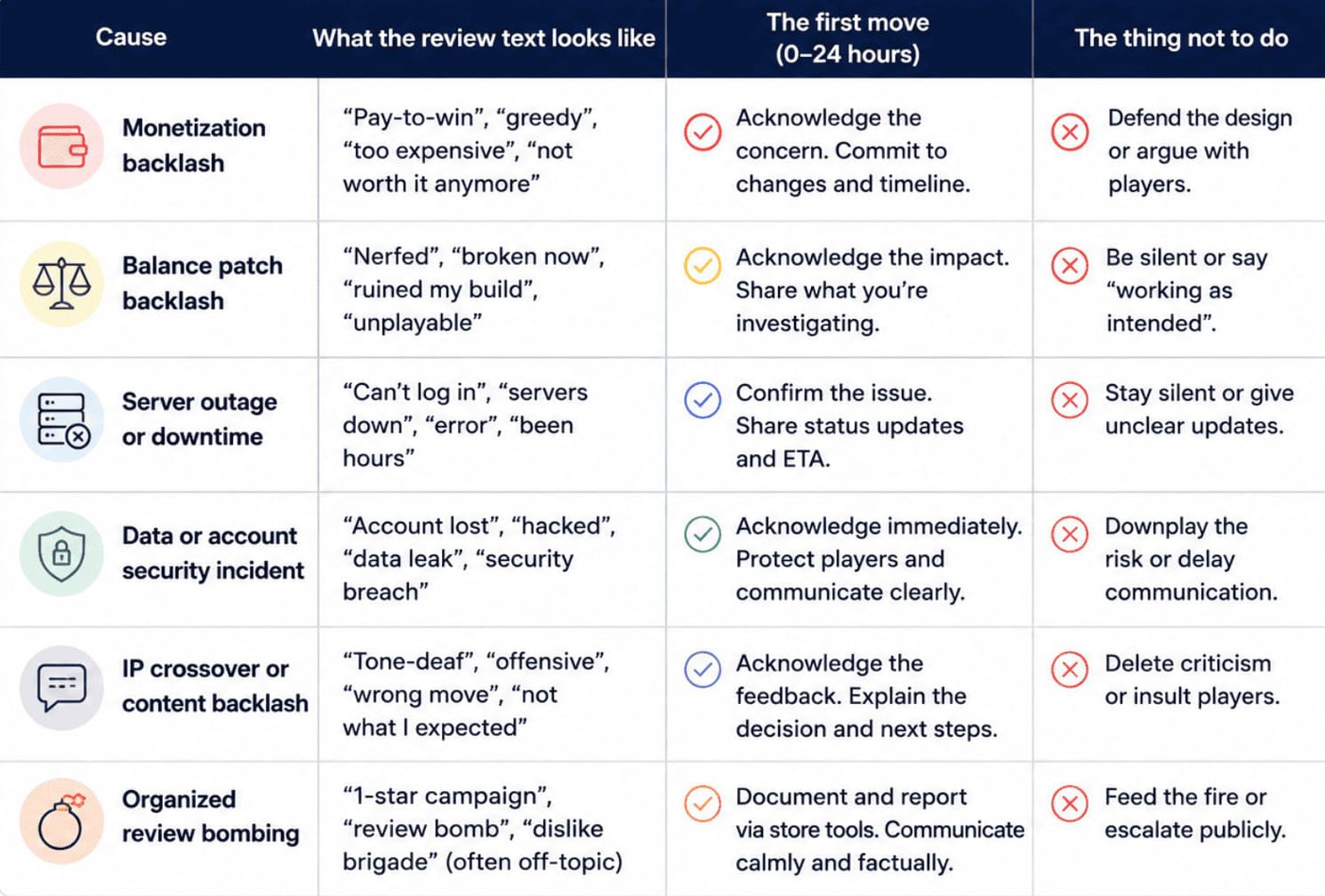
Scenarios 1 and 2 are the ones teams most often get backwards. The instinct is to apologize for the balance patch and explain the monetization change, when the evidence usually supports the opposite.
The 4 phases of mobile game reputation recovery
Day 0 is the day your public response goes live, not the day the crisis started. Each card below carries the same six fields, so you can hand one phase to one owner and check it off. Key performance indicator (KPI) definitions referenced here live in our mobile game KPIs guide.
Phase | Primary signals | Checkpoint |
|---|---|---|
1. Stabilize 0 to 14 days | Topic concentration, reply rate on 1 and 2 stars, review volume vs baseline | Reply rate above 60 percent, topic concentration falling, rate of rating decline slowing |
2. Turn sentiment 14 to 45 days | 7-day sentiment, positive-to-negative ratio, fix shipped | Fix live by Day 30, ratio above 2:1, crisis topic out of the top three |
3. Recover the rating 45 to 90 days | 30-day average, store conversion, keyword and category position | Average within 0.2 stars of baseline, conversion within 5 percent |
4. Make it permanent 90 to 180 days | 30-day average, sentiment stability, competitor movement | Average within 0.1 stars of baseline, playbook documented, cadence unchanged for 60 days |
cta_free_trial_purple
Phase 1: stabilize (Days 0 to 14)
What is happening in the data
The rating keeps falling and that is expected, because new negative reviews are arriving faster than positive ones can offset them. Review volume typically runs several times baseline. The number worth watching is not the average, it is topic concentration: when one theme holds most of your new negative volume, you have a diagnosis instead of a mood.
What to watch
Volume against your own baseline, the share of new negative reviews in the top topic, and reply rate on 1 and 2 stars. Set your alerting so a sentiment break reaches the community lead in the channel they already use, rather than on a dashboard nobody has open at 2am.
What to ship
How to respond to negative app reviews in Phase 1 is a volume question before it is a wording question: reply to every new 1 and 2 star review inside 24 hours. That target is not arbitrary, and our gaming reply time benchmarks explain why the first day is the window that still changes a review. For wording, our 43 examples of responding to negative reviews will save your team drafting time it does not have this week.
Then the letter and the perimeter. Publish a follow-up developer letter between Days 3 and 7 with a dated fix, checked against the apology decision framework if you are unsure how much to concede. Keep moderators active on Reddit and Discord, where the tone will be worse than in the store; our playbook on managing toxic players covers holding that line without escalating. Ship no new events, no new content, and no new offers until Day 14, because anything that looks like business as usual reads as a team that has not understood the complaint.
Owners and cadence
Community lead runs the reply queue. Product owns the fix date in the letter and is the only person allowed to change it. Marketing holds every campaign and event launch until Day 14.
Cadence is tightest here, and it should loosen on a schedule rather than on a feeling. Read the queue every three to four hours through the first 72 hours, then twice daily to Day 14. Ship a status update to the community every 48 to 72 hours whether or not there is progress, because a silent gap reads as a stalled fix.
Common pitfalls
- Going quiet after one acknowledgment. Promising a date engineering has not agreed to.
- Writing in corporate register to an audience that reads corporate register as evasion.
- Deleting or reporting legitimate criticism, which becomes its own crisis and, as Google notes, gets rejected anyway if the review does not actually break policy.
How to verify the phase closed
Pull the last 72 hours of reviews and re-run the topic grouping. If the top topic's share of negative volume is lower than it was on Day 3 and your reply rate on 1 and 2 stars is holding above 60 percent, which is well clear of the 24.8 percent global gaming average, Phase 1 is done even if the rating is still falling. If concentration is flat, your fix has not been believed yet and you are still in Phase 1.
The Phase 1 developer letter: five parts, in this order
- Acknowledge. Name the specific issue in the community's words, not legal's. If players are saying "you nerfed stamina to sell refills," say stamina and refills.
- Explain. One paragraph on what happened and why. No blame-shifting, no roadmap language.
- Compensate. The exact item or currency, who receives it, and by when.
- Commit. A real date or a tight range for the underlying fix. Not "soon," not "an upcoming patch."
- Sign. A named person and role. "The team" is not a signature.
Illustrative example, not a real studio. A mid-core RPG ships an energy change that cuts free daily runs from six to four:
"You told us the new stamina curve turned a 20-minute session into a paywall. You are right, and that is not the game we want to run. We tuned stamina against completion data from players well past the content you are actually playing, which is our mistake, not yours. Every account active in the last 30 days gets 30 stamina refills and 500 gems by Thursday. The curve itself reverts to the pre-2.3 values in patch 2.3.1, targeted for the week of 15 September, and we will publish the new completion data alongside it so you can check our work. Sorry for the week. Maria Ortega, Game Director."
That is 130 words and it does all five jobs. Length is not what makes a letter credible. Specificity is.
Phase 2: turn sentiment (Days 14 to 45)
What is happening in the data
Your average still looks bad and your review text no longer does. This is the phase where the two-to-three-week lag between sentiment and rating works in your favour rather than against you, so the evidence that you are recovering shows up in topics and tone before it shows up anywhere your CFO is looking.
What to watch
Sentiment across the last seven days rather than lifetime, read as direction rather than absolute score; our guide to measuring customer sentiment sets out which of the seven metrics actually move early. Weekly count of 4 and 5 star reviews divided by 1 and 2 star reviews, targeting better than 2:1 by Day 30.
The related store rating versus review rating gap is worth watching alongside it, because a recent-review rating running above the displayed store rating is the earliest sign the average is about to turn. Whether your crisis topic has dropped out of the top three complaint themes. Competitor sentiment across the same window, because a rival stumbling can flatter your numbers and hide a stalled recovery.
What to ship
The promised fix, live by Day 30 at the latest, because a missed date here costs more than the original incident. If the fix ships as a release, treat it as one: our guide to protecting ratings after release issues covers the reaction to expect. A follow-up letter that shows the fix in detail rather than announcing it.
Normal live operations (LiveOps) cadence restarted, since a quiet game reads as an abandoned one. In-game surfacing through patch notes, an announcement screen, and a push to lapsed players, because the people who left are the people who have not seen the fix.
Owners and cadence
Product owns shipping the fix. Community owns the announcement and the reply queue. Growth owns the lapsed-player push and holds paid acquisition flat until Phase 3.
Drop the queue read to twice daily, morning and end of day, and move the community update to weekly. Add one weekly standup with product, marketing and support, because this is the phase where the fix date and the announcement have to stay married to each other.
Common pitfalls
- Declaring victory on the sentiment turn and cutting reply cadence.
- Shipping the fix quietly, which is the single most common way teams waste a good Phase 2.
- Restarting LiveOps with a monetized event when the crisis was about monetization.
How to verify the phase closed
The fix is live, the positive-to-negative ratio has held above 2:1 for two consecutive weeks, and the crisis topic is out of your top three. If the ratio spikes for one week and falls back, that was an event, not a turn. Stay in Phase 2.
Phase 3: recover the rating (Days 45 to 90)
What is happening in the data
This is where you rebuild the app rating after the drop. The average finally starts climbing, because recent positive reviews now carry more weight than the crisis reviews behind them. Conversion follows the rating, and search and category position follow conversion. That ordering is why ranking recovery reads as slow: nothing is broken, the inputs simply arrive in sequence.
What to watch
Your computed 30-day average, store conversion from product page views to installs, and keyword positions alongside category rank. Rating matters here beyond vanity: moving an app from three to four stars has been associated with an 89 percent lift in conversions, a figure and its source we cover in our app rating impact analysis.
Against a 3.48 global gaming average and 4.34 for featured games, crossing back over 4.0 is where featuring and conversion both come back into range.
What to ship
Everything filed under how to improve app store rating belongs in this phase, and it is a checklist rather than a search query. Prompt for reviews at genuine high points, such as a completed event or a won match, and never after a failure state; our guide to asking for app reviews covers the prompt rules and the sessions to suppress.
Ship a content update on schedule. Shift replies from damage control to conversation. Refresh store assets if your screenshots still sell the pre-crisis game. Brief mid-tier creators on what actually changed, because a trusted third party moves sentiment in a way that no owned channel can.
Owners and cadence
Growth or ASO lead owns conversion, metadata and creator outreach. Community sustains replies at a lower, permanent rate. Product returns to roadmap.
One 15-minute read each morning covers it now: rating trajectory, sentiment direction, competitor movement. Add a weekly business review on conversion, keyword position and creator results, and a monthly update to leadership measured against the pre-crisis baseline rather than against last week.
Common pitfalls
- Buying installs to reset the funnel, which raises volume without raising trust.
- Cutting community headcount the moment the graph turns up.
- Expecting category rank to move with the rating rather than after it.
How to verify the phase closed
The 30-day average has climbed for four consecutive weeks and sits within 0.2 stars of your pre-crisis baseline, conversion is within 5 percent of baseline, and category position is within a handful of places. If the rating recovered but conversion did not, the problem is now your store listing, not your reputation.
Ilya Kataev, Professional Services Team Lead: "Across the recoveries we have supported the shape repeats. Two weeks of pain, a quiet turn around Day 30 that only shows up in review text, a visible climb by Day 60. Teams get into trouble when they read the early sentiment turn as a finished recovery and drop the reply cadence. The cadence is the thing that is working."
Phase 4: make it permanent (Days 90 to 180)
What is happening in the data
The crisis is far enough behind the recency weighting that new players see your current reputation rather than your worst month. Nothing dramatic happens in this phase, which is exactly the risk: there is no longer any pressure holding the new habits in place.
What to watch
The 30-day average holding within 0.1 stars of baseline. Sentiment stable rather than merely positive. Competitor movement, because players who left during your window are now somebody's retained cohort.
What to ship
Keep the reply cadence, the sentiment check and the letter rhythm that worked, and write them into the on-call rota so they survive a reorg. Phase 4 is where crisis response turns into ordinary app reputation management, and the conversion is deliberate rather than automatic.
- Run an internal post-mortem that records the signals you missed and how long you took to see them.
- Update the crisis runbook while the detail is fresh.
- Keep the creator relationships warm instead of treating them as emergency contacts.
If you run several titles, this is the point to lift the cadence into a shared standard, which we cover in portfolio review management at scale.
Owners and cadence
Community lead owns the standing rhythm. Leadership owns the monthly review, which is the thing that stops the rhythm quietly lapsing.
The Phase 3 cadence is now the permanent one, and only the purpose of the monthly review changes: the six signals become ordinary performance metrics rather than incident metrics. Nobody should be able to tell from the calendar that a crisis happened.
Top 3 common pitfalls
- Declaring the crisis over in a way that licenses everyone to stop.
- Losing the community managers who carried it, usually to a competitor who noticed how well they handled it.
- Filing the post-mortem without changing the alerting that failed.
How to verify the phase closed
App reputation management has become routine: the cadence has held unchanged for 60 days without anyone chasing it, the runbook exists and names owners, and one person can point to the alert that will catch the next event faster. If the cadence only holds when someone asks about it, Phase 4 has not closed.
cta_free_trial_yellow
The six recovery signals to track daily
Six signals, one daily read of about 15 minutes. This is app reputation management at its least glamorous and most useful. The point of a fixed set is that it stops the team relitigating which number matters while the crisis is running.
Signal | What to read | Healthy range |
|---|---|---|
1. Topic concentration | Share of new negative reviews in your top complaint theme | Falling week over week; under 30 percent is normal operation |
2. Sentiment, last 7 days | Direction of sentiment on recent reviews, not lifetime | Rising for two consecutive weeks |
3. Reply rate on 1 and 2 stars | Share answered within 24 hours | Above 60 percent in Phases 1 to 2, 30 to 50 percent after |
4. Positive-to-negative ratio | Weekly 4 and 5 star count divided by 1 and 2 star count, read against the store-review rating gap | Above 2:1 by Day 30, above 3:1 by Day 60 |
5. Store conversion | Product page views to installs, per store | Within 5 percent of pre-crisis baseline |
6. Competitor sentiment | Direction of tracked rivals' sentiment across your window | No longer moving inversely to yours |
Signal 4 is the one to keep if you can only keep one. A rising ratio means players are changing their minds. A falling negative count on its own often just means fewer people are playing, which is a worse outcome wearing a better number.
Two notes on ranges. The 60 percent reply target sits above the 52.4 percent that even AppFollow clients average, so treat it as a crisis-window push rather than a permanent standard.
Worth knowing where the effort actually lands: among AppFollow clients the 2-star band carries the highest coverage at 73.8 percent against 69.4 percent for 1-star, per our reply rate by star rating research, and the 2-star reviewer is the one most likely to revise upward. And read conversion against your own pre-crisis baseline rather than a benchmark, because category and geography move it more than reputation does.
Veronika Bocharova, Customer Success Manager: "During a recovery the community manager needs two views open and nothing else: the reply queue with sentiment on it, and the competitor view for context. Every extra dashboard is a decision they are not making. Two views, six signals, four phases is the whole scope.
cta_free_trial_purple
Store-specific recovery tactics: App Store vs Google Play
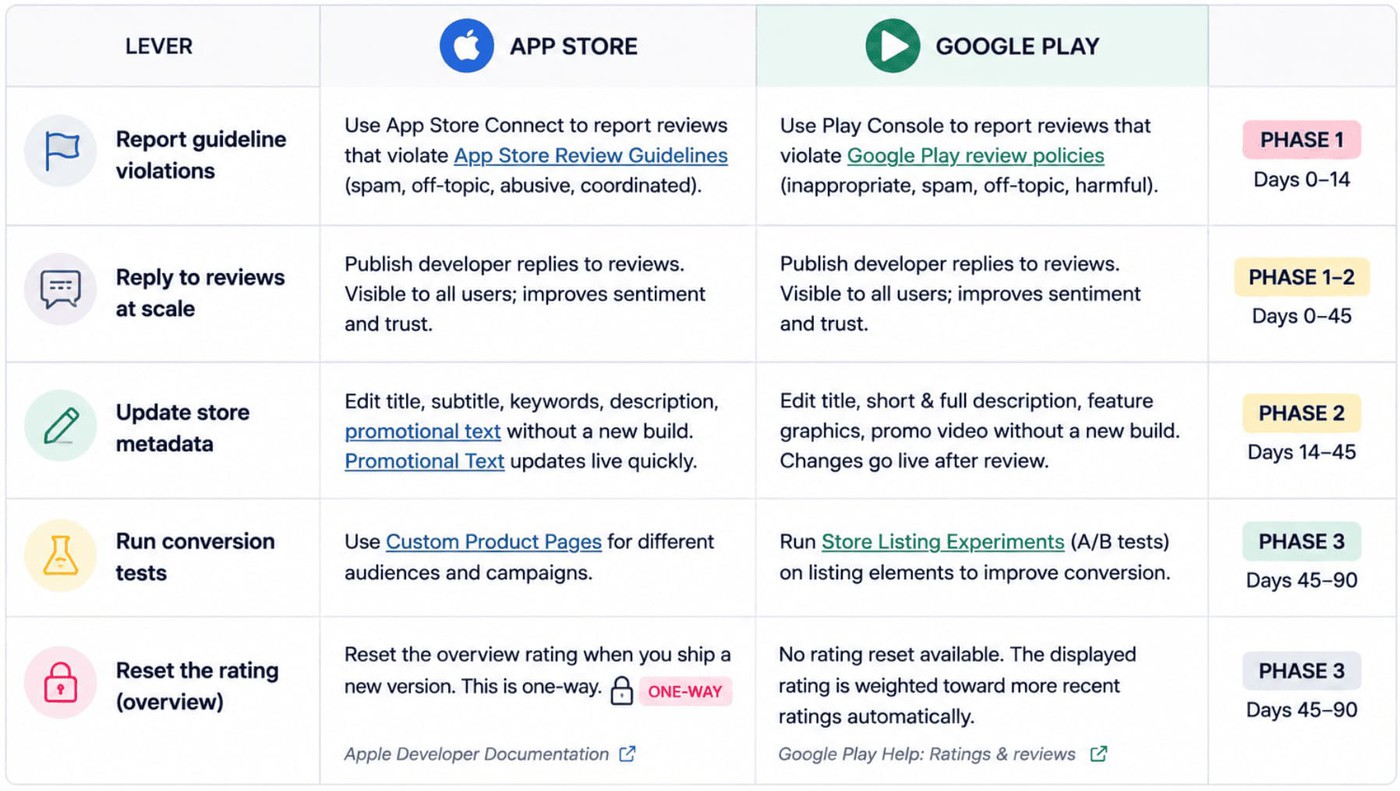
The framework is store-agnostic. The mechanics are not, and the differences are larger than most reputation advice admits. Five levers, with the official documentation for each, because these change and you should check them rather than trust an article.
App Store | Google Play |
|---|---|
1. New version and rating weighting You can reset the overview rating when a new version releases. It applies to all regions at once, written reviews stay visible, a notice appears on your product page, and the old rating cannot be restored. | 1. New version and rating weighting The displayed rating is weighted towards more recent ratings, so a substantive update plus new positive reviews shifts it without any reset mechanism. |
2. Reporting coordinated reviews Use Report a Concern under the review in App Store Connect for offensive content, spam, or terms violations. The reviewer is not notified. | 2. Reporting coordinated reviews Report inappropriate reviews from the Reviews page in Play Console. A specialist responds within a few business days, there is a daily submission limit, and a rejected review cannot be reported again. |
3. Fast store messaging Promotional text is up to 170 characters and editable without submitting a new version. It is the fastest legitimate surface you have during Phase 1. | 3. Fast store messaging Short description edits go through review, so plan for a delay rather than same-day. |
4. Conversion recovery testing Custom product pages vary screenshots, previews and promotional text across up to 70 additional versions, each on its own URL, and each assignable keywords. | 4. Conversion recovery testing Store listing experiments test icon, feature graphic and screenshots by default, or graphics plus descriptions across up to five languages, judged on install data. |
5. Per-market reading Ratings display per storefront, so a regional crisis need not become a global one. | 5. Per-market reading Same principle, and worth checking separately because your market mix differs by store. |
Lever 1 deserves the most thought and gets the least attention. Apple's reset is genuinely powerful and genuinely one-way: you cannot get the old rating back, your written reviews stay, and players see a notice explaining what happened. It suits a game whose rating collapsed from a genuinely fixed cause and whose new version is materially different.
It is a bad idea when the underlying complaint is unresolved, because you will rebuild the same rating from scratch with an added credibility cost.
One thing no lever does. You cannot delete bad app reviews for being negative, on either store. If you are searching for how to remove negative reviews from Google Play, the honest answer is that reporting removes policy violations and nothing else, and Google will tell you so in the rejection. Our guide to removing fake and inappropriate app reviews covers what actually qualifies
Two public cases: one non-recovery, one fast recovery
Public cases are more useful in pairs, because a recovery playbook is only credible if it also explains what a failed recovery looks like. Neither case below involves an AppFollow customer, and both rest on published reporting.
Diablo Immortal: revenue succeeded, reputation did not
Diablo Immortal launched on 2 June 2022 and became the clearest public example of what happens when Phase 1 goes the wrong way. Within days its PC listing held a Metacritic user score of 0.2 out of 10 across nearly 2,000 ratings, the lowest user score in the site's history at the time, as Video Games Chronicle reported that June, while critic reception sat at a mixed 59.
The main complaint was the endgame monetization was, and the criticism converged on it with unusual precision.
The response is the instructive part. Rather than acknowledging the specific objection, the game's director argued publicly that the negativity was based on misinformation, again reported by Video Games Chronicle, which the community read as a denial of what they were experiencing. Major Diablo community sites subsequently closed their Immortal sections. That is a Phase 1 failure in textbook form: the letter that names the issue in the community's own words never arrived, so the crisis stopped being about a monetization design and became about whether the team was listening.
The commercial outcome is what makes the case worth printing. The game passed 100 million dollars in its first eight weeks and 30 million downloads by late July 2022. Revenue and reputation decoupled completely, and stayed decoupled. For publisher context, see our breakdown of the biggest mobile game companies.
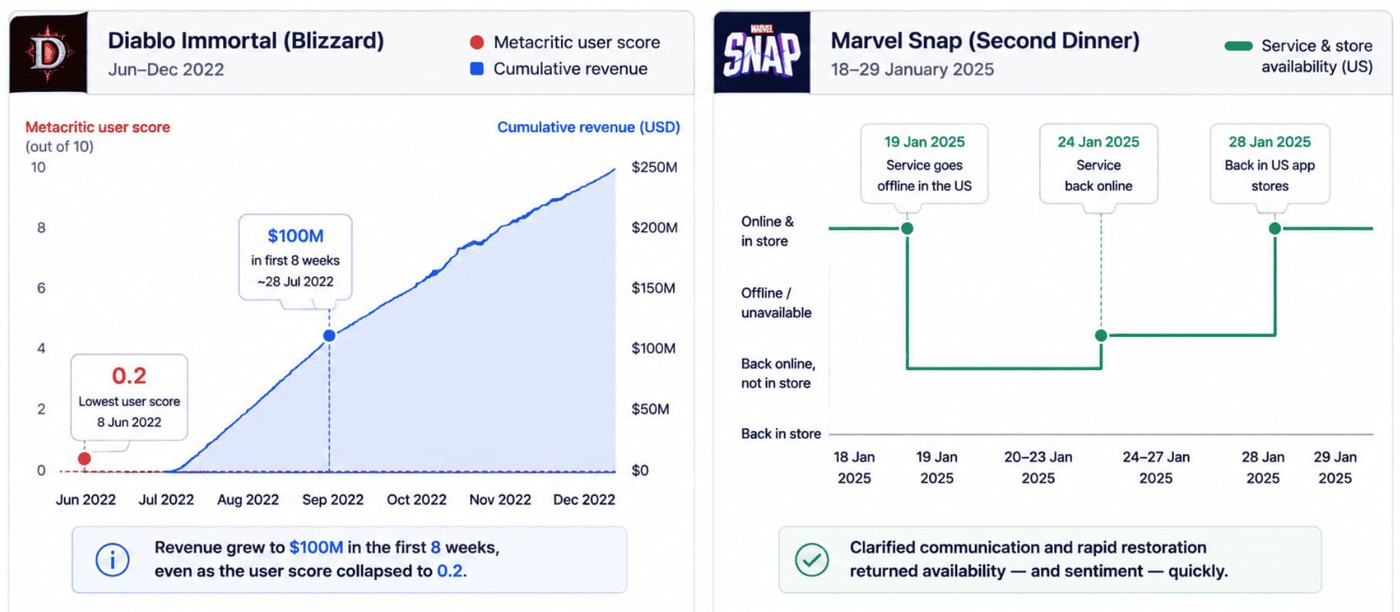
The lesson is narrow and worth stating plainly: strong revenue is not evidence that your recovery worked. If your Phase 1 letter does not name the complaint the community is actually making, you can hit every commercial target and still carry the brand impression for years.
Marvel Snap: a crisis that was never about the product
The counterpart arrived in January 2025 and had nothing to do with the game itself. Marvel Snap went offline in the US late on 18 January, pulled down alongside TikTok because its publisher at the time, Nuverse, was ByteDance-owned. AppMagic estimated the studio lost roughly 130,000 dollars in in-app purchase revenue across the two-day outage, as mobilegamer.biz reported on the day. Several other ByteDance-published titles went dark the same night.
Second Dinner's handling is the model. They posted publicly within hours naming exactly what had happened and what they knew, kept updating rather than announcing once, and the game was back in US app stores by 28 January, per Tom's Guide. The studio then worked to move publishing away from ByteDance-owned Nuverse, which addressed the cause rather than the symptom.
Two takeaways for reputation damage control in mobile games.
- When the cause sits outside your product, uncertainty is the damage, and a steady cadence of small honest updates is the entire fix.
- The fastest recoveries close the underlying cause, not the conversation about it.
How AppFollow supports the recovery playbook
When negative reviews spike after an update, Product needs to know which issue to fix first. The community team still has a queue of players waiting for answers. AppFollow brings App Store and Google Play reviews into one feed, so both teams can see what’s driving the spike, whether the main complaint is easing, and which reviews still need a reply.
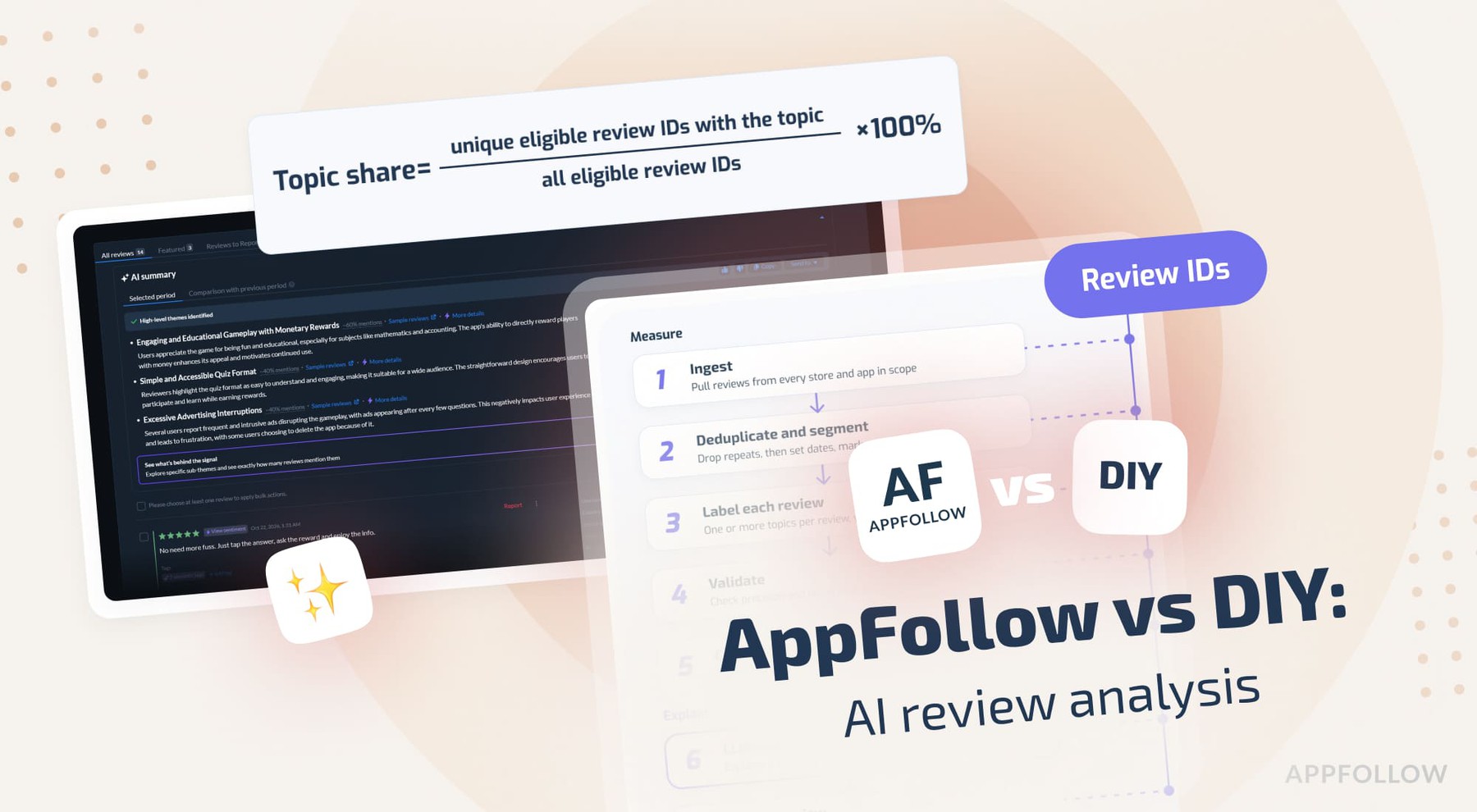
Track the top complaint in Phase 1. In the Reviews feed, filter new reviews by negative sentiment. Use semantic tags to count how many mention the leading complaint, then divide by all new negative reviews in that window. Spot-check the tagged reviews before sharing the number.
In the illustrative stamina case, the change accounted for 68% of new negative reviews, down from 79% three days earlier. The community lead brings that trend to the Phase 2 decision on whether to ship the fix or roll back the change.
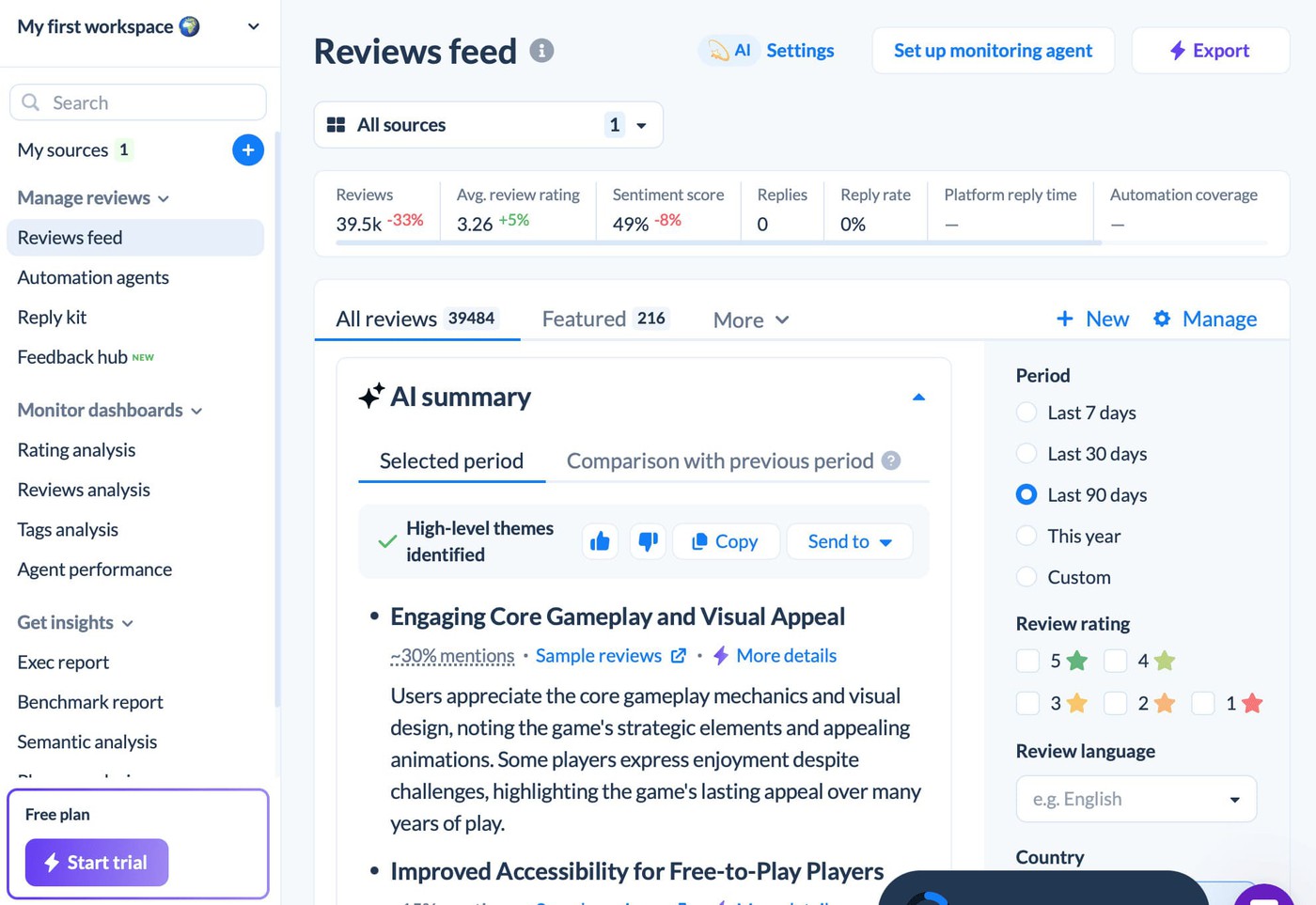
- Keep Phase 1 replies moving. Use Automation Agents to draft replies for new 1- and 2-star reviews. Set the tone and words to avoid in AI Reply Styles, keep human approval on, and check the queue against the 24-hour target. In AppFollow’s gaming reply-rate benchmarks, AI replies from AppFollow clients averaged 24.8 hours, while manual replies in the wider dataset averaged 299.3 hours.
- Route crash and login reviews to engineering. Set tagged-review alerts to go to the engineering team’s Slack channel. Include the review text, app version, and country where available so engineering knows which release and markets to check.
- Build the Day 30 update. Pull the reply rate for 1- and 2-star reviews from the Reviews feed for your Phase 1 window. During a review-bombing spike, use Report a Concern to track which reviews you reported and which the stores removed.
- Track the comeback in Phases 3 and 4. Compare the topics players praise in competing games over the same dates. Use recurring themes to shape your comeback message, and track keyword and category rankings in AppFollow’s ASO tools. Check store conversion against your pre-crisis baseline in App Store Connect and Play Console.
Toca Boca shows what the Phase 4 review cadence looks like at scale. The studio handles about 75,000 reviews a month. By the end of 2025, its reply rate reached 71.76%, and its App Store rating rose from 3.9 to 4.1, according to the Toca Boca case study.
cta_free_trial_yellow
Frequently asked questions about mobile game reputation recovery
These are the questions studios ask us in the first week, usually in this order. Each answer stands alone, so you can paste one into Slack without the surrounding article.
How do I respond to negative app reviews during a crisis?
Reply to new 1 and 2 star reviews within 24 hours and name the specific issue and the specific fix. Generic thanks-for-your-feedback replies are worse than silence, because they prove nobody read it. Apple notes that reviewers are notified and can update their review, which is where the rating gain comes from.
How do I improve my app store rating after a drop?
Fix the cause first, then reply fast, then prompt satisfied players at genuine high points, then ship a substantive update. Store metadata comes last. Expect three to six months for a drop of half a star or more, and check your target against the 3.48 global gaming average rather than against 5.0.
Can I delete negative reviews on Google Play or the App Store?
No. Both stores remove only reviews that break their policies, such as spam, offensive content, or coordinated abuse. Report through Report a Concern in App Store Connect or the Reviews page in Play Console. Google reviews reports within a few business days, applies a daily limit, and will not accept the same review twice.
How long does it take to recover an app rating?
Three to six months for a drop of 0.5 stars or more, assuming the cause is fixed inside the first 30 days. Outages recover fastest because the complaint disappears with the fix. Monetization and balance crises take longest, because the complaint is about intent. Severe incidents run 12 to 18 months.
What causes app reputation damage in mobile games?
Six causes: monetization changes read as value cuts, balance patch backlash, outages, security or account incidents, tone-deaf content or collaborations, and organized review bombing. The cause sets your first 24 hours, not your timeline, and review text identifies it faster than any dashboard metric.
Can a mobile game recover from a review bombing?
Yes, and usually within 14 to 30 days, provided you stay quiet publicly, report the coordinated reviews through each store's mechanism, and keep normal support running. The failure mode is a defensive public post, which supplies the engagement the campaign wants.
What is the difference between rating recovery and ranking recovery?
To recover from bad app reviews you need both clocks running. Rating recovery is your average returning to baseline, typically Days 45 to 90. Ranking recovery is search and category position following, and it lags because conversion has to move first and both stores weight recent performance. Track them as two separate clocks, or you will call a stalled recovery a slow one.