When to Apologize Publicly in the App Store: A Gaming Crisis Communication Playbook

Table of Content:
- TL;DR: the 4 rules for when to apologize publicly
- Why a well-timed apology lifts your rating, and a reflex one drags it down
- The apology decision framework
- Public apology, dev letter, or private reply?
- Five gaming crises that might need a public apology
- Where AppFollow gives your team the first 30 minutes back
Knowing when to apologize in the App Store decides whether a rating dips for a weekend or sinks for a quarter. Gaming crisis communication runs on its own physics, because players are loud, attached to the hobby, and a fair number of them keep a spreadsheet of your gacha rates.
So a public apology can rebuild trust in a day, or it can teach a few million people that your word is cheap.
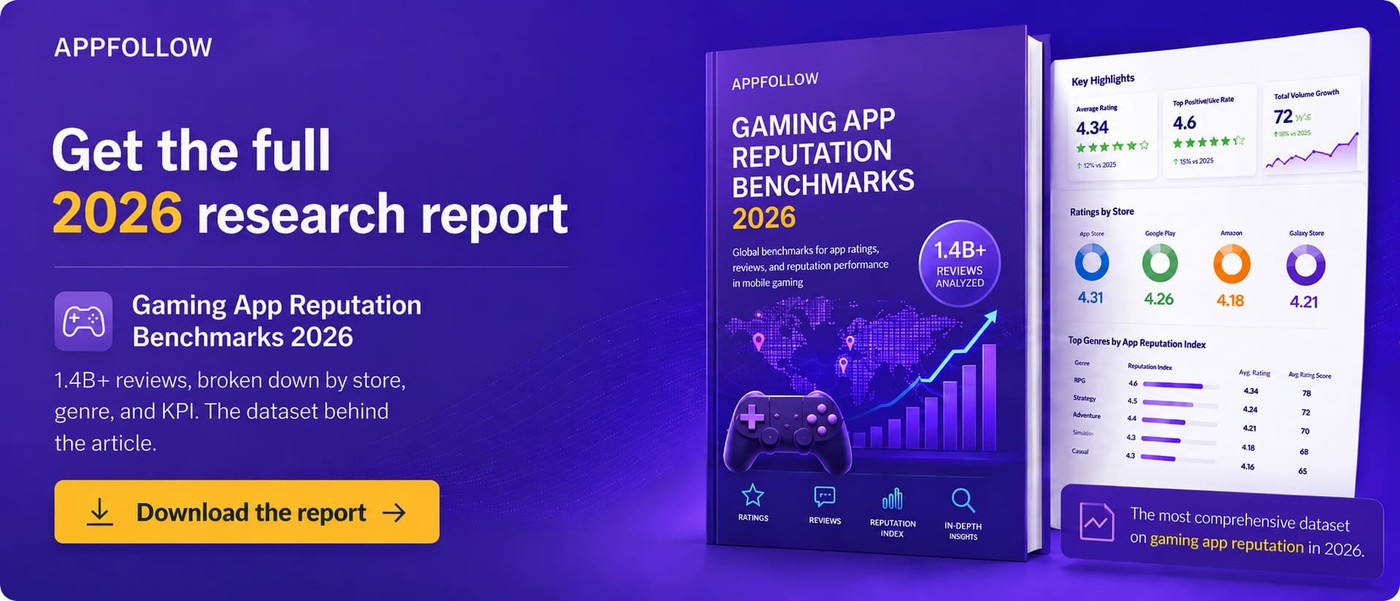
The math underneath isn't a vibe. Across 51.5 million reviews, games that reply to player feedback carry ratings half a star higher than the ones that stay quiet.
This playbook gives you the four-rule framework, five gaming-specific scenarios with wording you can adapt, and the AppFollow workflow that tells you which crisis you're actually in. Start with the block below.
TL;DR: the 4 rules for when to apologize publicly
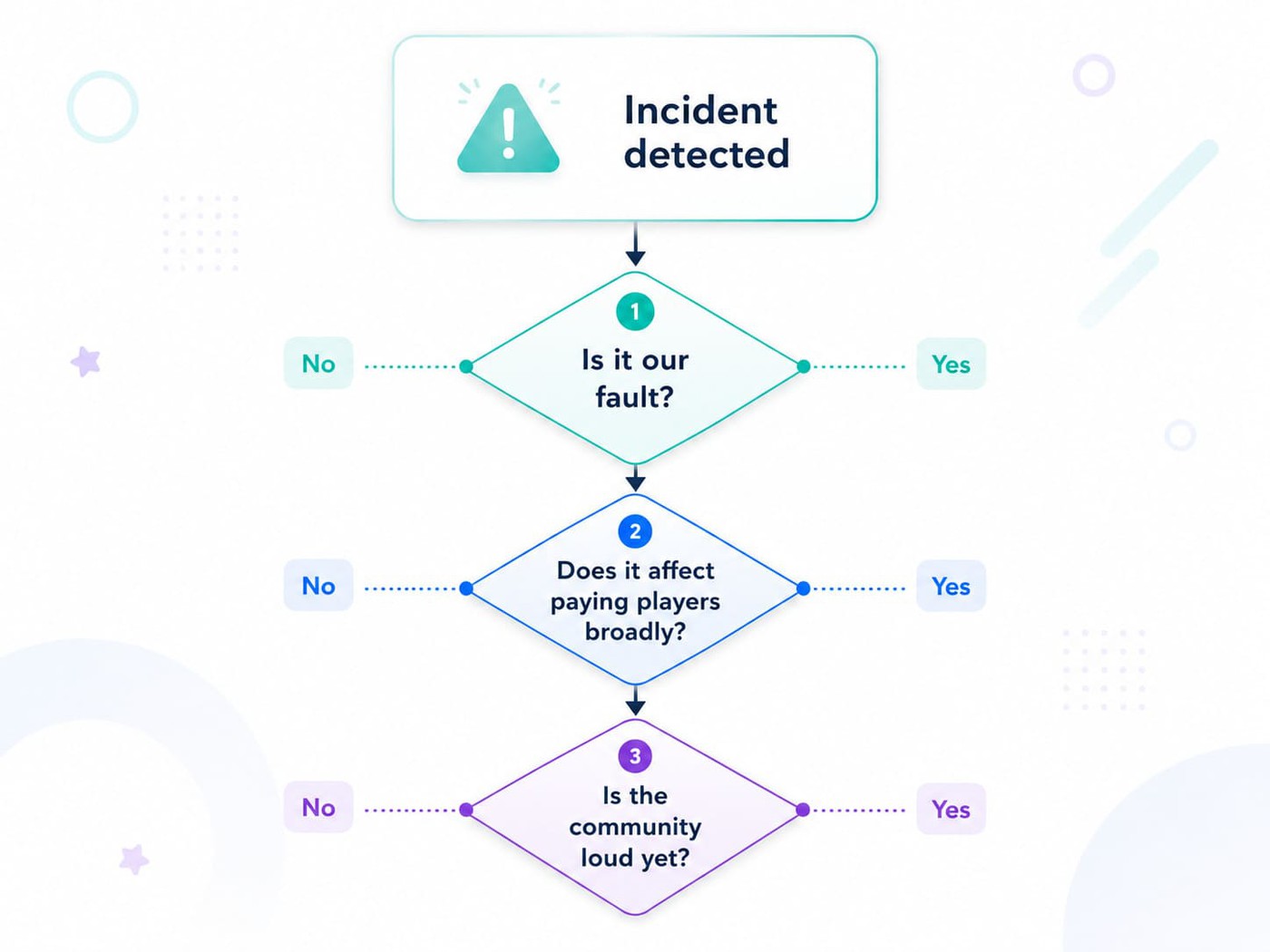
Apologize publicly only when the crisis is your fault, broad, and loud. The other three situations call for a private reply, a quiet fix, or nothing at all.
Four rules. One says yes, three say slow down.
- Apologize publicly when the problem is your fault, it broadly affects paying players, and the community is already discussing it loudly.
- Apologize privately (review replies plus support tickets) when the issue is real but narrow, hitting one cohort, one device, or one platform.
- Stay silent and ship the fix when the complaint is loud but your data shows the change was correct, like a nerf players hate that the win-rate proves works.
- Never over-apologize. A public apology every week strips the weight from the one that finally matters.
The signal that tells you which rule applies is sentiment velocity, and AppFollow Reviews & Ratings surfaces it in real time.
Why a well-timed apology lifts your rating, and a reflex one drags it down
The apology buys trust while you ship the fix. Replying to reviews at all is worth about +0.42 stars; doing it well lifts you into a 3.77-rating band.
Over-apologizing does the reverse.
The apology isn't the win; shipping the fix is. A public apology just buys you enough trust to be believed while that fix goes out. Time it well and you pull a sliding rating back from the edge. Botch it and you hand your most engaged players a screenshot they'll quote for months.
The store rewards showing up, and the numbers are blunt about it.
Games replying to 30 to 50% of their reviews average a 3.77 store rating, against 3.25 for games that reply to under 1%, measured across that same 51.5-million-review dataset (AppFollow, 2026).
Even replying to anything is worth roughly +0.42 stars over total silence.
Half a star feels academic until you remember what it touches: featured eligibility, organic install velocity, and the conversion rate on every dollar of paid acquisition.
That's why crisis response is an ASO for games problem, not just a PR one.
Veronika Bocharova, Customer Success Manager at AppFollow:
"Silence is costing gaming apps growth. While almost a third don't reply to reviews, those that engage smartly, focusing on negative feedback first, see measurable rating increases (up to +0.42). Better ratings drive more downloads, and ultimately, more revenue."
Two failure modes eat most studios.
- Some over-apologize, posting a heartfelt note every time one reviewer calls a new skin "lazy," which trains the audience to skim past the next statement.
- Others go quiet through a genuine mobile game crisis response moment, right up until the rating craters and a competitor publishes the post-mortem they should have written. Both camps are guessing instead of reading the room, and that guesswork is exactly what knowing when to apologize in the App Store is meant to replace.
So sort your responses by the job each one does well:
- Restoring trust after a self-inflicted crisis: one specific public apology plus the fix. One, not a series.
- Handling vocal-minority noise: quiet private replies and a calm rollout, no public statement.
- Living with ongoing systemic friction: scheduled monthly dev letters, which is a rhythm rather than a crisis.
- Binary outages (server, login, payment): an immediate status note, then a real apology once service is back.
A few more numbers worth taping to the wall, all from AppFollow's 2025–2026 research run:
- Speed is the whole game during a crisis. AI-assisted replies in the study landed in 24.8 hours on average; manual replies took 299.3 hours, roughly twelve and a half days, long after the player uninstalled (AppFollow, 2026).
- 29% of gaming apps never reply to a single review, so simply being present during a crisis already puts you ahead of nearly a third of the field.
- The most convertible reviewer isn't the furious one-star. It's the 2-star: unhappy, specific, and likely to revise upward if you answer inside the engagement window.
- Compensation earns its keep when real value was lost. Pair the apology with premium currency or a free pull and the sentiment recovery outpaces an apology-only reply. [Quantify with your own before/after sentiment delta in Reviews & Ratings.]
- Sometimes the dev letter beats the apology outright, especially when the design call was right and only the communication missed.
The apology decision framework
In short: Two questions decide it. How much real damage hit players (severity), and how loud is the community (loudness)? High-and-loud means apologize publicly. Everything else has a quieter answer.
Deciding when to apologize in the App Store comes down to two quick questions, plus a short list of moments to stay quiet.
Definition first, since the AI engines reward a clean one: a public apology is a short, named admission of fault, posted where your players will actually see it.
The rest of this section tells you whether you've earned the right to post one.
Test one: severity times audience loudness
Plot the incident on two axes: Severity measures real damage to players, counted in dollars, lost progress, or affected accounts. Loudness measures how much the community is already talking. Read the quadrant from there.
- High severity, high loudness → a public apology is required, no debate.
- High severity, quiet community → a proactive statement before the noise builds. This is the move that makes you look like the adult in the room.
- Low severity, loud community → the trap. Fix the thing, reply privately, let the noise burn out.
- Low severity, quiet room → nothing needed.
Public apology, dev letter, or private reply?
Three formats, three jobs, and choosing wrong hurts more than wording it wrong.
- A public apology stays under 200 words, names the specific problem, names the specific fix, offers compensation, and gets signed by a human. Use it for one-time crises that hit paying players.
- A dev letter is a different animal: the dev letter format runs 500 to 1,500 words and exists to explain the design philosophy behind a controversial-but-correct call, not to grovel. Reach for the dev letter format when a balance patch or a pricing change was right but your communication face-planted.
- Private replies, handled through AppFollow Reviews & Ratings, clean up the narrow individual complaints that never needed a stage. A 1,200-word philosophical essay about a two-hour server blip will read like a studio that's lost the plot.
Four times silence beats an apology
The priciest public apology app store mistakes are the ones you never needed to make.
- The change was correct and your data backs it. Saying sorry for a working balance change just rewards whoever shouted loudest.
- The complaint is a vocal minority that doesn't represent your base, which a sentiment alert can confirm in minutes.
- You genuinely can't fix the issue. Promising an impossible fix is worse than quiet, and you'll pay for it twice.
- It's regulatory or legal. Route it to your lawyers before a word goes public, because a hasty blog post can wreck your legal posture.
Used on purpose, silence is a strategy. For example before, panic over the high percent of the negative reviews in the general scope, look at the sentiment score of the selected topic in AppFollow:
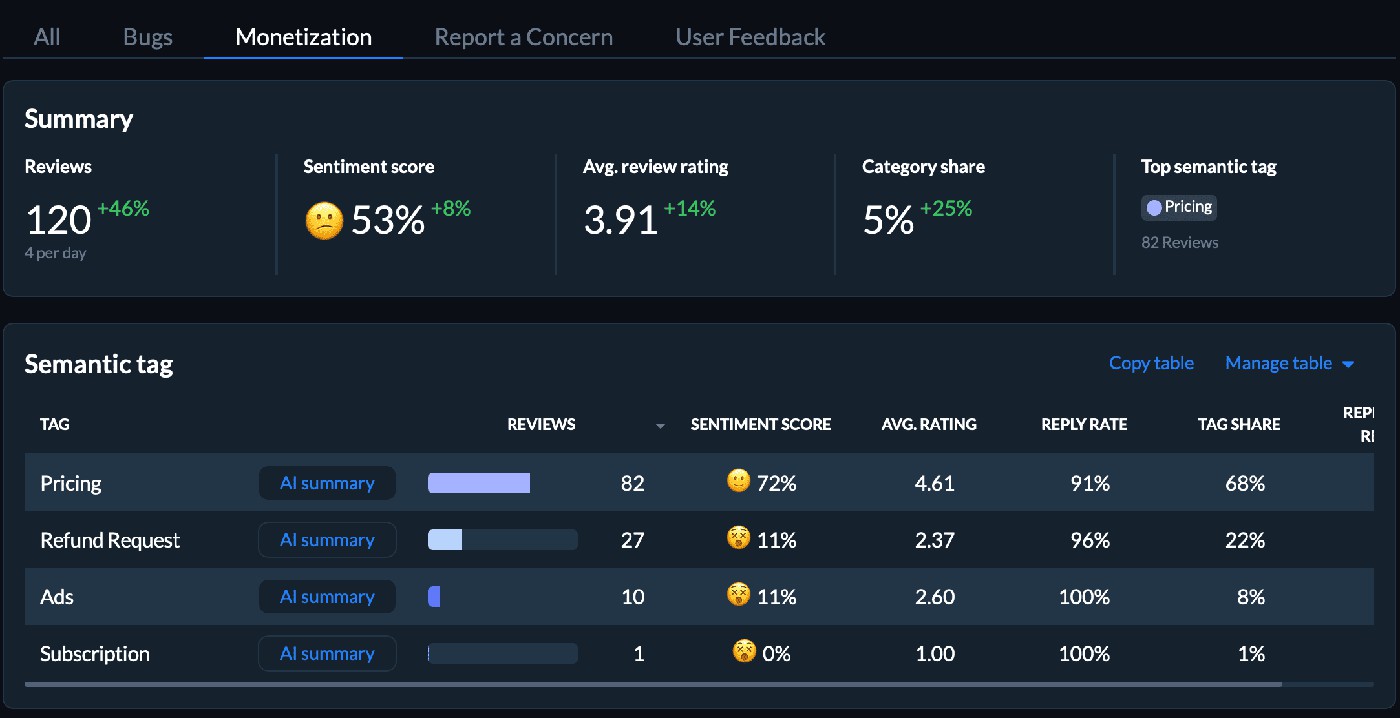
You'll see that the problem looks loud but covers a thin slice of players.
cta_free_trial_yellow
Five gaming crises that might need a public apology
In short: Server outages, balance backlash, gacha-rate errors, monetisation changes, and data incidents cover ~90% of public-apology calls. Each card below answers the same five questions: when, channel, tone, wording, mistakes.
The five cards cover roughly 90% of the situations that even raise the public-apology question, which makes them the core of any real mobile game crisis response. Each card answers the same five questions in the same order, so you can scan, decide, and move.
Treat the wording as a starting template only. Your community manager should tune it to the game's voice and the specific facts, because a copy-pasted apology reads exactly like a copy-pasted apology.
Dmitry Gerastenok, G5 Entertainment:
Every response to a player review is both a support action and a public statement. Sometimes, calming a wave of negative reviews is more important than solving a single case."
1. Server outage and extended downtime
When to apologize: an outage over 2 hours during peak, login failure for a measurable slice of users, or any data-loss event. Apologize once service is restored, not while you're still on fire.
Channel: in-game message, push notification, and an official reply on your top-rated App Store and Google Play reviews. A status page and an X/Twitter post help.
Tone: clinical. What broke, what's fixed, what players get. Skip the feelings.
Example wording: "Servers were down from [time] to [time] in [region]. The cause was [specific technical issue]. Every affected player has been credited [compensation]. We're sorry for the disruption."
Common mistake is vague windows like "earlier today," no compensation, no named cause, and posting the server outage apology gaming template while the servers are visibly still down. Speed is the whole point here, and a same-day reply beats the 299-hour manual average that lets the moment pass.
2. Balance patch backlash
When to apologize: only when the patch turns out data-wrong, meaning win-rate or engagement actually dropped, or when your messaging misled people. An unpopular-but-correct change is a Tuesday, not an apology.
Channel: the dev letter format on your blog, cross-posted to Reddit and Discord, with the top reply pinned on the App Store and Google Play. No push notification. Pushing a balance debate to someone's lock screen reads as aggressive.
Tone: confident and design-led. Walk through the win-rate, the meta target, the next iteration. Contrition optional, data mandatory.
Example wording: "We reviewed the numbers after Patch [X]. [Champion]'s win-rate fell to [Y%], below our healthy band. We're reverting [specific change] in Patch [X+1]."
Common mistake: issuing a balance patch apology because the loudest 2% demanded one, or promising a revert you have no intention of shipping. Both cost more than the original patch did.
3. Gacha rate and pity system controversy
When to apologize: when your published rates were wrong, or the pity system behaved differently than you said. Otherwise, explain the system rather than apologize for it. This scenario has teeth, too.
South Korea now mandates loot-box probability disclosure, with enforcement live since March 2024, which already pushed studios like Respawn to publish Apex Legends rates and EA to disable Ultimate Team packs for Korean users (loot box regulation overview).
Korea's Fair Trade Commission has also fined Nexon over MapleStory probability practices. Anything cross-border goes to legal first.
Channel: in-game banner notice, a dev letter on the blog, and per-market localised statements. Reply on App Store reviews that call out rates specifically.
Tone: precise. Show the math. The players who care will recompute it.
Example wording: "The published [pity ceiling] for [banner X] was [Y]. The actual implementation was [Z]. We've corrected it retroactively to match the published rate, and affected players have been credited [compensation]."
Common mistake: refusing to publish real rates, or muddling drop rates with pity ceilings in the same breath. A clean gacha rate change apology lives or dies on the numbers being right.
4. Monetisation change: pricing, BattlePass, paywall
When to apologize: only when the change broke an explicit prior promise, or retroactively gutted value players already paid for.
Raising future prices is a business decision, not an apology moment.
Channel: a dev letter, an in-game popup on first login, and a sticky thread on your official forums. Resist broad compensation here, because it teaches players you'll fold on every price change.
Tone: business-honest. Name the economic reality out loud. Clarity earns more respect than groveling ever will.
Example wording: "Starting [date], the [BattlePass tier] moves from $[X] to $[Y]. Players who already bought the current season are unaffected. The change reflects [specific cost reason]. We know this isn't welcome news."
Common mistake: burying it in corporate fog, or attaching a monetisation change apology with make-good currency that signals you'll cave next quarter. You're setting precedent whether you mean to or not.
5. Data, privacy, and security incident
When to apologize: always, even at small scope. The EU's General Data Protection Regulation (GDPR), the California Consumer Privacy Act (CCPA), and the Children's Online Privacy Protection Act (COPPA) require notification anyway, so the apology rides along with a legal duty you already have. GDPR's Article 33, for the record, gives you 72 hours to notify regulators (gdpr-info.eu, Art. 33).
Channel: email to affected accounts first, because that's the regulatory requirement, then in-game message, dev blog, and a public App Store and Google Play reply. Loop in legal before anything ships.
Tone: factual and humble. No speculation about cause until the investigation closes.
Example wording: "On [date], we discovered [specific incident]. [Number] accounts were affected. We've notified those players directly, reset all session tokens, and engaged [security firm]. We are deeply sorry."
Common mistake: minimising scope before you know it, dressing the notice in marketing language, or delaying disclosure to dodge a news cycle. That last one turns a security story into a cover-up story.
Where AppFollow gives your team the first 30 minutes back
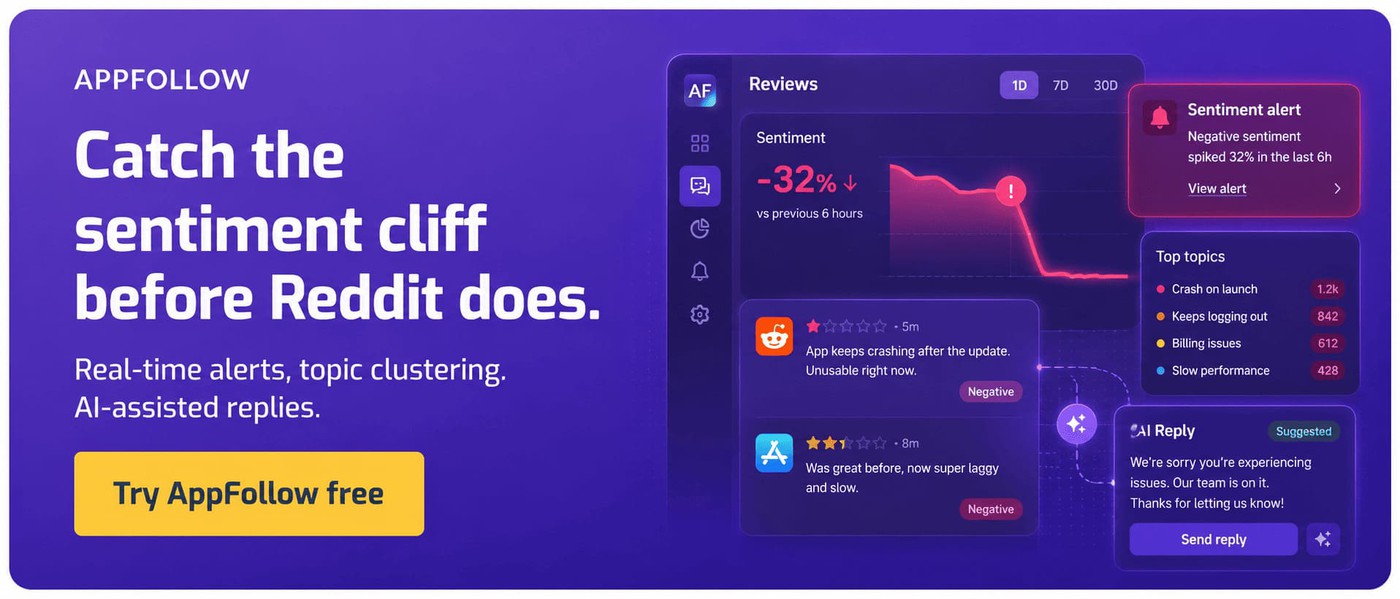
In short: AppFollow turns review spikes into an operating system for crisis response. You see what changed, which player group is affected, who should own it, and which replies can go out before the thread turns into “why are they ignoring us?”
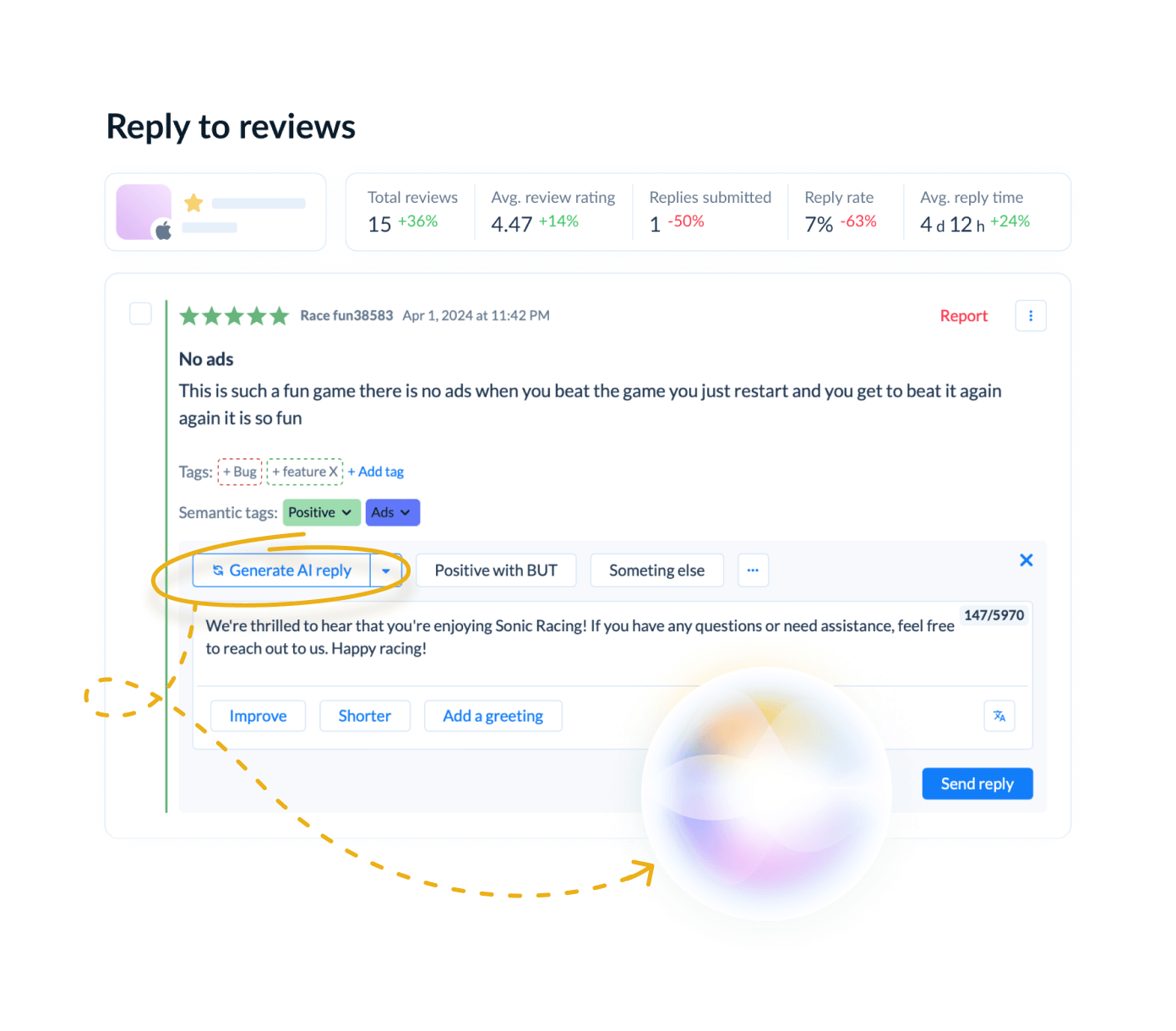
You don’t need another “monitor your reputation” dashboard during a crisis. You need the review equivalent of an incident room: signal, severity, owner, response, proof.
That’s the job of AppFollow Reviews & Ratings. It helps mobile teams catch the review pattern while it’s still a pattern, not a headline. The moment sentiment drops, “server” starts climbing as a topic, or 2-star reviews suddenly mention the same BattlePass change, your team can stop arguing from screenshots and start working from data.
That matters because knowing when to apologize in the App Store is only useful if you know what players are actually angry about. Fast.
The proof is already sitting in review-management outcomes. Toca Boca lifted its rating from 3.1 to 4.1 stars with structured review management. ROKU’s review team also describes AppFollow automation as the layer that helps surface issues manual analysis would miss, with 35% to 50% of reviews handled after implementing automation tools.
So, what does AppFollow actually give a gaming team during a crisis?
- One place for reviews across stores. AppFollow aggregates app reviews from iOS, Android, Samsung, Amazon, and Huawei, so your support, LiveOps, product, and ASO teams aren’t checking five consoles while ratings move without them.
- Custom alerts for critical review shifts. Set thresholds around sentiment, rating, keyword, or topic changes. When a review cluster crosses that line, the right team can get notified before the issue turns into a Reddit thread with 800 comments.
- Custom tags for crisis triage. Reviews can be categorized by sentiment, keywords, rating level, and feedback type. In practice, that means “server,” “login,” “payment,” “balance,” “gacha,” “ads,” or “BattlePass” can be routed to the people who can actually fix it.
- AI summaries for large review spikes. A real mobile game crisis response can create hundreds or thousands of reviews fast. AI summaries compress that volume into the core complaint patterns, so the team can see whether players are reporting one bug, five bugs, or a product decision they hate.
- AI-assisted replies in any language. AppFollow AI can draft personalized replies while keeping the brand’s tone. That’s the layer that makes a 24-hour response window realistic when manual replies average 299.3 hours and AI-assisted replies land around 24.8 hours in AppFollow’s gaming research.
- Automated routing to UX, Bugs, Marketing, or Product. A server outage should not sit in the same queue as a complaint about cosmetics. AppFollow lets teams set rules so the right review type reaches the right owner, which keeps crisis response from becoming one giant “who owns this?” Slack thread.
- Slack, Zendesk, Tableau, Webhook, and 20+ integrations. Reviews, ratings, and ASO data can move into the systems your team already uses. That matters most when escalation needs to happen in minutes, not after someone exports a CSV.
- Competitor context for response planning. Before you draft your own public apology app store reply, you can study how other publishers handled similar backlash. Use competitor messaging for structure, timing, and channel choice. Don’t borrow the sincerity. Players can smell that immediately.
The platform wrinkle is worth building into your SLA, too. AppFollow’s data puts Google Play sentiment at 65.5 against the App Store’s 46.4. That 19-point gap means iOS players tend to write more critically, and a well-timed reply may carry more weight there.
So when the alert says “server,” you’re probably in card one. When it says “balance,” you may need a dev letter before you need an apology. When it says “payment failed” and the rating curve drops, the room gets very quiet very fast.
That’s the value: AppFollow helps gaming crisis communication move from “who saw this first?” to “which scenario are we in, who owns it, and what do we say now?”
cta_free_trial_purple