Monetization and paywall complaints in mobile game reviews: the operator's playbook

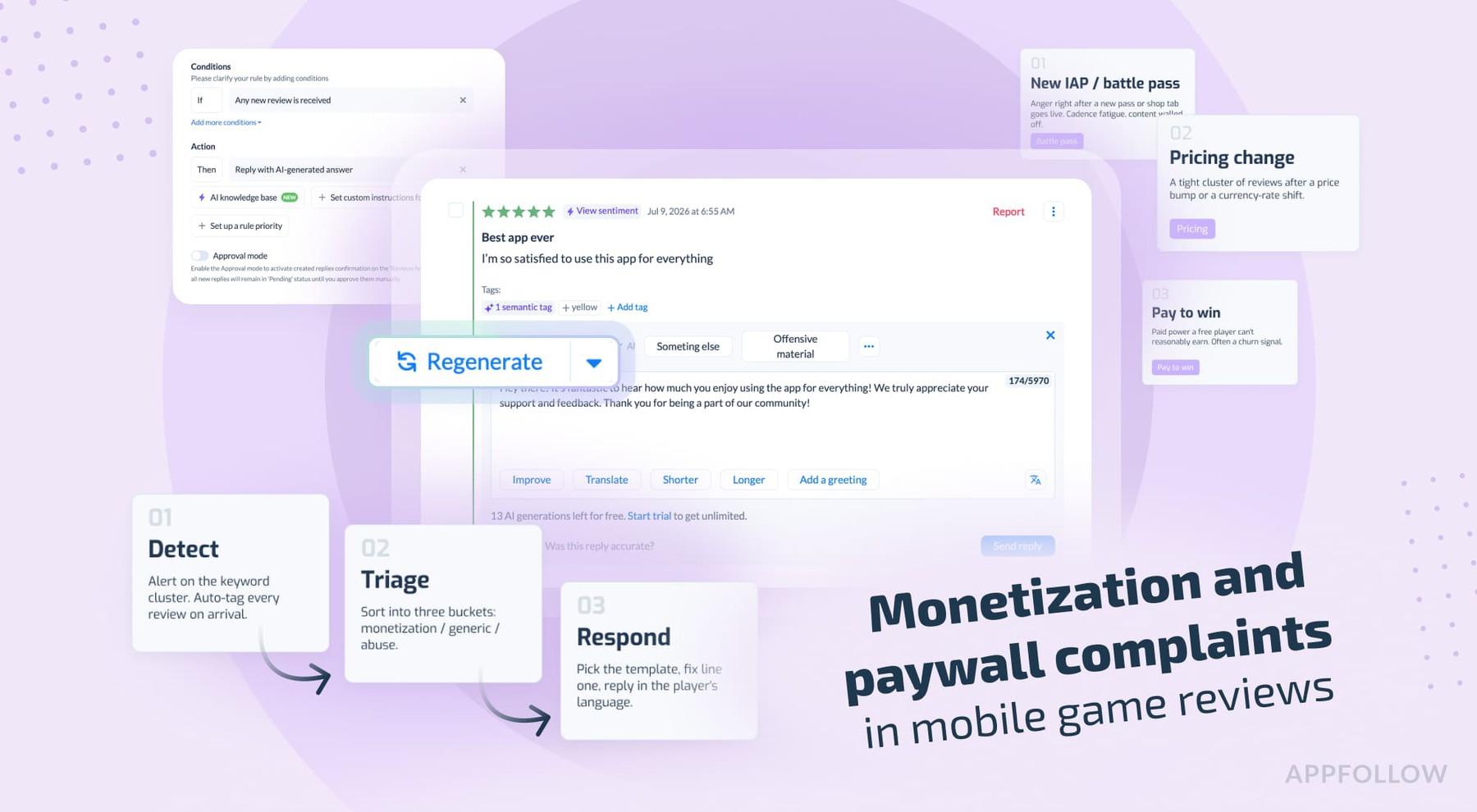
Table of Content:
- TL;DR
- Key insights: what monetization complaints tell you
- What is monetization complaint?
- Why monetization rage matters
- The five types of monetization complaints
- How to respond to monetization complaints: the four-step framework
- Six reply templates for monetization complaints
- Balancing monetization and player satisfaction
- How AppFollow runs the playbook
- FAQs
Players don't just get mad about spending money. Something about feeling tricked into it sets them off, and that's the part that changes how you're supposed to reply.
A price goes up, and you get a wall of one-star ratings, all saying some version of the same thing. Most studios treat these as one big angry blob and answer them the same way, which is part of why the replies don't work.
This article breaks monetization complaints into five types, walks through the four steps for handling them (detect, triage, reply, escalate), and hands you templates you can just copy and adjust. Enjoy!
TL;DR
If you're short on time, monetization complaints split into five types you can tag on sight:
- Anger at a new IAP or battle pass
- Reviews about a pricing change
- Pay-to-win accusations
- Subscription remorse
- Refund or missing-currency frustration.
- The response loop is four steps: detect, triage, reply, escalate.
There are six copy-paste reply templates further down, one per type plus a catch-all. A rating dip has real cost, somewhere around 30 to 40% lower install conversion once you slip under 4.0 stars, per Apptentive's data. And there's a rule for when to change course and when to hold, because reacting to every rage wave teaches players to rage.
AppFollow runs the detection and reply side of this at scale, which is where this article will be handy for you, though most of what's here works with any tool.
Key insights: what monetization complaints tell you
These are patterns that show up across the mobile game reviews AppFollow monitors. Some have public data behind them, some are things our team notices in customer feeds, and I've tried to flag which is which so you can weigh them yourself.
- Players resent paying for power. They reward paying for expression! Cosmetic purchases almost never turn up in monetization complaints. The anger clusters around functional buys: power, time-skips, progression that money buys and play can't reasonably reach. Honor of Kings is the example people keep pointing to: monetization built around identity and prestige rather than winning, and it sidestepped a lot of the churn that hit competitive titles leaning on power sales.
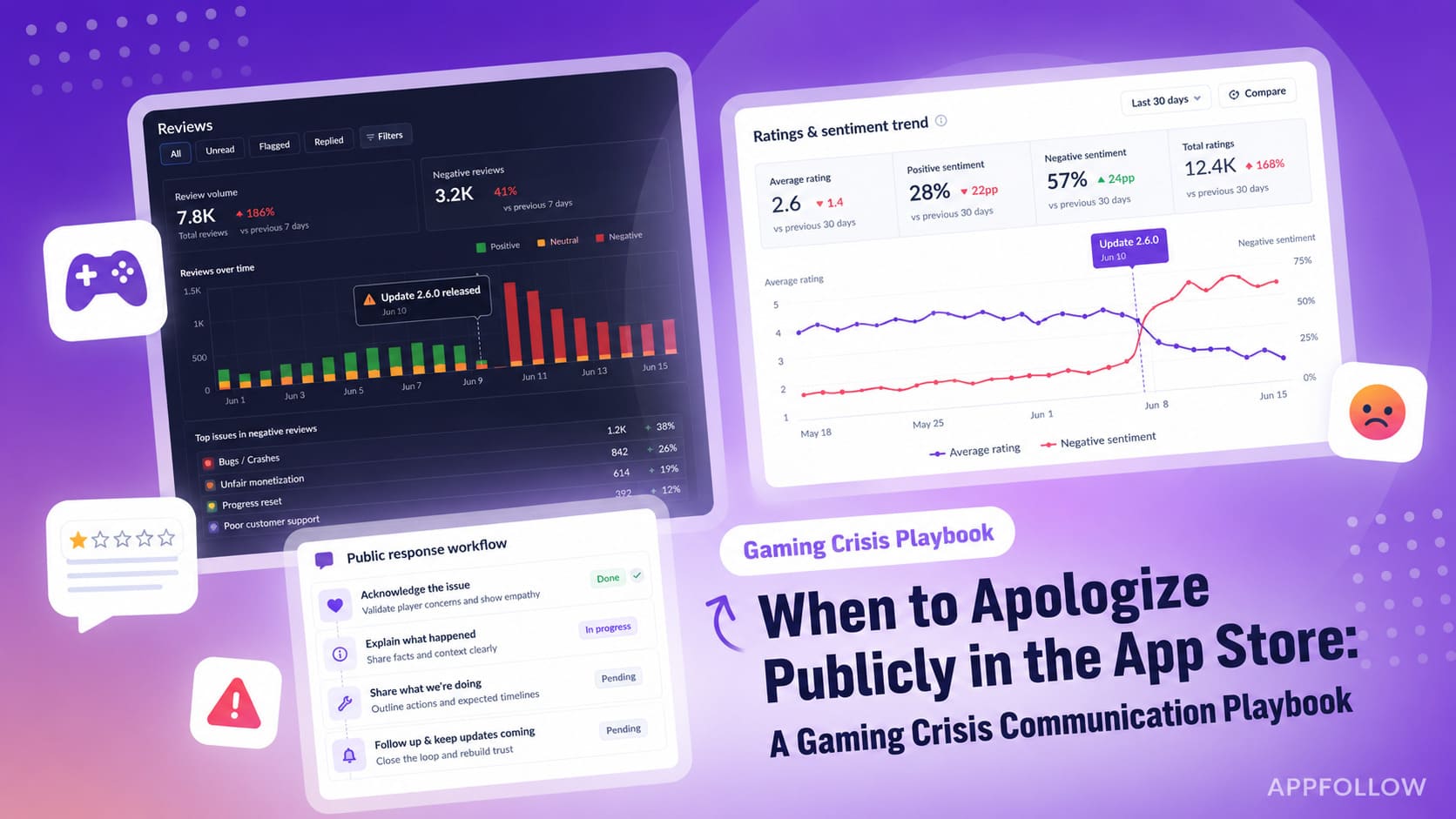
- The patch-day rage spike is predictable, so use it. Every monetization change sets off a spike in angry reviews, usually inside 24 to 72 hours. The bigger the change, the bigger the spike. Studios that log how large each spike gets start calibrating future changes against their own history, which turns out to be more useful than any industry benchmark.
- Battle passes generate more rage than the price justifies, and it's usually about time, not money. Players rarely object to a $9.99 pass. What sets them off is the daily play the pass quietly demands before it pays back what they spent. Our own player-sentiment work found the same thing in the review text: non-expiring passes read as fair, limited-time passes get called manipulative.
- A pay-to-win accusation is often a churn signal. The player writing "pay to win" tends to be someone already halfway out the door. Read the accusation as a flag for churn and not only as a perception problem. (We don't have a clean public number on the uninstall rate here, so treat this as a pattern our team sees rather than a stat you can quote.)
- A reply, sent early, can move a rating. A thoughtful reply while the player is still installed and still a little angry sometimes gets them to edit the review upward. Worth being straight about this, though: AppFollow's own reply-effect data shows a lot of rating changes happen with no developer reply at all, so speed isn't the entirety of magic, but certainly a part of it. When a reply does come, responding to it early seems to matter more than getting the wording perfect.
- Whales complain differently than everyone else. Paying players tend to complain about value, some version of "this isn't worth it." The complaints from people who never paid sound different, more about access, "I can't get this without paying." Different problems, so different replies, and triaging without knowing who's a payer means you're guessing.
What is monetization complaint?
A monetization complaint is any review where the player's negative feedback is specifically about money: what they were charged, what got locked behind a paywall, what they feel they didn't get for what they spent, or what the game now costs that it didn't yesterday.
That's a narrower thing than "a bad review," and the narrowing matters. A crash report is a bug. "This game is boring now" is a balance or UX complaint. Monetization complaints are in the middle: angry, sometimes very angry, but legitimate. The player is describing a real disagreement with a decision you made about money.
Treating an IAP complaint like abuse, or abuse like an IAP complaint, damages your store presence and tells players you're not reading what they wrote. So the first job is sorting, before anyone drafts a reply.
Why monetization rage matters
The cost of a rating slide isn't vague: once an app falls under 4.0 stars, install conversion falls, on the order of 30 to 40% versus apps sitting at 4.5+, according to Apptentive, and roughly 79% of users check the rating before they download at all. A monetization-driven dip is expensive in a way that's easy to under-count, because you're paying for it on every paid channel at once through higher effective CPI.
Both store weightings heavily in ranking and featuring, so a dip below 4.0 costs you organic reach on top of the immediate revenue loss from whatever change caused it. You lose the change's upside and some of the discovery you already had.
Then there's an unanswered wave that becomes a Reddit screenshot, which then becomes a headline. Electronic Arts is the case study everyone knows: Star Wars Battlefront II's progression-linked microtransactions drew enough backlash that EA pulled the system before launch and spent years living it down (one summary here). The cheap version of that problem is the one you handle inside the thread within a day.
It costs your team. Community managers burning out on monetization rage is a real driver of attrition, and it's the part of this that doesn't show up in a dashboard. Worth naming when you're deciding how much of the load to automate.
The five types of monetization complaints
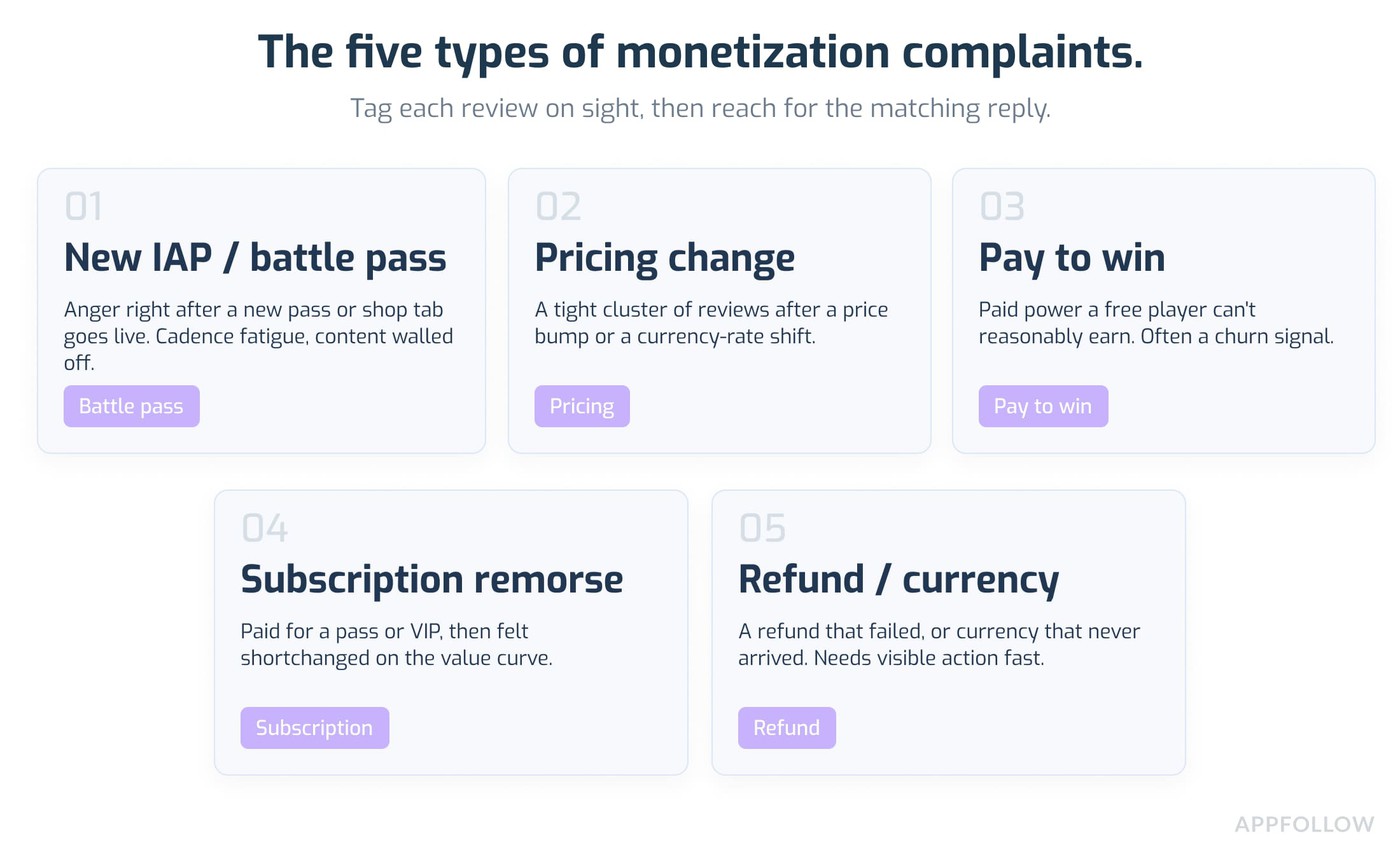
Type 1: angry about a new IAP or battle pass
These land within hours of a new pass or shop tab going live. "Why is there a new pass already? I just bought the last one, and now I'm behind again." What's underneath is cadence fatigue, plus the sense that content got walled off. The reviewer isn't wrong that it feels fast.
The reply that works acknowledges the cadence, explains the intent (a fresh track for endgame players, say), and points to the value without arguing them into it. Arguing value into a player is the fastest way to make them dig their heels in.
Type 2: reviews about a pricing change
These cluster tight in time, right on the 72-hour spike, after a price bump or a currency exchange-rate shift. "You raised the price of gems again. Not paying. Done." Short, final, and there's usually a wall of them at once. Keep the reply short too, and never defend the new price as reasonable. Acknowledge the friction, say you're tracking the response, and if the change is reversible, let that show.
Type 3: pay-to-win accusations
A game reads as pay-to-win when paying players gain a competitive advantage that non-paying players can't reasonably earn through play. Four design choices tend to trigger the accusation:
- A gear or power gap between paid and free
- Hard time-gates
- Premium-only events
- Gacha rates that quietly move elsewhere.
"Pure pay to win. The new sword is impossible to get without paying $50. Uninstalled." The reply names the gameplay path to the contested item if one exists, and asks for specifics. It does not defend the design in public.
Type 4: subscription and paywall remorse, the "feels like a scam" review
These come from players who did pay for a season pass or VIP or remove-ads, and feel shortchanged. "I bought the season pass thinking I'd get the rewards. Turns out I have to play 4 hours a day, or I lose them. Scam." The value curve disappointed them, and calling them wrong makes it worse. Validate the frustration honestly, offer a one-time make-good if your policy allows it, and tell them the pacing is under review if it is.
Type 5: refund and missing-currency frustration
Players who tried and failed to get a refund through Apple or Google, or who bought currency that never showed up. "Bought the 9999 gem pack and it never arrived. Support won't reply. Worst game ever!" This one needs visible action fast: route them to support, open a ticket, and prove it's being handled. A player who had to escalate to a public review to get help is telling you your support path is broken.
How to respond to monetization complaints: the four-step framework
This is the part that runs every day. AppFollow is how a lot of teams run it without a human staring at the feed, and I'll name where the tool fits, but the steps hold whatever you use.
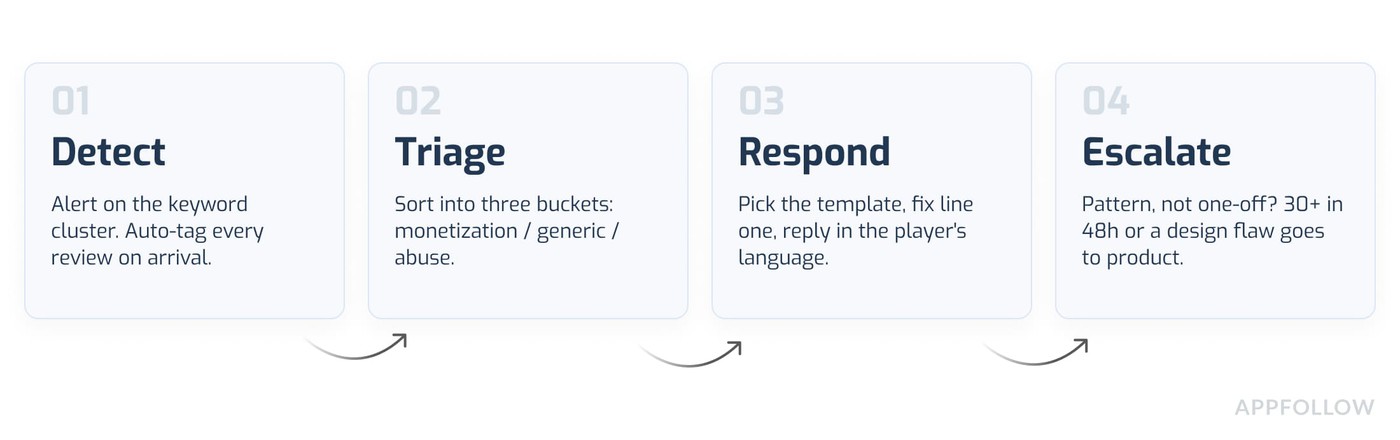
Step 1, detect
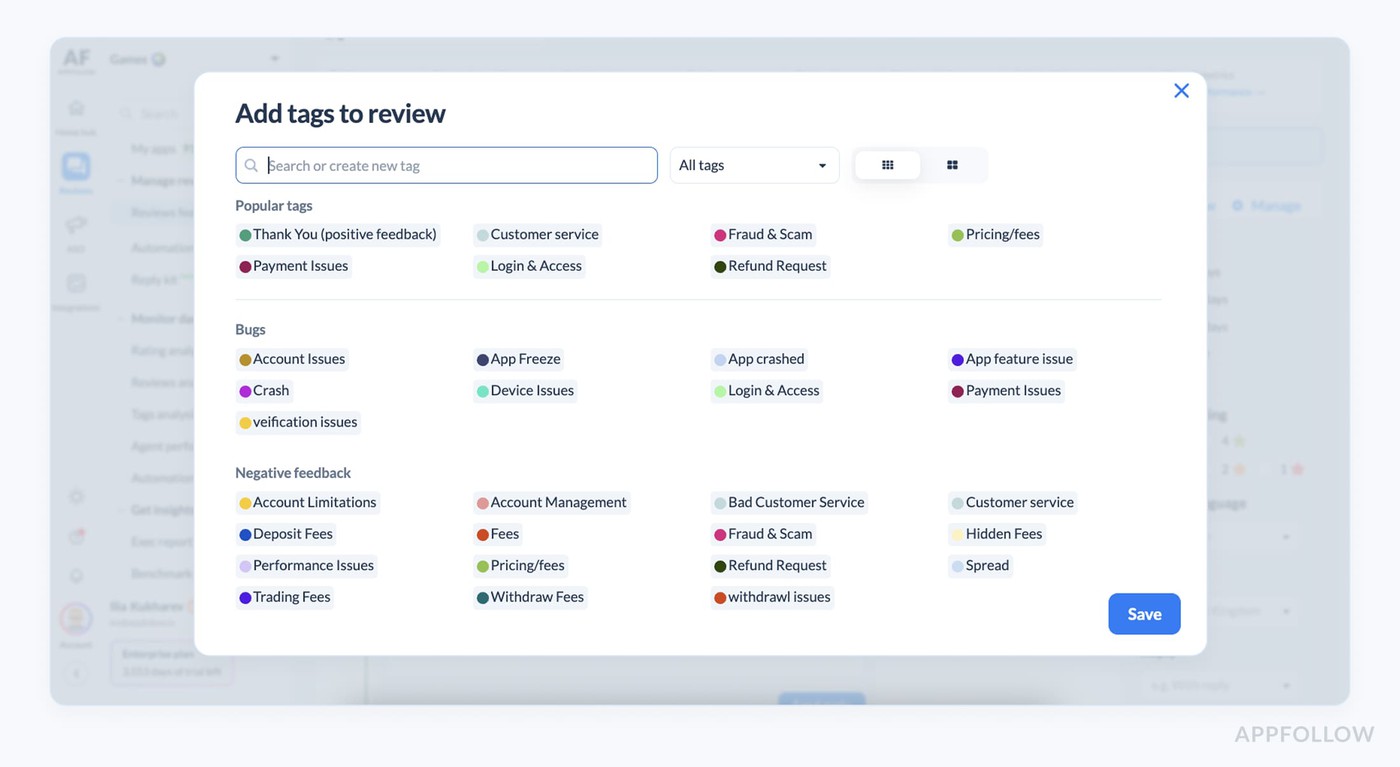
Catch the complaint inside an hour. Set real-time alerts on a monetization keyword cluster: "pay to win," "scam," "refund," "too expensive," "battle pass," "IAP," "paywall," "microtransaction." Auto-tag each incoming review against the five types above so the inbox arrives pre-sorted. A useful threshold: five monetization-tagged reviews inside 30 minutes opens an incident channel.
Step 2, triage
Sort into three buckets. A real monetization complaint goes to the reply flow below. A generic negative (bug, UX, balance) goes to standard support. Getting this sort right is most of the job.
Step 3, respond
Pick the template, customize the first line, ship. Six templates are below. Change the opening sentence to fit the specific player, leave the rest as-is, and reply in the player's language. This is where speed pays, so don't over-polish.
Step 4, escalate
Push it into product when it stops being a support problem. When the same pattern hits 30 or more reviews in 48 hours, it’s a product signal and it goes to the monetization PM. When a pricing change triggers a coordinated wave, the real question is whether to roll back. Document every escalation. The record of which change caused which wave is the most valuable monetization research your studio owns, and almost nobody keeps it.
Six reply templates for monetization complaints
Copy, paste, change the first line. Tone rules for all six: name the player, sign as a team, never argue value into them, never promise a future patch you can't guarantee, and reply in the player's own language. A rage review in Brazilian Portuguese gets answered in Brazilian Portuguese.
Template 1, new IAP or battle pass backlash
"Hi [Player Name], thanks for flagging this. We hear you on the cadence. The new pass is meant to give endgame players a fresh track, not to push you off the last one. If you want, our team can look at your current progress and see what we can do. Reach us at [support link]. The [Game] team."
Template 2, price increase
"Hi [Player Name], we know the new pricing isn't what you wanted to see. The change went live to [reason, keep it short and honest]. We're watching the feedback on this closely. If you want to say more, we're at [support link]. The [Game] team."
Template 3, pay-to-win accusation
"Hi [Player Name], we don't want anything in [Game] to feel un-earnable. Every premium item in this update is also reachable through play, via [path]. If something specific still feels gated, tell us at [support link], we read every report and adjust. The [Game] team."
Template 4, subscription or battle pass remorse
"Hi [Player Name], we're sorry the pass didn't land the way it should have. We're crediting [item / store credit] to your account as a thank-you for telling us. The team is reviewing pass pacing for next season based on feedback like yours. The [Game] team."
Template 5, refund or missing currency
"Hi [Player Name], this is on us to fix. Send your transaction ID to [support link] and we'll have it sorted within [SLA]. Sorry you had to leave a review to get this handled. The [Game] team."
Template 6, general monetization rage, no specific item
"Hi [Player Name], we hear the frustration. We don't always get monetization right the first time, and reviews like this are how we learn what to change. Reach us at [support link] if you want to talk specifics. The [Game] team."
Balancing monetization and player satisfaction
The hard calls belong to monetization PMs and live-ops leads, so this is the section for them. When do you listen to the rage, and when do you hold?
When to change course: the rage is concentrated in 48 hours, the language is consistent across reviews, and the rating drop is past 0.2 stars.
That combination is a strong enough signal, so roll back, communicate, recover. Same if the complaint names a genuine design flaw, like a pass that demands more daily play than the last one; in that case adjust the pacing, not just the messaging.
And pay extra attention when the cluster is coming from your paying players, since they're the loudest signal you've got.
When to hold: the cluster is from non-payers, and the change is reasonable on its face, so hold. The new IAP is balanced, and the rage is loud but thin, 50 reviews against 5M MAU, so hold. And hold, hold, and hold carefully and with a lot of communication, when rolling back would teach players that complaining loudly reverses pricing, because that lesson is expensive later.
There's no correct percentage for the balance between monetization and player satisfaction. What works is a discipline: listen to every complaint, change only when the data crosses a line you set in advance, and tell players the truth either way.
The most under-used asset on a monetization team is the complaint archive. Every change that caused a measurable rage spike was a market test you already paid for. Build the archive, and pull it up before the next monetization design review. For the strategic side, how the models work and how to choose between them, see how to choose a monetization model.
How AppFollow runs the playbook
Five capabilities, each tied to a step above. This is the article where the tool fit is direct, so I'll be plain about it.
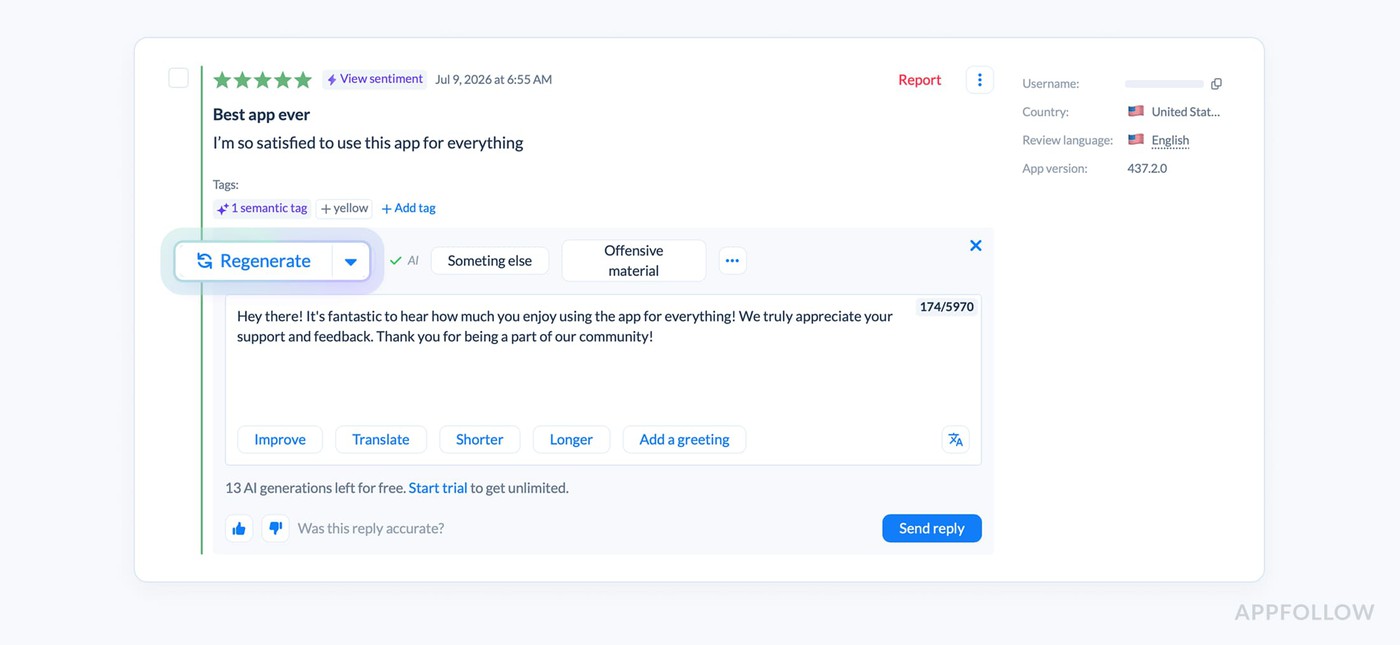
Monetization-tuned tagging auto-classifies reviews into IAP, paywall, pay-to-win, refund, subscription, and pricing, so the community manager opens the feed already sliced by complaint type instead of scrolling. That's the detect step, mostly automated (AI-powered review management).
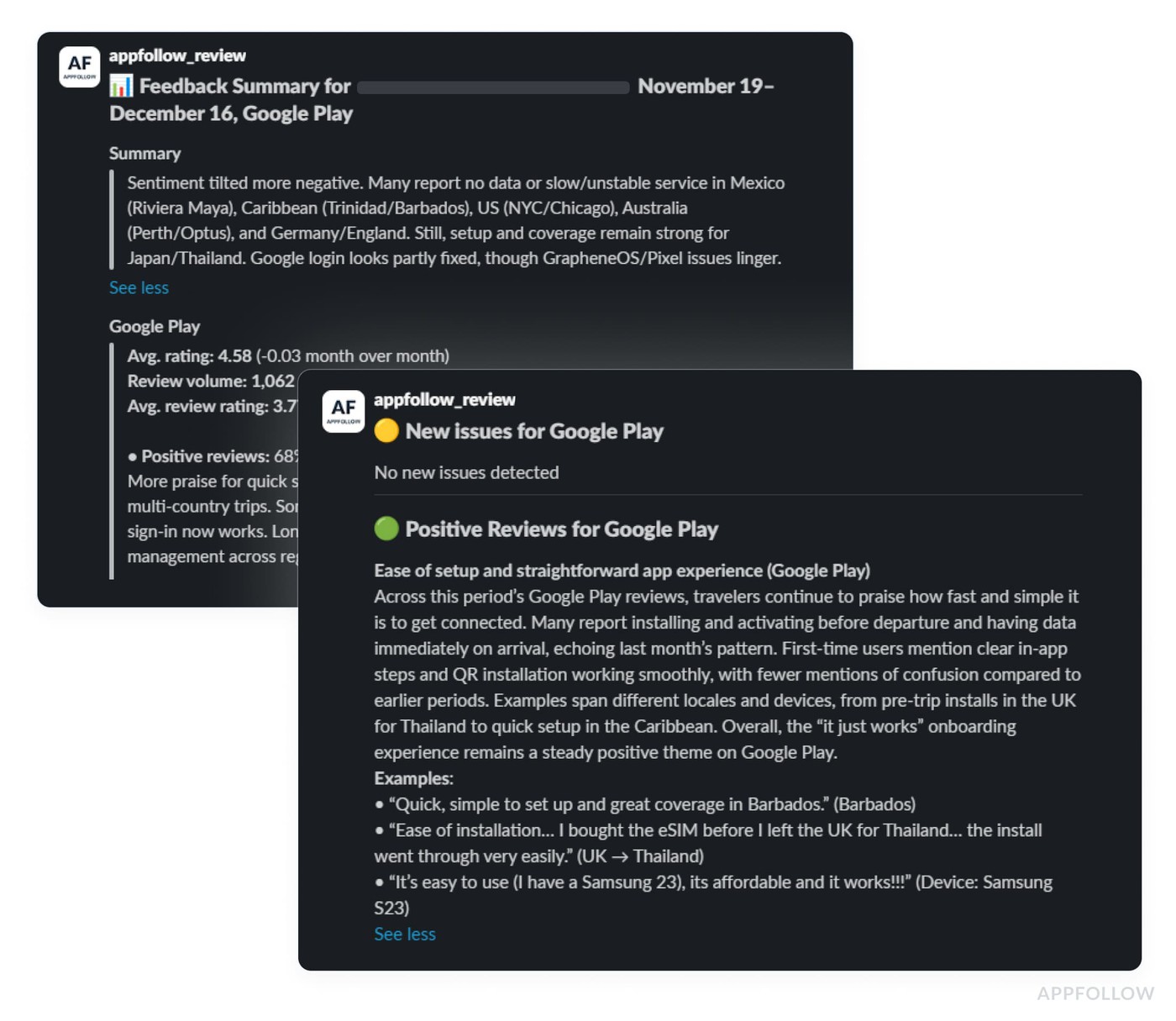
Real-time keyword alerts push a spike to Slack the moment it starts, so a 4x jump in "pay to win" mentions in the last hour wakes the team, rather than getting discovered at standup the next morning (workflow automation).
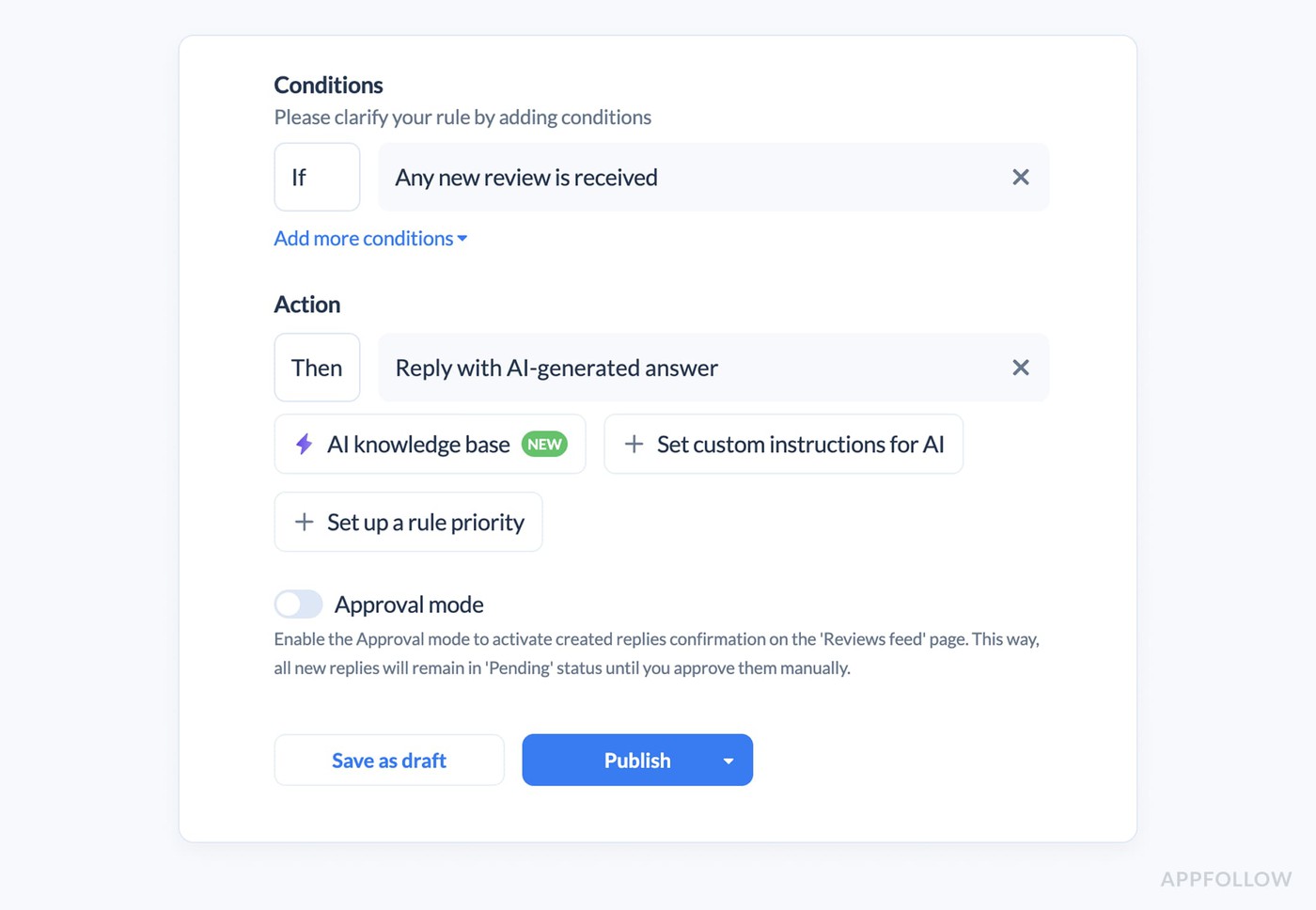
AI-assisted reply drafts come back in the player's language and in your brand voice; you edit and ship. That's what cuts time-per-reply from minutes to seconds and makes the early-window replies possible at volume. The Toca Boca case hit a 75% reply rate largely on this loop.
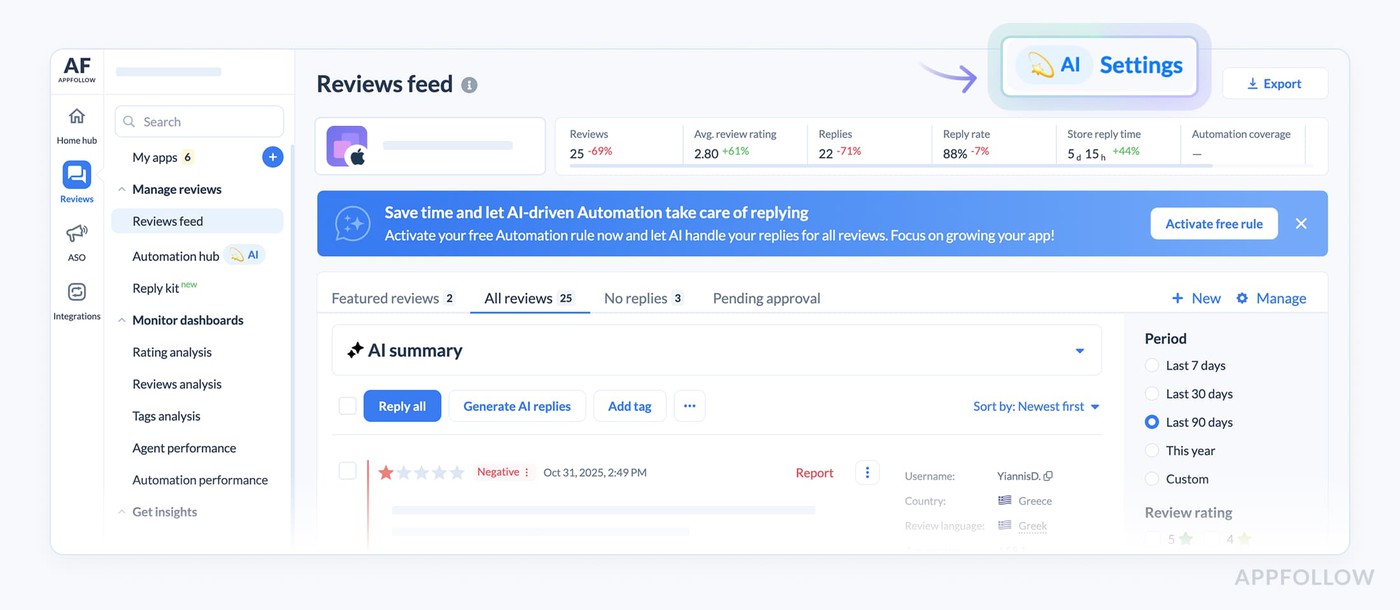
Escalation to your help desk turns a refund or account-loss case into a ticket in Zendesk, Helpshift, Salesforce, or Freshdesk, with the original review attached, so it doesn't get lost between "reply" and "resolve" (integrations).
And for publishers running a portfolio, cross-title dashboards put monetization-complaint patterns side by side, so one studio's painful pass launch becomes something the whole portfolio learns from before the next one ships (gaming solution), regardless of the language.
cta_get_started_purple
FAQs
How do I respond to pay-to-win reviews?
Name the player, acknowledge the concern without arguing value, point to the gameplay path that earns the contested item, and offer a support channel for specifics. Don't defend the design in the public reply. If the same accusation piles up past 30 reviews in 48 hours, it's a product signal, so send it to the monetization PM with a recommendation rather than replying your way out of it.
How do I handle complaints about a new battle pass or IAP?
Use Template 1, and reply early. Acknowledge the cadence, give the design intent in a sentence, point to the value. If the pattern crosses 30 reviews in 48 hours, escalate.
Should I respond to negative reviews about pricing changes?
Yes, briefly and without getting defensive. Don't argue the new price was fair. Acknowledge the friction, signal that you're tracking the response, and use Template 2. These come in tight clusters, so a template plus fast localization is what keeps you above water.
How do I respond to negative app store reviews?
Run the four-step framework: detect the review fast, triage it into monetization / generic / abuse, reply early with the right template, and escalate if the pattern is structural rather than one-off. The framework holds for most negative reviews, not only monetization ones.
What is pay-to-win, and what triggers the accusation?
A game is considered pay-to-win when paying players gain competitive advantages that non-paying players can't reasonably earn through play. Four design choices invite the label: a gear or power gap between paid and free, hard time-gates, premium-only events, and gacha rates that shift. If any of those describe your game, expect the accusation and prepare the reply in advance.
How fast should I respond to monetization complaints?
Early, while the player is still installed and still emotionally in the game. The exact number matters less than the habit of catching the wave the day it starts instead of the morning after.
Should I offer refunds or compensation in a review reply?
Offer in-game compensation (credit, currency, items) when your policy allows it. For actual money back, point the player to the platform store's refund process and don't promise what Apple or Google control. Getting that boundary right keeps you from making a commitment you can't keep.
When should I escalate a monetization complaint to the product team?
When the same pattern hits 30 or more reviews in 48 hours, when the complaint names a structural design flaw rather than a one-off frustration, or when the cluster is concentrated in your paying-player segment. Any of the three means it's stopped being a support problem.