Finance app reputation benchmarks 2026: where your reviews stand

Table of Content:
Finance apps answer more of their reviews than any other category we track, and most teams still cannot say whether that puts them ahead or behind. These finance app reputation benchmarks close that gap.
We pulled 14.4 million reviews across roughly 1,880 finance apps on the App Store and Google Play, from July 2025 to July 2026, and lined up the reputation metrics a finance team actually reports on: reply rate, reply speed, whether a reply moves the rating, and how much of the work runs on automation.
It is written for the people who own that number inside a bank, a broker, or a payments or investing app. The review and support leads, the growth and ASO managers, the product owner who gets asked how the app compares in a quarterly review.
Here is what the data settles:
- what counts as a good finance reply rate
- whether replying actually lifts your star rating
- where finance teams quietly pull ahead of the market
Key insights
- Finance leads on coverage. About 51% of finance reviews get a reply, the highest of any category in this year's reply rate benchmarks. The AppFollow client subset reaches 55%.
- Replying moves the rating, when you answer the right reviews. Finance teams running a process recover about 0.57 rating points per reply, close to four times the 0.13 the broader market manages, and around 1.3 on iOS.
- Automation is the quiet lever. Client finance apps send roughly 44% of their replies through automated workflows. The market sits near 2%.
- The one-star pile is the tell. All finance apps answer about 59% of one-star reviews. The teams pulling ahead answer 71%.
See where your finance app lands on all five reputation metrics
What these finance benchmarks measure
Before the numbers mean anything, two things matter: where the data comes from, and what each metric actually counts.
The report pulls from 14.4 million reviews across about 1,880 finance apps, split 1,275 on Google Play and 605 on the App Store, over the 12 months to July 2026. Worldwide, no country cuts.
Five metrics do the work. Reply rate is the share of reviews that got a developer reply. Reply time is how long that reply took on average. Reply effect tracks whether a user changed their rating after a developer replied, and you can read more on that in the reply effect. Sentiment score reads the review text and lands on a number, higher being warmer. Automation rate is the share of replies sent through automated workflows.
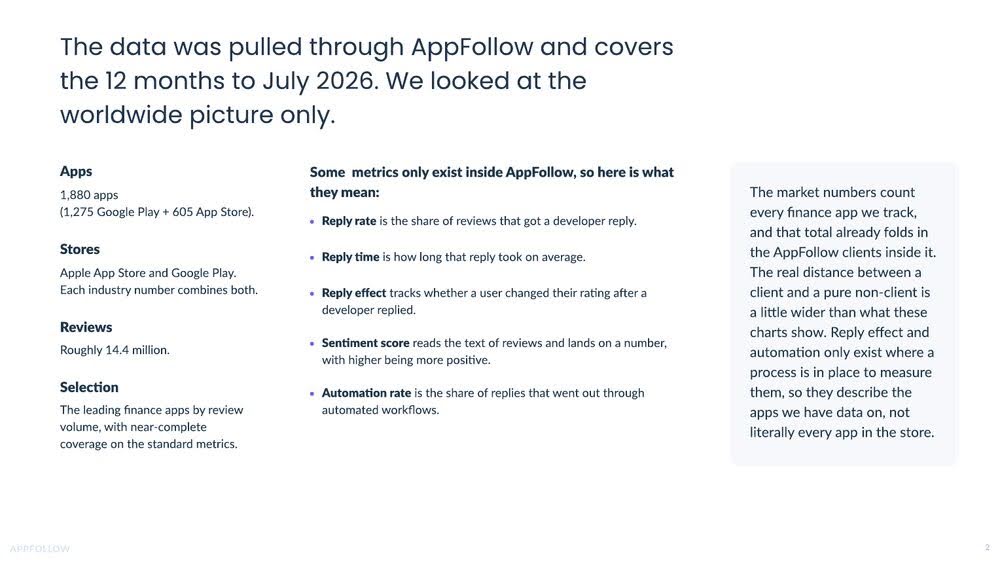
One nuance to keep in your head. The client figures describe apps that run review management through AppFollow, so reply effect and automation only exist where there is a process measuring them. Read the client column as finance teams with a system, not as better apps.
Where finance apps stand across every metric
One table holds the whole picture. All finance apps on the left, the AppFollow client subset on the right.
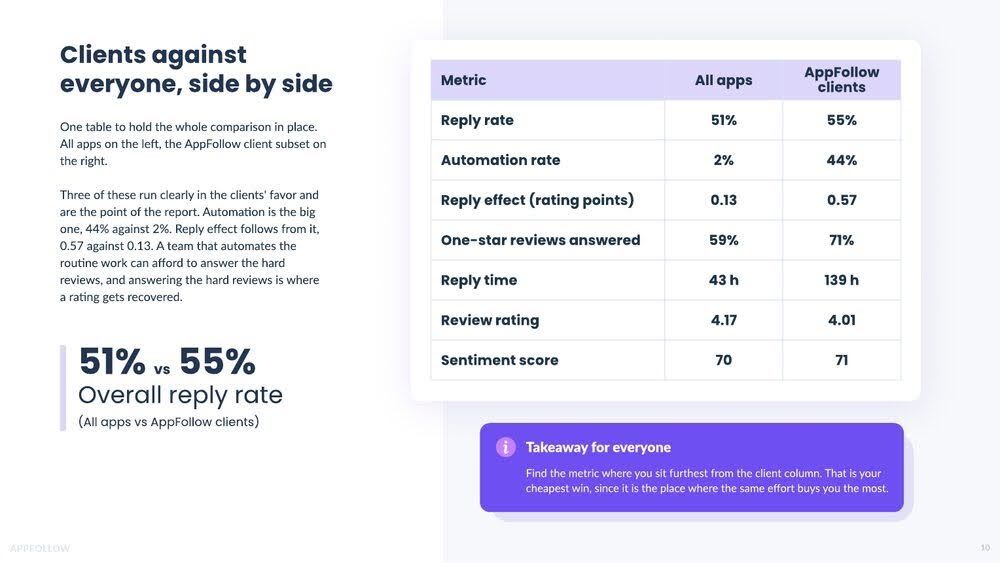
Read the row where you sit furthest from the client column. That is your cheapest win, because it is the place where the same effort buys you the most.
Coverage is already strong for the category, 51% of reviews answered and 55% for clients. Ratings barely move, 4.17 against 4.01. The gaps that actually matter cluster in three rows:
- automation at 2% versus 44%,
- reply effect at 0.13 versus 0.57,
- and one-star coverage at 59% versus 71%.
Those three move together, and the rest of this piece is about why.
One number looks backwards at first glance. Client reply time reads 139 hours against 43 for the market, which sounds slower. It is coverage, not sloth. When you answer the old backlog and the one-star pile nobody wanted to open, the average climbs even as you do far more of the work. There is a full breakdown in the finance reply time benchmarks.
Get the client-versus-market comparison and the fastest finance apps by name
The three things finance teams do differently
Three levers separate a finance app that holds its rating from one that drifts. Each has its own deep dive. Here is the short version.
They answer the one-star reviews
Both groups answer unhappy reviewers more than happy ones, which tracks.
Across all finance apps, one- to three-star reviews get a reply about 58 to 59% of the time. Client apps carry that up to roughly 71%.
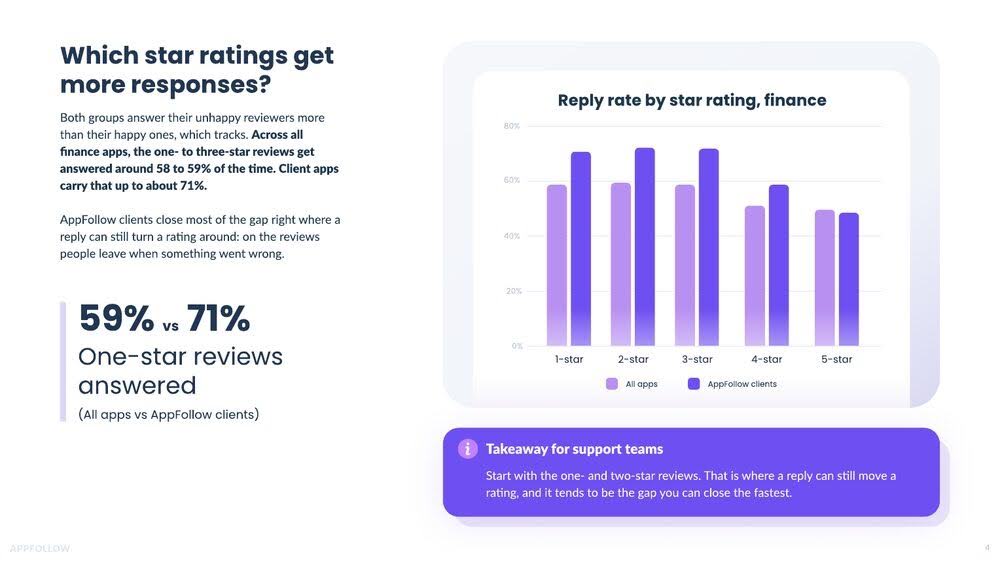
Five-star reviews get answered less, and that is the right call. A reply on a one-star review is where a rating can still turn around. If you are going to spend a support hour, spend it on the angry end.
The full cut sits in the finance reply rate benchmarks, and if you want response patterns to copy, start with these review response examples.
They let a reply move the rating
Reply effect is the payoff metric, and finance is where the gap is loud. The market recovers about 0.13 rating points per reply. Finance teams running a process recover 0.57, close to four times as much.
On iOS the effect climbs to around 1.3, since iPhone users update their rating more readily and the reviews that get a reply there tend to be the ones with the most room to move.
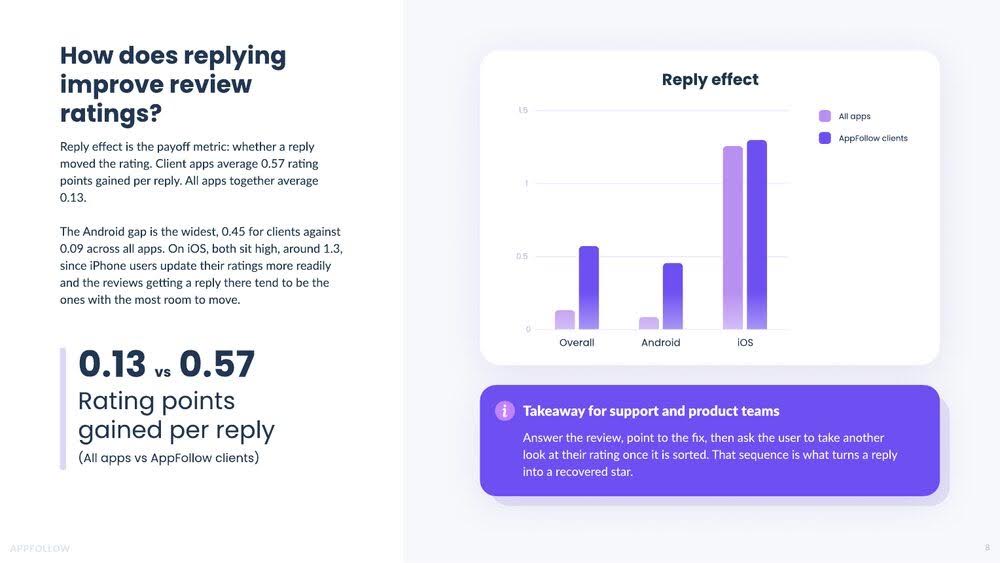
The low market number is not proof that replies do nothing. It is a coverage problem. Most apps answer too few of the reviews that could actually change a score. Dig into the mechanics in how replies affect the average rating.
They automate the routine
Automation is the lever under the other two.
Client finance apps send about 44% of their replies through automated workflows. The market sits near 2%.
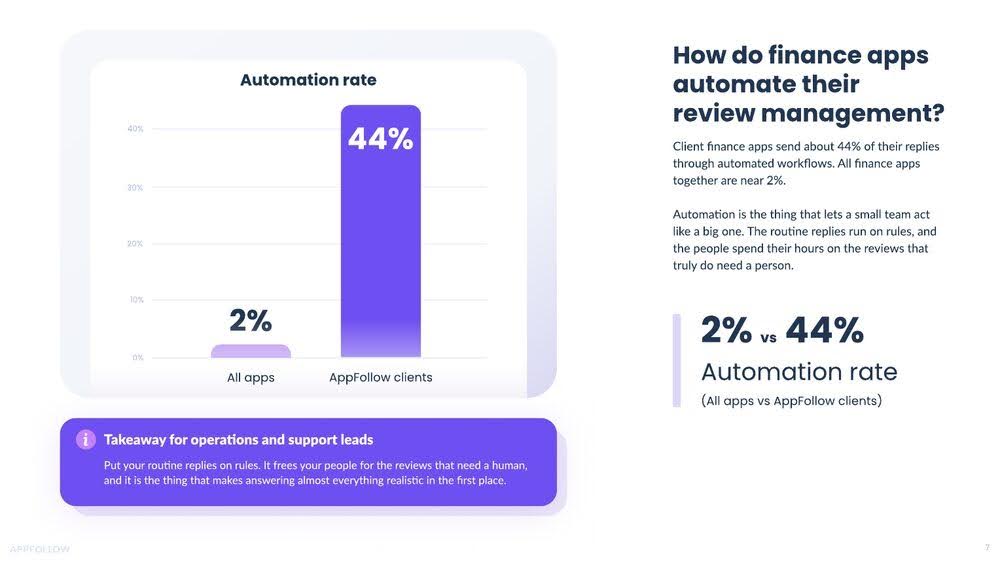
Rules handle the acknowledgements and the first touch. People spend their hours on the compliance-sensitive and money-related reviews that genuinely need a human. Without that split, answering half your reviews and clearing the one-star backlog is not realistic for a team that is not growing headcount. The playbook is in the finance review automation benchmarks, with the wider method in reputation automation.
Find your cheapest win against the finance benchmark
The table gives you a diagnosis in about a minute. Here is how to run it.
- Score your app on reply rate, reply time, reply effect, and automation against the client column.
- Find the metric where you sit furthest behind. That is where the same effort buys the most.
- Fix it with the matching play: lift one-star coverage with templates, cut reply time so a reply still lands while the rating can move, or put the routine replies on rules.
- Re-measure in 30 days.
One expectation to set with stakeholders. Closing a coverage gap tends to show up in the rating across a quarter, not a week. If someone wants the star count to jump by Friday, that is the wrong promise to make.
Run finance review coverage without growing the team
By this point the shape of the work is clear. You need to see every review across both stores and, often, across several finance apps, then decide which ones a human takes today and let the rest run on rules.
That is the job AppFollow is built for. It aggregates reviews from the App Store and Google Play into one queue, filters them by star rating and topic so the one-star pile surfaces first, drafts and automates the routine replies while leaving the sensitive ones for a person, tags reviews by sentiment, and fires an alert when a one-star spike starts after an outage or a failed-payment wave. You can route any review into Slack, Zendesk, or Helpshift so it lands with the team that owns the fix.
Set it up once and the 51% coverage in this report stops being a stretch. See how it fits a finance workflow on the finance app review management page, or the mechanics behind it in review management. Start a free trial when you want to benchmark your own numbers against the table above.
Benchmark your finance app against 14.4 million reviews
FAQ
What is a good reply rate for a finance app?
Finance already leads every category at about 51% of reviews answered, so treat that as the floor, not the target. The more useful number is one-star coverage. Teams running a process answer 71% of one-star reviews, and that is the slice where a reply can still move the rating.
Does replying to reviews raise a finance app's rating?
Yes, when you answer the reviews that have room to move. Finance teams with a process recover about 0.57 rating points per reply against 0.13 for the market, and close to 1.3 on iOS. Replying to five-star reviews does little for the score.
How fast should a finance app reply to reviews?
Fast enough that a reply still lands while the rating can change, which in practice means hours, not days, on the one-star reviews. The fastest finance teams reply within about 15 hours while still covering their backlog.
What is the average finance app rating?
Finance apps average 4.17, with the AppFollow client subset at 4.01. Most finance reviews are five stars, so the one-star slice, around 16 to 19% of reviews, is what a prospect actually scrolls before trusting the app with money.
How much do finance teams automate review replies?
Client finance apps automate about 44% of their replies, against roughly 2% for the market. Automation handles the routine acknowledgements so people can focus on the compliance-sensitive reviews that need a human.
The numbers here are the finance cut. The full Finance App Reputation Benchmarks 2026 report has every metric, the client comparison, the store split, and the fastest finance apps by name.