12 Biggest Mobile Game Companies in 2026 (Ranked by Revenue)

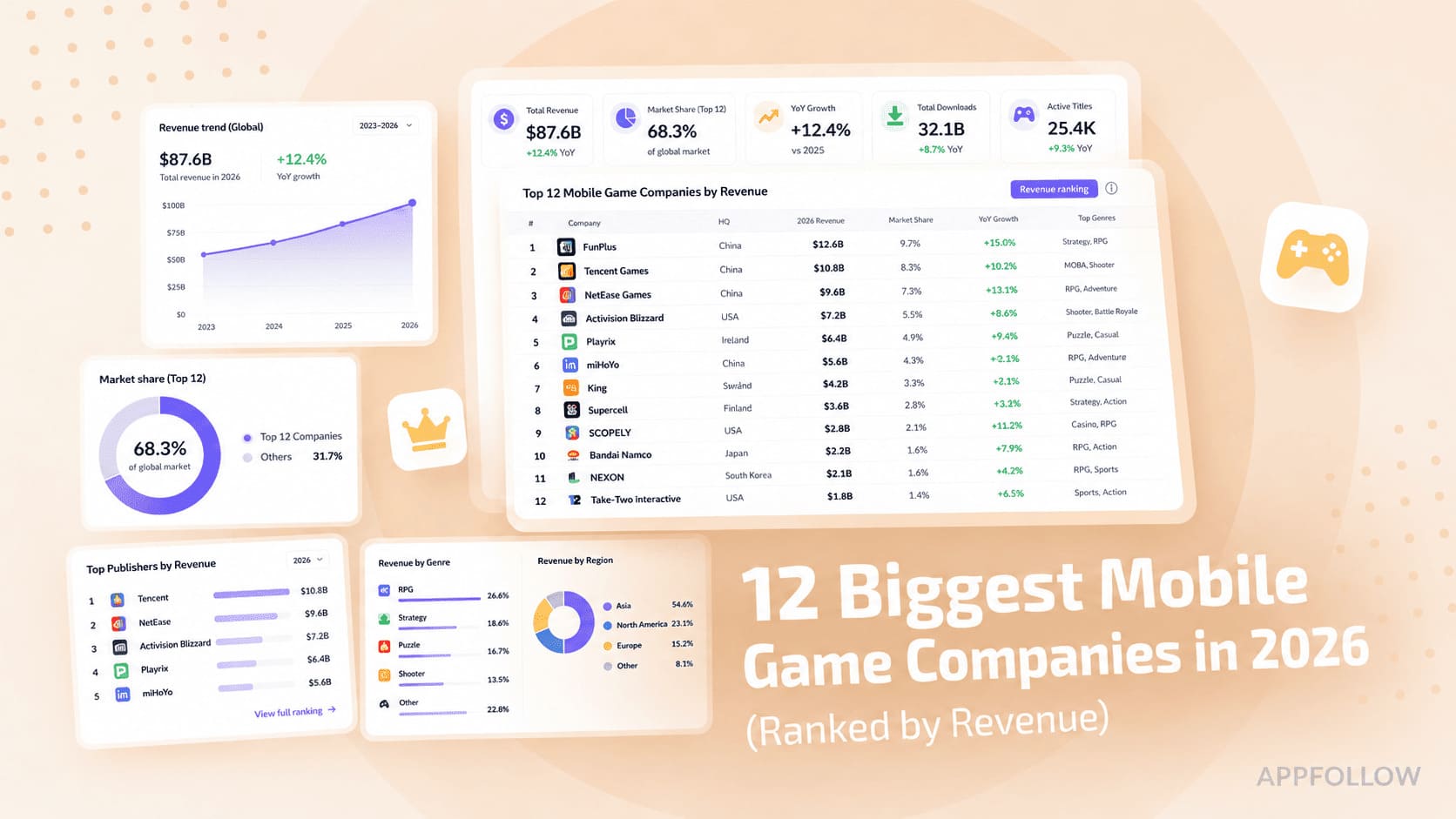
Table of Content:
- Mobile game company, developer, publisher, or studio: what are you actually looking for?
- The state of mobile gaming in 2026 (the seven numbers that matter)
- How we ranked the list (and what we left out)
- Company revenue ranking is not the same as game revenue ranking
- What “biggest” actually measures (and what it misses)
- Comparison table: the biggest mobile game companies at a glance
- The 12 biggest mobile game companies in 2026
- Which of these mobile game companies should you actually study?
- If you meant “mobile game development companies to hire,” read the list differently
- App promotion in mobile gaming: why it decides who wins
- How AppFollow helps you study mobile game companies without copying them blindly
- FAQs
Most people remember the games first. Candy Crush. Genshin Impact. Free Fire. Monopoly GO! The company behind the hit usually comes second, if it comes up at all.
For app teams, that is a missed signal.
The biggest mobile game companies are not interesting only because they are big. They are interesting because they show how mobile games keep revenue alive after launch: content cadence, LiveOps, regional publishing, IP strategy, monetization pressure, player support, and store visibility all working at once. And the stakes keep growing: mobile is the largest slice of the entire games business, forecast at $121.1B in 2026, about 57% of the $213.9B global games market (Newzoo).
In this guide, we rank the biggest mobile game companies in 2026 by mobile revenue where public or reliably estimated data is available, using Sensor Tower’s 2025 publisher data and its State of Mobile report. Then we look one layer deeper: which games carry the business, which growth pattern each company is using, and what ASO, product, and LiveOps teams can actually study from it.
One caveat before the list. This is not a vendor directory. If you came here looking for a studio to hire, jump to the development-company criteria section. If you came to understand who leads the mobile gaming market and why, stay here. The ranking tells a better story than a logo wall ever could.
Quick read: the biggest mobile game companies in 2026 are not simply “the companies with the most famous games.” They are the publishers and studios that keep mobile revenue compounding through LiveOps, regional scale, IP, monetization systems, and constant store-level optimization.
Use this list in three ways:
- To see which companies lead mobile gaming by revenue scale.
- To understand which growth engine each company depends on.
- To spot what your own team can study without blindly copying a market leader.
A practical read: Tencent is a scale and ecosystem story. King is a retention machine. HoYoverse is content cadence and fandom discipline. Scopely is LiveOps and IP execution. Playrix is casual-game creative testing at industrial speed.
That is the value of the list. Not “who is famous.” Who keeps winning, and how.
Jump to: Methodology · Company vs game revenue · Comparison table · The 12 companies · Development-company criteria · AppFollow workflow · FAQs
Mobile game company, developer, publisher, or studio: what are you actually looking for?
These terms get mixed together in search results. In practice, they answer different questions.
A mobile game company is the broadest term. It can mean a publisher, developer, platform, studio group, or parent company that earns meaningful revenue from mobile games.
A mobile game developer builds the game. That includes game design, engineering, art, economy design, backend systems, QA, and platform delivery.
A mobile game publisher brings the game to market. Publishers usually handle distribution, user acquisition, monetization, creative testing, app store positioning, localization, and sometimes LiveOps.
A mobile game studio is the creative and production team behind one or more titles. Some studios self-publish. Others work under a larger publisher or parent company.
Why this matters: a company can be brilliant at publishing and still not be the right development vendor. Another team can be excellent at building games but weak at global distribution. When you compare mobile game companies, do not compare the logo. Compare the job they are actually doing.
For this article, we focus on companies that operate successful mobile games at scale. When a company is also useful to study as a developer, publisher, or studio, we call that out.
The state of mobile gaming in 2026 (the seven numbers that matter)
The mobile game companies at the top aren’t winning on luck or on one viral hit. They win on operational tempo, and the distance between them and everyone else is mostly a data gap. Before the profiles, here’s the field.
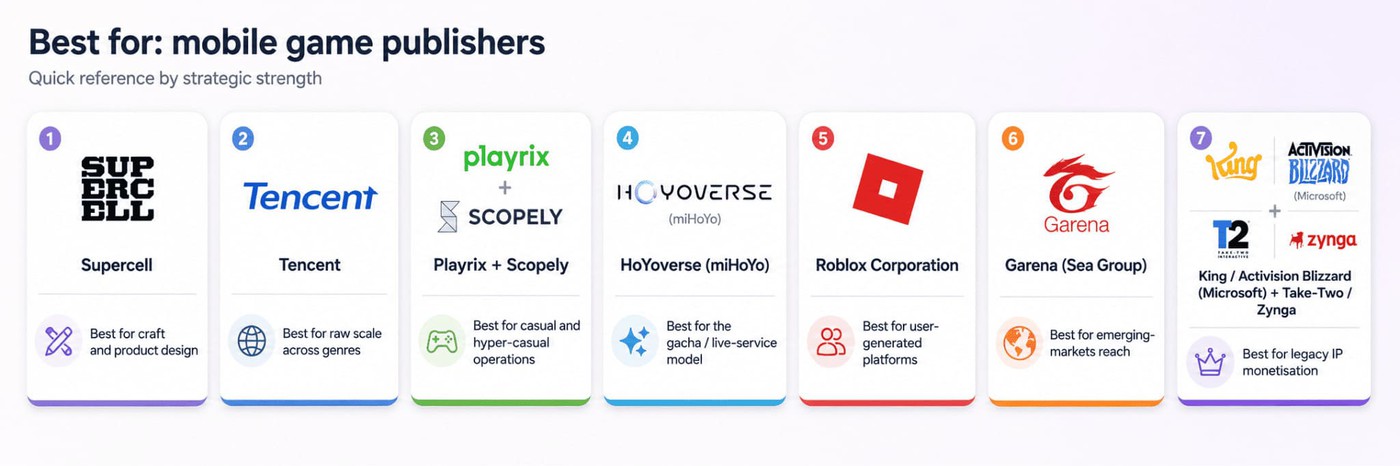
“Best for” cheat sheet (treat it as the TL;DR for the list below):
- Best for craft and product design: Supercell
- Best for raw scale across genres: Tencent
- Best for casual and hyper-casual operations: Playrix and Scopely
- Best for the gacha / live-service model: HoYoverse (miHoYo)
- Best for user-generated platforms: Roblox Corporation
- Best for emerging-markets reach: Garena (Sea Group)
- Best for legacy IP monetisation: King / Activision Blizzard (Microsoft) and Take-Two / Zynga
Now the numbers worth memorising. Each one carries a source, and the figures shift every quarter, so check the latest report before you quote them.
- Mobile games are forecast to reach $121.1B in 2026, up 6.8% and about 57% of the $213.9B global games market (Newzoo). Sensor Tower, which counts only App Store and Google Play in-app purchases, puts 2025 mobile game spending at $82B, up just 1% (Sensor Tower). The gap is mostly definition: direct-to-consumer web shops, third-party stores, and Chinese Android sit outside store-tracked IAP.
- Roughly 40% of all mobile gaming revenue flows to just the top 10 mobile game companies, per the latest Sensor Tower publisher data.
- In-app purchases drive about 80% of mobile gaming revenue, with advertising covering the other 20% or so (Sensor Tower / State of Mobile).
- China and the United States together account for 52% of all consumer spending on games in 2026 (Newzoo).
- Latin America is forecast to grow 7.9% to $9.3B in 2026, ahead of the 6.1% global average (Newzoo), and its spend already grew 2 to 3 times faster than the global average in 2024 (AppsFlyer). That makes it the headline story in mobile gaming industry growth.
- Mobile reaches 3.1 billion players in 2026, 84% of all players, and women make up close to half of all mobile gamers, which quietly retires a lot of old assumptions about who plays (Newzoo).
- Hybrid-casual, the genre that smuggles mid-core retention systems into hyper-casual mechanics, is climbing faster than any other category.
Yaroslav Rudnitskiy, Senior Professional Services Manager - ASO guru:
“What surprises new marketers is how concentrated the top really is. The biggest mobile game companies earn more than the next few hundred publishers combined, and that’s not a fluke. It’s daily ASO, daily LiveOps, daily engagement loops, repeated for years across every locale. Anyone can copy a feature. Almost nobody copies the cadence.”
How we ranked the list (and what we left out)
The list of biggest mobile game companies below is built on Sensor Tower’s 2025 worldwide publisher revenue, cross-checked against its State of Mobile report. One ranking signal, applied consistently: combined App Store and Google Play in-app purchase revenue for the 2025 calendar year. Clean, defensible, and the metric analysts argue about least.
Four caveats keep this honest:
- China undercount. Chinese third-party Android stores go uncounted in most Western reports, so Tencent and NetEase almost certainly earn more than the numbers here suggest.
- IAP only. IAP-only rankings ignore advertising revenue, which makes a platform like Roblox look smaller than it lives.
- Private companies. Supercell, Scopely, and HoYoverse disclose very little, so treat their figures as educated estimates rather than audited truth.
- Ownership shifts. Activision Blizzard and King sit under Microsoft now, while Scopely belongs to Savvy Games Group, backed by Saudi Arabia’s Public Investment Fund.
And one boundary: this is a ranking of companies that operate mobile games, not a directory of development vendors to hire.
Company revenue ranking is not the same as game revenue ranking
Small trap. Easy to miss.
A mobile game company ranking groups revenue by publisher, studio group, or parent company. That is why Tencent can lead the company list even when a single title from another publisher dominates one month in one country.
A mobile game revenue ranking, the “highest grossing mobile games” list most people look up, usually ranks individual games. That list changes faster. One update, one collaboration event, one gacha banner, one UA push, one seasonal offer, and the top games can shuffle.
Use both views, but do not mix them.
- Use company rankings to understand scale, portfolio strategy, and business durability.
- Use game rankings to study current demand, event timing, monetization peaks, and category momentum.
- Use country-level rankings when you care about a launch market, not global bragging rights.
Example: King is a company-level case study in franchise longevity. Candy Crush is a game-level case study in retention, economy tuning, and years of incremental optimization.
Different lens. Different lesson. If you want to read game-level chart movement properly, start with mobile app ranking analytics.
What “biggest” actually measures (and what it misses)
Revenue is the headline, not the whole story, especially when you’re deciding which of the biggest mobile game companies to learn from. Money tells you who won last year. Whether the win repeats, and why, sits in four other places. So I weight five things, and only the first one sets the rank.
- 2025 worldwide IAP revenue. The primary signal, and the single most defensible number anyone publishes.
- Portfolio breadth. One hit can be lightning. A roster of ten sustained titles reveals operational depth you can study and borrow from.
- Geographic reach. Sitting top-10 across five regions beats dominating one, because reach is really a proxy for localisation muscle and infrastructure.
- LiveOps and retention. Games that hold day-30 and day-90 retention compound revenue per install instead of leaking it.
- ASO and UA sophistication. The part you can genuinely copy. Our 2026 app store optimization playbook for games breaks down what the best of these mobile game companies do at the store level.
Comparison table: the biggest mobile game companies at a glance
Before we get into the company profiles, scan the list like an operator.
Revenue shows scale. It does not explain the machine.
The useful part is the pattern behind the revenue: a global platform, a mature franchise, a high-frequency LiveOps engine, a gacha content calendar, a puzzle-game testing system, or a region-first publishing advantage. That’s what the What to study column is for. It turns the table from a revenue list into a practical swipe file for gaming teams. The last column shows which store signals to watch for each company or studio if you track them in AppFollow.
Company / studio | HQ | 2025 revenue (est.) | Top games | Best for | What to study | AppFollow monitoring angle |
Tencent | Shenzhen, China | $10B+ mobile | Honor of Kings, PUBG Mobile | Scale across genres | Regional scale, portfolio breadth | Per-region creative and metadata changes |
NetEase | Hangzhou, China | $4-5B | Identity V, Eggy Party | Genre experimentation | Fast genre experiments | New-title launches and early ranking curves |
King / Activision Blizzard (Microsoft) | London / Redmond | $3-4B | Candy Crush Saga | Legacy IP monetisation | Mature franchise retention | Seasonal metadata and event update cadence |
Scopely (Savvy Games) | Los Angeles, USA | $3B+ | Monopoly GO!, Stumble Guys | Casual LiveOps | LiveOps cadence, event economy | Rank and review response to live events |
HoYoverse (miHoYo) | Shanghai, China | $3B+ | Genshin Impact, Honkai: Star Rail | Gacha / live-service | Content cadence, fandom loops | Ratings and reviews around version and banner drops |
Take-Two / Zynga | New York, USA | $2-3B | Toon Blast, Match Factory! | Hybrid-casual portfolios | Cross-promotion across a portfolio | Cross-promo launches across the portfolio |
Playrix | Dublin (founded Russia) | $2-3B | Homescapes, Gardenscapes | Casual product craft | Creative testing at scale | Icon and screenshot changes |
Supercell | Helsinki, Finland | $2B+ | Clash of Clans, Brawl Stars | Product design | Product focus, long-lived communities | Review themes before and after balance updates |
Roblox Corporation | San Mateo, USA | $3B+ bookings | Roblox (platform) | UGC platforms | Creator economy | Category rank and review sentiment |
Electronic Arts Mobile | Redwood City, USA | $1-2B | EA SPORTS FC Mobile | Sports and licensed IP | Content drops on real-world calendars | Rankings around sports-season starts |
Garena (Sea Group) | Singapore | $1-2B | Free Fire, Free Fire MAX | Emerging-markets reach | Emerging-market device fit | Keyword rankings in LATAM and Southeast Asia locales |
Netmarble | Seoul, South Korea | $1-2B | Solo Leveling: ARISE | Mid-core and RPG | IP-timed launches | Launch-week rankings and ratings |
The 12 biggest mobile game companies in 2026
Ranked by 2025 worldwide revenue per Sensor Tower and the State of Mobile report, with the order treated as directional. Small swaps between positions 5 and 12 show up between reports, and the China numbers carry the biggest asterisk. Each card carries a pattern tag and closes with one thing you can actually steal. Here they are, card by card.
1. Tencent
Best for: studying scale across every genre at once.
Pattern: Scale · Localization · Portfolio
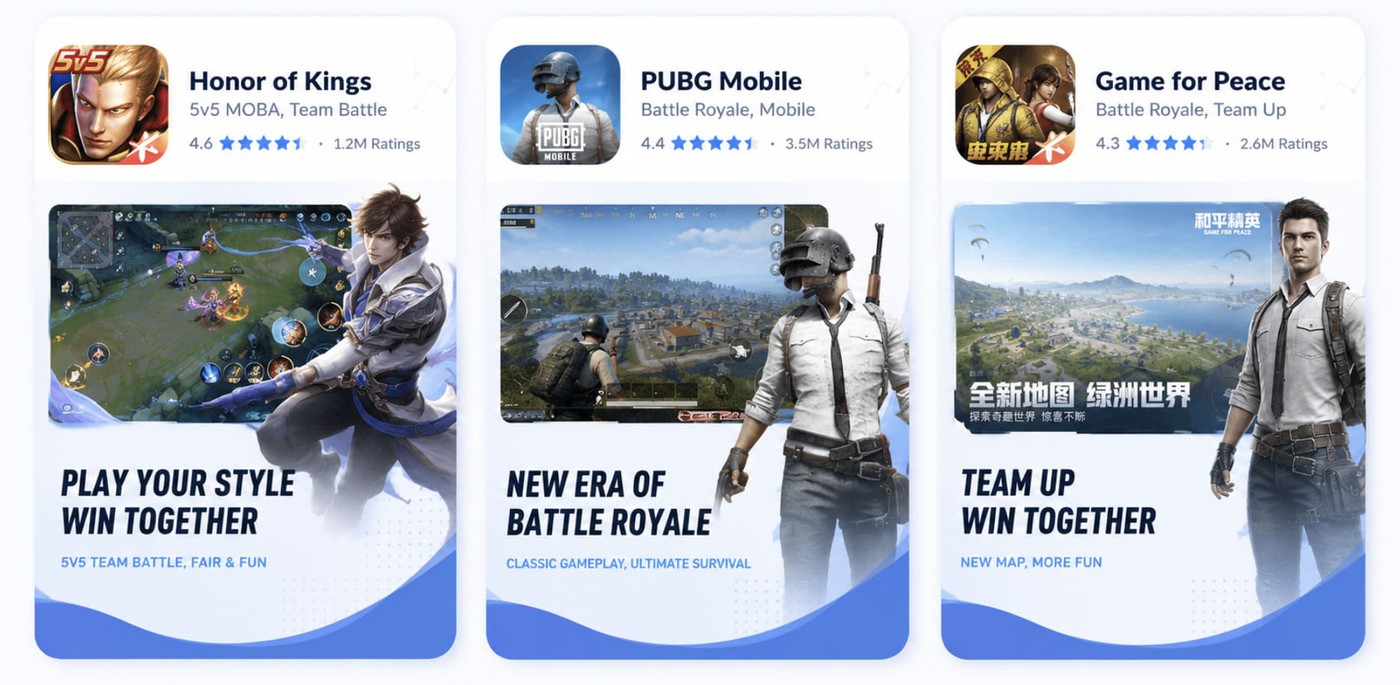
The largest of the biggest mobile game companies by a wide margin. Tencent owns Honor of Kings (the highest-grossing mobile game on earth most years), runs PUBG Mobile globally, and holds stakes in studios almost everywhere else, Supercell included.
Top games: - Honor of Kings - PUBG Mobile - Game for Peace
Scale: $10B+ in mobile revenue (2025 est.), Shenzhen HQ, with a player base in the hundreds of millions of MAU (Sensor Tower).
Tencent re-tests store creative per region rather than shipping one global set. Even a two-locale icon test on your top market borrows the principle.
2. NetEase
Best for: watching a publisher out-experiment everyone on genre.
Pattern: Genre experimentation · Speed
NetEase is the other Chinese titan, and it ships more genuinely original titles than any rival its size. Eggy Party went from launch to national phenomenon in months, which shows how fast this team moves once a hook lands.
Top games: - Identity V - Eggy Party - Knives Out
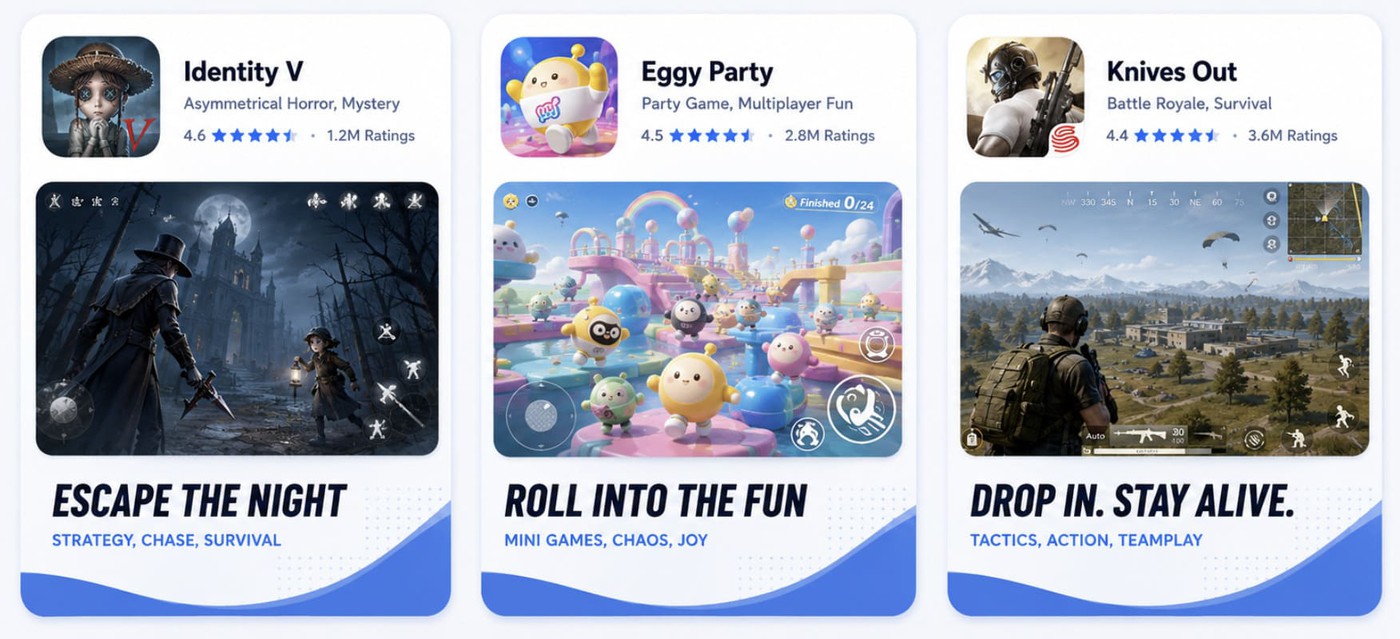
Scale: $4-5B mobile revenue (2025 est.), Hangzhou HQ, with several titles topping 10M+ MAU in China (Business of Apps).
Watch which experimental NetEase titles survive past month three. The survivors signal where a genre is heading before Western charts catch up.
3. King / Activision Blizzard (Microsoft)
Best for: seeing how a 13-year-old game still prints money.
Pattern: LiveOps · ASO · Retention
Candy Crush turned 13 in 2025 and still ranks among the top-grossing games worldwide. Microsoft owns King now, through the Activision Blizzard deal, and the franchise keeps humming on relentless live-ops rather than nostalgia.
Top games: - Candy Crush Saga - Candy Crush Soda Saga
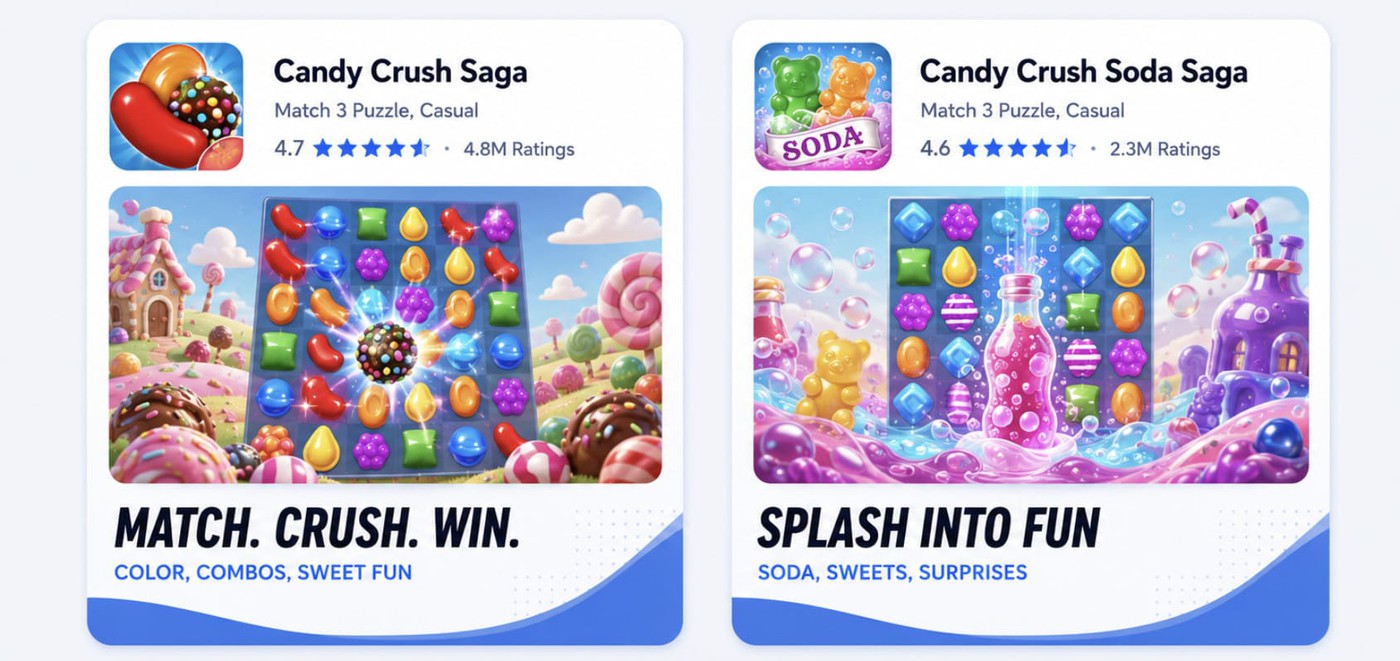
Scale: $3-4B mobile revenue (2025 est.), London HQ under Redmond ownership, with Candy Crush alone holding tens of millions of monthly players (Sensor Tower).
King refreshes metadata and seasonal events on a fixed calendar. A predictable update cadence keeps a mature title from sliding, and it’s something a one-person ASO team can schedule.
4. Scopely (Savvy Games / Saudi PIF)
Best for: studying casual LiveOps at full throttle.
Pattern: LiveOps · IP · Events
Monopoly GO! is the casual story of the decade, reportedly crossing $3B in lifetime revenue faster than almost anything before it. Now owned by Savvy Games Group, Scopely also absorbed Niantic’s games business in 2025, Pokémon GO included.
Top games: - Monopoly GO! - Stumble Guys - MARVEL Strike Force
Scale: $3B+ mobile revenue (2025 est.), Los Angeles HQ, with Monopoly GO! reaching tens of millions of players (Business of Apps).
Scopely runs events as the core retention loop, not as a bolt-on. Map your own calendar of recurring in-game moments before you spend a cent scaling UA.
5. HoYoverse (miHoYo)
Best for: learning the gacha and live-service model from the studio that perfected it.
Pattern: Monetization · Content cadence
Genshin Impact rewrote what a mobile game could earn, reportedly clearing billions inside its first couple of years. HoYoverse, the global brand of Shanghai’s miHoYo, builds console-grade worlds and monetises them through a gacha system players seem to genuinely enjoy.
Top games: - Genshin Impact - Honkai: Star Rail - Honkai Impact 3rd
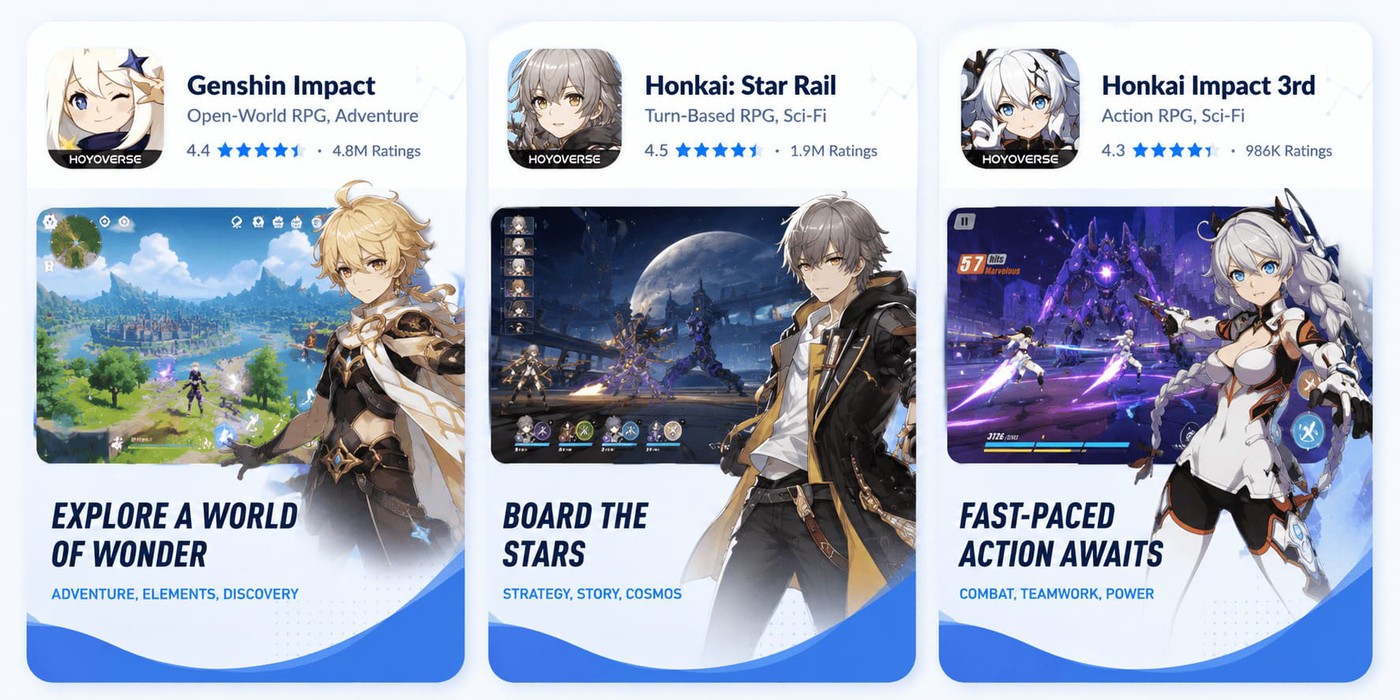
Scale: $3B+ mobile revenue (2025 est.), Shanghai HQ, with cross-platform audiences in the tens of millions (Sensor Tower).
HoYoverse ties every banner and update to a fixed six-week content beat. Players plan their spending around it. Predictability, not surprise, drives the revenue.
6. Take-Two / Zynga
Best for: a tour of hybrid-casual portfolio building.
Pattern: Portfolio · Cross-promotion
Take-Two bought Zynga in 2022, and the mobile arm has quietly become one of the steadiest casual portfolios going. Match Factory! broke out in 2024, proof the studio still finds fresh hits instead of only milking old ones.
Top games: - Toon Blast - Match Factory! - Words With Friends
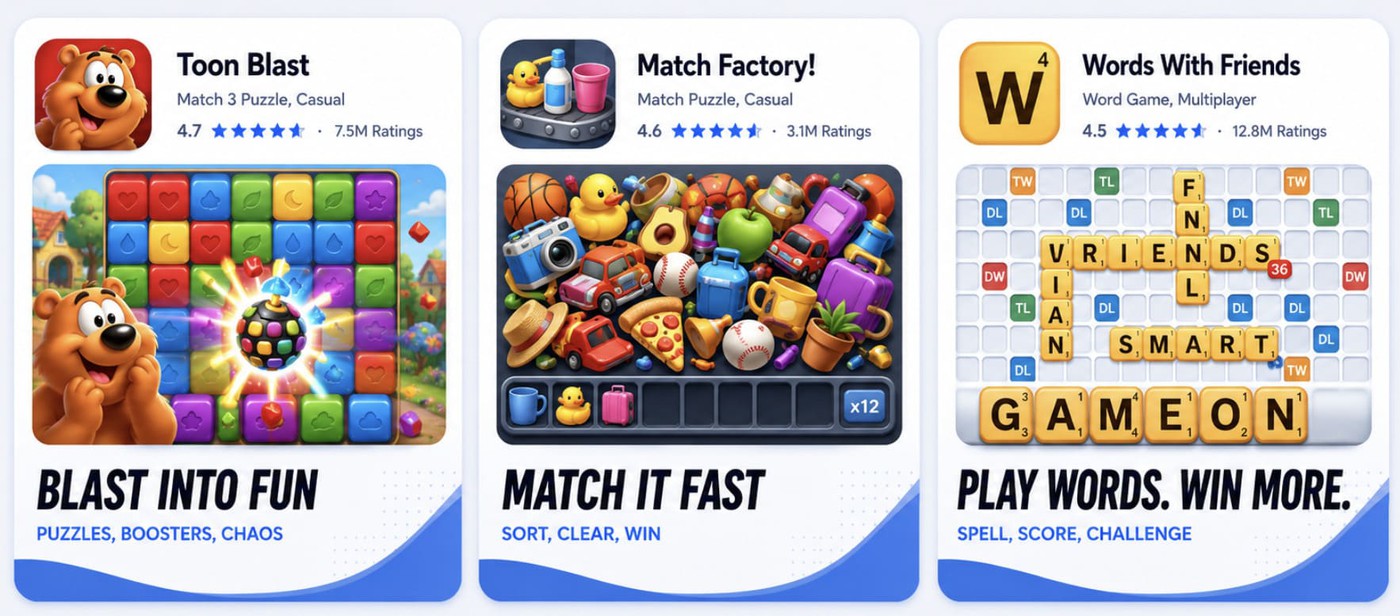
Scale: $2-3B mobile revenue (2025 est.), New York HQ, with a portfolio spanning puzzle, word, and casino (Business of Apps).
Zynga cross-promotes new titles to its existing puzzle audience first, buying down launch CPI. If you run more than one app, your own user base is the cheapest acquisition channel you own.
cta_get_started_yellow
7. Playrix
Best for: copying casual product craft, carefully.
Pattern: Creative testing · ASO
Homescapes and Gardenscapes defined the “meta-game wrapped around a puzzle” format that half the casual market now imitates. Dublin-registered and founded in Russia, Playrix remains one of the most studied creative and UA operations in the genre.
Top games: - Homescapes - Gardenscapes - Fishdom
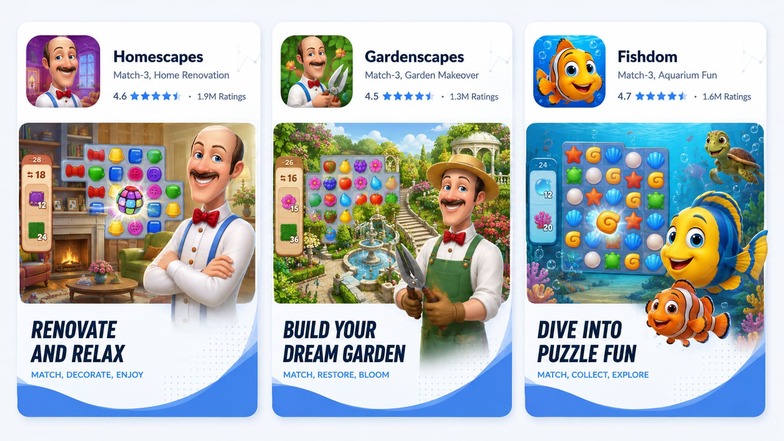
Scale: $2-3B mobile revenue (2025 est.), Dublin HQ, with flagship titles holding tens of millions of MAU (Sensor Tower).
Playrix tests dozens of creative variants before committing budget. Borrow the ratio, not the volume: validate a concept on a small spend before you pour money into it. (Our ASO screenshots guide covers the store-side version.)
8. Supercell
Best for: the cleanest product principles in the industry.
Pattern: Product discipline · Player feedback
Few studios earn this much from this few games. Supercell ships rarely, kills projects without sentiment, and runs Clash of Clans, now over a decade old, as if it launched last month. Tencent holds the majority stake, yet the Helsinki team operates with famous independence.
Top games: - Clash of Clans - Clash Royale - Brawl Stars - Squad Busters
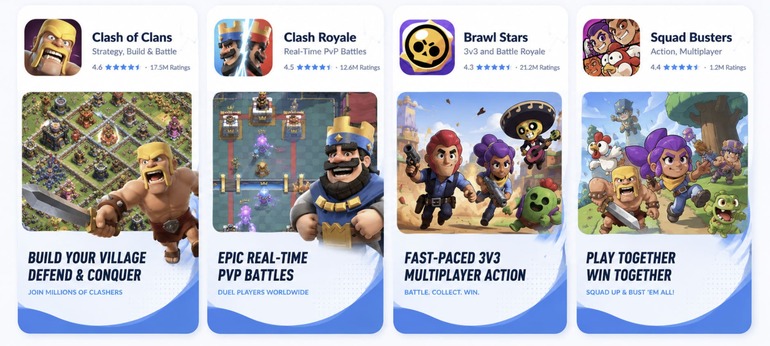
Scale: $2B+ mobile revenue (2025 est.), Helsinki HQ, with Brawl Stars enjoying a major 2024 resurgence into tens of millions of MAU (Business of Apps).
Brawl Stars came back because Supercell listened to player feedback at scale and shipped against it. A disciplined review and feedback loop is the most copyable thing here.
9. Roblox Corporation
Best for: understanding user-generated platforms.
Pattern: UGC · Community
Roblox runs more like an economy than a single game. Creators build the experiences, Roblox takes a share, and the whole thing turns on bookings and ad revenue instead of classic IAP. That structure is exactly why IAP-only rankings undersell it.
Top games: - Roblox (the platform itself)
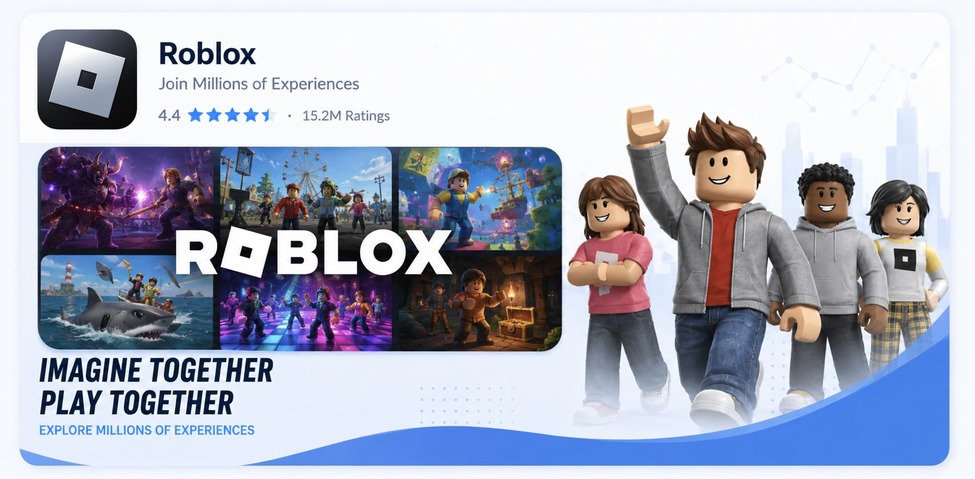
Scale: $3B+ in bookings (2025 est.), San Mateo HQ, with daily active users well into the tens of millions, skewing young (Roblox investor relations).
Roblox grows through its creator community, who market the platform for free. Even outside UGC, turning your most engaged players into advocates lowers blended acquisition cost.

10. Electronic Arts Mobile
Best for: licensed sports IP at mobile scale.
Pattern: IP · Seasonal LiveOps
EA’s mobile division converts the world’s biggest sports licences into year-round live services. EA SPORTS FC Mobile (the rebranded FIFA Mobile) anchors a portfolio that leans on brand recognition most studios would envy.
Top games: - EA SPORTS FC Mobile - Star Wars: Galaxy of Heroes - MADDEN NFL Mobile
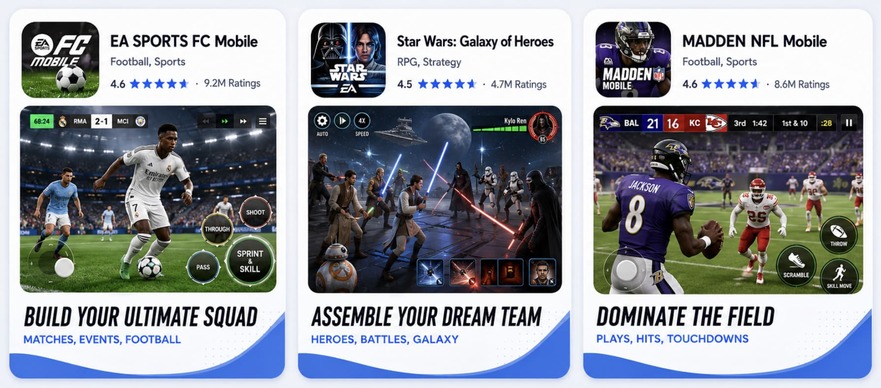
Scale: $1-2B mobile revenue (2025 est.), Redwood City HQ, with FC Mobile drawing tens of millions of seasonal players (Sensor Tower).
EA syncs in-game seasons to real-world sports calendars, so demand spikes arrive on schedule. Tie your biggest content drops to moments your audience already cares about.
11. Garena (Sea Group)
Best for: reach into emerging markets nobody else owns as well.
Pattern: Localization · Device fit
Free Fire is the quiet giant. While Western press fixated on PUBG and Fortnite, Garena built the dominant battle royale across Latin America and Southeast Asia, running on devices that can’t handle the heavier titles. In Brazil, Free Fire is a genuine cultural anchor.
Top games: - Free Fire - Free Fire MAX
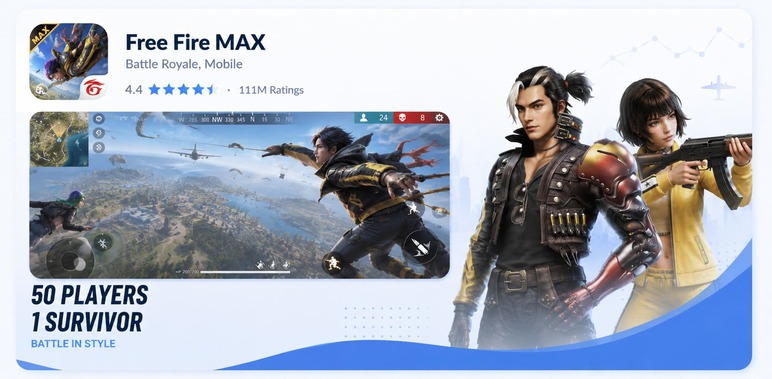
Scale: $1-2B mobile revenue (2025 est.), Singapore HQ, with Free Fire among the most-downloaded games globally and hundreds of millions of registered players (Business of Apps).
Garena built a lightweight MAX build for low-end phones and won markets the giants ignored. Device and connection constraints are a positioning opportunity, not just a tech problem.
12. Netmarble
Best for: mid-core and RPG live-ops out of Korea.
Pattern: IP · Launch timing
Netmarble closes the list with a deep bench of RPGs and licensed mid-core titles. Solo Leveling: ARISE was one of 2024’s standout launches and shows the studio’s knack for turning hot anime IP into live-service revenue.
Top games: - Solo Leveling: ARISE - Lineage 2: Revolution - MARVEL Future Fight
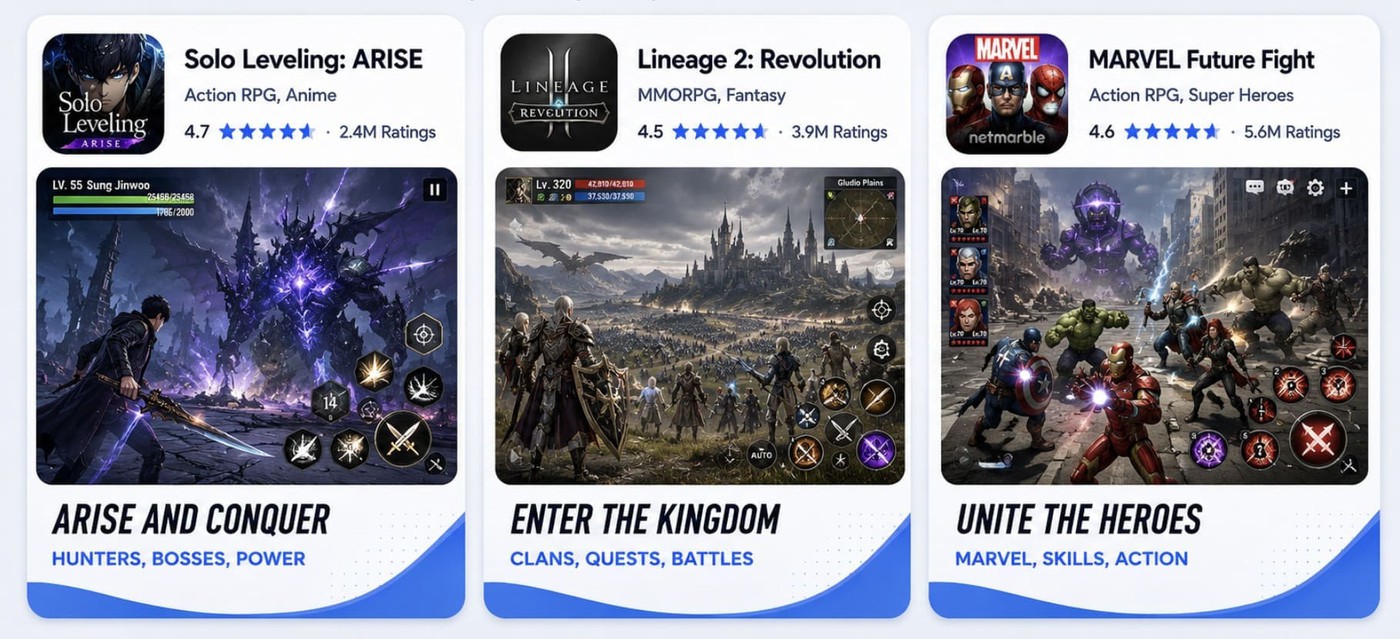
Scale: $1-2B mobile revenue (2025 est.), Seoul HQ, with a portfolio strongest across Asia (Sensor Tower).
Netmarble times launches to an IP’s cultural peak, like a hit anime’s airing window. Riding an existing audience wave beats manufacturing demand from zero.
Honourable mentions, in case any of the above slip in the next report: Krafton (BGMI, PUBG: New State), Nexon (Blue Archive, MapleStory M), Niantic-origin titles now under Scopely (Pokémon GO), Bandai Namco, and Lilith Games.
Which of these mobile game companies should you actually study?
“Biggest” and “most useful to your team” are different questions, and treating them as one wastes your research time. Before you go deep on any of these mobile game companies, get clear on what you’re trying to answer. Three versions come up most.
Studying craft? Start with Supercell, Playrix, and HoYoverse. Smaller portfolios, cleaner product principles, and playbooks documented across GDC talks and postmortems. You’ll learn more from how Supercell kills a game than from how Tencent ships fifty.
For benchmarking ASO and UA at scale, Tencent, NetEase, Scopely, and Zynga are the teachers. Their volume forces an efficiency indie teams can’t fake, and tracking their store moves week over week is an education by itself.
Tools like App Competitor Analysis exist precisely so you can watch those moves without a full research team.
Hunting for a publisher or partner is a different chase. The giants rarely sign third-party titles, so smaller specialists outside the top 12 (Krafton, Lilith, Nexon’s mobile arm) tend to be far more reachable. Even among the top 12, only a handful actively take on outside games.
If you meant “mobile game development companies to hire,” read the list differently
A revenue ranking is not a vendor shortlist.
That sounds obvious until you look at the SERP. Search for “mobile game development companies” or “app game development companies” and Google mixes several things: directories, agency landing pages, Reddit discussions, and lists like this one. Same keyword family. Different job.
If you need a company to build a game, do not start with the biggest publisher. Start with the shape of the game you need to ship.
Here is the faster filter:
Selection signal | What to check | Why it matters |
Genre proof | Has the team shipped games in your genre? Puzzle, casino, RPG, shooter, idle, strategy, kids, sports? | A studio that understands one genre can still misread another. |
Platform depth | iOS, Android, cross-platform, tablets, low-end devices, regional stores. | Mobile performance issues usually appear late and hurt reviews fast. |
Economy design | IAP, ads, subscriptions, battle pass, gacha, web shop, hybrid monetization. | Monetization is product design, not a checkout button. |
LiveOps readiness | Events, seasons, limited-time offers, content pipelines, player segmentation. | Most mobile game revenue is earned after launch. |
Store feedback loop | Review monitoring, rating drops, keyword movement, competitor updates. | If the team cannot read store signals, they will miss early warning signs. |
QA and support handoff | Crash handling, device coverage, localization QA, support workflows. | A good launch can still turn into 1-star cleanup if operations are weak. |
So yes, study Tencent, Scopely, King, HoYoverse, Playrix, and Supercell. But do not hire by size. Hire by fit.
A huge publisher can teach you what durable mobile-game operations look like. A smaller specialist may be the better build partner. Before you sign one, run a quick app competitor analysis on the games they’ve shipped: ratings, review themes, and ranking history tell you more than a portfolio page.
App promotion in mobile gaming: why it decides who wins
Here’s what most newcomers don’t see coming. In this category, promotion does more to determine outcomes than the product itself, which feels backwards until you look at the spend.
Why the biggest mobile game companies treat app promotion as a core competency
Tencent, Supercell, and Scopely each spend an estimated 25 to 40% of revenue on user acquisition and creative production. Mobile gaming is the only major software category where marketing, not engineering, becomes the largest line item below cost of revenue. It has to, because without continuous promotion (ASO, paid UA, and retention LiveOps working together) even a brilliant game slides down the charts within 60 to 90 days. That ranking decay is fast and unforgiving.
What this means for smaller publishers
Outspending Tencent on UA isn’t happening, and chasing it would only burn your runway. Out-executing on ASO and on focused creative testing, where effort beats budget, absolutely is. For a studio under $10M in revenue, app store optimisation is the single most leverageable channel available, and the gains compound.
Reviews are part of that channel: our recent research of 51.5 million game reviews found the average mobile game holds a 3.48 rating while studios that actively manage reviews average 4.30, a gap worth real downloads.
Most indie studios we work with close that ASO gap with the biggest publishers in their genre before they scale a single paid campaign.
How AppFollow helps you study mobile game companies without copying them blindly
The lazy version of competitive analysis is simple: open the top games, copy the screenshots, borrow a few keywords, and hope the market rewards the imitation.
It usually does not.
A better workflow starts with movement.
Open the games you compete with. Track where they rank by keyword, country, and category. Watch what happens after a release, a season, a collaboration event, or a pricing change. Then line that movement up with reviews, ratings, metadata, and competitor updates.
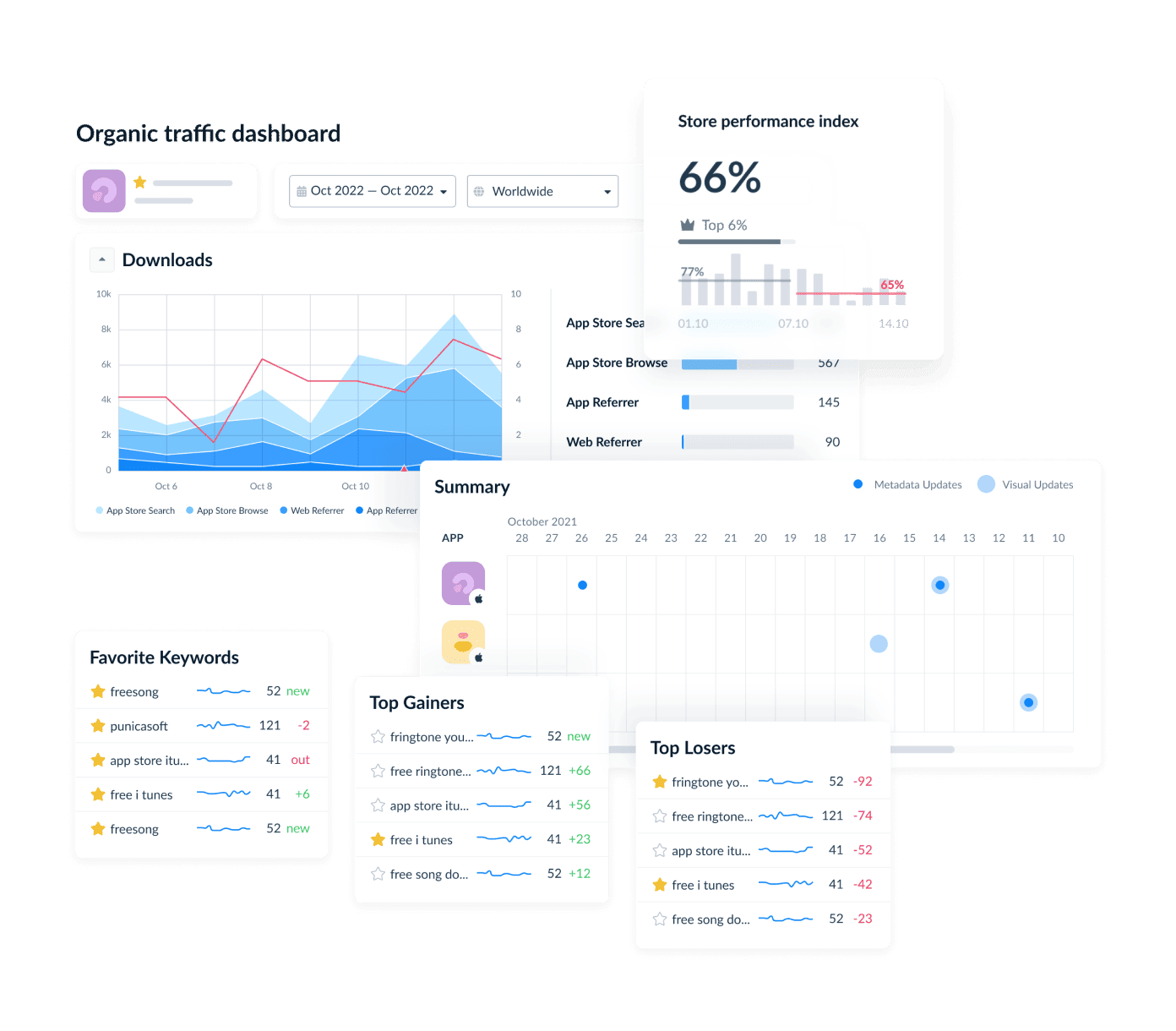
That is where AppFollow becomes useful for gaming teams. You can use it to:
- Track rank changes by keyword and country. Track rankings by keyword and country daily, across every Google Play and App Store locale. If a competitor jumps for “match 3 puzzle game” in the US but not in Germany, the story is probably not only metadata. For LATAM, you’d track separate Brazilian Portuguese and Mexican Spanish keyword sets side by side, which is exactly where the Free Fire competitors are winning installs.
- See what the giants change, the day they change it. Competitor Intelligence keeps daily timestamped snapshots of metadata changes and ranking trajectories for every Tencent, Supercell, Playrix, or Scopely title you add. If Playrix swaps the Homescapes icon on a Tuesday, you see it within a day and watch the rank response over the next week.
- Connect ranking movement to ratings and reviews. A ranking drop after an update means something different when 1-star reviews spike in the same week.
- Compare visibility across competitors. One studio may win on brand search. Another may win long-tail category terms. A third may be carried by paid bursts and lose organic visibility fast.
- Monitor player language at scale. Reviews reveal what the store listing cannot: difficulty spikes, ad pressure, bugs, pricing frustration, event fatigue. The review and ratings tools give a small team reply-queue routing, sentiment tagging, and rating-trend views in one place, with AI-assisted replies handling the repetitive volume. The biggest publishers often answer 60 to 80% of incoming reviews; this is how you hold that tempo without their headcount.
- Turn the finding into action. Update metadata, adjust screenshots, reply to review themes, escalate product bugs, or watch the next release cycle before reacting.
The point is not to copy the biggest mobile game companies. Their budgets, IP, and distribution power are not yours.
The point is to see the pattern early enough to make a smaller, smarter move. That’s why gaming teams use AppFollow to monitor reviews, rankings, and release signals for games in one place.
cta_get_started_purple
FAQs
What are the biggest mobile game companies in 2026?
The biggest mobile game companies in 2026 include Tencent, NetEase, King, Scopely, HoYoverse, Take-Two/Zynga, Playrix, Supercell, Roblox, EA Mobile, Garena, and Netmarble. The order depends on whether you rank by mobile IAP revenue, bookings, downloads, or total company revenue.
Who is the biggest mobile game company?
Tencent is still the largest mobile game company by mobile revenue scale, driven by titles such as Honor of Kings, PUBG Mobile, and Game for Peace. Its China exposure means public Western revenue estimates often undercount the full picture.
What is the difference between a mobile game developer and publisher?
A developer builds the game. A publisher brings it to market through distribution, UA, monetization, store strategy, and regional support. Some companies do both, but the capabilities are different.
How should I choose a mobile game development company?
Choose by genre proof, platform depth, LiveOps capability, store performance, QA coverage, and feedback loop maturity. A high-revenue publisher is not automatically the right vendor for a new build.
Why do mobile game rankings change so often?
Rankings move because installs, revenue, ratings, reviews, creative updates, events, and competitors all change at different speeds. For gaming teams, the useful question is not only who ranks higher, but what changed before the move.