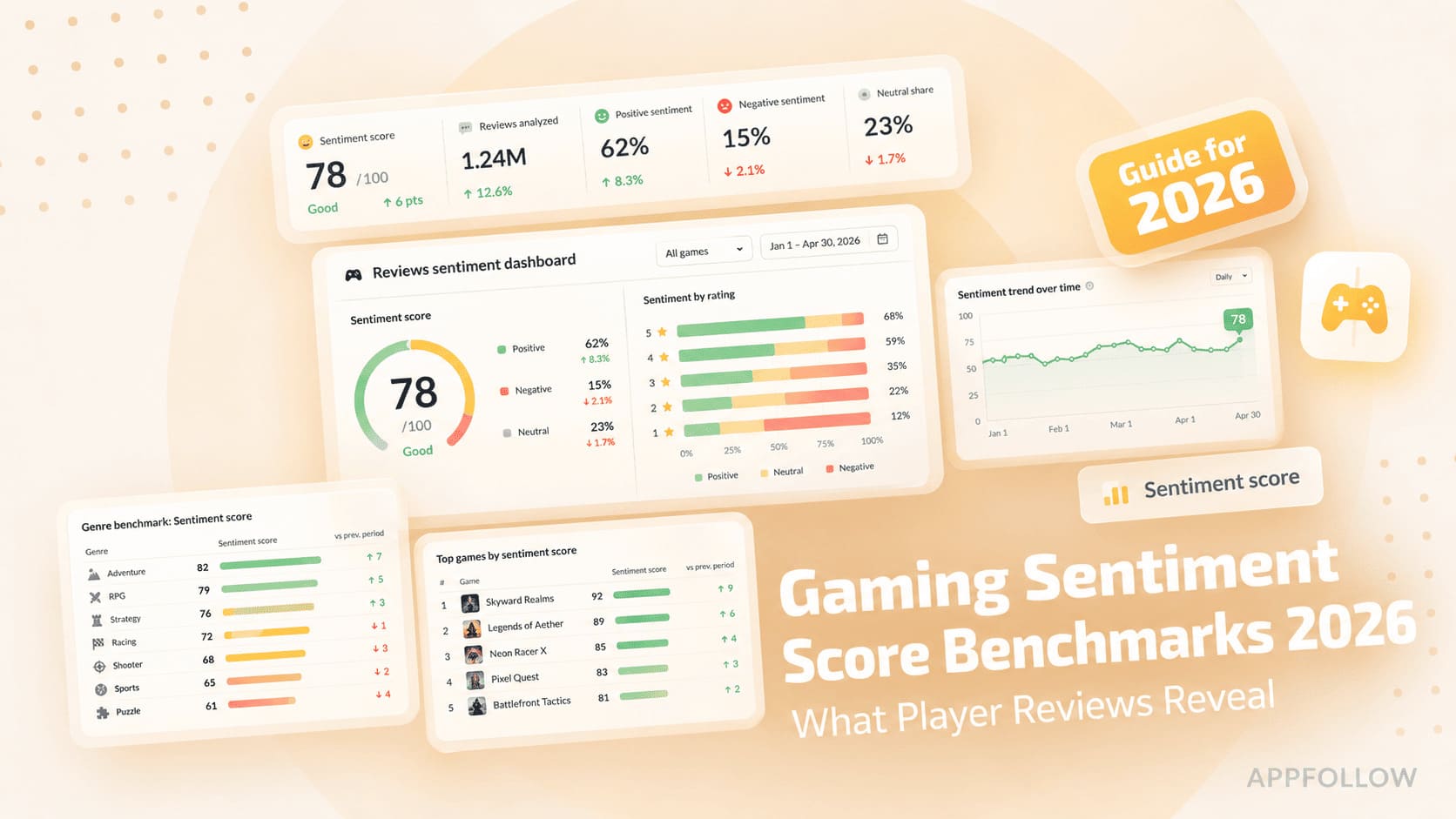
Gaming Sentiment Score Benchmarks 2026: What 51.5M Player Reviews Reveal About How Players Actually Feel

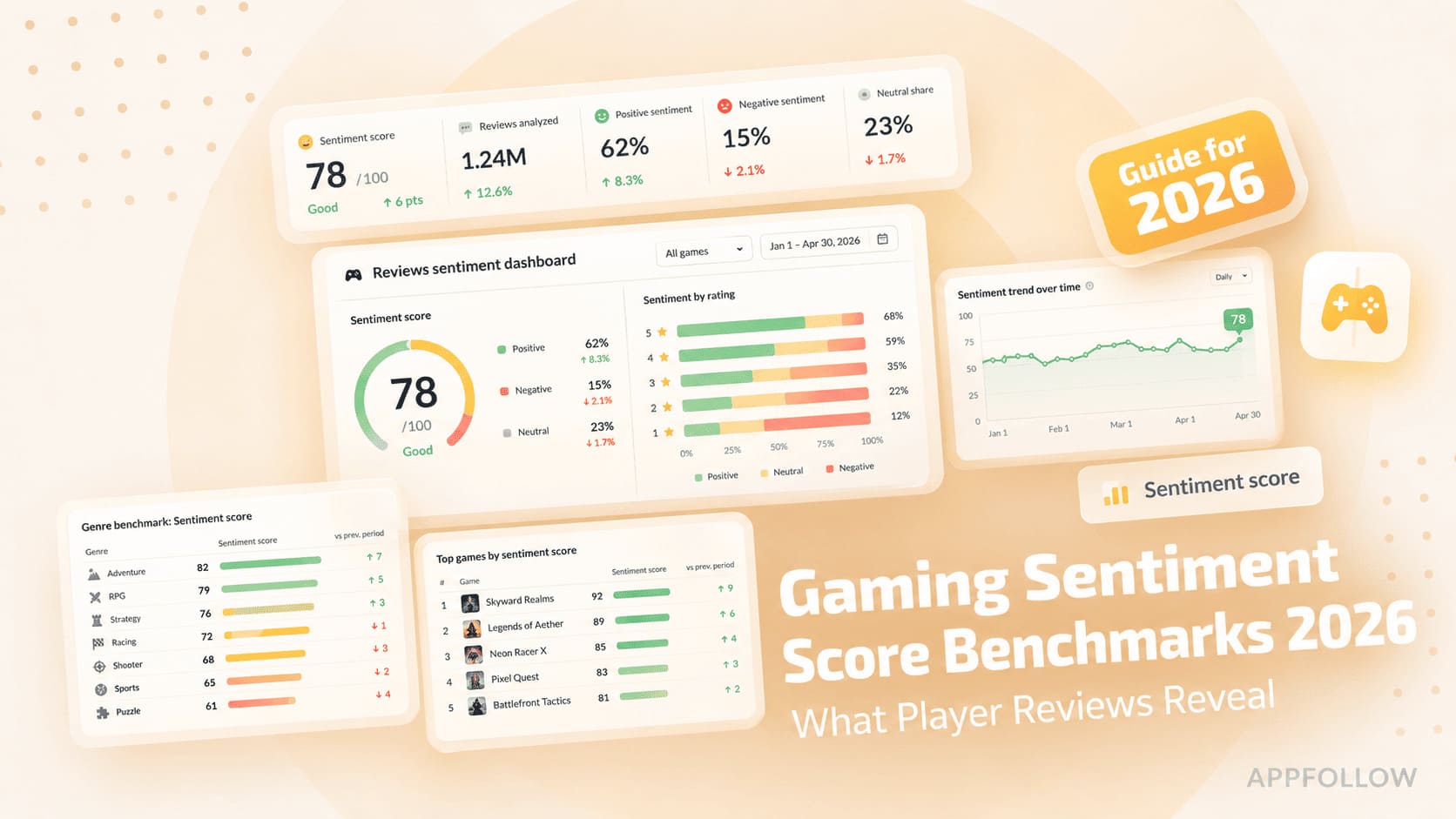
Table of Content:
- Key insights at a glance
- How we collected this data
- 2026 sentiment benchmark snapshot: global, featured, and AppFollow clients
- Star ratings tell you what already happened. Sentiment tells you what’s about to
- What is sentiment score in mobile gaming?
- The most striking finding in the 2026 report — the 19-point platform gap
- The decoupling: replying moves ratings, not sentiment
- Sentiment by genre — Google Play
- Sentiment by genre — App Store
- What sentiment looks like at the top — featured games leaderboard
- Top 10% vs. bottom 10% of apps — what the spread reveals
- Sentiment vs. star rating — the leading indicator your dashboard probably doesn’t track
- AI replies and the “feeling of being processed”
- Five hypothesis-ready levers for 2026 sentiment operations
The average sentiment score across mobile gaming in 2026 is 65.5 on Google Play and 46.4 on the App Store — a 19-point platform gap that holds across nearly every genre.
Sentiment behaves differently than star ratings. Replying to reviews moves star ratings by +0.42 on average, but barely budges sentiment (62.4 vs. 61.9 between repliers and non-repliers).
The number on your store page changes when you engage. The way players feel changes when you ship product.
The two metrics measure different things, and the studios winning in 2026 instrument both. Across 51.5 million reviews and 22,800+ apps, sentiment is the leading indicator that fires two to three weeks before the headline rating moves.
Key insights at a glance
- Dataset: 51.5M reviews, 561,000+ replies, 22,800+ gaming apps, January 2025 – January 2026.
- Google Play global average sentiment: 65.5.
- App Store global average sentiment: 46.4. The 19-point platform gap is the most striking finding in the 2026 report.
- The decoupling: replying to reviews barely moves sentiment (62.4 repliers vs. 61.9 non-repliers — only 0.5 points), but moves star rating by +0.42.
- AppFollow top 10% apps: 65.9 sentiment vs. bottom 10% at 62.5 — a real but modest gap.
- Highest sentiment among AppFollow client genres on Google Play: Arcade at 88.2.
- Lowest sentiment among AppFollow clients on Google Play: Role Playing at 53.0 — RPG players write longer, more critical reviews.
- Featured Google Play top sentiment: Kids Games: For Toddlers 3-5 (92), Word Search Explorer (88).
- Featured App Store top sentiment: Disney Solitaire (79), Balatro (63), MONOPOLY GO! (58).
- Sentiment is a leading indicator that typically shifts two to three weeks before headline star ratings move.
- Sentiment-by-feature-tag is the highest-information signal in the public review dataset for predicting rating direction.
- Customer cases in the 2026 report: Easybrain on AI-vs-personal touch, Hyperhug on AI synergy, G5 on response-as-public-statement.
How we collected this data
AppFollow Research · Data range: January 1, 2025 to January 1, 2026
Sample. 51.5 million reviews and 561,000+ developer replies across 22,800+ gaming apps on Apple App Store and Google Play. Includes a non-aggregated dataset of 2,115 individual apps (1,797 on Google Play, 318 on App Store) for app-level distribution analysis, plus the top 100 featured games chosen by the platforms in 2025.
Sources. First-party AppFollow telemetry across 1,000+ managed client apps (64% Google Play, 36% App Store), plus public store data ingested through the AppFollow Reviews API across 15 gaming genres.
Benchmarks. Three tiers compared head-to-head: global (the whole market), featured (the top 100 apps each platform chose to promote during 2025), and AppFollow clients (managed apps using our review-management and AI reply tooling).
Caveats. Sentiment is scored at review level via AppFollow’s in-house classifier and requires a minimum review volume. About 400+ apps in the non-aggregated set carry a store rating of zero due to insufficient ratings. Top 10% and bottom 10% segments are based on store rating percentiles, not revenue or volume.
2026 sentiment benchmark snapshot: global, featured, and AppFollow clients
Tier | Google Play sentiment | App Store sentiment | Notes |
|---|---|---|---|
Global average | 65.5 | 46.4 | 19-point platform gap |
AppFollow top 10% | 65.9 | — | Modest 3-point lift over bottom 10% |
AppFollow bottom 10% | 62.5 | — | Floor higher than global average |
AF Arcade clients | 88.2 | — | Highest sentiment across all genres |
AF Role Playing clients | 53.0 | — | Lowest — RPG players write longer, critical reviews |
Featured top apps (GP) | Up to 92 | — | Kids Games: For Toddlers 3-5 |
Featured top apps (AS) | — | Up to 79 | Disney Solitaire |
Repliers vs. non-repliers | 62.4 / 61.9 | 62.4 / 61.9 | Only 0.5-point gap — sentiment ≠ rating |
Sentiment and star rating are not the same lever. Replying moves your rating. Shipping product changes (or losing players) moves your sentiment. The 2026 data makes this distinction operationally usable.
Star ratings tell you what already happened. Sentiment tells you what’s about to
Open your store page. Look at the review section. Notice anything that feels off?
A 5-star review might open with the words "please fix the lag." A 3-star might say "love it, just installed." The number is one signal. The feeling underneath the number is another.
That’s sentiment. The actual emotion in the text, scored independently of how many stars the user tapped. And in 2026, the data shows sentiment doing things that star ratings can’t. It moves earlier. It exposes problems your headline rating hasn’t caught up to yet. It tells you where the next quarter’s rating drift is going to come from before the drift starts.
Anatoly Sharifulin, CEO and co-founder at AppFollow, frames the 2026 audience: "Gaming has the most charged audience out there. Players will write about everything in their reviews — the game itself, a promotion they missed, pricing changes, an ad they saw somewhere, a tournament that went wrong."
All of that texture lives in the review text. Sentiment is how you read it at scale.
What is sentiment score in mobile gaming?
Sentiment score is the net positive sentiment across written review text, calculated independently of star rating. AppFollow’s in-house classifier labels each review as positive, neutral, or negative, then aggregates across genre, store, region, or time window.
The most striking finding in the 2026 report — the 19-point platform gap
Google Play global sentiment averages 65.5. App Store global sentiment averages 46.4. The gap is 19 points. It holds across genres, app tiers, and review volumes.
That gap is not about app quality. It’s about how iOS users write reviews.
Look at the same game on both stores and the App Store reviewers will use sharper language. They’ll write longer reviews. They’ll spend more time describing specific frustrations. The star rating on iOS might end up similar to Android, but the text underneath skews more critical.
The implication for any cross-platform studio: a 50 sentiment score on the App Store and a 65 on Google Play might both be perfectly average for their respective platforms. If you’re comparing them directly and panicking about the iOS number, the panic is misplaced. Different audiences. Different writing cultures. Different baselines.
Key takeaway: Set separate sentiment baselines for App Store and Google Play. Compare your App Store score against 46.4, not against 65.5. The 19-point gap is structural and persistent.
The decoupling: replying moves ratings, not sentiment
Here’s the result that surprised our research team in 2026. Across the non-aggregated dataset of 2,115 individual apps:
- Apps that reply to any reviews: 62.4 average sentiment.
- Apps that never reply: 61.9 average sentiment.
- Gap: 0.5 points. Functionally indistinguishable.
Compare that to the reply-effect data on star ratings. Apps that reply: 3.61 average rating. Apps that never reply: 3.18. A +0.42 difference, large enough to shift store algorithms.
So replying changes how players rate your app. It doesn’t fundamentally change how they feel about your app. Two different mechanisms. Two different levers.
Which means if your sentiment is dropping, replying harder won’t fix it. The fix lives in the product. The reply layer is for managing how that product experience shows up on the store page.
Key takeaway: Sentiment is a product signal. Star rating is a relationship signal. Replying improves the relationship. Shipping product fixes improves the underlying feeling. Use both — but use them for what each one actually measures.
Sentiment by genre — Google Play
Across the global Google Play dataset, sentiment leaders cluster in the 65–72 range. Trivia and Casual top the leaderboard. Role Playing sits noticeably lower at around 62, even though its star ratings are reasonable.
Why? RPG players write longer, more detailed reviews. They pick apart monetization mechanics, balance issues, multiplayer matchmaking, and update notes. The text is more critical even when the star rating reads fine.
Among AppFollow client genres on Google Play, the spread runs wider:
- Arcade — 88.2 (highest)
- Adventure — 72.7
- Action — 70.2
- Board — 70.1
- Casino — 69.7
- Puzzle — 70.0
- Racing — 67.8
- Simulation — 66.0
- Sports — 64.1
- Strategy — 61.6
- Trivia — 59.4
- Word — 55.1
- Role Playing — 53.0 (lowest)
Sentiment by genre — App Store
On the App Store, sentiment scores run lower across every genre — consistent with the 19-point platform gap. The relative ranking changes slightly, with Casino leading among AppFollow clients (App Store enjoyers do seem to like Casino games the most, by the data).
Racing and Trivia stand out for low App Store sentiment, partly because of lower review volumes that amplify variance.
The practical takeaway: if you’re benchmarking your App Store sentiment against your Google Play sentiment, you’re benchmarking against the wrong number. Anchor against your App Store peers in your own genre. The platform realities are too different to merge.
What sentiment looks like at the top — featured games leaderboard
The platforms featured 100 games each on Google Play and the App Store during 2025. Looking at the top performers by sentiment shows what excellence in the category actually scores.
Top 7 featured Google Play games by sentimentKids Games: For Toddlers 3-5 — 92 Word Search Explorer — 88 Doomsday x Attack on Titan — 84 Piano Kids - Music & Songs — 83 Subway Surfers — 82 Baby Panda's Supermarket — 82 Happy Color® - Color by Number — 80 | Top 7 featured App Store games by sentimentDisney Solitaire — 79 Balatro — 63 MONOPOLY GO! — 58 Disney Magic Match 3D — 55 Roblox — 47 Call of Duty: Mobile — 46 Wittle Defender — 44 |
Look at the spread. Google Play featured leaders cluster 80–92. App Store featured leaders cluster 44–79. The 19-point platform gap shows up even at the very top of the leaderboard.
If you’re a publisher trying to benchmark a flagship title, those are the numbers to chase store-by-store. Not against each other.
Top 10% vs. bottom 10% of apps — what the spread reveals
Across the AppFollow client base, top 10% apps by store rating average 65.9 sentiment. Bottom 10% average 62.5. A 3.4-point gap.
That gap is smaller than you might expect, given that the rating spread between the two cohorts is much wider. The story underneath: sentiment doesn’t move dramatically between successful and struggling apps. What moves is the operational discipline around responding to that sentiment.
Top 10% apps spread their replies more evenly across star ratings — 63.6% on 5-stars, 18.2% on 1-stars, plus meaningful coverage on the 2-4 star middle. Bottom 10% apps cluster their replies on the extremes (48.4% on 5-stars, 28.1% on 1-stars, almost nothing in between).
Sentiment shows the audience’s emotional baseline. Reply discipline shows what the team does with that signal. The studios that win in 2026 read both.
Sentiment vs. star rating — the leading indicator your dashboard probably doesn’t track
Sentiment drifts before star ratings do. Typically two to three weeks before. The AppFollow Top Performer cohort uses this lag deliberately — sentiment alerts feed into the daily standup before the headline rating starts to slip, which gives the team a window to ship a patch, push a reply campaign, or rework messaging before the public-facing number takes the hit.
Most studios watch the headline rating. By the time it moves, the underlying story is already two weeks old. The competitive advantage in 2026 belongs to the teams instrumented for the upstream signal.
Definition: Sentiment-by-feature-tag
Review-level sentiment cross-tabulated against feature tags (monetization, performance, multiplayer, IAP, onboarding, ads, etc.). AppFollow tags reviews automatically using AI classification, then surfaces the tags driving sentiment up or down.
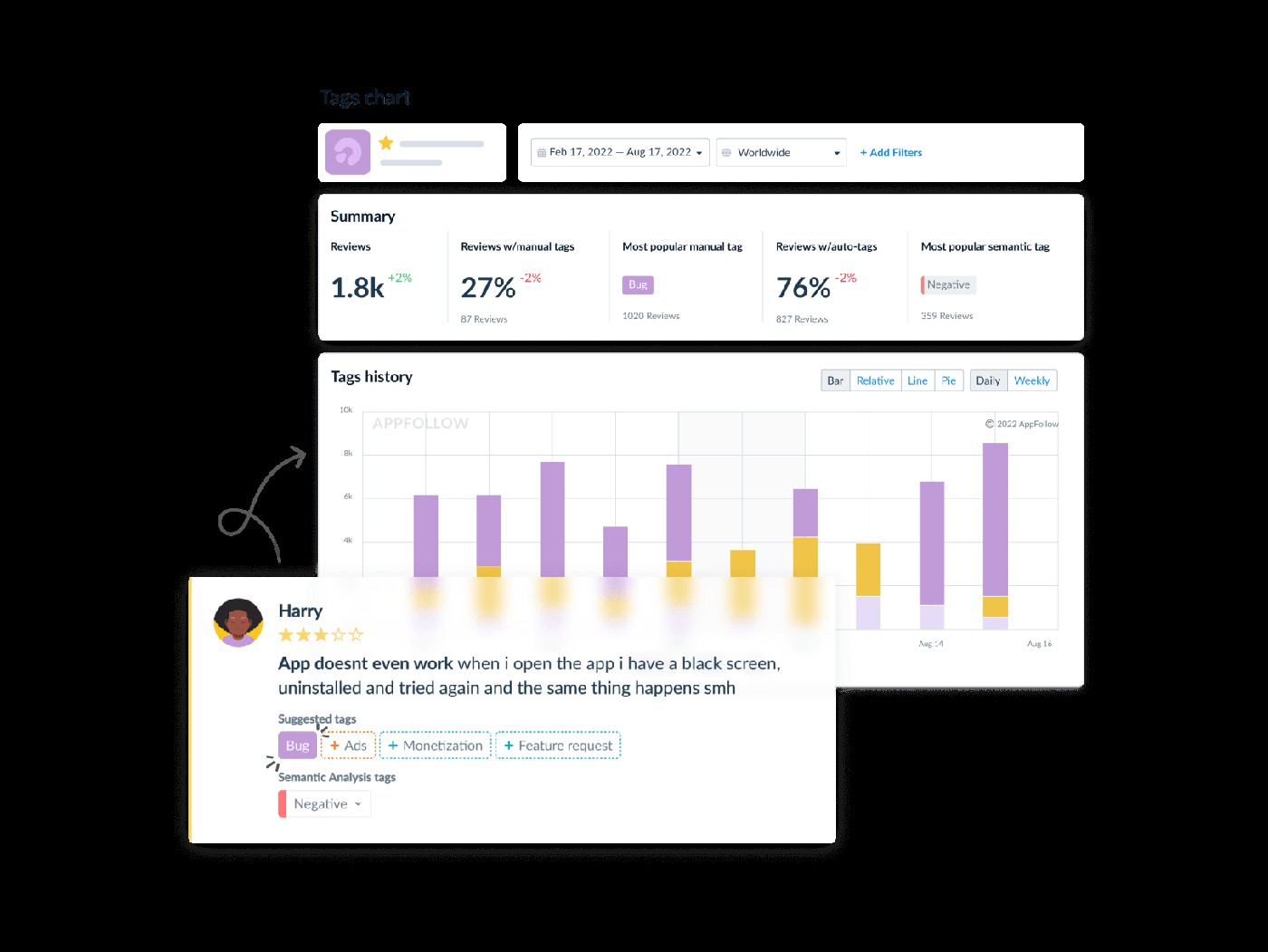
The highest-information signal in the public review dataset for predicting rating direction and identifying the next product-roadmap priority.
If you can read sentiment by feature tag, you can predict which sprint will move your rating the most. Tag-level negative sentiment usually translates to specific bug, balance, or monetization issues that have a fix-it path.
AI replies and the “feeling of being processed”
Sentiment lives in the felt experience of the player. Which means the way a studio responds to reviews can affect sentiment, just not in the direction most people assume.
Veronica Cherenkova, Lead Support Manager at Easybrain:
"In 2026, using AI in review management won’t be a differentiator — everyone will be doing it. The advantage will be keeping the experience personal at scale. Automation should handle the routine, but humans must still own empathy, accountability, and product expertise. Players don’t mind AI — what they mind is the feeling of being processed."
That last line is the entire sentiment story in one sentence.
Martin Saakyan at Hyperhug echoes the same finding:
"We use AppFollow’s analytics to track review dynamics and use AI assistance to process feedback at scale without losing the personal touch. This synergy between AI efficiency and authentic player communication allows Hyperhug to remain agile, prioritizing improvements that truly matter to our audience and keeping our ratings on a steady upward trend."
And Dmitry Gerastenok at G5 Entertainment:
"Every response to a player review is both a support action and a public statement. Sometimes, calming a wave of negative reviews is more important than solving a single case."
Three different studios. Same operational pattern. Use AI for the scale. Use humans for the moments where the sentiment is going to be made or broken.
Five hypothesis-ready levers for 2026 sentiment operations
1. Daily sentiment alerting on 7-day negative trends
Hypothesis: titles with sentiment trending negative for >7 consecutive days who receive same-week intervention experience 30–50% fewer rating-decline events in the following quarter. The mechanism is the two-to-three-week lag between sentiment drift and rating drift.
2. Genre-baseline gates for launches
Hypothesis: any new title launching into a category at sentiment below the genre baseline (e.g., RPG under 53, Arcade under 88 on Google Play) is structurally underperforming regardless of headline rating. Use genre sentiment baselines as internal launch-readiness gates.
3. Feature-tag sentiment as a product-roadmap signal
Hypothesis: the top three negative feature tags in a 30-day window are the highest-ROI roadmap items for the next sprint. The AppFollow tag-routing surfaces these automatically. The product change that moves sentiment is the product change that moves rating the following month.
4. Separate sentiment baselines by store
Hypothesis: studios maintaining unified iOS/Android sentiment dashboards systematically misread their App Store performance. The 19-point platform gap means the App Store always looks worse. Setting platform-specific baselines (46.4 for App Store, 65.5 for Google Play) reframes the conversation from "why is iOS broken" to "how is iOS performing relative to its own peers."
5. Triage reply effort using sentiment, not stars
Hypothesis: routing replies based on sentiment classification (negative sentiment in any star band gets a human response; positive sentiment in any star band gets an AI response) outperforms routing by star rating alone. Easybrain and Hyperhug both report this pattern as their internal practice.cta_get_started_purple