Gaming Reply Time Benchmarks 2026: Why AI Replies Arrive 12x Faster — and What That Does to Your Star Rating

Table of Content:
- 2026 reply time benchmark snapshot: manual vs. AI vs. featured leaders
- Twelve and a half days. That’s the average.
- What is reply time in mobile gaming?
- Where does your team actually sit?
- The 12x AI speed advantage — what the gap actually does
- Google Play vs. App Store — speed asymmetries by platform
- Reply time by genre — where the variance lives
- The featured-games fastest-responder leaderboard
- Top 10% vs. bottom 10% — the speed gap is real but modest
- AppFollow client deep dive — AI vs. agent reply time by genre
- What happens when a studio fixes its reply time — Toca Boca and Fingersoft
- How reply time influences your role specifically
The average mobile game manual reply takes 299.3 hours to arrive — twelve and a half days. By then, the player has uninstalled, moved on, or forgotten what they were upset about.
AI-powered replies through AppFollow land in 24.8 hours. Twelve times faster. Same coverage. The speed gap is the operational mechanism behind a +0.42 star-rating lift for apps that engage versus apps that don’t.
Featured games on Google Play hit sub-14-hour reply times. The studios pulling ahead in 2026 are not the ones replying the most. They’re the ones replying the fastest — and using AI to do it without burning out their teams.
Key insights at a glance
- Industry average manual reply time: 299.3 hours (≈ 12.5 days).
- AppFollow AI reply time: 24.8 hours — 12x faster than manual.
- AppFollow client Google Play AI reply: 25.2 hours. App Store AI reply: 22.0 hours.
- Top 10% apps by store rating reply in 197.9 hours on average. Bottom 10%: 231.6 hours. The speed gap exists but is modest.
- Featured Google Play fastest responders: Goods Puzzle (12.8h), Words of Wonders (13.2h), PK XD (13.3h).
- Featured App Store fastest responders: Roblox (43.0h), Archero 2 (64.0h), Wittle Defender (64.9h).
- Fastest reply-time genre globally: Word — 76h on Google Play, 64.6h on App Store.
- Slowest reply-time genre: pushes past 484 hours on App Store and 382 hours on Google Play.
- Among AppFollow client agent teams, Trivia agents average 2,356 hours per reply (~98 days). AI replies in the same category run far below 40 hours.
- Manual reply time across both stores (AppFollow clients): 306.9h on Google Play, 277.3h on App Store.
- Reply effect: apps that reply at all average 3.61 stars; apps that never reply average 3.18. The +0.42 lift requires the reply to land inside the player’s engagement window.
How we collected this data
AppFollow Research · Data range: January 1, 2025 to January 1, 2026
- Sample. 51.5 million reviews and 561,000+ developer replies across 22,800+ gaming apps on Apple App Store and Google Play. Includes a non-aggregated dataset of 2,115 individual apps (1,797 on Google Play, 318 on App Store) for app-level distribution analysis, plus the top 100 featured games chosen by the platforms in 2025.
- Sources. First-party AppFollow telemetry across 1,000+ managed client apps (64% Google Play, 36% App Store), plus public store data ingested through the AppFollow Reviews API across 15 gaming genres.
- Benchmarks. Three tiers compared head-to-head: global (the whole market), featured (the top 100 apps each platform chose to promote during 2025), and AppFollow clients (managed apps using our review-management and AI reply tooling).
- Caveats. Sentiment is scored at review level via AppFollow’s in-house classifier and requires a minimum review volume. About 400+ apps in the non-aggregated set carry a store rating of zero due to insufficient ratings. Top 10% and bottom 10% segments are based on store rating percentiles, not revenue or volume.
2026 reply time benchmark snapshot: manual vs. AI vs. featured leaders
Metric | Global manual reply | AI reply (AppFollow) | Fastest featured apps |
|---|---|---|---|
Avg reply time | 299.3 hours | 24.8 hours | 12.8–14h (GP) / 43h (AS) |
Google Play | 306.9 hours | 25.2 hours | Goods Puzzle 12.8h |
App Store | 277.3 hours | 22.0 hours | Roblox 43h |
Speed multiplier | 1x | ≈12x faster | ≈25x faster |
Inside engagement window? | No (player has moved on) | Yes (player still active) | Yes (peak window) |
Reply effect impact | Limited — archival | +0.42 star lift baseline | Full reply-effect benefit |
Key takeaway: Reply time is the difference between a response that recovers a player and a response that documents the loss for future readers. The 30-day engagement window is the operational target.
Twelve and a half days. That’s the average.
Imagine your most frustrated player. They opened the game, hit a bug, dropped a 1-star review, and waited for someone to acknowledge them.
Twelve and a half days later, your reply arrives.
They’ve already uninstalled. They’ve already left a similar review on Reddit. They’ve already told two friends in their group chat. Your reply lands in their notification tray like a postcard from a stranger they stopped emailing months ago.
That is the 2026 manual-reply reality, and it shows up across 51.5 million reviews and 22,800+ gaming apps. The blended global average is 299.3 hours from review post to reply landing. Most teams know the problem. Far fewer have done anything about it.
The studios that have — the AppFollow client cohort — average a 24.8-hour reply. One day. Inside the window where the player still cares. Twelve times faster than the global market, with the same coverage and often higher.
Anatoly Sharifulin, CEO and co-founder at AppFollow
"A timed response to a review is often the thing that keeps a player from uninstalling, and a bad reputation compounds faster than most studios realize."
What is reply time in mobile gaming?
Reply time is the median elapsed time between a review being posted and the developer response being submitted. AppFollow measures it separately for AI-generated replies and human-agent replies, because the two operate at different orders of magnitude and serve different operational purposes.
Where does your team actually sit?
Quick check before the analysis. Match your median reply time to one of the bands below.
- Under 24 hours — AppFollow client AI territory. Inside the engagement window. Reply effect compounds.
- 24–100 hours — Operationally disciplined. Below the top-10% benchmark. Replies still mostly land in window.
- 100–200 hours — Top 10% apps territory, but late. Many players already disengaged.
- 200–300 hours — Middle of the market. The reply lands as archival text.
- 300+ hours — Global manual reply average. Reply is for future readers of the review thread.
- 400+ hours — Trailing the market. Some genres push past 480 hours.
Key takeaway: If your median reply time is above 100 hours, you’re mostly writing replies for future readers, not for the user who left the review. The data says that flips at 24-hour median. AI is the only realistic way to flip it.
The 12x AI speed advantage — what the gap actually does
AI replies across the AppFollow client base average 24.8 hours. Manual replies average 299.3 hours. The ratio is roughly 12 to 1.
Why does the gap matter beyond the obvious? Because of how reviewers actually behave.
Most users who leave a 1-star or 2-star review are still inside an engagement window for the first 30 days after their post. They open the app again. They see a notification. They might be willing to update their review if a developer addresses the specific complaint.
A reply at 24 hours catches them inside that window. A reply at 299 hours catches them long after they’ve moved on. The +0.42 star reply effect documented across the 2026 dataset depends on landing inside the window. Outside it, the reply still helps future readers of the review thread, but the rating uplift collapses.
Veronica Cherenkova, Lead Support Manager at Easybrain:
"In 2026, using AI in review management won’t be a differentiator — everyone will be doing it. The advantage will be keeping the experience personal at scale. Automation should handle the routine, but humans must still own empathy, accountability, and product expertise. Players don’t mind AI — what they mind is the feeling of being processed."
Google Play vs. App Store — speed asymmetries by platform
AppFollow client reply times split by store reveal a surprising pattern. The App Store is actually slightly faster than Google Play among managed clients.
- Google Play manual reply: 306.9 hours.
- App Store manual reply: 277.3 hours.
- Google Play AI reply: 25.2 hours.
- App Store AI reply: 22.0 hours.
Part of that is review volume distribution — AppFollow clients see roughly 90% of their reviews on Google Play and 10% on App Store, which makes the App Store queue easier to keep up with.
The bigger structural factor: Apple’s moderation cycle. Replies on the App Store pass through a moderation queue that historically adds days before becoming publicly visible. Studios who measure only the submitted-to-published time often underestimate how slow their App Store presence actually feels from the player’s perspective. AppFollow’s reply-time metric reports the time-to-submit, which is what the team controls.
Key takeaway: Measure reply time at the submit point, not the visibility point. The Apple moderation delay is real but external. The internal speed your team controls is what predicts reply effect.
Reply time by genre — where the variance lives
Reply time variance across genres is wild. Some categories push four times faster than others.
Google Play global reply time by genre — fastestWord — 76 hours Trivia — 77.3 hours Casual — 84.0 hours Board — 104.0 hours Puzzle — 105.8 hours Casino — 110.3 hours |
Google Play global reply time by genre — slower bandsAdventure — 141.1 hours Action — 141.9 hours Strategy — 170.3 hours Card — 174.4 hours Simulation — 180.5 hours Arcade — 191.3 hours Role Playing — 249.9 hours Racing — 269.6 hours Sports — 382.2 hours (slowest) |
App Store global reply time — selected genresWord — 64.6 hours (fastest) Trivia — 128.6 hours Board — 187.8 hours Casual — 196.6 hours Simulation — 202.6 hours Casino — 216.8 hours Strategy — 230.4 hours Card — 273.2 hours Puzzle — 285.7 hours Role Playing — 299.7 hours Arcade — 306.2 hours Action — 330.6 hours Adventure — 370.9 hours Racing — 456.5 hours Sports — 484.2 hours (slowest) |
Notice how Sports trails on both platforms by a wide margin. Sports apps reply slowly and infrequently — a category-wide blind spot. Word leads on both stores, which tracks with smaller review volumes and tighter player communities.
The featured-games fastest-responder leaderboard
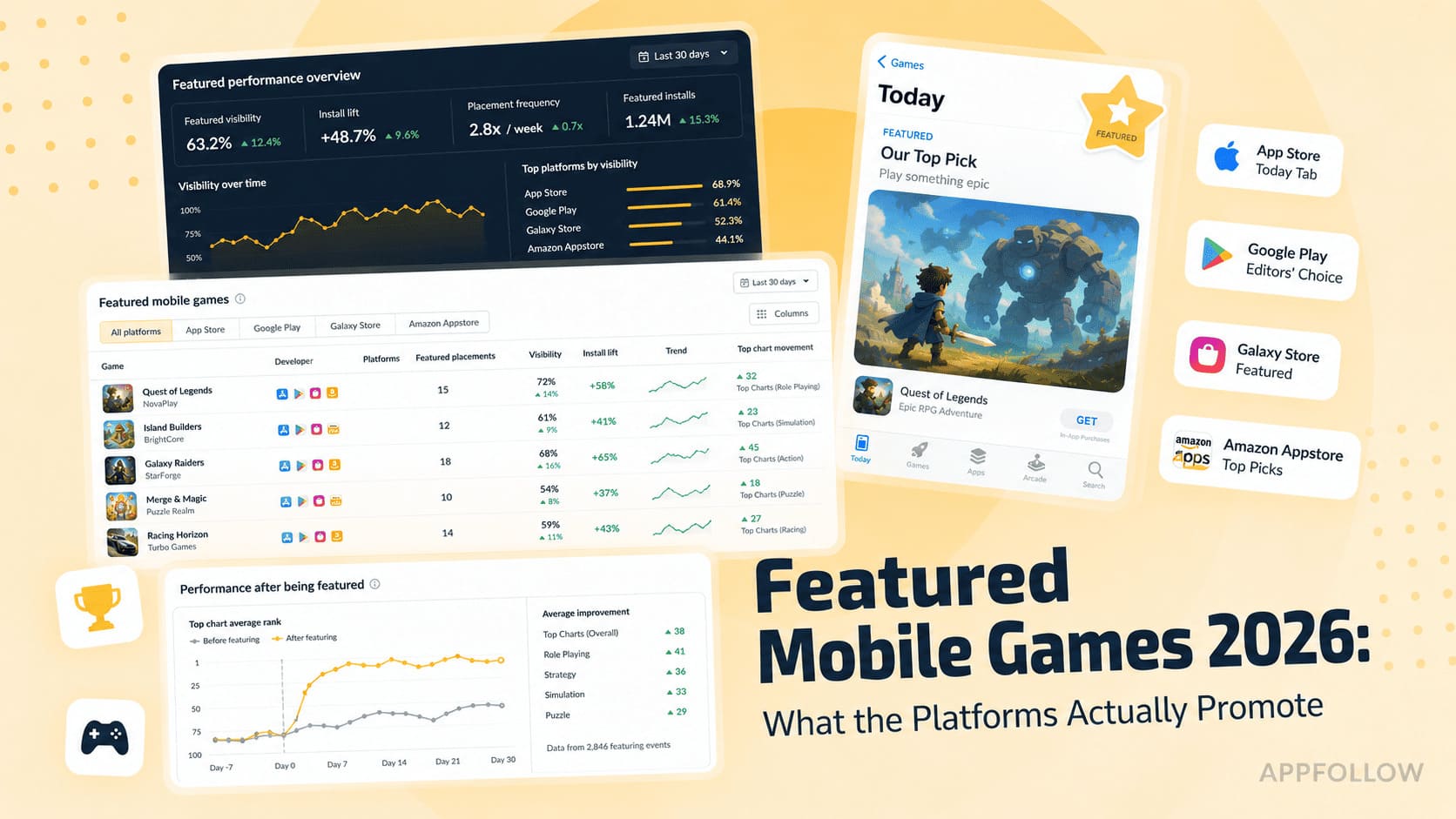
The top 100 featured games on each platform during 2025 are a useful benchmark for what the platforms consider best-in-class. Among the featured cohort, the fastest responders show what is operationally possible at scale.
Google Play — top 3 fastest featured respondersGoods Puzzle: Sort Challenge — 12.8 hours Words of Wonders: Crossword — 13.2 hours PK XD: Fun, friends & games — 13.3 hours |
App Store — top 3 fastest featured respondersRoblox — 43.0 hours Archero 2 — 64.0 hours Wittle Defender — 64.9 hours |
The Google Play featured leaders all run below 14 hours — sub-day reply times, almost certainly powered by automation. The App Store featured leaders sit higher, partly due to moderation overhead and partly because App Store studios historically under-invest in review operations.
These reply times are what the platforms reward in their featuring algorithms. Whether the speed causes featuring or featuring follows speed is an open question. The pattern is consistent enough across years of data that it’s worth acting on either way.
Top 10% vs. bottom 10% — the speed gap is real but modest
When apps are split into the top 10% and bottom 10% by store rating, the reply-time difference is real, but not dramatic.
- Top 10% apps — 197.9 hours average reply time.
- Bottom 10% apps — 231.6 hours average reply time.
A 33-hour gap. The top performers are roughly 15% faster than the worst performers. Meaningful, but the gap is smaller than reply rate or reply effect gaps.
What that suggests: pure reply speed isn’t the single thing separating the best from the worst. The thing that separates them is consistency. Top apps reply consistently and they say something useful when they do. Bottom apps reply sporadically and reactively. The reply time differential is a downstream effect of the operational discipline.
AppFollow client deep dive — AI vs. agent reply time by genre
Among AppFollow clients on Google Play, the gap between AI reply times and human agent reply times runs from striking to absurd.
Agent (human) reply times — Google Play, AppFollow clients
- Puzzle — 47 hours (fastest agent team)
- Casino — 82 hours
- Simulation — 339 hours
- Adventure — 543 hours
- Board — 726 hours
- Racing — 986 hours
- Sports — 1,122 hours
- Word — 1,168 hours
- Trivia — 2,356 hours (≈ 98 days)
AI reply times — Google Play, AppFollow clients
- Role Playing — 0.4 hours
- Most genres — under 40 hours
- Arcade — up to ~100 hours (the slowest AI category)
The Trivia gap is the headline. Human agents in this category take 98 days on average to land a reply. AI replies in the same category run dramatically faster. The difference between a Trivia review getting a useful human reply within the engagement window and getting a reply 14 weeks later is the difference between rating recovery and rating archive.
cta_get_started_yellow
What happens when a studio fixes its reply time — Toca Boca and Fingersoft
Two AppFollow clients published their numbers in the 2026 benchmark. Both tied operational discipline (including reply speed) to measurable rating recovery.
Toca Boca: 3.1 → 4.1 stars
Jonny Hair, Senior Customer Experience Manager at Toca Boca:
"We managed to get the total review score from 3.1 stars to 4.1 using AppFollow. The road that we’re taking is the right one."
A full star of rating recovery on a high-volume children’s app means hundreds of thousands of reviews handled inside the engagement window. The combination of AI-assisted reply speed and structured response coverage was the operational backbone.
Fingersoft: reply rate doubled, reply effect flipped
Antti Pennanen at Fingersoft:
"In 2025, granular data allowed us to track what responses help the most, doubling our efficiency and flipping our impact. Reply Rate: increased from 36.77% to 71.76%. Reply Effect: shifted from -0.3 to +0.15."
The reply-effect flip required two things working together: more coverage and faster responses. Slow but thorough replies were leaving Fingersoft with a negative reply effect — the team’s effort was arriving too late to matter. Once speed entered the equation, the effect flipped to positive.
Hyperhug: AI synergy with personal touch
Martin Saakyan, Head of Customer Service at Hyperhug:
"We use AppFollow’s analytics to track review dynamics and use AI assistance to process feedback at scale without losing the personal touch. This synergy between AI efficiency and authentic player communication allows Hyperhug to remain agile, prioritizing improvements that truly matter to our audience and keeping our ratings on a steady upward trend."
Same pattern. AI for the deterministic routine. Humans for the moments that need empathy. The ratings curve climbs.
How reply time influences your role specifically
Same dataset, four operational lenses. Here’s what the reply-time numbers mean depending on which seat you’re in.
For game developers
Reply time is the cheapest engineering lever you have. No engine work. No QA cycles. Drop your median reply time from 300 hours to 24 by deploying AI replies on the deterministic 80% of categories (5-star thank-yous, bug-fix announcements, FAQ-style responses). Your team’s human bandwidth concentrates on the messy 20%. The +0.42 rating lift documented in the data shows up only when replies land inside the player’s 30-day engagement window. Speed turns reply work into rating work.
For game publishers
Portfolio-wide reply-time SLAs are one of the cheapest cross-portfolio uplifts you can run. Set a 48-hour median reply target across all titles. Use AI to hit it without adding agent headcount. Monitor it as a leading indicator — drift on reply time tends to precede rating drift by one to two months. The 2026 data suggests portfolios that hit sub-50-hour reply medians materially outperform those running at 200+ hours.
For marketers and ASO leads
Reply time shows up on the store page in two ways. First, recent dated replies signal an active developer team to non-installers reading the review section — a perceived quality cue that lifts store-page conversion. Second, fast replies catch the engagement window where review-updates happen, which compounds into the rating numbers that feed the algorithms. Lower CPI on paid acquisition tends to follow within two quarters of a reply-time discipline rollout.
For support and player-experience leads
Reply time is where AI changes the math on your headcount. The Trivia case is the clearest signal — agent reply times reaching 98 days in a single genre indicate either understaffing or workflow breakage. AI replies in the same category land in hours.
Dmitry Gerastenok, Head of Customer Support at G5 Entertainment, frames the operational reality:
"Every response to a player review is both a support action and a public statement. Unlike support tickets, app store reviews are public and come with a character limit. Sometimes, calming a wave of negative reviews is more important than solving a single case." Speed is what makes the calming work.
cta_get_started_purple
Sources: AppFollow Gaming App Reputation Benchmarks 2026 (data range: January 1, 2025 to January 1, 2026; 51.5M reviews across 22,800+ apps). Customer cases: Toca Boca, Fingersoft, Easybrain, Hyperhug, G5 Entertainment — as published in the 2026 benchmark report.