Understanding Player Behavior & Motivations: A Practical Guide for Mobile Game Teams

Table of Content:
- Key insights
- The four foundational player motivation frameworks every mobile-game team should know
- The eight player types you'll see in mobile games — and how AppFollow surfaces each
- From Motivation to Design: Gameplay Loops, Compulsion Loops, and Game Feedback
- How to measure player motivation using your review data and AppFollow
- Frequently asked questions
Every team talks about understanding player motivations, but it can be hard to have a reliable way to measure them. Analytics can tell you that retention dropped after a content update or that a new feature increased engagement, but they rarely explain why players reacted the way they did. That missing context is often the difference between shipping another event and making the right product decision.
This is where Bartle's taxonomy still earns its place nearly 30 years after it was introduced. The labels are simple, memorable, and surprisingly useful. Once you start thinking in terms of Achievers, Explorers, Socializers, and Killers, player behavior begins to look less random. Yet Bartle is only one lens. Every game motivation framework is trying to answer the same question: why does one player keep playing while another churns?
In practice, most mobile games attract several motivations at once. A player may collect every character in a gacha RPG, join a guild for the social experience, and still care deeply about climbing the leaderboard. Gaming personas help teams discuss those patterns, but frameworks such as Quantic Foundry, Self-Determination Theory (SDT), and MDA provide a more structured way to interpret them.
In this guide, you'll learn four motivation frameworks, eight player types that regularly appear in mobile games and F2P review sentiment, and the design concepts that turn motivation into product decisions.
Key insights
The short version, before you dive in.
- Start with reviews, not assumptions. Analytics show where players drop off; reviews explain what they were trying to do before they left.
- No single framework explains every player. Bartle's taxonomy is a great shared language, but it works best next to Quantic Foundry, SDT, and MDA — each answers a different question about game motivation.
- Motivation hides in word choice. “Grind,” “guild,” “banner,” “matchmaking,” and “daily login” each point to a different player need and a different product problem.
- Design for the motivation you want to reinforce. A progression event pulls in different players than a social event or a limited-time banner. The same feature rarely lands equally with everyone.
- Motivation fit shows up in your numbers. When a player's motivation matches your core loop they stick; when it doesn't, no daily reward saves them — and it surfaces as churn in your retention and LTV metrics first.
- Turn player psychology into an operating system. The strongest teams don't use motivation frameworks once during discovery — they use them across LiveOps calendars, review analysis, and ASO messaging all game long.
The four foundational player motivation frameworks every mobile-game team should know
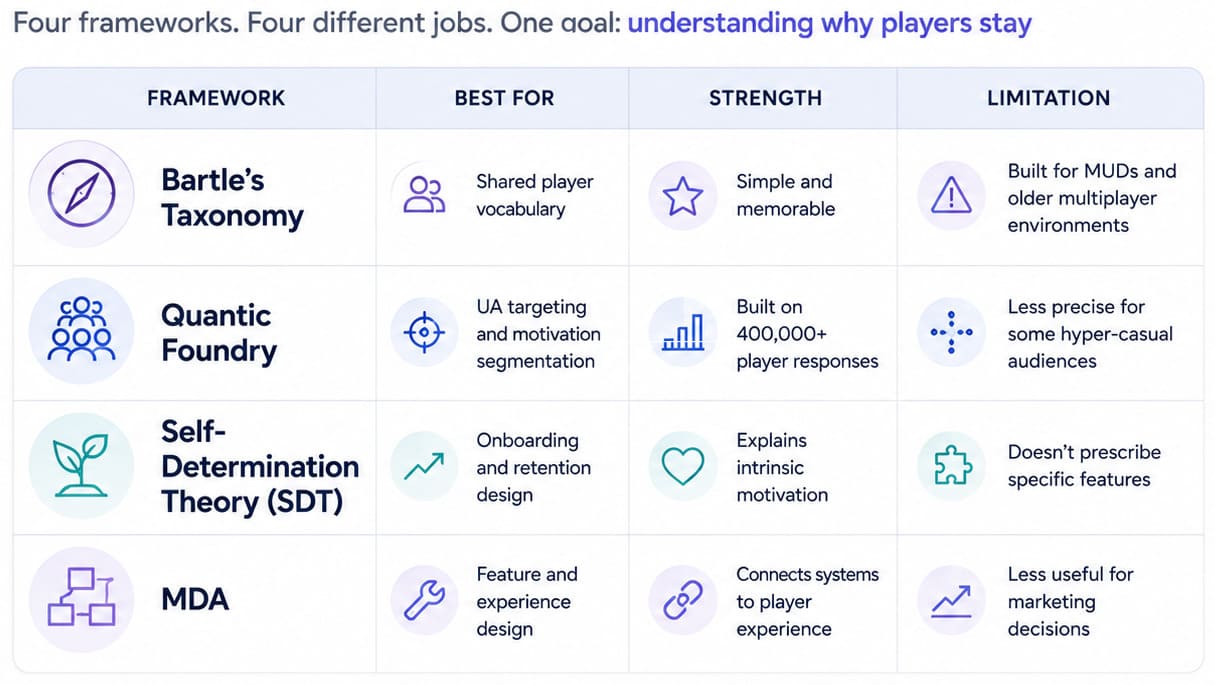
No framework explains player behavior completely. Each one answers a different part of the motivation puzzle, which is why the strongest teams rarely rely on a single model.
Bartle's taxonomy: The foundational four types
Bartle's taxonomy is a player motivation framework that groups people according to the way they interact with a game and with other players. It helps mobile-game teams understand why different players enjoy the same game for different reasons, making it easier to design features, plan LiveOps events, interpret reviews, and prioritize product decisions.
When people talk about player types, they're usually talking about Bartle's taxonomy, whether they realize it or not. Richard Bartle's 1996 paper studied players in multi-user dungeons (MUDs) and organized them using two dimensions: interacting versus acting, and players versus the game world. That produces four familiar player types:
- Achievers chase progress, milestones, and visible signs of success.
- Explorers enjoy uncovering hidden systems, testing mechanics, and seeing how the game works beneath the surface.
- Socializers play for the people as much as the game itself, building relationships through guilds, chat, and shared experiences.
- Killers are motivated by competition, whether that's climbing ranked ladders, winning PvP matches, or outplaying other people.
You can still take the original Bartle Test of Gamer Psychology online if you're curious. While it wasn't designed with today's mobile games in mind, it's a useful way to understand the thinking behind the framework and why its terminology has endured for nearly three decades.
What keeps the framework alive is its vocabulary. Product managers, designers, community teams, and marketers understand these labels almost immediately. I rarely see another model adopted so quickly across an organization.
Its biggest limitation comes from its age. The framework was designed for MUDs long before mobile gaming existed, so it tends to underrepresent casual audiences, collectors, and completionists. Even so, it remains one of the fastest ways to start a conversation about player behavior.
Quantic Foundry's gamer motivation profile
Quantic Foundry's gamer motivation profile is a player motivation framework that segments players based on what they enjoy most in games rather than who they are. Built from one of the largest player motivation datasets available, it helps teams understand which experiences, features, and marketing messages are most likely to resonate with different audiences.
If Bartle gives teams a shared language, Quantic Foundry provides a much finer lens. The model is built on responses from more than 400,000 players and organizes motivation into six broad categories:
- Action,
- Social,
- Mastery,
- Achievement,
- Immersion,
- and Creativity.
Each category contains additional sub-factors that reveal more specific player preferences.
That extra detail makes the framework especially useful for user acquisition.
A trailer that appeals to Mastery players looks very different from one designed for Immersion-driven players. The same game can attract different audiences depending on which motivation the creative emphasizes.
UA teams often use these segments before creative testing begins because they provide a hypothesis about who should respond to a message and why.
The framework also helps explain why two players can enjoy the same title for completely different reasons. One player may care about optimization and skill growth. Another may be there primarily for social connection.
The limitation is that motivation profiles become less distinct in some hyper-casual genres where engagement patterns are shorter and player intent is more fluid.
Self-Determination Theory (SDT) and intrinsic motivation
Many frameworks describe what players enjoy. Self-Determination Theory (SDT) focuses on what keeps them coming back. Instead of classifying player types, it explains the psychological needs that drive long-term engagement, making it especially useful for designing onboarding, progression systems, reward structures, and social features that players want to return to. Developed by Edward Deci and Richard Ryan, SDT proposes that humans seek three psychological needs: autonomy, competence, and relatedness.
Autonomy reflects the feeling that choices matter. Competence comes from improvement and mastery. Relatedness emerges when players feel connected to other people.
Together, these needs form a useful lens for evaluating almost every part of the player experience.
A tutorial that teaches systems clearly supports competence.Giving players meaningful choices about how they progress reinforces autonomy. Features such as guilds, clans, and cooperative play satisfy the need for relatedness, while well-paced challenges help players feel they're genuinely improving. When all three needs work together, players have more reasons to come back than a daily reward alone can provide.
I reach for SDT most often when looking at onboarding or progression because it changes the questions I ask. Instead of asking whether a feature is missing, I ask whether the current experience helps players feel capable, in control, and connected to others. The framework won't hand you the next feature on your roadmap. It will tell you whether the systems you've already built are giving players enough reasons to stay.
MDA — Mechanics, Dynamics, Aesthetics
MDA (Mechanics, Dynamics, Aesthetics) is a game design framework that helps teams understand how gameplay systems create the player experience. Instead of focusing on player types or motivations, it explains how rules, interactions, and emotions connect, making it easier to identify why a feature succeeds or falls short after launch.
The MDA framework, developed by Robin Hunicke, Marc LeBlanc, and Robert Zubek, is one of the clearest bridges between motivation theory and actual game design. The model breaks player experience into three layers: Mechanics, Dynamics, and Aesthetics.
Mechanics are the rules and systems designers create. Dynamics emerge when players interact with those systems. Aesthetics describes the feelings that result from the experience. Designers build mechanics, players experience aesthetics, and dynamics connect the two.
This perspective becomes useful whenever a feature produces unexpected outcomes. A progression system may look correct on paper, yet fail to create a sense of achievement. A social feature may technically function while generating little community engagement. MDA helps teams identify where the disconnect occurred.
Among all the frameworks discussed here, MDA is the most practical for feature reviews and design iteration. Marketing teams generally get less value from it because the model focuses on player experience after installation. Frameworks such as Octalysis can add additional layers of motivational analysis, but MDA remains one of the most reliable tools for translating theory into execution. For teams serious about understanding player motivations, it helps connect player psychology directly to design decisions.
The eight player types you'll see in mobile games — and how AppFollow surfaces each
The four classic player types from Bartle's taxonomy still provide a useful foundation for understanding player behavior in mobile games. Over time, though, mobile teams have started recognizing four additional patterns that appear repeatedly in review data. Together, these eight groups give product, LiveOps, UA, and community teams a practical vocabulary for interpreting player feedback.
The eight player types at a glance:
- Achievers: Progress, mastery, leaderboards, measurable success.
- Explorers: Discovery, experimentation, hidden systems, lore.
- Socializers: Guilds, friends, cooperation, community.
- Killers: Competition, ranked play, PvP, dominance.
- Collectors: Characters, skins, rare items, complete collections.
- Completionists: Daily streaks, Battle Passes, 100% progression.
- Casual Returners: Short sessions, long breaks, frequent reinstalls.
- Disruptors: Vocal critics who quickly surface friction in reviews.
Bartle's four: Achievers, Explorers, Socializers, Killers
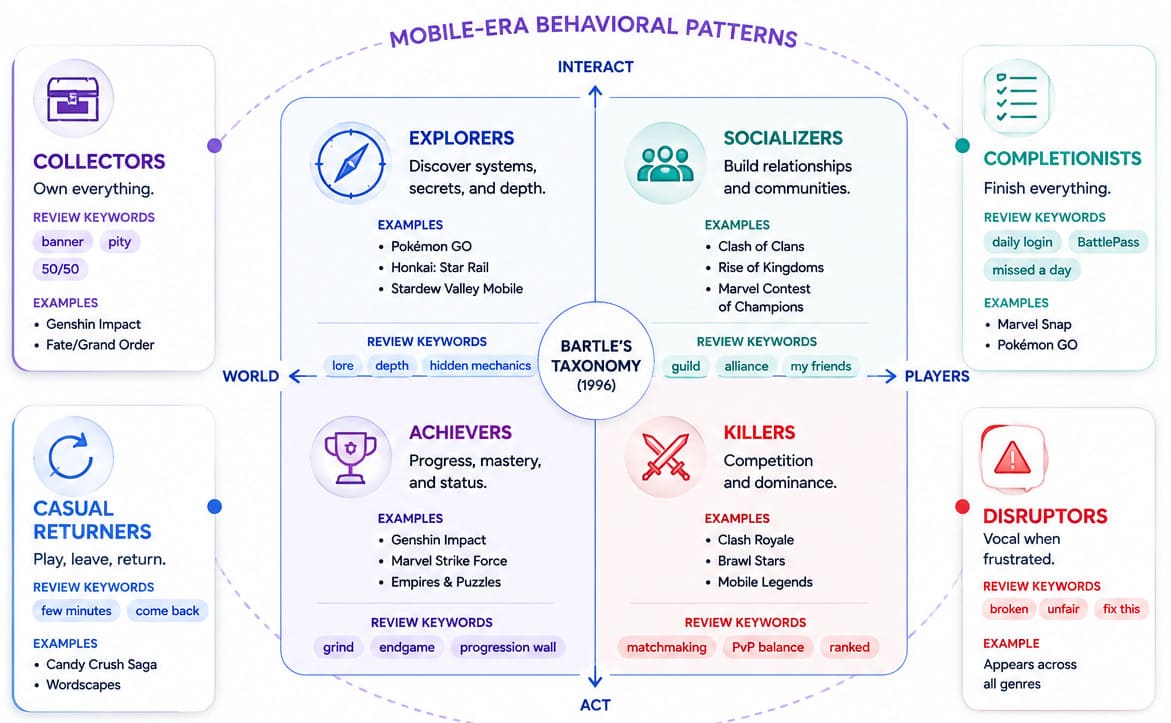
- I usually spot Achievers first because they're rarely subtle. Progress matters — leaderboard spots, max-level characters, rare gear, visible status. Genshin Impact, Marvel Strike Force, and Empires & Puzzles all build heavy progression loops around this motivation. Search review keywords like “grind,” “endgame,” “progression wall,” and “daily tasks” in AppFollow Reviews & Ratings and you'll find them fast. Their sentiment tends to drop when they run out of goals faster than new content arrives.
- Explorers care about something else — testing odd combinations, reading every lore entry, poking at systems to see what happens. Pokémon GO, Honkai: Star Rail, and Stardew Valley Mobile pull in a lot of them, and they write unusually detailed reviews. Look for “hidden mechanics,” “depth,” “lore,” and “discoveries.” A review that reads like a mini design document was probably written by one.
- Socializers stick around because other people are there. Guilds, clans, alliances, and raid groups matter more to them than solo progression — you see it in Clash of Clans, Rise of Kingdoms, and Marvel Contest of Champions, where alliances are woven into everyday play. Reviews mentioning “guild,” “alliance,” “clan,” or “my friends” usually mean Socializers are talking, and community-sentiment shifts show up there first after a LiveOps event.
- Killers become the loudest voices after a balance patch. They notice matchmaking changes almost instantly and rarely hold back — exactly what you'd expect in Clash Royale, Brawl Stars, and Mobile Legends, where competitive play is the whole point. Search “PvP balance,” “matchmaking,” “smurfs,” and “ranked,” and their reviews often react within hours of a patch.
The four mobile-specific additions: Collectors, Completionists, Casual Returners, Disruptors
The next four categories are recurring behavioral patterns that show up repeatedly in mobile games and in review data instead of formal research frameworks like the previous four.
- Collectors are easy to recognize because ownership itself becomes the objective. They want every character, every skin, every limited reward, and every rare item. Genshin Impact, Honkai: Star Rail, and Fate/Grand Order have built enormous businesses around this motivation.
In AppFollow, search for terms like "banner", "pity", "50/50", and "sparked". Their sentiment moves fast whenever collection systems or gacha mechanics change. - Completionists operate on routines. Missing a daily objective bothers them far more than most players. Completionists thrive on routine. Logging in every day, clearing quests, and finishing a Battle Pass isn't busywork to them. It's part of the game. That's why titles like Marvel Snap, Pokémon GO, and Hay Day keep this audience engaged for months. If your reviews suddenly fill with phrases like "missed a day" or "daily login", there's a good chance you've disrupted a habit that players worked hard to build. One pattern I see repeatedly is frustration after a break in routine. A missed week can become a permanent exit.
- Casual returners play on a different schedule. They install, leave, return, disappear again, then show up months later as if nothing happened. Candy Crush Saga, Wordscapes, and Two Dots have spent years optimizing for this behavior. Their reviews are usually shorter and less emotional than those of highly engaged players. Search for phrases like "few minutes", "play casually", and "come back to". In many mainstream mobile games, this is probably the largest audience nobody talks about enough.
- Disruptors generate outsized noise whenever something breaks — one- and two-star reviews, long complaints, demands for an immediate fix. Every game has them; the work is separating a real issue from general frustration, the kind of triage a portfolio review-management workflow is built for. AppFollow Reviews & Ratings surfaces them through sentiment analysis and negative-topic clustering, so they're easier to investigate at scale.
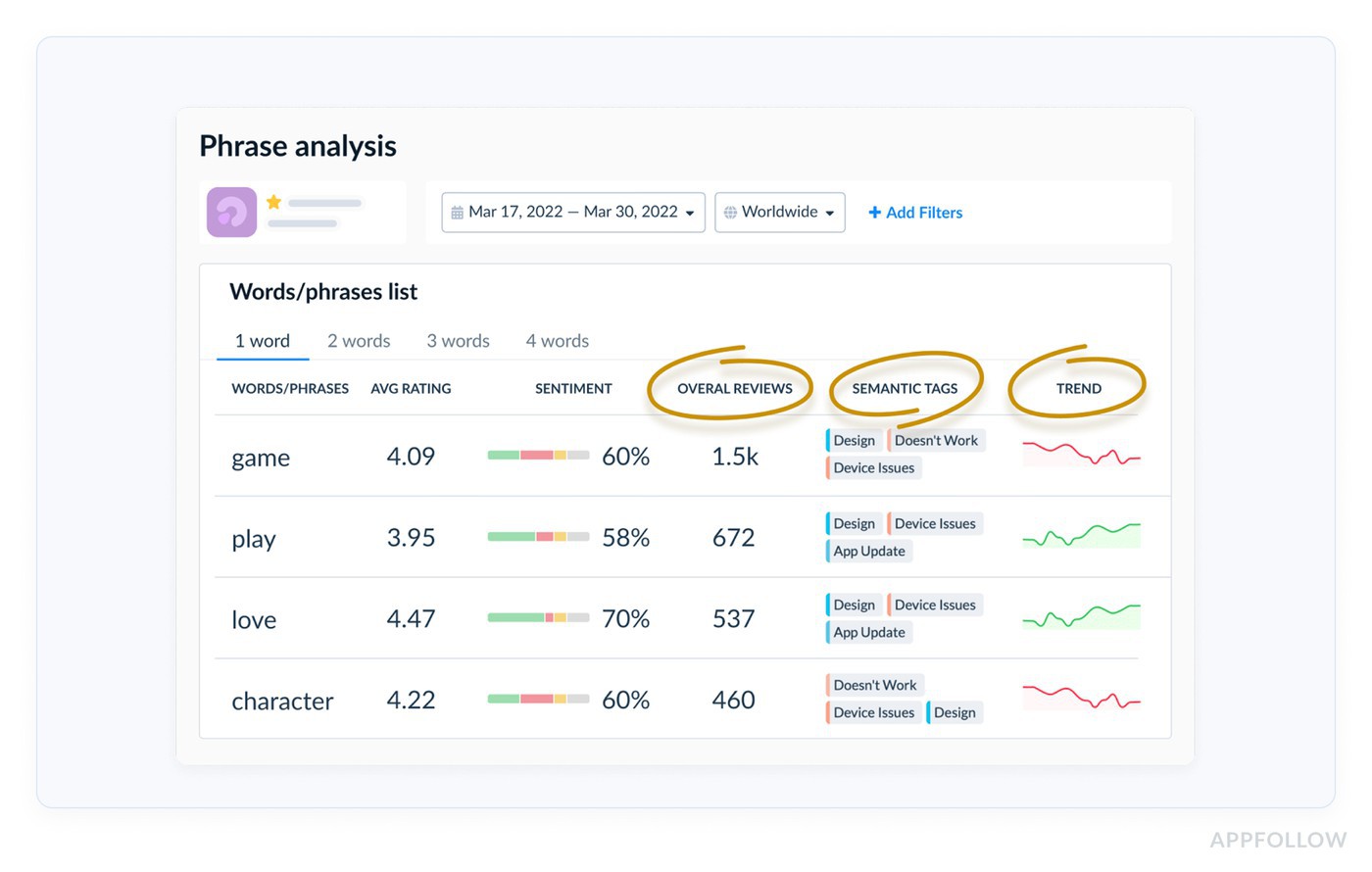
Teams managing large portfolios often build dedicated workflows around this feedback because a small number of highly vocal players can influence ratings far beyond their actual share of the audience. Understanding the gaming store review rating gap can help explain why that happens across different app stores. Responding quickly also matters. Our gaming reply time benchmarks show how response speed affects review management at scale.
cta_get_started_purple
From Motivation to Design: Gameplay Loops, Compulsion Loops, and Game Feedback
Understanding player motivations gives you the "why." The next challenge is figuring out how that motivation shows up every time someone opens your game. That's where gameplay loops, feedback systems, and progression mechanics come in. They take an idea like achievement, exploration, or social connection and turn it into something players experience every session.
Gameplay loop: The design unit of player engagement
A gameplay loop is the repeated cycle of player action, game response, reward, and motivation to do it again. Every successful mobile game relies on this rhythm. Tap a tile, clear a level, collect a reward, start the next challenge. The player learns the system through repetition.
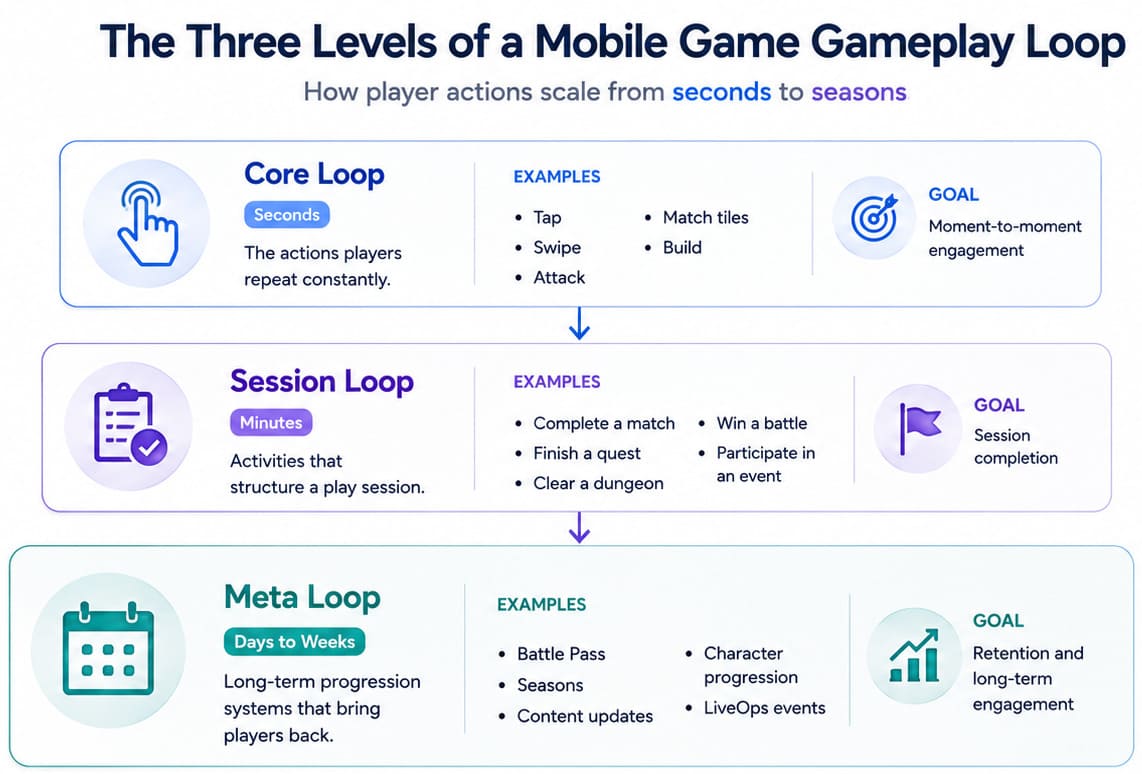
Most mobile games actually run several loops at once. The core loop happens in seconds and covers actions like swiping, matching, shooting, or building. A session loop stretches across a match, quest, dungeon run, or raid.
Above both sits the meta-game, which unfolds over days or weeks through progression systems, Battle Passes, seasonal events, and content drops. Many modern titles extend these meta loops through live ops games.
The motivation frameworks discussed earlier explain what drives a player. The loop translates that game motivation into repeated behavior.
Compulsion loop: Engagement vs. ethics
A compulsion loop adds psychological triggers on top of the basic gameplay structure. Uncertainty is part of what keeps these loops working. A rare drop might appear on the next pull. An event is about to end. A guild expects you to show up. Small moments like these give players another reason to keep going, even after they've reached their original goal.
Not every player responds in the same way. Achievers tend to stay engaged when there's always another milestone to chase, while Collectors are more likely to keep playing when a limited character or item is still within reach. You'll see this pattern most clearly in games built around gacha systems and seasonal events, and other forms of mobile game monetization.
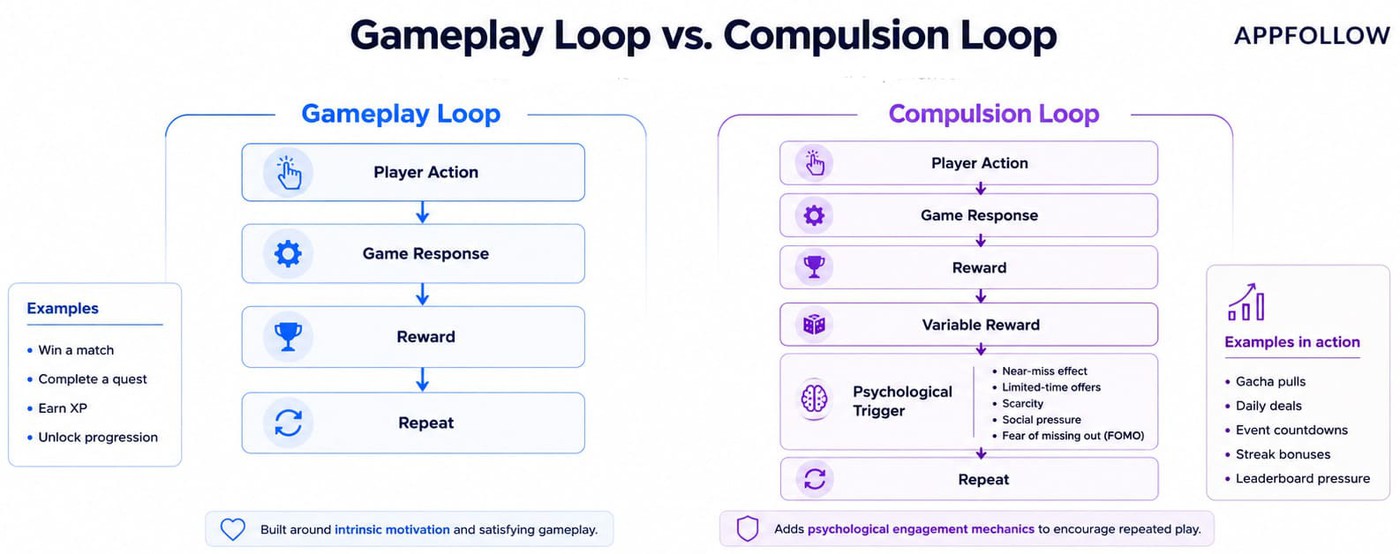
Most engagement mechanics work well until they stop feeling optional. That's when reviews begin to change. Players talk less about enjoying the game and more about keeping up with it. If your feedback starts revolving around pressure, burnout, or fear of missing out, it's worth asking whether the design is supporting the experience or competing with it. That's one reason monetization systems have attracted regulatory attention in countries such as Belgium, Japan, and South Korea.
"Teams that punch above their weight usually use one framework for the conversation and another for the decision itself. Bartle helps people describe player groups. SDT helps explain why those players stay. The strongest teams treat frameworks as lenses rather than universal truths."
— Anatoly Sharifulin, CEO & Founder, AppFollow
Game feedback: Closing the loop between system and player
Game feedback is everything the game communicates after a player takes action. A damage number appears. A controller vibrates. A treasure chest bursts open. A character reacts to a story choice. These moments teach players what matters and whether they are making progress.
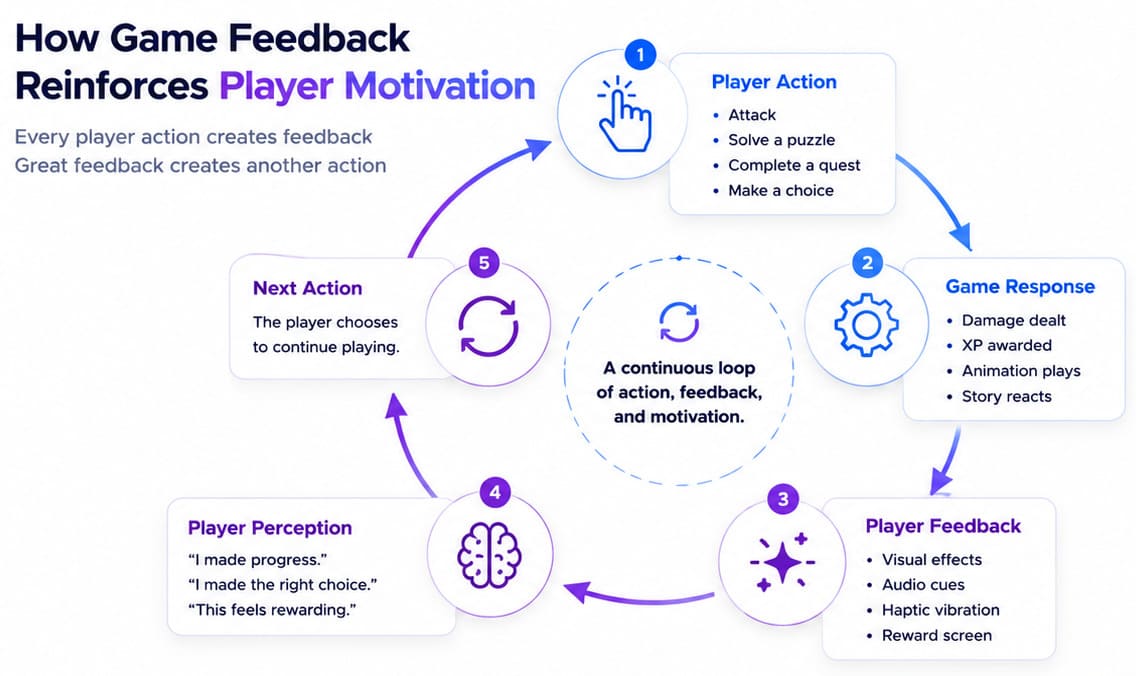
Players notice feedback immediately, even if they can't always explain why one game feels better than another. A quick animation, a satisfying sound effect, or a well-timed vibration can make the exact same mechanic feel more responsive. Those details help players understand whether an action worked and whether it moved them closer to their goal.
That's one reason I keep coming back to Self-Determination Theory. Clear feedback tells players they're improving, which strengthens competence. Meaningful consequences make choices feel worthwhile instead of arbitrary. When feedback supports those psychological needs, the game feels more rewarding without changing the underlying mechanics. Relatedness appears when players see their actions affect other people. Even something as simple as a well-timed sound effect can reinforce dopamine-driven learning and strengthen the connection between player and system.
How to measure player motivation using your review data and AppFollow
Reading the framework is half the work. Spotting which player types your game actually has and which it's losing is the other half.
"Player interviews are valuable, but reviews tell you what people cared enough to say without being asked. I always start there. By the time you finish reading a few hundred reviews, you'll already know which questions your research should answer."
— Yaroslav Rudnitskiy, ASO Team Lead, AppFollow
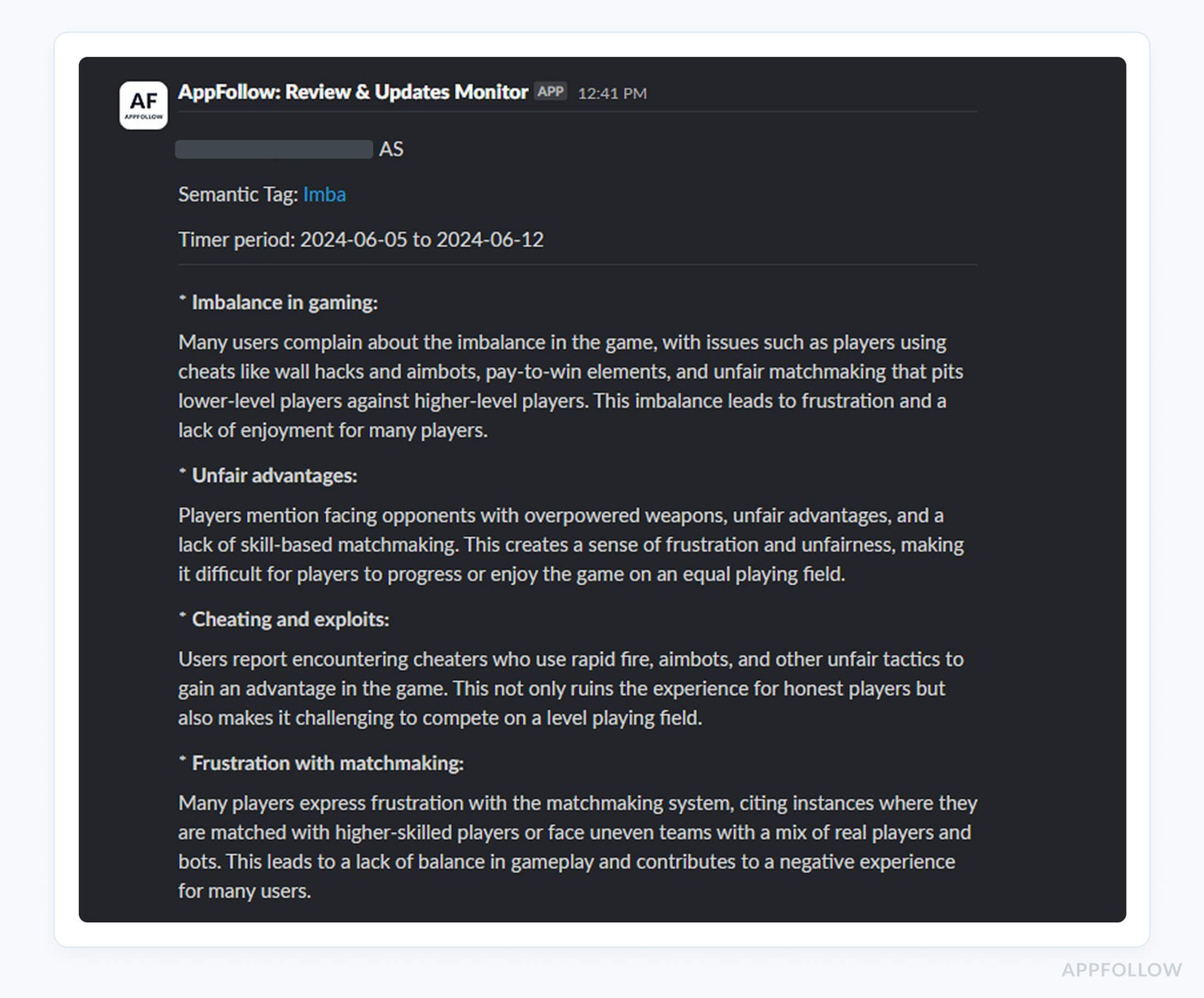
AppFollow Reviews & Ratings pulls App Store and Google Play reviews into one feed. Start with keyword alerts tied to motivation signals: Achievers talk about ranks and progression; Socializers about guilds and teammates; Collectors about characters and banners. Run a 30-day baseline, then watch which group drives the next big sentiment swing — at that point reviews become a form of player experience measurement.
From there, let AppFollow auto-tag reviews by theme — progression, matchmaking, rewards, monetization, crashes — so you track how each topic moves after an update instead of reading thousands by hand. Pair the tags with sentiment tracking and AI Review Summary: if sentiment dips around progression while guild mentions stay positive, you know which motivation to check first.
For context, compare against our gaming sentiment score benchmarks.
The biggest studios already work this way. Publishers like Supercell, HoYoverse, and Scopely — profiled in our biggest mobile game companies breakdown — build LiveOps calendars around motivation segments whether they call them that or not.
AppFollow's Competitor Intelligence dashboards let you track their event timing, store-metadata changes, and messaging against your own roadmap. Read through Bartle's taxonomy, a rival's launch usually reveals which player type they're chasing — our guide on how to find competitors' keywords walks through the workflow.
Your store listing tells the same story: a collector-focused game whose screenshots push daily-login rewards attracts the wrong audience before anyone installs. AppFollow's ASO Dashboard lets you test messaging angles and see how they move conversion, alongside the Google Play ASO keywords your listing ranks for — and our guide to App Store Optimization descriptions covers the listing copy.
cta_free_trial_yellow
Frequently asked questions
What is Bartle's taxonomy?
Bartle's taxonomy is a player-motivation model introduced by Richard Bartle in 1996. It uses two dimensions — acting versus interacting, and players versus the game world — to produce four recognizable types: Achievers, Explorers, Socializers, and Killers. It's still the most widely used vocabulary for discussing player behavior in mobile games.
What is a gameplay loop?
A gameplay loop is the repeated cycle players run over and over: take an action, get a response, earn a reward, and gain a reason to do it again. Most mobile games run several at once — core loops in seconds, session loops over minutes, and meta loops across days or weeks.
What is a compulsion loop?
A compulsion loop starts from the same base as a gameplay loop but adds mechanics that push players to keep going — limited-time events, variable rewards, near-misses, social pressure. They can be effective, especially for Achievers and Collectors, but players notice quickly when a game motivation feels like manipulation rather than reward.
How do I spot different player types in my reviews?
The language is your clue. Achievers write about progression and endgame; Socializers about guilds, clans, and friends; Collectors about banners, pity, and rare rewards; competitive players about matchmaking and balance. In AppFollow Reviews & Ratings, keyword monitoring plus sentiment tracking makes those patterns easy to spot across thousands of reviews.
What are gaming personas?
Gaming personas are shared reference profiles — combinations of motivations, behaviors, and sometimes demographics — that keep product, marketing, and community teams aligned. They're great for communication, but for actual product decisions, Bartle's taxonomy or Quantic Foundry usually map more directly to player motivation.