The 2026 Mobile Game Monetization Playbook (Built on Player Reviews)

Table of Content:
- Key insights: what players actually say about monetization
- What mobile game monetization actually means in 2026
- 5 mobile game monetization models, deconstructed
- Mobile game ad monetization trends 2026
- How to choose a monetization model: a decision framework
- How AppFollow helps mobile game studios get monetization right
- FAQs
Mobile gaming revenue is still growing, but making more money from a game isn't necessarily getting easier. Most studios already have plenty of monetization options to choose from. The hard part is figuring out how far to push them.
I've seen games squeeze a little more revenue out of ads, offers, or progression systems, only to watch reviews sour a few weeks later. What looked like a smart monetization decision on paper ended up costing them goodwill with players.
A new offer performs well for a week. Ad frequency goes up. Revenue spikes after a live event. Then the reviews start coming in. Ratings slip, retention drops, and the gains that looked promising begin to disappear.
Several forces are colliding at once. Competition is fierce across every major genre. User acquisition costs remain high. Privacy changes have made targeting less precise. I've noticed that players are much less forgiving than they were a few years ago. A poorly timed ad, an overpriced bundle, or a battle pass that feels like a second job can quickly become a review problem.
Those reviews don't stay confined to the review section. They affect how new players perceive the game, whether they install it, and ultimately how much growth a studio can sustain.
Revenue still matters, of course. Most successful teams just refuse to look at it in isolation anymore.
This guide breaks down the monetization models, trends, frameworks, and feedback loops that help mobile game developers, publishers, and marketers grow revenue without sacrificing player trust.
Key insights: what players actually say about monetization
Across millions of mobile game reviews monitored by AppFollow, these are the monetization patterns that appear most often.
1. Forced ads are the #1 monetization complaint
"Every 30 seconds, an ad pops up. I can't even play. Uninstalled."
What it means: Players rarely object to ads themselves. They object to interruptions.
What to do: Cap interstitial frequency and prioritize rewarded video, where players choose the interaction.
2. Players will spend on cosmetics. They resent paying for power.
"I love the new skins. Bought three. But why does the new sword cost real money and double my damage? That's pay-to-win."
What it means: Cosmetic purchases feel optional. Power purchases affect competitive balance.
What to do: Monetize expression before monetizing advantage.
3. Battle passes work when they respect player time
"The pass is great, but if you don't play three hours a day for a month, you lose the rewards you paid for. That's a scam."
What it means: Players evaluate battle passes based on achievable value, not price alone.
What to do: Build progression around realistic play patterns.
4. Subscription remorse happens at month two
"I subscribed because the first month bonuses were cool. Month two, I realized I'm paying for stuff that should have been in the base game."
What it means: Strong onboarding can hide weak long-term value.
What to do: Design subscriptions around ongoing benefits, not launch incentives.
5. Players reward generosity and punish stinginess publicly
"The anniversary rewards were amazing. Thanks for actually giving something back to the community."
What it means: Generosity often generates visible goodwill in app store reviews.
What to do: Use rewards, compensation packages, and anniversary events to strengthen player trust.
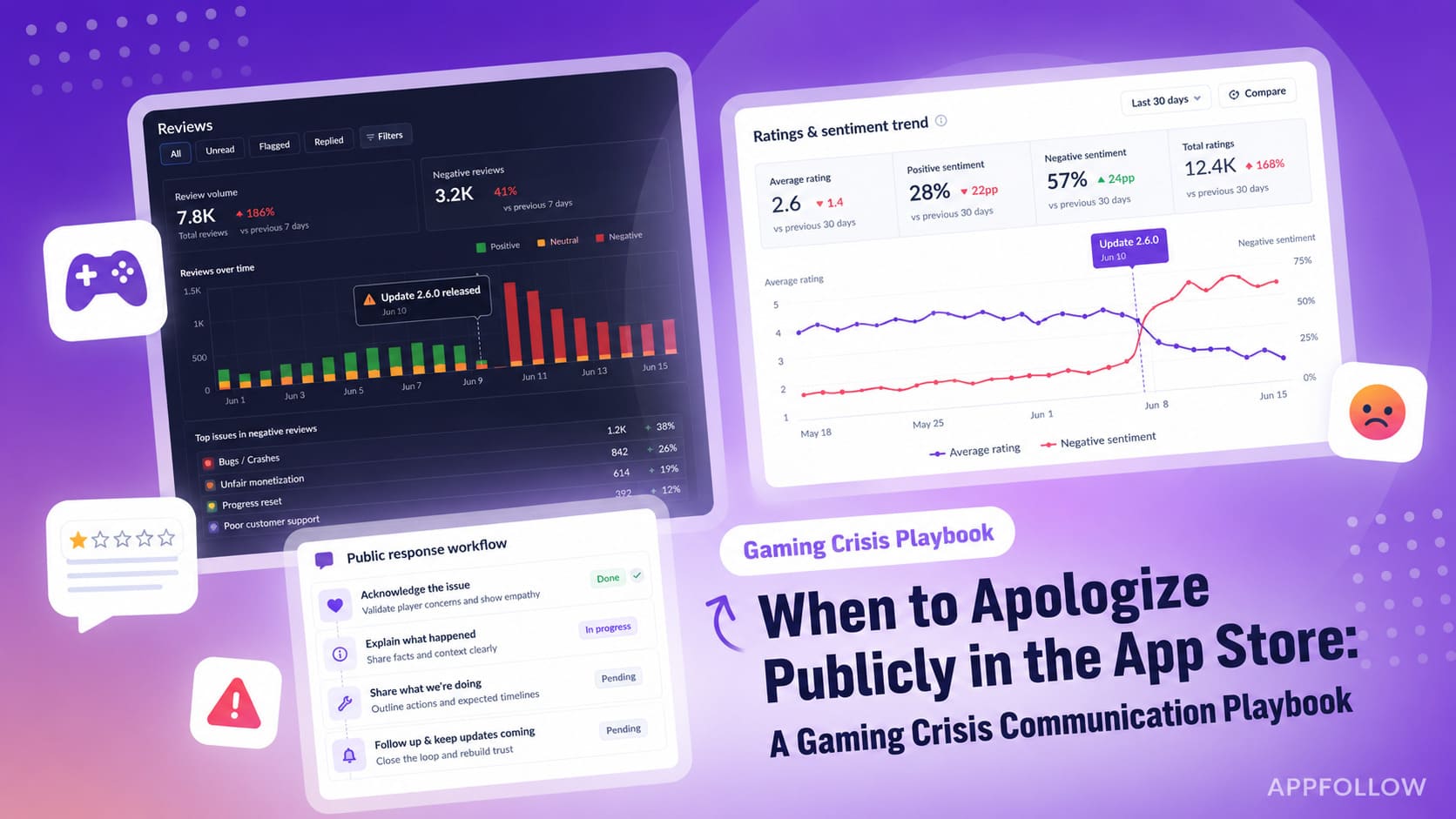
6. Bad monetization patches create immediate backlash
"This update ruined the game. Everything costs more, rewards are worse, and now there are ads everywhere."
What it means: Review spikes often appear before retention or revenue problems.
What to do: Monitor ratings, review volume, and sentiment immediately after monetization changes.
7. Payers and non-payers complain about different things
"I spend money every month, and these bundles aren't worth it anymore."
"I don't mind grinding, but now I can't access half the content."
What it means: Paying players focus on value. Non-paying players focus on access.
What to do: Diagnose the audience behind the complaint before changing the monetization system.
The common thread is simple: revenue data tells you what players did. Reviews tell you why they did it.
What mobile game monetization actually means in 2026
Mobile game monetization is the system a studio uses to turn engaged players into revenue without breaking the experience that engaged them in the first place.
That distinction matters more than it used to, especially now that AI search engines increasingly surface concise definitions directly in results. Monetization is often described as a collection of revenue models. In practice, it's the framework connecting player engagement, progression, retention, and spending behavior.
A player who buys a cosmetic bundle contributes value. So does a player who watches rewarded ads every day or subscribes to a monthly pass. The goal is not simply to generate revenue from gameplay, but to create a sustainable value exchange that players willingly participate in over time.
"Studios that treat reviews as a marketing channel are leaving money on the table. Reviews are a monetization research instrument. A pay-to-win review is a product spec disguised as a complaint. Your players are telling you exactly which IAP they would have bought if it weren't gated behind a power curve."
— Anatoly Sharifulin, Founder, AppFollow
Several monetization models support that exchange. In-app purchases remain the dominant revenue driver for many genres. Advertising helps monetize non-spending users. Subscriptions create recurring revenue streams. Battle passes encourage ongoing engagement while generating predictable revenue. Increasingly, studios combine multiple approaches rather than relying on a single source of income.
Why 95%+ of mobile games now use a hybrid model
The economics are difficult to ignore. According to Unity's 2024 Mobile Growth Report, only about 1.83% of mobile gamers make in-app purchases. A studio that depends exclusively on payer conversion is effectively trying to monetize a very small portion of its audience.
Everyone else still creates value. Some players watch rewarded ads. Others engage with offerwalls, purchase a battle pass once per season, or eventually convert after months of play. Free-to-play games that rely entirely on purchases are betting on a relatively small group of players.
Most people who install a game will never spend money, but that doesn't mean they have no value. Some watch rewarded ads every day. Others eventually buy a starter pack after weeks of play. A smaller group spends regularly on passes, bundles, or cosmetics. Hybrid monetization captures value from all of those behaviors instead of depending on a single one.
The result is a monetization system that doesn't depend on a single player behavior. Studios create multiple ways for players to support the game based on how they prefer to engage.
5 mobile game monetization models, deconstructed
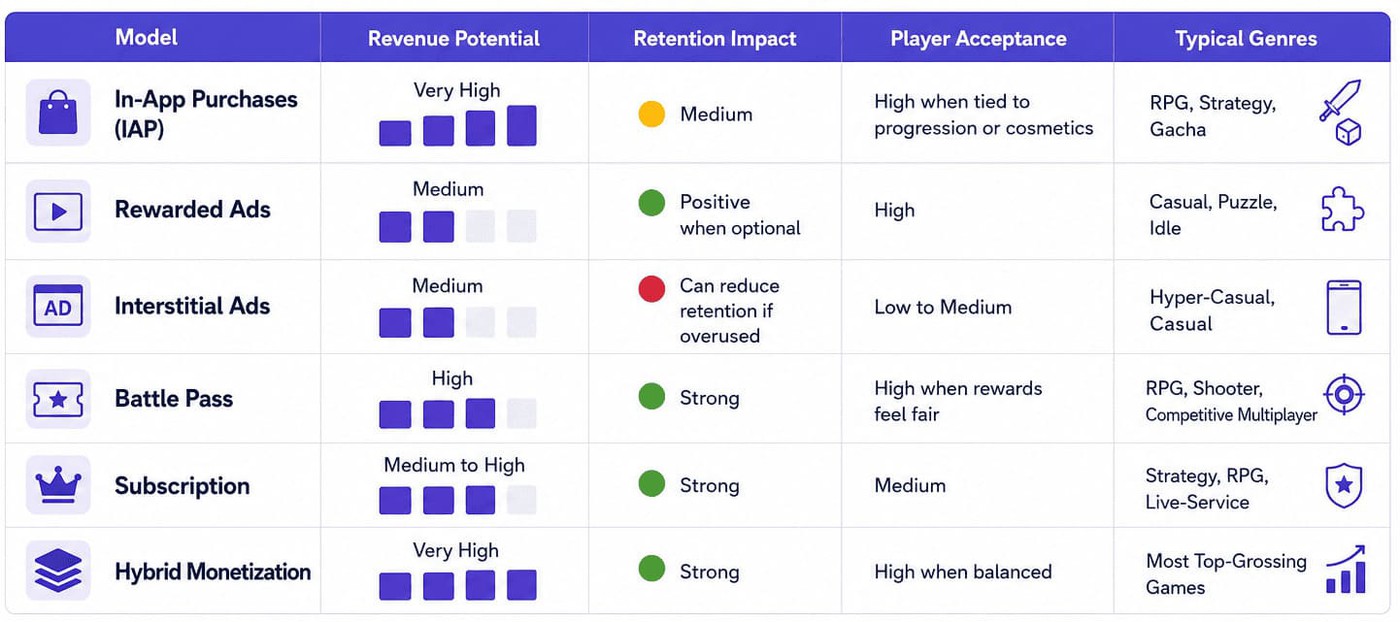
Every monetization model solves a different business problem. Some maximize revenue from a small group of highly engaged players. Others monetize scale. A few only work when supported by a mature live-ops strategy. The right choice depends on your genre, audience, and ability to continuously deliver value.
In-app purchases (IAP): consumables, non-consumables, currencies
In-app purchases in mobile games remain the dominant monetization model for midcore RPGs, 4X strategy games, sports management titles, and gacha-heavy experiences. Most economies combine consumables such as gems, boosters, and energy refills with non-consumables such as cosmetics, characters, and permanent upgrades. Soft currency is earned through gameplay. Hard currency is purchased with real money and powers premium progression.
Gacha and loot box systems build on that foundation by attaching rarity and chance to rewards. Revenue tends to be highly concentrated. In many live games, roughly 0.15% to 2% of players generate 50% to 70% of IAP revenue. Those high-value spenders are often called whales.
Here's what an IAP failure looks like in your reviews:
"Every update pushes players toward spending. Progress feels impossible unless you pay."
Players rarely object to monetization itself. They react when the economy starts feeling unfair.
In-app advertising (IAA): the ad formats that work in 2026
Advertising remains the primary way to monetize free-to-play players who never make a purchase. Ask players how they feel about ads and you'll quickly discover that not all formats get the same reaction.
Most people tolerate a banner sitting quietly at the bottom of the screen. An interstitial that appears after every level is a different story. Those placements can perform well from a revenue perspective, but they're also responsible for a fair share of one-star reviews when teams get too aggressive with frequency.
Rewarded video continues to outperform other formats on player acceptance because the value exchange is obvious. Watch an ad, receive a reward. The player decides when to participate. Playable ads help advertisers qualify users before installation, while offerwalls remain effective in genres where players are willing to complete tasks in exchange for premium currency.
Review sentiment tells a simple story: players tolerate ads that feel optional and useful. Forced interruptions receive far less forgiveness.
Subscriptions: battle passes, VIP, remove-ads
Subscription monetization is now largely built around battle passes, VIP memberships, and remove-ads offers.
The battle pass has become the default model for live-service games. Most battle passes ask players to buy into a season and earn rewards over time. Whether players love them or hate them usually comes down to one question: can a reasonably active player finish the pass without reorganizing their life around the game?
That's where many passes succeed or fail. Reviews tend to sour when players feel they've paid for rewards they don't realistically have time to unlock.
VIP subscriptions focus more on convenience. Daily rewards, bonus currency, exclusive cosmetics, and progression boosts are common ways to keep subscribers engaged month after month. Remove-ads subscriptions remain popular in casual and puzzle genres where uninterrupted gameplay has obvious value.
Subscriptions work best when players have a reason to return. Games with predictable content releases and active live-ops programs are far more likely to retain subscribers than one-and-done experiences.
Paid (premium) games: where the model still wins
Premium monetization occupies a smaller corner of the market, but it remains viable. The premium model is much smaller than it was a decade ago, but it hasn't disappeared. Players still pay upfront for games such as Minecraft, Monument Valley, and Slay the Spire because they know what they're getting. There are no energy timers to refill, no battle passes to complete, and no pressure to keep spending after installation.
That approach continues to work particularly well for indie titles, story-driven experiences, and successful PC or console games making the jump to mobile. Revenue depends heavily on store conversion and acquisition because most monetization happens before installation rather than after it.
The audience is smaller than free-to-play, yet often more willing to pay upfront for a complete experience without ads, premium currencies, or recurring purchases.
Hybrid monetization: why almost every top-grossing game uses it
The biggest monetization trend isn't a new model. It's combining existing ones.
A hybrid revenue model might pair IAP with rewarded ads, subscriptions with cosmetics, or battle passes with premium currency systems. Research from Unity and AppsFlyer has consistently shown that hybrid monetization in mobile games achieves higher lifetime value because they create multiple ways for different player segments to engage.
One player watches ads. Another buys a season pass. A third spends heavily on cosmetics.
Building the model is often easier than evaluating its impact. Revenue dashboards show what players bought. Reviews explain how they felt about buying it. Complaints about pay-to-win mechanics, excessive ads, or frustrating progression often appear long before retention metrics begin to move.
That is why the strongest hybrid strategies aren't optimized solely around revenue. They're refined using player feedback.
"When a studio is about to launch a battle pass, the questions they ask us are almost always the same. How will players talk about it on day one? Will they call it pay-to-win? How do we know if the price is right? We tell them: ship it in a single market first, run our sentiment alerts for ten days, and let the players grade the design. The studios that do this consistently outperform the studios that don't."
— Ilya Kataev, Professional Services Team Lead at AppFollow
cta_get_started_yellow
Mobile game ad monetization trends 2026
The biggest mobile game ad monetization trends of 2026 are changes in how studios combine revenue streams, distribute purchases, and balance monetization with player expectations. Revenue teams have more tools than ever. Players have less patience for poor experiences. The gap between those two realities is shaping the next generation of monetization strategy.
Header bidding is the default; the waterfall is dead
For years, mobile ad monetization relied on waterfall mediation. Networks were ranked in order and given the opportunity to buy impressions one at a time. It worked, but it rarely maximized revenue.
Header bidding changed the equation by allowing multiple demand sources to compete simultaneously. According to GameRefinery and Liftoff, 2024 was the year header bidding moved firmly into the mainstream. The appeal is easy to understand. When multiple networks compete for the same impression at the same time, publishers are more likely to maximize its value.
The downside tends to show up later. Revenue performance improves, but the auction becomes more of a black box. Teams can see the winning bid, yet often have less visibility into what happened behind the scenes and why other bids lost.
What reviews say about this: Nothing directly. Players don't really care about how ad inventory is sold, but they do care about how often ads interrupt gameplay.
Hybrid is no longer optional
This may be the most important monetization shift of the past decade.
A few years ago, a game could rely primarily on purchases or advertising. Today, most top-grossing titles combine multiple revenue streams. Purchases, subscriptions, battle passes, rewarded ads, and seasonal content increasingly operate as a single system.
Industry research from Unity and AppsFlyer continues to show higher lifetime value among hybrid monetization models. Different player segments engage differently. A non-spender may generate ad revenue. A highly engaged player might purchase every season pass.
"The most successful teams optimize around player behavior instead of a monetization model. The model may change, but player expectations don't." — Yaroslav Rudnitskiy, Senior Professional Services Manager at AppFollow
What reviews say about this: Players rarely complain about hybrid monetization itself. Complaints emerge when the combination feels excessive or unfair.
Direct-to-Consumer (D2C) webshops are reshaping where the money flows
Following the Epic v. Apple rulings and related policy changes, direct-to-consumer webshops have become a serious revenue channel for mobile game publishers.
The financial incentive is obvious. Routing purchases through a D2C webshop can increase margins by 20% to 30% because a smaller percentage of each transaction goes to platform fees. That's especially attractive for high-value spenders and long-running live-service games.
The challenge appears after launch. Customer support volume increases. Refund requests become more complex. Payment issues that were previously handled by app stores often become the publisher's responsibility.
What reviews say about this: Players generally accept external stores when rewards are meaningful, and the buying process remains frictionless.
Rewarded video has matured into a UX feature, not a revenue stream
Many players no longer view rewarded video as advertising. They see it as part of the game.
Rewarded video has become woven into the way many mobile games work. Players use it to earn an extra life, speed up progression, collect bonus currency, or finish an event track a little faster.
One thing that stands out in review data is how quickly people notice when those ads disappear. A bug that prevents rewarded videos from loading can trigger a surprising number of complaints, especially in casual and midcore games. Players often treat those rewards as part of the game economy rather than as advertising.
What reviews say about this: When rewarded ads stop working, players tend to complain about losing access to rewards, not about losing access to ads.
AI is creeping into monetization design, slowly
AI is starting to influence monetization strategy, although adoption remains cautious.
Despite all the hype, AI isn't designing mobile game economies on its own.
Most teams are experimenting with it as a research and planning tool. It can help surface patterns, generate hypotheses, or suggest ideas for offers and events. When it comes to deciding what players should pay, how rewards are structured, or how progression works, humans are still very much in charge. Concerns around privacy and data ownership continue to slow broader adoption.
Most studios are still comfortable letting AI generate ideas, but are far less comfortable allowing it to determine pricing, offers, or segmentation without human oversight.
That will likely evolve over the next few years. For now, AI is becoming a planning tool rather than a decision-maker.
What reviews say about this: Players rarely discuss AI directly. They respond to the outcomes, whether those outcomes were created by people or algorithms.
How to choose a monetization model: a decision framework
By this point, most teams aren't asking whether in-app purchases, ads, or subscriptions work. They do. The harder question is which combination fits your game.
I've seen teams copy monetization systems from top-grossing competitors without asking whether they have the audience, content cadence, or player expectations to support them. That's usually where problems start.
Step 1: Pick the model that matches your genre and session length
Genre is often the strongest predictor of monetization success. I've seen teams get into trouble when they copy a monetization model from a successful competitor without considering whether their players behave the same way.
A hyper-casual audience usually won't engage with monetization the way an RPG audience does. People dipping into a game for a few minutes at a time are often a better fit for ad-supported models. Players who spend weeks building a roster, managing a team, or progressing through a strategy game tend to be far more receptive to purchases tied to progression, convenience, or personalization.
Premium IPs, narrative games, and certain indie titles can still succeed with a one-time purchase or paid-plus-cosmetics approach.
Start with the genre. Player behavior usually follows.
Step 2: Match the model to your live-ops capacity
A monetization model is only as good as your ability to maintain it.
Battle passes, subscriptions, seasonal events, and VIP programs require a steady stream of content. Rewards need refreshing. Events need planning. Progression tracks need updating. A battle pass isn't a monetization feature. It's an ongoing commitment.
Studios with mature live-ops teams can support that workload. Smaller teams often generate better results with simpler systems that they can maintain consistently.
Before choosing a model, ask a practical question: Can your team support it six months from now?
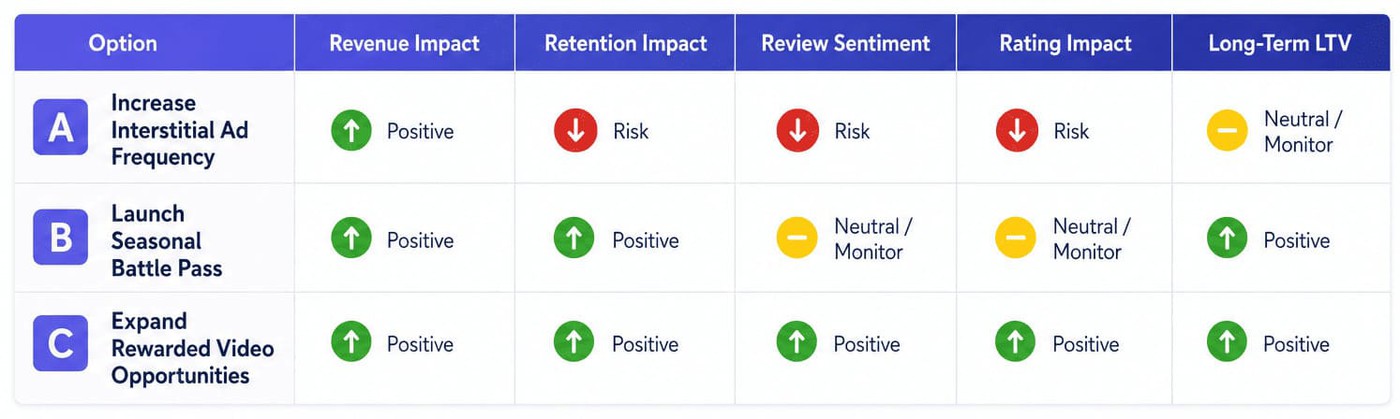
Step 3: Validate against player feedback before you ship
This is the step many teams skip.
Revenue projections, competitor research, and internal testing can tell you whether a monetization change looks promising. Players tell you whether it actually works.
A safer approach is to launch changes in a soft-launch market, monitor sentiment for 7 to 14 days, and look for recurring themes in reviews. Watch for complaints about pricing, progression, ad frequency, fairness, or subscription value. If sentiment remains healthy, expand gradually. If concerns appear immediately, fix the issue before a global rollout.
Player feedback is often the earliest warning system available.
"We see the same pattern across hundreds of titles: studios A/B test their monetization screens, but they don't A/B test the player conversation that follows. The reaction is the test. If you ship a new ad cap and reviews don't move, you have a result. If reviews spike negatively within 48 hours, you have a different result. Most teams aren't watching that signal."
— Veronika Bocharova, Customer Success Manager at AppFollow
Step 4: Build the post-launch listening loop
Launch day isn't the end of the monetization process. In many cases, it's the moment players start telling you whether the change actually worked.
A new battle pass, pricing tweak, subscription offer, or ad placement can generate feedback within hours. That's why it's worth paying attention to terms such as "pay-to-win," "ads," "subscription," "refund," and "scam" after every major update. Review volume, sentiment, and ratings often move before deeper business metrics do.
I've seen small complaints turn into a much bigger problem simply because nobody noticed them early. Catching an issue when a few dozen players mention it is a lot easier than responding after it becomes the dominant theme in your reviews.
How AppFollow helps mobile game studios get monetization right
Monetization teams rarely lack data — they have dashboards for revenue, retention, ads, and purchases. What's hard is reading how players react before a monetization change becomes a ratings problem.
Reviews are the earliest warning signal. Players tell you when ads get too aggressive, when a battle pass misses, or when an economy update feels unfair — usually before it shows up in retention. AppFollow connects that feedback to monetization decisions in time to act on it.
What AppFollow gives monetization teams
- Sentiment tagging tuned for monetization signals. AI-powered review management auto-classifies reviews into monetization, ads, IAPs, refunds, paywalls, and pay-to-win — so you can instantly see every mention of ad frequency or purchase friction instead of digging through spreadsheets. Kolibri Games uses this to act within a live-ops cycle, not months later.
- Real-time alerts on keyword spikes. Get notified the moment reviews about ads, pricing, refunds, or pay-to-win jump — so you investigate while players are still reacting, not at the next weekly report.
- Cross-store, cross-portfolio dashboards. AppFollow's Gaming solution unifies feedback from App Store, Google Play, Galaxy Store, Huawei AppGallery, Microsoft Store, and Apple Arcade — making recurring monetization patterns easy to spot across every title.
- AI-assisted replies in 50+ languages. Respond to monetization complaints fast, in the player's language, in your team's tone — before frustration hardens into a one-star review. Toca Boca reached a 75% reply rate this way.
- Competitor monetization intelligence. Track ratings, sentiment, and review trends across competing titles. When a rival's new pricing or battle pass triggers backlash, you learn from it before testing the same thing on your own players.
Revenue tells you what already happened. Player feedback tells you what happens next. The strongest teams treat reviews, ratings, and sentiment as leading indicators
cta_get_started_purple
FAQs
What is mobile game monetization?
Mobile game monetization is the system a studio uses to turn engaged players into revenue without breaking the experience that engaged them in the first place.
In practice, that revenue usually comes from a combination of in-app purchases, advertising, subscriptions, battle passes, or premium purchases. The most successful studios choose the mix that fits their genre, audience, and live-ops capabilities.
What are the best mobile game monetization models in 2026?
In 2026, the best-performing mobile game monetization model is hybrid: combining in-app purchases, rewarded video advertising, and a time-bound subscription such as a battle pass.
The approach works because different player segments engage differently. Some players spend money. Others watch ads. A smaller group purchases battle passes, subscriptions, or cosmetics. Hybrid monetization allows studios to generate revenue across a much larger portion of the player base while improving long-term lifetime value.
How may a freemium game entice gamers?
A freemium game entices gamers by giving the full core gameplay loop away for free, then offering optional purchases that compress time, add cosmetic expression, or remove friction — never by gating advancement behind a paywall.
The most successful freemium games monetize convenience, personalization, and engagement. Cosmetic skins, battle passes, optional progression boosts, and remove-ads purchases tend to generate healthier player sentiment than systems built around pay-to-win progression. Reviews consistently show that players accept monetization when it feels optional and transparent.
What are the latest trends in mobile game monetization?
A few developments are shaping the industry in 2026. More publishers have moved from waterfall mediation to header bidding. Hybrid monetization has become the norm rather than the exception. Direct-to-consumer webshops are helping studios keep more of each purchase, while rewarded video is increasingly treated as part of the gameplay experience. AI is also entering the conversation, although most teams still use it for research and planning rather than monetization decisions.
Taken together, these shifts point in the same direction: studios are paying closer attention to how monetization feels from the player's perspective, not just how it performs on a dashboard.
What is the difference between IAP and IAA in mobile games?
The difference comes down to who is paying. With in-app purchases (IAP), players spend money on things such as cosmetics, currency, subscriptions, or progression-related items. With in-app advertising (IAA), advertisers fund the experience when players view or interact with ads.
You can usually spot the distinction in reviews. Complaints about IAP tend to focus on pricing, bundles, or pay-to-win mechanics. Complaints about IAA are more likely to mention ad frequency, interruptions, or rewarded videos that stopped working.
How do mobile games make money without in-app purchases?
Not every game depends on players opening their wallets. Many hyper-casual titles earn most of their revenue from advertising, while premium games charge upfront and skip in-app purchases entirely. Some live-service games lean heavily on subscriptions instead. The mix varies, but the underlying idea is the same: players don't have to buy virtual items for a game to become a viable business.
Do reviews actually affect mobile game revenue?
Yes, often more than teams realize.
Ratings influence whether a player installs a game in the first place, so even a small drop can hurt conversion. Reviews matter for another reason, too. They tend to surface monetization frustrations early. By the time retention or revenue starts moving in the wrong direction, players have often been talking about the problem for days.
What monetization model is best for a small indie game?
Most indie studios are better off starting simple.
A combination of rewarded video, cosmetic purchases, and an optional remove-ads upgrade can generate revenue without creating a lot of extra work. Battle passes and subscriptions can be effective, but they come with an ongoing content commitment. Unless you already have the capacity to run live events, ship rewards regularly, and keep players engaged season after season, they can become difficult to maintain.
How can player reviews improve monetization decisions?
Player reviews provide context that revenue dashboards cannot.
Revenue data tells you what players bought. Reviews explain how they felt about buying it. Sentiment analysis, ratings trends, and recurring feedback themes help studios identify issues related to ad frequency, pricing, progression, battle pass value, and pay-to-win perceptions before those issues impact long-term growth.
What monetization metric matters most?
It's tempting to focus on whichever metric happens to be trending in the right direction. A spike in ARPPU looks great when a small group of players starts spending more. Strong ARPDAU can be equally reassuring.
The problem is that neither metric tells you much about what happens six months from now. That's why many teams pay close attention to lifetime value. LTV forces you to look beyond short-term wins and ask a harder question: are players continuing to find enough value in the game to stick around and keep spending over time?