What is ASO? A Complete 2026 Guide to App Store Optimization

Table of Content:
- ASO in one paragraph, then the details
- What does ASO mean? Definition, spellings, and marketing context
- How does app store optimization work?
- The four main pillars of ASO
- Why ASO matters: the business case
- ASO vs SEO, in one paragraph
- How AppFollow.io helps you do ASO
- Frequently asked questions about ASO
- The takeaway
Building an app is no longer the hard part. Being found is. Roughly 850 million people visit Apple’s App Store every single week, and most of them show up with a search in mind rather than a brand.
So what is ASO, and why does it quietly decide which of those people end up downloading you? Short version: ASO stands for App Store Optimization, the ongoing practice of improving an app’s visibility and conversion rate inside the App Store and Google Play. The whole aso meaning lives in two jobs done well, over and over: get found, then get chosen.
This guide walks the full picture from an operator’s seat: a clean definition, a plain look at how app store optimization actually works, the four pillars, the numbers that justify the effort, a quick read on ASO versus SEO, and where AppFollow fits the daily rhythm.
Founder who needs discoverability you can’t buy, marketer explaining ASO to a skeptical boss, publisher juggling a portfolio: this is the place to start.
ASO in one paragraph, then the details
ASO (App Store Optimization) is the practice of improving an app’s visibility and conversion rate in the App Store and Google Play.
It rests on four things: keywords, creative assets, ratings and reviews, and engagement signals. Apps that run ASO well tend to see a 20 to 50 percent lift in organic installs within six months, and the gains compound from there.
Where does it pay off first? Four quick reads on who benefits most:
New founders launching an app ASO hands you discoverability you can’t afford to buy on day one. | Marketers moving from web SEO Same instinct, different rulebook. Apple runs no hidden crawler, and Google Play has no PageRank. |
Publishers running a portfolio The channel compounds across every title you own, so the work pays rent on all of them. | Teams under paid-UA pressure Stronger organic raises the lifetime value of every install and lowers your effective cost per install (CPI). |
The numbers worth memorizing:
- Around 70 percent of App Store visitors use search to find apps, and almost 65 percent of downloads happen right after a search.
- Apps sitting in the top three results for a target keyword capture roughly half of that search’s installs.
- Well-run ASO delivers a 20 to 50 percent organic install lift within six months for most apps.
- Organic installs usually retain and monetize 20 to 30 percent better than paid ones, because the user went looking for exactly what you offer.
What does ASO mean? Definition, spellings, and marketing context
ASO stands for App Store Optimization: the practice of improving an app’s visibility and conversion rate in mobile app stores, primarily Apple’s App Store and Google Play.
So what does aso mean once you strip the jargon? Picture the mobile-app cousin of SEO. Same goal of being found by people already looking, different referees. On mobile the ranking systems belong to Apple’s App Store search and Google Play, not Google Search.
That’s the ASO definition in operator terms, and it doubles as the app store optimization definition you’ll see echoed everywhere. Whenever someone asks for the app store optimization meaning, or types it as “what is an aso” with an article and all, the answer holds: earn the visibility, then earn the install.
A word on spelling. American English writes “Optimization” with a z. The UK, Ireland, and much of the Commonwealth prefer “Optimisation” with an s, so what is app store optimisation and what is app store optimization point to the exact same discipline.
Google reads the two as synonyms in nearly every locale, which means you lose nothing by picking one. AppFollow uses the American “Optimization” as the house spelling, mostly because about 70 percent of app-marketing content worldwide already leans that way.
Now the org chart. ASO lives inside the broader mobile marketing stack, next to user acquisition (UA), retention and CRM, and product marketing. So what is aso in marketing? It’s the organic-install engine of that stack, and it usually plays out like this:
- The core idea. SEO pulls organic traffic to a website; ASO pulls organic installs to an app. That’s the honest aso marketing meaning.
- Who owns it. At a big company, the growth team. At an indie studio, the founder or a lone marketer, coffee going cold.
- Why the wording wobbles. Phrases like what is aso marketing and even what is aso app store optimization keep surfacing in job posts. People are double-checking they’ve matched the right acronym to the right store.
From the field: Most people meet ASO as a checklist: pick keywords, write the metadata, upload some screenshots. That’s the vocabulary, not the craft. ASO is the steady work of making an app easy to find and worth installing once it’s found. Every move you make should serve one of those two jobs, or it’s decoration.
How does app store optimization work?
Here’s the mental model I hand every new hire. App store optimization works in two loops. A visibility loop puts your app in front of people searching for something like it. A conversion loop turns those viewers into installs. Both stores watch both loops all day and rank you on the results. If you’ve ever typed how does app store optimization work into a search bar, that two-loop picture is the honest answer beneath the tactics.
The two stores’ algorithms, at a high level
Apple and Google score apps differently, and the finer points earn their own guides (that’s what the iOS ASO guide and the Google Play ASO guide are for). Painted broadly:
- Apple’s App Store leans on your app name (30 characters, heaviest weight), the subtitle (another 30), a hidden 100-character keyword field, plus ratings, download volume, and how reliably installs turn into opens.
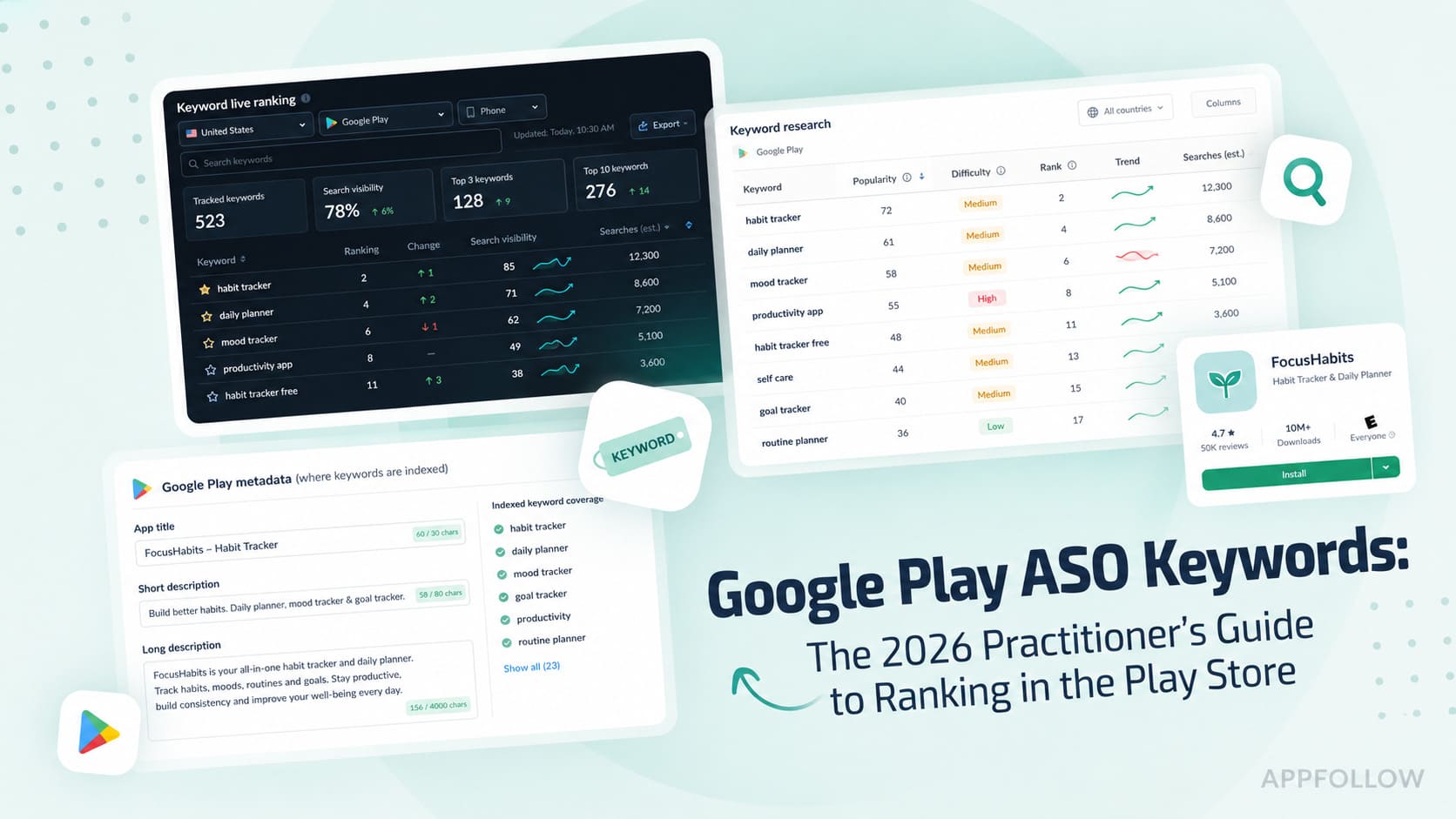
- Google Play reads far more text. It indexes the title (30 characters), the short description (80), and the entire long description (up to 4,000), then folds in ratings, install velocity, retention, and technical health through Android Vitals.
One phrasing you’ll hear, what is aso app store optimization doing under the hood, comes down to feeding the right signals into two very different scoring systems.
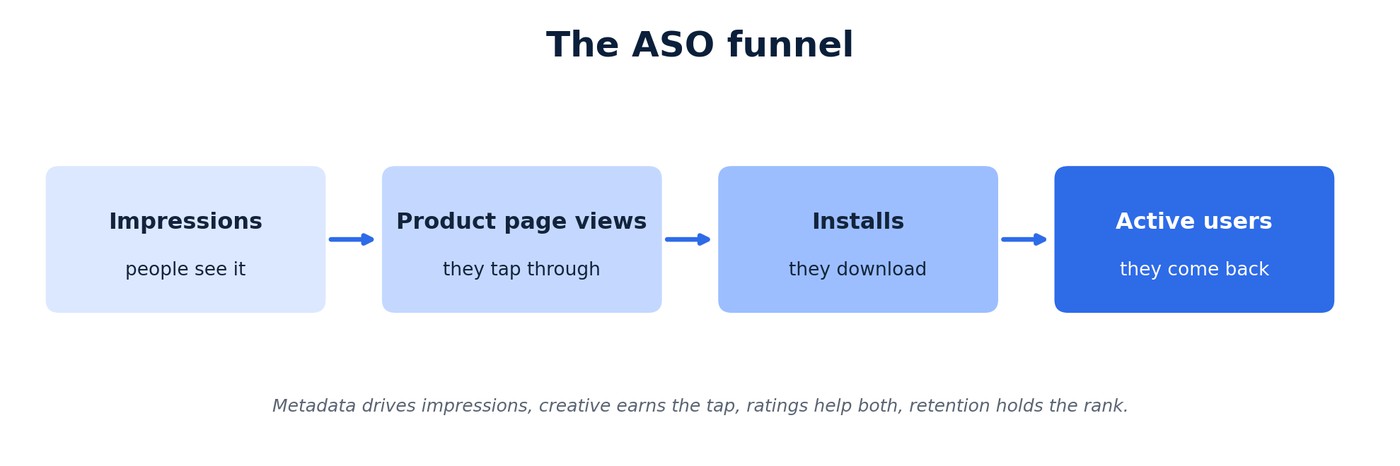
The ASO funnel, from a glance to a loyal user
Zoom out and ASO becomes a funnel you can measure at every step, and each step has its own lever:
- Impressions (people see your app). Metadata does the heavy lifting here.
- Product page views (they tap through). Your icon and first screenshots earn the click.
- Installs (they download). Creative and ratings close the deal together.
- Active users (they open it and keep coming back). Retention feeds straight back into ranking.
Retention is the part beginners underrate. Both stores keep scoring your app long after the download, so an install that never opens does less for you than the dashboard suggests. Anyone typing aso meaning app into a search box is usually circling this exact truth: ASO covers the app’s whole life in the store, not just the tap on the install button.
From the field: The slip I see most is a team optimizing for downloads while ignoring what comes next. Apple and Google both measure engagement after the install. A one-tap download that never opens teaches the algorithm to show you to fewer people. ASO doesn’t end at the install button; it starts proving itself right after.
The four main pillars of ASO
Read ten ASO frameworks and they collapse into the same four pillars. Each one behaves differently, rewards a different kind of attention, and breaks in its own way, so I’ll treat them differently too.
For the operational checklist that maps to each pillar, the ASO keywords guide picks up where this section stops.
Pillar 1: Keyword research and metadata
This is where visibility is won or quietly lost. Keywords are the words people type when they’re hunting for an app like yours. The work splits cleanly in two: research which terms are worth chasing (search volume against relevance against how crowded the space is), then place them where each store actually reads them.
A sleep app that targets “white noise” and “sleep sounds” instead of the generic “relax” can pull thousands of extra monthly impressions from the same listing. No new users invented, just better matching.
Where each store indexes your text:
Field | Apple App Store | Google Play |
|---|---|---|
Primary | App name (30 characters, heaviest weight) | Title (30 characters) |
Secondary | Subtitle (30 characters) | Short description (80 characters, indexed) |
Deep text | Keyword field (100 characters, hidden from users) | Long description (4,000 characters, fully indexed) |
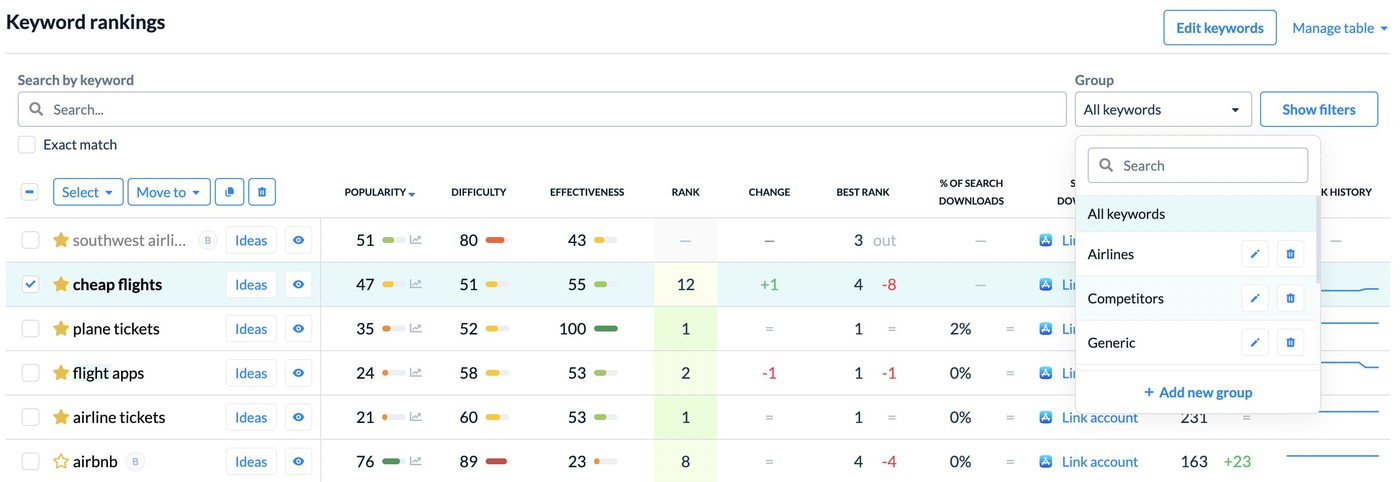
Ranking never sits still, because positions drift the moment competitors move, so most teams watch ranks daily with a keyword tracker such as AppFollow’s Keyword Tracking dashboard.
cta_get_started_purple
Pillar 2: Creative optimization (icon, screenshots, video)
Metadata wins the impression. Creative wins the tap. Your icon is the first tiny bet, and it has to read clearly at thumbnail size while still fitting its category. Screenshots carry the pitch, and you get roughly three to five seconds to make them land, so lead with the value rather than a login screen.
Here’s the part that surprises people: the “obvious” creative choice loses more often than you’d guess, which is exactly why the stores build testing tools into the product.
Apple’s own Product Page Optimization case studies make the point better than theory can. Peak Brain Training tested four icon designs against each other, and the brain icon beat the robot design and the rest, lifting conversion 8 percent at greater than 98 percent confidence.
Simply Piano then tried leading its page with an app preview video, a move most marketers would bet on blindly, and the original page without the video actually won. Two real tests, two reminders that taste is a hypothesis, not a strategy.
Compare different app icons, screenshots, and app previews on your App Store product page to find out which resonate with people most.
Apple, App Store Product Page Optimization
Preview video earns its keep in categories where motion does the selling, think games, video editors, and camera apps, though the Simply Piano result shows it’s worth testing rather than assuming.
Pillar 3: Ratings, reviews, and social proof
Short pillar, heavy weight. Both stores treat ratings as a ranking signal and parade them in front of users at the same moment, so a strong average works twice. Volume matters alongside the number itself: 4.7 stars off 10 reviews reads thinner than 4.5 stars off 10,000.
Replying to reviews, the unhappy ones especially, has shifted from nice touch to baseline hygiene, which is where AppFollow’s Reviews & Ratings dashboard earns its place. Analysts who watch the charts put a rough floor on it.
The most consistent way to stay high in the rankings and be featured is by having a good review rating, usually over 4.4 out of 5.
David Curry, Business of Apps
Pillar 4: Engagement signals (retention, uninstalls, Android Vitals)
What happens after the install loops straight back into your ranking, and Google is unusually blunt about it. Its Android vitals documentation spells out the technical-quality thresholds a title should stay under to protect its store visibility.
Google Play core vital | Overall threshold | Per phone model |
|---|---|---|
User-perceived crash rate | 1.09% | 8% |
User-perceived ANR (app not responding) rate | 0.47% | 8% |
Core vitals are the most important metrics in Android vitals, and affect the visibility of your app on Google Play... If your app or game exceeds a bad behavior threshold, Play may reduce the visibility of your title.
Google, Android Developers documentation
Apple reads the same story through install-to-open rate and long-term retention. Strong day-one retention is what lets good keyword work actually stick, which is why this pillar ties ASO to product. The two rise together, since a store that watches people stay rewards you with more people to win in the first place.
Why ASO matters: the business case
Paid user acquisition is the largest line under cost of revenue for almost every consumer app. ASO is the rare lever that shrinks that line and lifts the value of the users who convert, at the same time. The argument isn’t a hunch; the platforms publish most of the proof themselves.
Start with where the demand actually is. Apple states plainly that 70 percent of App Store visitors use search to discover apps, and that almost 65 percent of downloads happen directly after a search (Apple Ads). That store reaches over 850 million people a week. If two-thirds of your would-be users are typing a query, the search box is your storefront, and ranking in it is the whole game.
Then look at what a strong listing converts at. Intent-matched placement is efficient in a way few channels match, and the proof points stack up:
- Ads at the top of search results convert at an average over 60 percent (Apple Ads), a ceiling organic listings chase with the same signals.
- A single tested creative change lifted Peak Brain Training’s conversion 8 percent (Apple).
- Chart-watchers peg the practical rating floor at roughly 4.4 out of 5 before visibility and conversion both slip (Business of Apps).
The levers, and what moving each one tends to return:
Lever | Typical move | What it tends to return |
|---|---|---|
Keyword position | From #10 to top 3 for a target term | Roughly 3 to 5x the organic installs from that search |
Store conversion rate | Test icon and first two screenshots | High single-digit to double-digit percent lift (see Apple’s 8%) |
Rating average | Hold above ~4.4 stars | Higher ranking plus higher tap-to-install rate |
Install source mix | Shift toward organic | ~20 to 30% better retention and spend vs paid installs* |
Put those together and a flywheel appears: a better position brings more organic installs, which lifts value per user, which lowers your effective cost per install (CPI) on paid campaigns now competing against a stronger free baseline. Organic users also arrive with expressed intent, since they searched for exactly what you do, which is why practitioners consistently see them retain and monetize better than bought installs.
The team math is friendly too. A founder or solo marketer can run meaningful ASO on four to six hours a week with the right tooling. A dedicated in-house ASO manager tends to earn back their salary within 6 to 12 months for any app with material paid-UA spend.
Past ten apps in a portfolio, a proper team plus tooling stops being optional, because the manual overhead grows faster than headcount. The ASO services guide weighs agency versus in-house, and the ASO pricing guide breaks down the numbers.
*Organic-versus-paid retention and spend figures reflect widely reported practitioner benchmarks rather than a single published study; treat them as directional.
From the field: Teams that commit to ASO in year one usually see the biggest payoff in year two. It isn’t a switch you flip. The compounding is what’s real: a keyword position you hold today keeps producing organic installs next quarter, next year, and every quarter after until someone takes it from you. Paid UA never stacks like that.

ASO vs SEO, in one paragraph
SEO and ASO run on the same instinct, help people find you, yet the machines behind them share almost nothing. Google Search ranks web pages on link graphs, content quality, and a few hundred other signals. The App Store and Google Play rank apps on metadata, ratings, installs, and engagement. So SEO tunes for one algorithm while app store optimization tunes for two.
Content SEOs picking up ASO usually find their footing within a few weeks, since the mental model carries over even when the specifics don’t. The full ASO vs SEO comparison goes deeper if you want it.
How AppFollow.io helps you do ASO
AppFollow.io is the all-in-one platform where the daily ASO work actually happens, from tracking keyword ranks to answering reviews at scale.
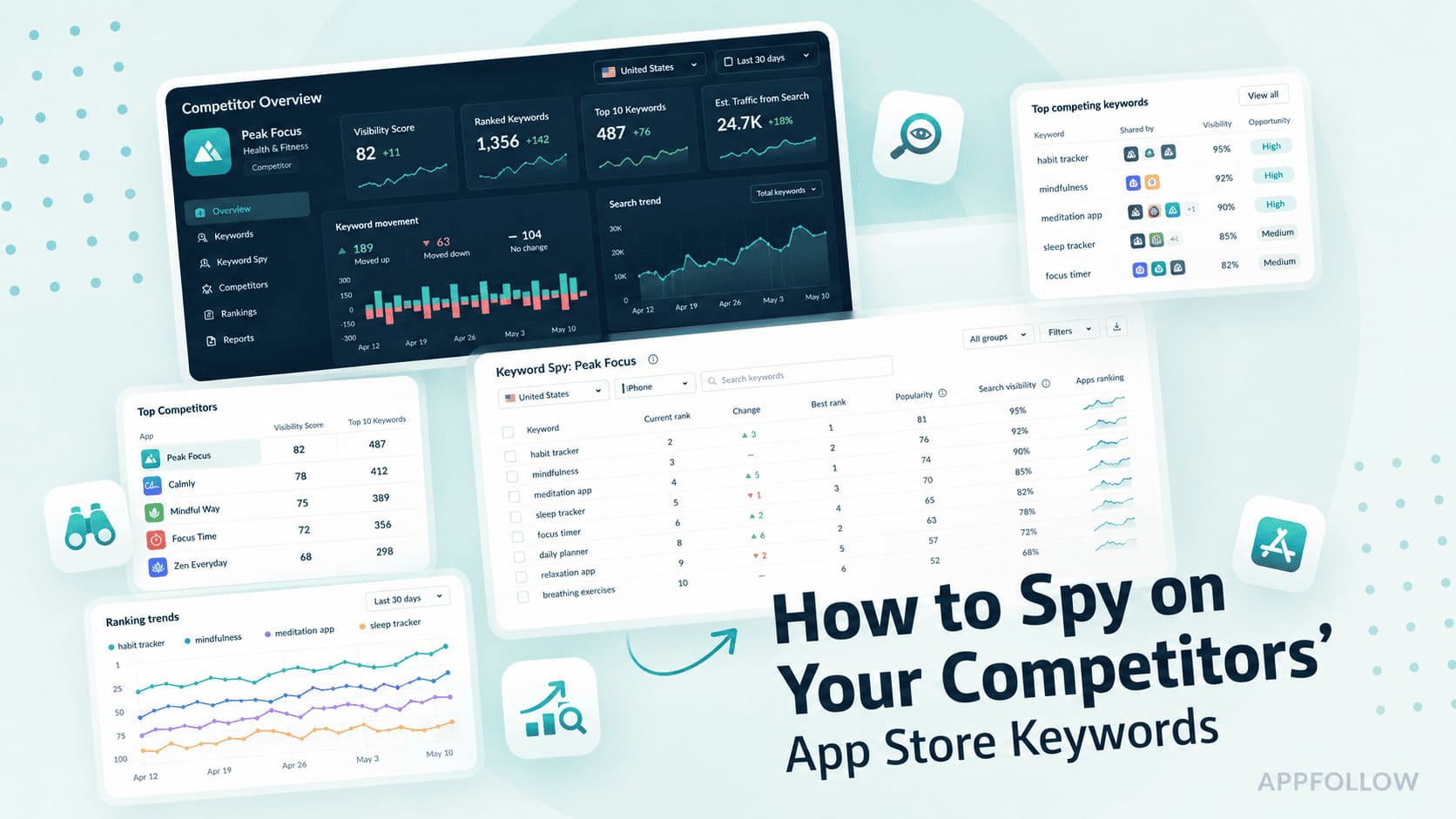
Start with visibility. AppFollow gives you daily rank updates for every target keyword across the App Store and Google Play, in every country your app ships to. Layer on Competitor Intelligence and share of voice against the rivals you track, plus metadata-change alerts that ping you the moment a competitor edits their listing.
That last piece is quietly powerful, since it’s the fastest way to spot which tactics are working in your category without asking a soul. For teams weighing which aso tool to standardize on, this is usually the first surface they test.
Then the review side. AppFollow pulls Reviews & Ratings from both stores in real time and tags sentiment automatically, so a rising complaint theme surfaces before it drags your average down. AI reply assist drafts responses in each app’s voice, and your community managers approve, tweak, or send.
Holding it together is the ASO Dashboard, one view of store conversion, install velocity, keyword rank, and review sentiment across iOS and Android.
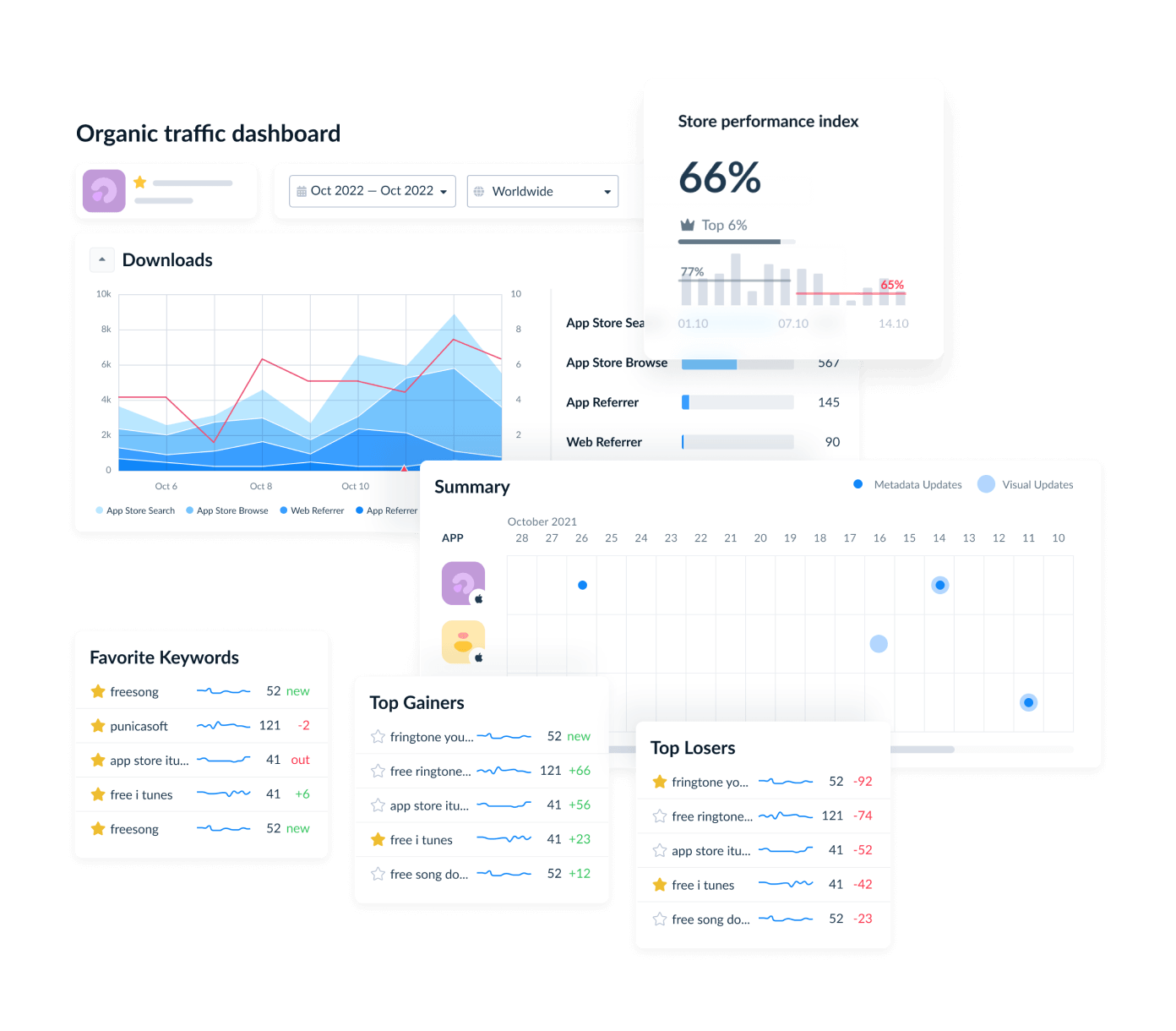
Native integrations with Slack, Zendesk, Helpshift, Looker, and Tableau push those signals into the tools your team already opens every morning. The pattern stays consistent across accounts: AppFollow surfaces the ASO signal, and the stack you already run acts on it.
cta_get_started_purple
Frequently asked questions about ASO
What does ASO stand for?
ASO stands for App Store Optimization, the practice of improving an app’s visibility and conversion rate in mobile app stores. It spans keyword research, metadata, creative assets like your icon, screenshots and video, ratings and reviews, and post-install engagement signals such as retention.
What is app store optimization?
App store optimization is the ongoing practice of improving an app’s ranking and install rate in the App Store and Google Play. It’s the mobile-app equivalent of SEO, but the systems doing the ranking are Apple’s App Store algorithm and Google Play’s algorithm rather than Google Search. Run consistently, it lifts organic installs quarter after quarter.
What is ASO in marketing?
In marketing, ASO is one of the core organic-acquisition channels for mobile apps, sitting alongside content, brand, and influencer work. It usually lives inside the growth or mobile marketing team. Where SEO earns organic web traffic, ASO earns organic app installs, which is why marketers moving over from web pick it up quickly.
How does app store optimization work?
App store optimization works in two loops. A visibility loop gets your app in front of people searching for something like it, and a conversion loop turns those viewers into installs. Both stores rank apps on how well they perform in each loop, then factor in post-install signals such as retention and, on Android, Vitals data like crash and ANR rates.
What is the best ASO tool?
There’s no single best ASO tool, since the right choice depends on portfolio size, budget, and workflow. Look for daily keyword rank tracking, competitor intelligence, and review management in one place, which is what AppFollow brings together. Start with a free trial and judge by workflow fit rather than raw feature count.
How long does ASO take to work?
First measurable keyword-rank movement usually shows up in 30 to 60 days. Meaningful organic install lift tends to arrive around 90 to 120 days and then compounds, so month six often runs three to five times better than month three. Expecting big impact before 60 days sets you up for a false read.
Is ASO worth it for small apps?
Yes, and arguably more so. Organic installs cost nothing per install once the upfront work is done, which matters most when budgets are tight. A solo founder or marketer can run meaningful ASO on four to six hours a week using free-tier tools, and the positions they earn keep paying out quarter after quarter.
The takeaway
So, what is ASO in a single breath? The practice of improving your app’s visibility and conversion across the App Store and Google Play, built on four pillars: keywords, creative, ratings, and engagement. The aso meaning that actually sticks is that it compounds, which is what makes app store optimization worth starting before you feel ready for it.
Treat ASO as a daily discipline rather than a quarterly project. The teams that check in each morning and act on what moved tend to pull steadily away from the teams that audit once a season and hope for the best.
cta_get_started_yellow