Mobile Gaming Trends 2026: A Player-Side Pillar Guide for Developers, Publishers, and Marketers

Table of Content:
- Key takeaways
- What "mobile gaming trends" actually means in 2026
- Mobile gaming industry trends: the market shape in 2026
- Current mobile gaming trends: the operational shifts
- Mobile game UI design trends (2025 → 2026)
- AI in mobile gaming: future trends for the next 8 years
- Mobile game advertising trends
- Future of mobile gaming: trends shaping mobile gaming's future
- What player reviews tell us about emerging trends
- Stay ahead of app store trends with AppFollow
- FAQs
Mobile gaming trends are usually discussed through market reports, download rankings, and revenue forecasts. Those sources are useful, but they share the same limitation: they tell you what already happened. This guide reads the mobile game trends of 2026 from a different angle — the player's side — using review intelligence, the signal hidden in what players write in app store reviews before it ever reaches a market dashboard.
Players often reveal the next trend much earlier. A new expectation starts appearing in reviews. A feature request shows up across multiple games. Complaints about onboarding, monetization, accessibility, or AI become more frequent. By the time those patterns appear in industry reports, thousands of players have often been talking about them for months.
This guide looks at mobile gaming trends from that player-side perspective. We'll examine the market forces shaping the industry, the operational and design shifts changing how games are built, the technologies likely to influence the next decade, and the regulatory changes affecting distribution. Most importantly, we'll look at the signals hidden in player feedback that often predict where mobile gaming is heading next.
Key takeaways
- Mobile gaming trends now span four connected layers: market shifts, design and UI changes, AI and technology adoption, and the regulations shaping how games are distributed, monetized, and operated.
- The earliest trend signals rarely appear in revenue dashboards first. They show up in app store reviews, support conversations, and player communities months before market reports catch up.
- Mobile gaming is still the industry's biggest revenue driver. Recent estimates from Newzoo and Sensor Tower put annual revenue above $90 billion, with mobile accounting for roughly half of all global gaming spending.
- The best mobile interfaces are getting out of the player's way. Instead of long tutorials and multiple prompts, successful games increasingly drop players into gameplay within seconds. Vertical layouts and fewer interruptions have become part of that same shift.
- AI is quietly becoming part of everyday game operations. Studios are using it to generate supporting content, analyze player feedback, personalize live-ops, improve matchmaking, and speed up customer support. The biggest gains over the next few years are likely to come from helping teams work faster, not replacing creative roles.
- Don't treat mobile game trends in 2026 as a checklist. The more useful approach is to watch how your own players react, test ideas early, and pay attention to the patterns emerging in reviews before they show up in industry reports.
What "mobile gaming trends" actually means in 2026
Mobile gaming trends are the operational, design, and player-behavior shifts that change how mobile games are built, played, and monetized, measured most accurately through what players say in app store reviews.
That definition matters because mobile gaming no longer evolves through technology alone. A new monetization model can influence retention. An accessibility feature can affect ratings. One thing I've noticed is that good ideas travel fast. A feature that delights players in one genre can quietly become common across dozens of others within a year. Looking at market data alone doesn't always reveal that. Following how players respond usually does.
The four layers of mobile gaming trends
Throughout this guide, mobile gaming trends fall into four connected layers.
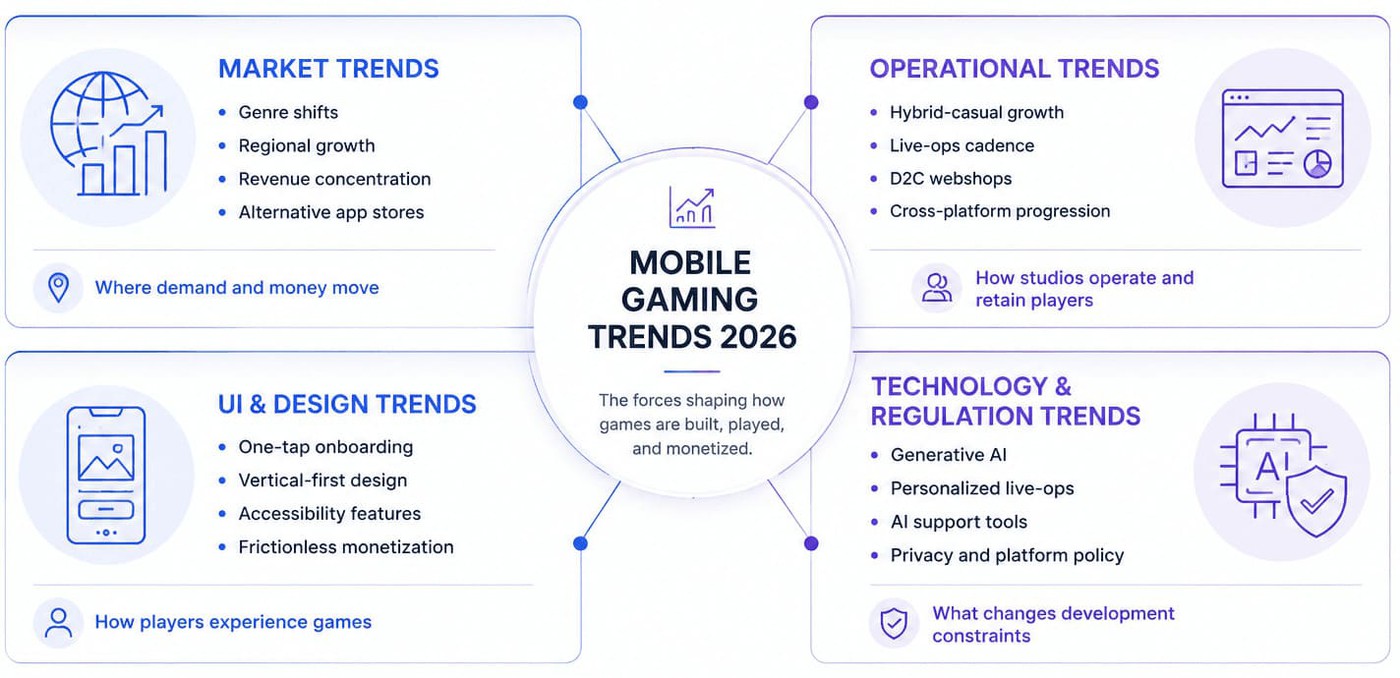
- Start with the market. This is where you'll see revenue trends, genre performance, regional expansion, and changes in how players discover and spend on games.
- Next comes design. Onboarding, accessibility, vertical-first layouts, and monetization flows all shape the experience players have every time they open a game.
- Technology is the layer moving fastest. AI-assisted personalization, procedural content generation, smarter matchmaking, and automated player support are changing both development workflows and live operations.
- Then there's regulation. Privacy rules, AI governance, platform policies, and alternative app stores increasingly influence how games are launched, distributed, and monetized.
Each trend discussed later in this article fits somewhere within this framework, even when multiple layers overlap.
Why reading trends through reviews beats reading them through dashboards
Market reports are valuable, but they are inherently retrospective. By the time a trend appears in industry dashboards, studios have often been reacting to it for weeks or months.
Player reviews behave differently. They capture expectations as they form. Consider the rise of cozy and wellness-focused games. Long before analysts highlighted the category, players were leaving reviews that mentioned relaxation, stress relief, and the desire for games that felt calmer and less demanding.
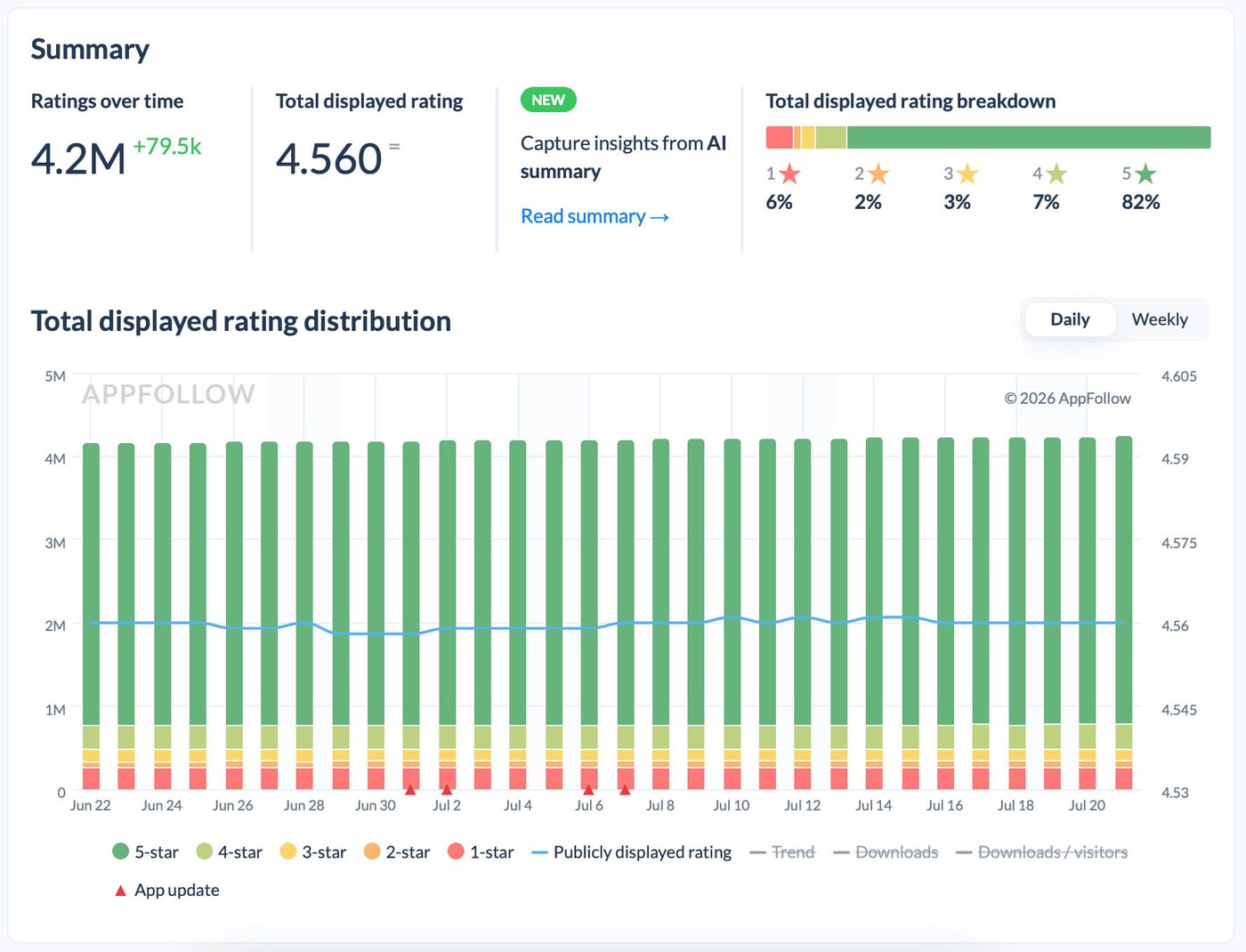
Reviews saying "Finally a game I can play without stress" started appearing across very different games, not just one or two cozy titles. At first it looked like coincidence. Then the same ideas kept coming back. Players talked about relaxing after work, slowing down, enjoying the lack of pressure, or simply wanting something calmer than the games they usually played.
That's the kind of pattern a support or community team is likely to notice first. Someone reviewing feedback across a portfolio of puzzle, idle, and simulation games might realize those comments are becoming more common week after week. By the time analysts begin describing cozy gaming as a broader market trend, players have often been talking about it for months.
At first, each review looks anecdotal. Then, review tags and sentiment analysis show those themes growing month after month. The team groups them into a broader category, such as low-stress gameplay, and shares the findings with product, marketing, and LiveOps teams.
By the time analysts publish reports about the rise of cozy gaming, the signal has already been visible in player reviews for months. Reviews rarely tell you how large a trend will become, but they often reveal what players are starting to value before download charts and revenue data make the shift obvious.
Reviews won't replace market data. They provide something equally valuable: an early warning system for what players are beginning to want next.
Mobile gaming industry trends: the market shape in 2026
Industry reports tell us where the market is today. Reviews often tell us where it is going next. Both matter, but they answer different questions. Market data reveals where players are spending money and time. Player feedback helps explain why.
Market size and growth: where mobile sits in the gaming market
Mobile remains the largest segment of the global games industry. Recent estimates from Newzoo and Sensor Tower place mobile gaming revenue at roughly half of all worldwide gaming revenue, ahead of both console and PC. Growth has slowed from the extraordinary pandemic years, but the market continues expanding.
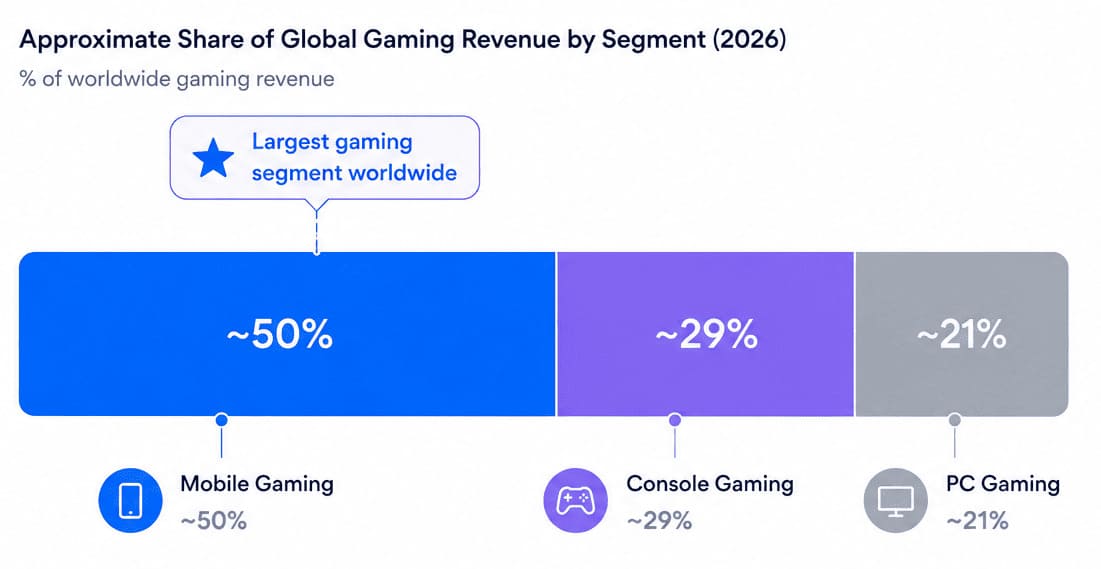
The story in 2026 is less about explosive growth and more about maturity. Mobile gaming is no longer the industry's emerging platform. It is the platform against which every other gaming segment is measured.
Genre mix: casual still rules, hybrid-casual keeps growing
Open almost any mobile download chart and casual games are hard to miss. That isn't changing anytime soon. According to the Statista Mobile Gaming topic page, casual titles still generate hundreds of millions of downloads every year in the United States, well ahead of the rest of the market.
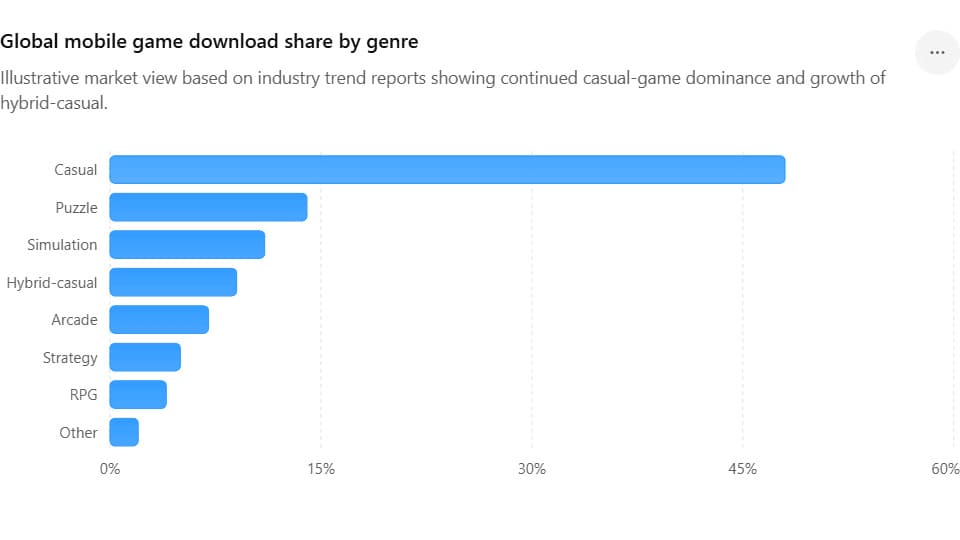
The chart explains why casual remains the industry's largest acquisition engine. If your goal is pure reach, few genres can compete with games that are easy to understand and quick to start.
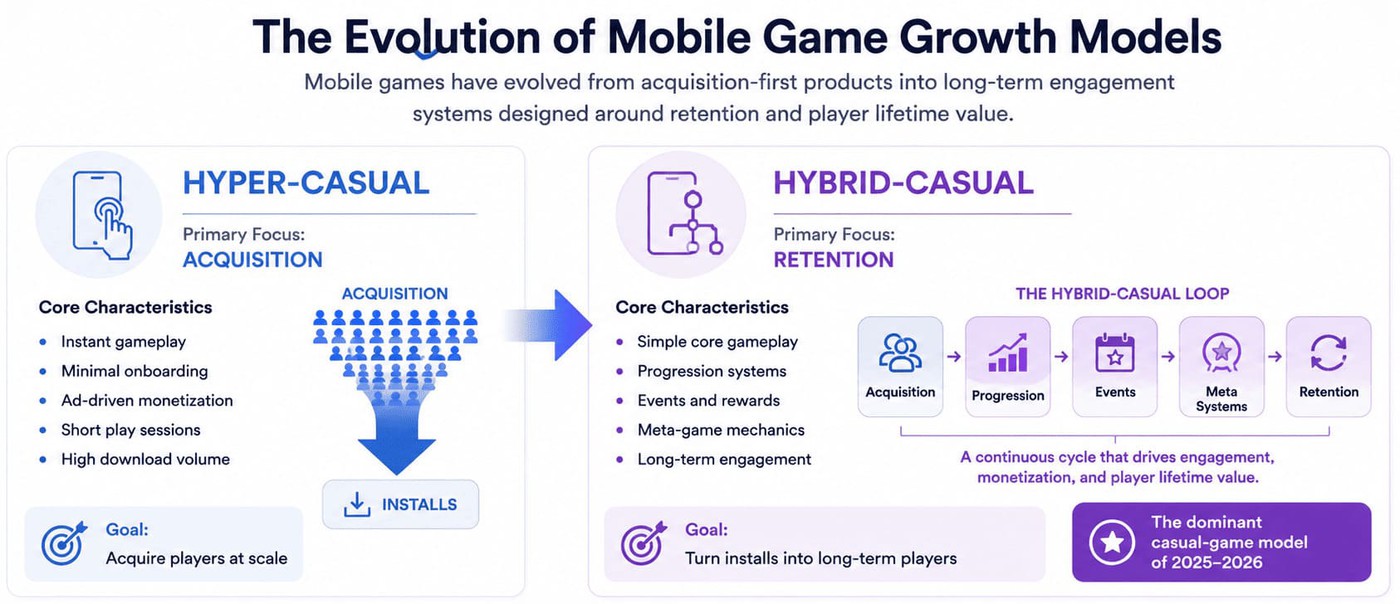
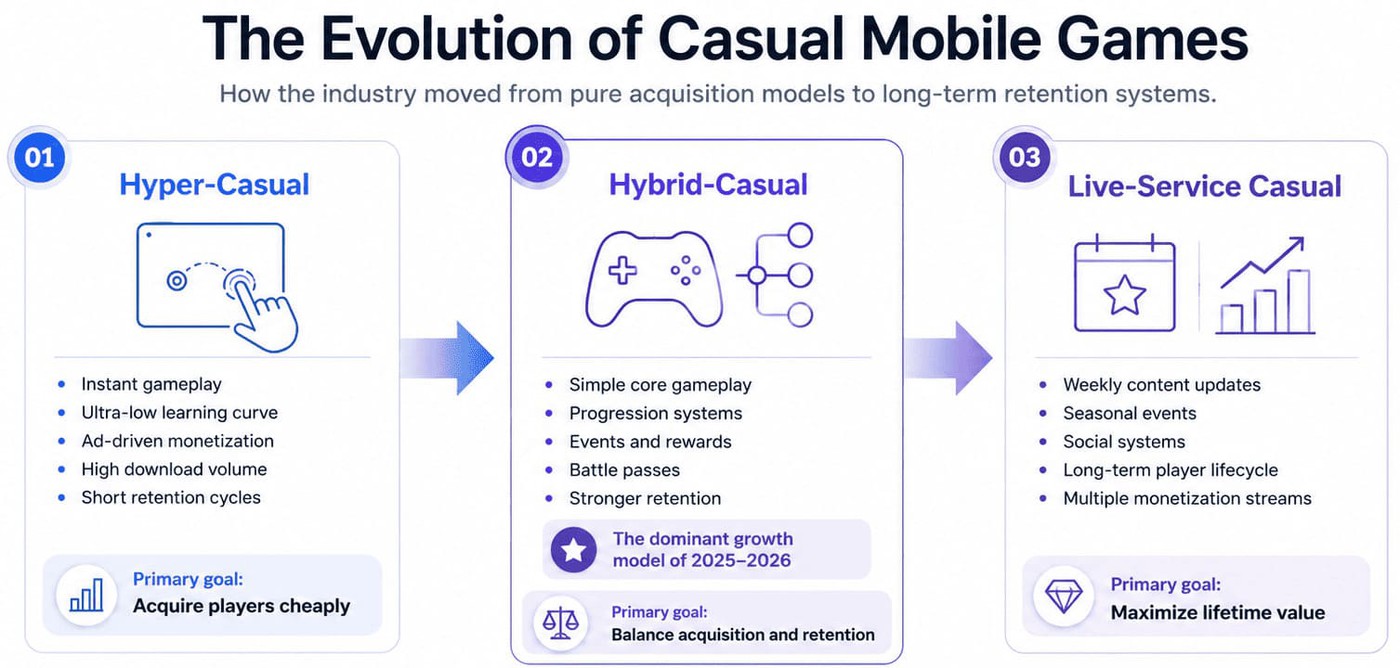
What has changed is the way successful casual games are built. The hyper-casual model that prioritized rapid acquisition above everything else has evolved. Many publishers now combine simple gameplay loops with progression systems, live events, battle passes, and long-term retention mechanics.
That shift explains why hybrid-casual appears repeatedly throughout discussions of current mobile gaming trends. Players still want low-friction gameplay. They are increasingly willing to stay much longer once they find it.
Regional shifts: LATAM, MENA, India, and Southeast Asia
Several of the most important mobile game industry trends are regional.
Brazil and Mexico continue attracting publisher attention thanks to growing smartphone adoption and expanding gaming audiences. For a deeper look at localization, monetization, and player behavior in both markets, see our guide on how to win Brazil and Mexico's mobile gaming market.
MENA is becoming one of the most attractive emerging regions from a monetization perspective, with spending patterns drawing increasing interest from global publishers.
India remains a volume story. The market generates enormous player numbers, although revenue per user still trails more mature gaming economies. Southeast Asia continues to combine strong player growth with a deeply established mobile-first gaming culture.
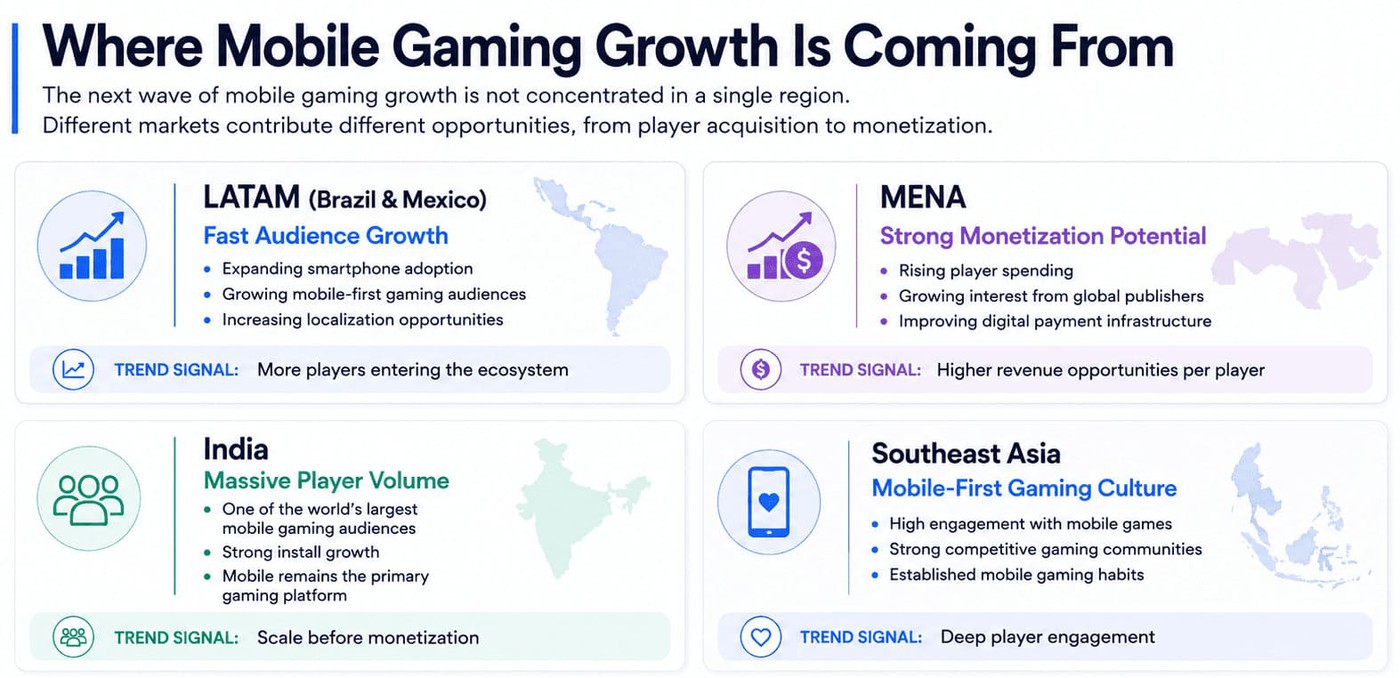
For developers, these markets are about more than finding new players. They offer an early look at how player expectations are changing, which localization choices matter most, and what people are actually willing to spend money on.
Publisher concentration remains significant
If you look at the download rankings year after year, the same names keep showing up. Sensor Tower's annual publisher rankings for 2025 include companies such as Azur Games, Voodoo, SayGames, and Playrix near the top, especially in casual gaming.
The more interesting takeaway is how quickly successful mechanics spread across the industry. Features that resonate with players often move from one publisher's portfolio into dozens of competing titles within months. That makes trend detection increasingly valuable. By the time a mechanic reaches industry-wide adoption, players have usually been discussing it in reviews for quite some time.
"Most studios learn about industry trends six months late, from a slide deck. The studios that win read trends straight from their own review feed. Players announce every shift, from cozy genres and cross-save to AI fatigue and accessibility, months before the analyst reports catch up. Reviews are the leading indicator. Everything else is the lagging one."
— Anatoly Sharifulin, Founder, AppFollow
Market reports explain what happened. The challenge for studios is understanding what happens next. That is where player feedback becomes valuable, because the earliest signs of change rarely appear in a revenue chart first.
Current mobile gaming trends: the operational shifts
Market reports tell us where the industry is moving. Operational trends reveal what studios are actually changing inside their products. These shifts influence retention, monetization, content planning, and player satisfaction long before they show up in annual industry summaries.
Trend 1: Hybrid-casual is the new default
A few years ago, hyper-casual games optimized for rapid acquisition. Today, many of the most successful teams are building hybrid-casual experiences that combine simple gameplay with progression systems, collectibles, events, and long-term goals.
The broader shift toward hybrid-casual design has also been discussed extensively in the GameRefinery Mobile Games Playbook podcast, where retention mechanics and long-term engagement systems are recurring themes. They want to understand a game immediately, but they also want reasons to come back. Publishers such as SayGames, Supersonic, and Homa have all embraced variations of this approach.
Player review signal: "I downloaded it because it looked simple. Three months later I'm still unlocking new content."
Trend 2: Cross-platform continuity is expected
It has become increasingly common to start playing on one device and continue somewhere else later. A session might begin on a laptop, pick up again on a phone during the commute home, and finish on a tablet in the evening. That's one reason cloud saves, shared progression, and synchronized accounts are quickly becoming expected rather than premium features. Newzoo Gamer Segmentation Report points to the same shift, showing that players regularly move between devices and expect the experience to move with them.
Player review signal: "I love that I can pick up exactly where I left off, no matter which device I'm using."
Trend 3: D2C webshops are mainstream
Direct-to-consumer webshops have moved from experimental projects to a mainstream monetization strategy for many mobile game publishers, a shift documented by companies such as Xsolla and Appcharge in their D2C commerce reports.
The appeal is straightforward. Transactions completed through external channels can reduce platform fees and allow publishers to retain a larger share of player spending, which is one reason D2C webshops have gained traction across the industry.
Player review signal: "The web store discounts are great. I just wish account syncing was a little easier."
Trend 4: Live-ops cadence is a competitive advantage
Not long ago, a major content update could set one game apart from the rest. Today, players expect something new to happen almost every week. Seasonal passes, limited-time events, evolving storylines, and rotating challenges have become part of the rhythm of successful live-service games. When that rhythm slows down, players notice.
GameRefinery, Unity, and Sensor Tower have all linked consistent live-ops programs with stronger engagement and retention. It's not difficult to see why. A steady flow of fresh content gives players another reason to come back, even when the core gameplay hasn't changed.
"Players forgive bugs faster than they forgive boredom. When review sentiment drops, the cause is often content cadence rather than technical issues. "
— Dzianis Shalkou, Solutions Engineer, AppFollow
Player review signal: "There's always a new event running, so I never feel like I've run out of things to do."
Trend 5: Cozy and wellness games are rising
A few years ago, "cozy gaming" was mostly associated with a handful of farming and life simulation titles. It's now part of a much broader conversation. Market analyses from Newzoo and GameRefinery point to growing demand for games that feel relaxing rather than relentlessly competitive.
That shift is easy to spot in player reviews. Instead of celebrating difficulty or high-stakes competition, many players talk about winding down after work, enjoying a slower pace, or appreciating games that don't demand constant attention. Farming sims, decorating games, life simulations, and gentle puzzle games have all benefited from that change in expectations.
Player review signal: "Finally a game I can play without stress."
Trend 6: User-generated content and creator economies expand
Roblox showed what happens when players become creators instead of just consumers. That idea is spreading well beyond a single platform. Reports from Newzoo and Game Developer point to growing investment in creator tools, custom content, and community-driven experiences across the industry.
For developers, the appeal goes beyond keeping content fresh. User-created levels, events, and challenges give players a reason to stay involved while reducing the pressure to produce every new experience internally. The stronger the community becomes, the longer a game tends to stay relevant.
Player review signal: "Half the reason I keep playing is seeing what other players create next."
Rather than pointing in different directions, these trends reinforce one another. Players are looking for games that fit more naturally into everyday life, keep evolving after installation, and give them reasons to return without feeling forced. Review feeds often show those expectations taking shape long before they appear in annual industry reports.
cta_free_trial_purple
Mobile game UI design trends (2025 → 2026)
Mobile game UI doesn't generate as many headlines as AI, monetization, or live ops, but it's one of the biggest reasons players stick around. Every session runs through the interface, whether someone is claiming a reward, opening a store, or jumping into a match.
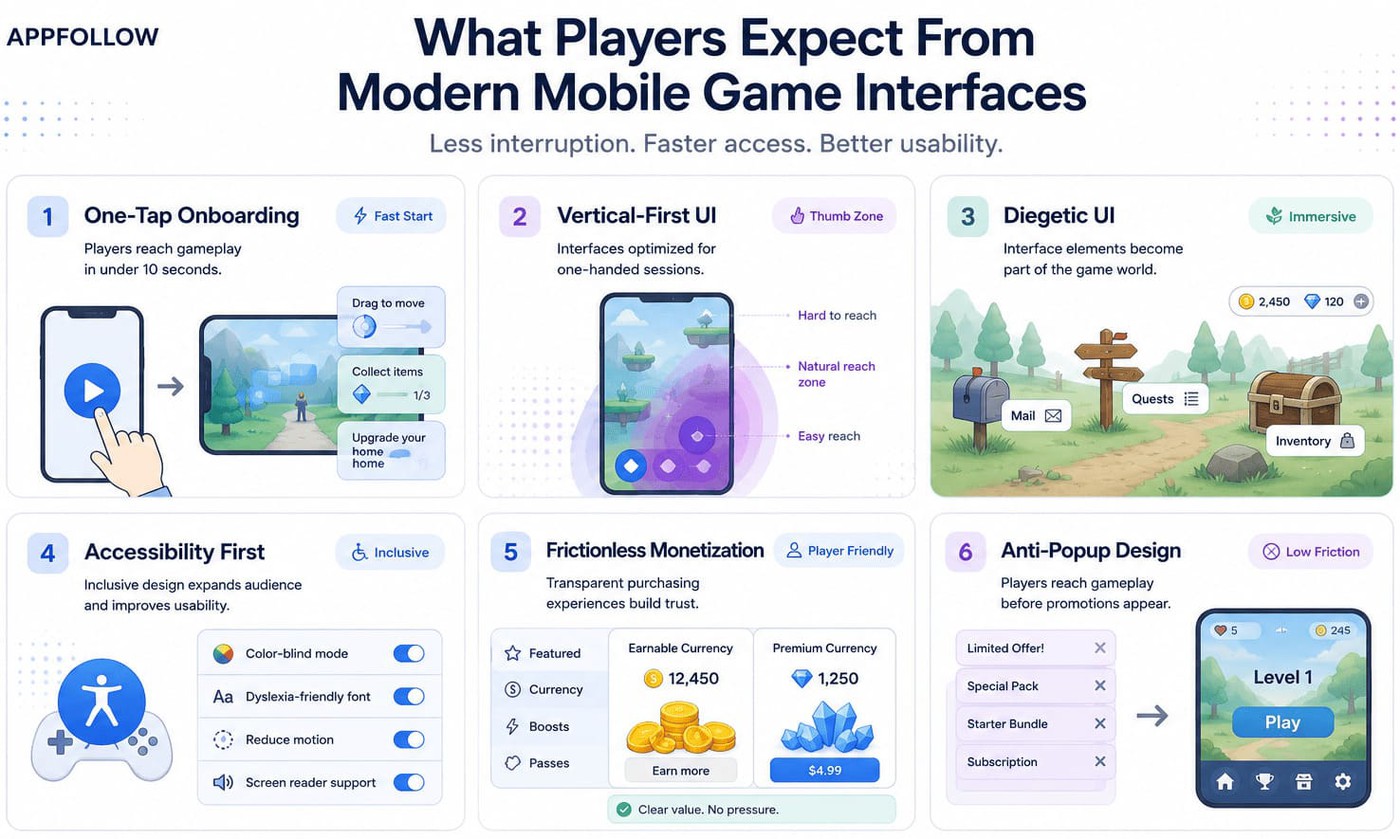
Over the past couple of years, I've noticed the best interfaces becoming easier to ignore. Players get into the game faster, tutorials interrupt them less often, and even monetization screens are starting to feel less intrusive. Good UI is increasingly defined by how little it gets in the way.
One-tap onboarding and zero-friction first session
One of the clearest mobile game UI design trends 2025 data highlighted is the decline of lengthy onboarding sequences.
Studios increasingly measure first-session conversion as closely as monetization. Industry reports from GameAnalytics and Unity have repeatedly highlighted the importance of reducing early-session friction because players often decide whether to continue within the first few minutes after installation. Every extra screen creates another opportunity to leave.
Traditional tutorials that explain every mechanic up front are disappearing. Instead, instructions appear when players need them. A merge game teaches merging through the first move. A strategy game introduces systems gradually. Players learn by doing rather than reading.
Many successful casual and hybrid-casual titles now aim to get users into gameplay in under ten seconds after launch.
Vertical-first UI and one-handed play
Player behavior continues pushing games toward vertical experiences.
Mobile gaming sessions frequently occur during short, on-the-go moments, which is one reason many developers continue optimizing interfaces for one-handed play and vertical interaction. Those moments favor one-handed interaction. Developers have responded by designing around thumb reach rather than screen symmetry.
Buttons, navigation, progression menus, and reward claims increasingly sit in natural touch zones near the bottom of the screen. This trend extends well beyond hyper-casual titles. Puzzle, idle, simulation, and social casino games continue to adopt vertical-first layouts because they align more naturally with how people use their devices.
Diegetic UI for casual and cozy games
Casual and cozy games are increasingly embedding interface elements into the game world itself.
Designers refer to this as diegetic UI. A mailbox becomes a quest center. A signpost handles navigation. Storage systems appear as shelves, chests, or backpacks rather than floating menus.
The approach reduces visual clutter while strengthening immersion. It has become especially common in farming games, life simulations, decorating titles, and other low-pressure experiences where atmosphere is part of the appeal.
Accessibility-first design
Accessibility has become a mainstream design expectation. Apple and Google continue expanding developer guidance around inclusive design, while accessibility features increasingly appear in launch checklists for major releases.
Color-blind modes, scalable text, dyslexia-friendly fonts, customizable controls, reduced-motion settings, and improved readability are appearing in a growing number of releases. Accessibility requests also show up more frequently in review streams than they did a few years ago.
Platform holders continue encouraging inclusive design through developer resources and featuring programs, making accessibility an increasingly common part of launch planning rather than a post-release enhancement.
"Players rarely ask for more UI. They ask for less friction. The best-performing interfaces are often the ones users barely notice."
— Veronika Bocharova, Customer Success, AppFollow
Frictionless monetization screens
Players have become much less tolerant of confusing stores and aggressive purchase prompts. That feedback is showing up in app store reviews, where complaints about cluttered offers, unclear pricing, or constant interruptions appear alongside criticism of the game itself.
As a result, many studios have started cleaning up the purchase experience. Premium and earnable currencies are easier to tell apart, subscription perks are explained more clearly, and store navigation relies less on full-screen popups. Buying something shouldn't feel like solving a puzzle.
When players describe a game's monetization as fair or easy to understand, they're often talking about the interface as much as the pricing. Small UX improvements can have a noticeable impact on how the overall experience is perceived.
The death of the popup-on-open
Few design patterns frustrate players more than launching a game and immediately encountering a stack of offers, subscriptions, event announcements, and promotional messages.
Studios are responding by delaying non-essential prompts, consolidating notifications, or surfacing offers after meaningful gameplay moments instead of before them.
Review analysis frequently links excessive onboarding prompts, offer popups, and notification overload to negative player sentiment, particularly during first-session experiences. Among all current mobile gaming trends, this may be the simplest lesson: players downloaded the game to play it, and the interface should help them get there as quickly as possible.
AI in mobile gaming: future trends for the next 8 years
Ask someone about AI in mobile gaming future trends for the next 8 years, and the conversation usually turns to fully AI-generated games. That is not where the industry is heading first. The biggest changes over the next eight years will happen behind the scenes. AI will help studios create content faster, understand players better, personalize experiences more effectively, and respond to feedback at a scale that was impossible a few years ago.
The future of mobile gaming belongs to teams that use AI as an operational advantage rather than a replacement for designers, writers, artists, or community managers.
Generative content: procedural levels, NPC dialog, side quests
Generative AI is already appearing in game development workflows and live-service content pipelines, although players often do not realize when AI-assisted systems are involved. Loading-screen tips, flavor text, NPC barks, event descriptions, and low-risk side content are increasingly generated or assisted by AI systems.
That pattern will continue through the next three years because it solves a practical problem. Live-service games need enormous amounts of content to keep players engaged. Creating every line manually becomes expensive as games scale.
Writing the main story is a different matter. Players are surprisingly quick to notice when characters all sound the same or dialogue starts feeling repetitive. Some studios have experimented with AI-generated quests and story content, but the results are mixed. Once the emotional moments feel generic, players tend to disengage.
Over the next eight years, expect AI to handle more procedural content generation, especially for puzzle layouts, side missions, event narratives, and personalized progression paths. Human writers will remain responsible for the parts players remember and discuss long after the session ends.
AI-driven matchmaking and dynamic difficulty
Every successful game has a friction cliff. It is the moment when a player becomes frustrated enough to quit.
AI-driven matchmaking and adaptive difficulty systems are increasingly being explored as tools for improving player retention and reducing frustration during critical progression moments. Instead of applying fixed difficulty curves, modern systems can adjust enemy behavior, reward pacing, challenge frequency, or opponent selection based on player behavior during a session.
The retention benefits are significant. A player who experiences steady progress is more likely to return tomorrow.
Of course, there's a limit to how much players will accept. If a game suddenly becomes much easier after several failed attempts, some people notice straight away and feel the challenge has been artificially lowered. In competitive games, even the suspicion that matchmaking is being manipulated can undermine trust.
That's why the most effective AI systems are likely to stay in the background. Small adjustments that smooth out frustration without making players feel they're being steered will probably be far more successful than heavy-handed intervention.
Personalized live-ops via ML
Personalization is becoming a much bigger part of how mobile games keep players engaged and monetize over time. Instead of showing everyone the same offers, machine learning helps studios adapt rewards, events, and promotions to the way different people actually play. Someone who has just started might see a bundle that helps them progress. A long-time player is more likely to receive offers connected to competitive events, collection goals, or content they've already shown interest in.
Many studios are moving toward what analysts call segment-of-one personalization, where offers, rewards, and retention campaigns adapt to individual behavior rather than broad audience segments.
The revenue upside is obvious. Relevant offers convert better than generic promotions.
Players also have limits. Once personalization starts feeling invasive, trust begins to erode. Nobody wants the impression that a game understands their spending habits better than they do. Studios will spend the next several years balancing personalization gains against player comfort and transparency.
Sentiment-driven product decisions
Player feedback volumes have become too large for manual review alone.
The challenge isn't collecting player feedback anymore, but actually making sense of it. Between app store reviews, support conversations, surveys, and community discussions, most studios have more feedback than they can realistically process. AI-powered customer sentiment analysis helps sort that information into themes, making it easier to spot recurring bugs, popular feature requests, or shifts in player sentiment.
Platforms such as AppFollow already use AI to organize review streams this way, so teams spend less time reading individual comments and more time deciding what to fix next.
"The biggest AI opportunity is helping teams understand player feedback at a scale humans can't process manually."
— Yaroslav Rudnitskiy, Senior Professional Services Manager at AppFollow
The real benefit isn't that AI reads reviews faster. It's that teams no longer have to hunt for the signal themselves. Instead of scrolling through thousands of comments, they can focus on the handful of themes players mention again and again.
That shift is likely to make sentiment analysis a standard part of product development over the next few years. The earlier a team notices a change in player expectations, the easier it is to adjust before lower ratings or weaker retention make the problem impossible to ignore.
AI player support and reply automation
Customer support is another area where AI adoption is accelerating.
Tier-one support requests are highly repetitive. Password resets, payment questions, installation issues, and account recovery requests follow predictable patterns. Large language models are increasingly capable of handling these interactions with reasonable accuracy.
Many studios already use AI-assisted response drafting and Workflow Automation to help support teams process higher ticket volumes. Community managers are seeing similar benefits when responding to reviews and public feedback. A good example is Toca Boca. Using automation, the team increased its review reply rate to 75%, a result we explore in our Toca Boca: 75% review reply rate with automation case study.
The interesting part isn't that AI answers more reviews. It's that support teams can spend less time on routine requests and more time helping players with the issues software can't resolve on its own. Billing disputes, harassment reports, and sensitive account problems still need people.
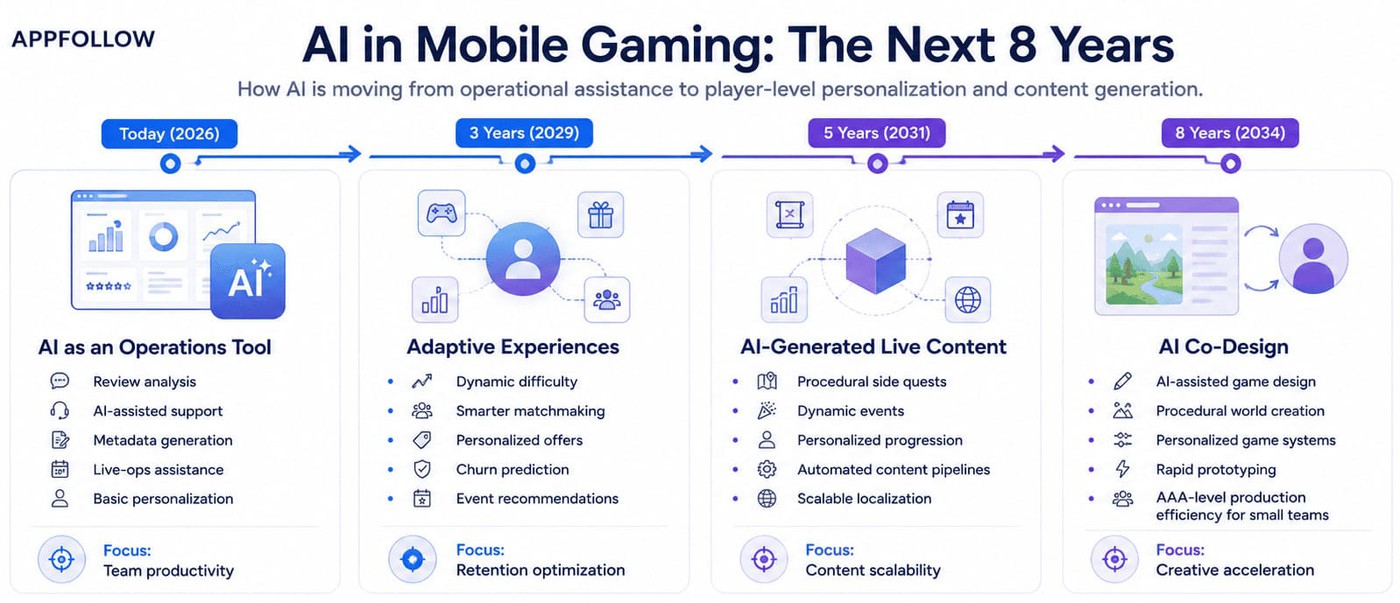
Taken together, these trends point toward a fairly predictable evolution of AI adoption in mobile gaming over the next decade.
The eight-year arc
So what are the AI trends in mobile gaming over the next eight years? The answer is probably less dramatic than many predictions suggest.
2026–2028: Most studios focus on practical wins. AI speeds up content production, helps sort player feedback, supports customer service, and takes repetitive work off developers' plates.
2029–2031: Personalization becomes much more visible to players. Live events, progression, and in-game offers adapt more naturally to individual play styles instead of broad audience segments.
2032–2034: AI starts acting more like a creative collaborator than a production tool. Smaller studios gain access to rapid prototyping, co-design tools, and content-generation workflows that were once realistic only for much larger teams.
Throughout this entire period, human creative direction remains the differentiator. AI can generate options, identify patterns, and accelerate execution. Designers still decide what deserves to reach players.
The privacy and policy headwinds
Every forecast about the future of mobile gaming must include regulation.
The European Union's AI Act is already creating new compliance expectations around transparency, risk management, and disclosure. And Europe isn't the only place where the rules are changing. A growing number of U.S. states are introducing AI legislation, and both Apple and Google regularly update their app store policies as new questions around AI, privacy, and data use emerge.
Studios collecting behavioral data for personalization, matchmaking, or monetization systems will face increasing scrutiny.
The winners over the next eight years are unlikely to be the teams with the most aggressive AI systems, but the teams that earn player trust while using those systems responsibly. Consent, transparency, and clear disclosure are becoming product requirements rather than legal afterthoughts.
cta_free_trial_yellow
Mobile game advertising trends
Advertising remains one of the fastest-changing areas of mobile gaming. The fundamentals are familiar, but the mechanics behind acquisition, monetization, and measurement continue to evolve as platforms, privacy rules, and player expectations change.
Four shifts in 90 seconds
- Header bidding has become the default monetization architecture for many mobile publishers. Industry reports from Liftoff and Unity Ads have documented the gradual shift away from traditional waterfall setups toward real-time auction models. Think of it as an auction instead of a queue. Multiple ad networks compete for the same impression at the same time, giving publishers a better chance of serving the highest-value ad.
- Hybrid monetization is now standard practice. Open almost any top-grossing mobile game and you'll usually find more than one revenue model at work. GameRefinery and Liftoff both describe hybrid monetization as the direction the industry has taken in recent years. Ads, in-app purchases, battle passes, subscriptions, and rewarded video now tend to complement one another instead of competing for the same player.
- Rewarded video has matured into a player expectation. What began as an optional ad format has become a familiar part of the user experience, particularly in casual and hybrid-casual games. Players often expect the ability to watch an ad in exchange for extra lives, currency, boosts, or progression shortcuts. We explored this behavior in more detail in what mobile game players want: monetization insights from app store reviews.
- Measuring user acquisition isn't as straightforward as it was a few years ago. Apple's SKAdNetwork, Google's Privacy Sandbox, and new privacy rules have reduced the amount of user-level data marketers can access. That has pushed many UA teams toward aggregated reporting and a heavier focus on testing creatives to understand what actually drives installs.
These mobile game advertising trends are influencing everything from player acquisition costs to monetization design. For a deeper look at advertising economics, revenue models, attribution, and monetization-specific developments, see our dedicated Mobile Game Monetization guide (forthcoming).
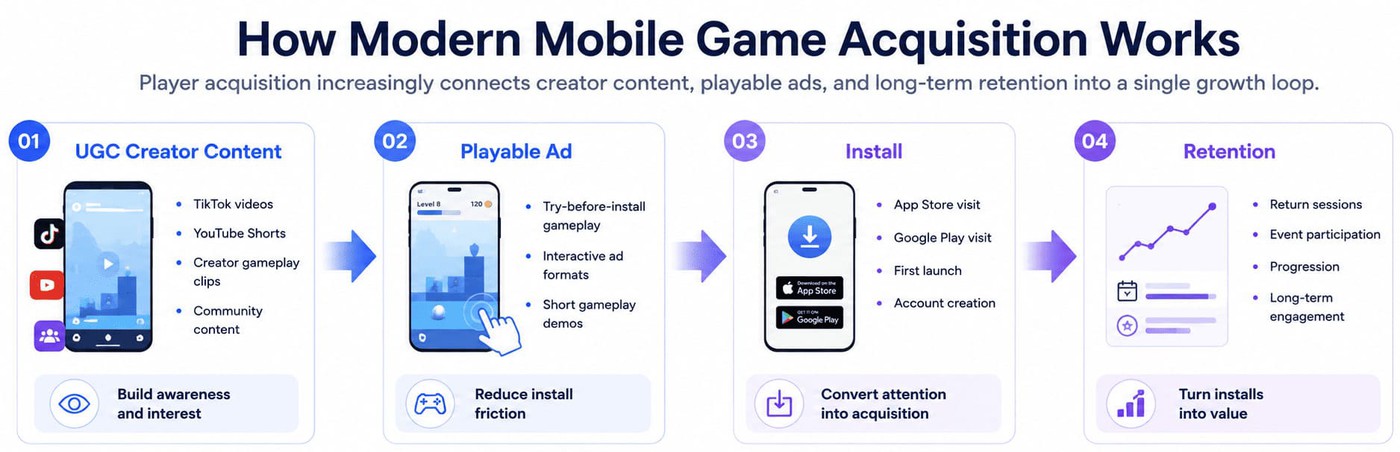
Future of mobile gaming: trends shaping mobile gaming's future
Most predictions about the future of mobile gaming focus on whatever technology is generating headlines at the moment. In practice, the biggest changes tend to arrive more gradually. Hardware improves. Distribution evolves. Players get used to new behaviors. Then, almost without noticing, the industry starts operating differently. Several shifts already underway in 2026 look likely to shape the rest of the decade.
Cloud gaming on phones gets real (finally)
Cloud gaming has spent years hovering between promise and reality. The missing piece was reliability. Players will tolerate a download. They rarely tolerate input lag.
That gap is starting to close. Faster mobile networks, improving cloud infrastructure, and more capable devices are making streamed gaming increasingly practical, a trend highlighted by cloud gaming providers such as Xbox Cloud Gaming and NVIDIA GeForce NOW. Cloud gaming will not replace native mobile games, but it is becoming a viable option for players who want access to larger experiences without investing in dedicated hardware.
Console-quality mobile is the new ceiling
Mobile hardware continues to improve faster than many game-development assumptions.
The latest Apple Silicon and Snapdragon flagship chipsets can support increasingly sophisticated graphics workloads, enabling developers to bring more ambitious experiences to mobile devices. That shift is already influencing what publishers choose to build. Games are becoming larger, visually richer, and more ambitious because the devices can finally support them.
Titles such as Diablo Immortal helped prove that players are willing to invest significant time in deeper mobile experiences. Recent mobile versions of franchises like Resident Evil push that trend further. The question is no longer whether phones can run these games. It is whether developers see mobile as a primary platform from the start.
cta_free_trial_purple
Web games and PWAs comeback
Not every future trend depends on bigger downloads.
Progressive Web Apps (PWAs) and browser-based games are benefiting from improvements in mobile browser performance, device capabilities, and web technologies. A player can discover a game through a link and start playing immediately. No store visit. No installation process. No waiting.
That simplicity matters most in markets where storage limitations, older devices, and data costs still influence player behavior. App stores remain the center of mobile gaming, but browser-based experiences are quietly reclaiming some of the ground they lost years ago.
Alternative app stores and the EU DMA
Regulation is becoming part of the distribution strategy.
The EU Digital Markets Act has opened the door to alternative app marketplaces on iOS, creating new distribution options for publishers operating in Europe. Most players will continue using the App Store because it is familiar and convenient. Even so, a small shift in player behavior can represent meaningful revenue at scale.
That shift has practical consequences. A studio can't assume every player is coming through the same storefront anymore. Watching rankings, reviews, and sentiment across several marketplaces gives a much clearer picture of how a game is performing.
Esports and competitive mobile keep rising
Mobile esports has grown well beyond its early days. Titles such as Mobile Legends: Bang Bang, PUBG Mobile, and Free Fire now fill arenas, attract major sponsors, and draw millions of online viewers through regional and international competitions.
Watching has become part of the experience, too. Plenty of players discover a game through a creator or tournament before they ever install it. Others keep following competitions long after they've stopped playing regularly. For publishers, that extra layer of engagement helps keep games visible between updates and introduces them to new audiences.
Taken together, these developments point toward a future where the distinction between mobile, console, PC, cloud, and web gaming becomes less important. Players care about convenience, continuity, and access. The platforms delivering those experiences most effectively are likely to define the next chapter of mobile gaming.
What player reviews tell us about emerging trends
Across millions of mobile game reviews monitored by AppFollow, the same player signals keep surfacing months before they crystallize into industry trends. The six below are the ones worth watching now. Each is a pattern drawn from anonymized, aggregated review language rather than a single account, and each tends to appear in reviews well before it shows up in revenue charts.
Insight 1: Cozy and wellness language is spreading through 5-star reviews
Low-stress framing now shows up far beyond farming and life-sim titles. Players describe winding down after work, playing without pressure, or appreciating a slower pace — and they do it across puzzle, idle, and simulation games alike. Phrasing like “Finally a game I can play without stress” recurs often enough to read as a category signal, not a coincidence. The practical move is to lean into cozy positioning and low-pressure UX choices early; a rating lift usually arrives before the category surfaces in market reports.
Player review signal: “This is the only game that doesn't stress me out. Finally.”
Insight 2: “AI” has become a polarizing word in reviews
The same three letters now carry opposite meanings depending on the sentence. Players praise AI when it makes opponents feel human or NPCs feel responsive, and they weaponize it when writing feels generated or a system feels manipulative. That split — the lexical shift itself — is the trend worth tracking, because it tells a studio whether its AI features are landing as craft or as a shortcut.
Player review signal (positive): “The AI opponents finally feel human.” — Player review signal (negative): “This dialogue is obviously AI-generated. Refund.”
“The most under-rated trend of 2026 is that players have started using the word ‘AI’ as both a compliment and an accusation in reviews. ‘This AI dialog is so realistic’ on the one hand; ‘this is clearly AI-generated, I want a refund’ on the other. The studios that learn to read that signal — and act on it — will be the ones that ship AI features players actually love.”
— Ilia Kukharev, Product Manager AppFollow
Insight 3: Cross-progression is now make-or-break
Few complaints are as final as losing progress after switching devices. Reviews that mention lost saves, device transfers, or account syncing tend to end in uninstalls, and they spike whenever a new phone cycle lands. Cloud save and cross-platform progression have moved from a premium feature to table stakes.
Player review signal: “Lost all my progress when I switched phones. Done with this game.”
Insight 4: Accessibility complaints have left the niche
Requests for color-blind modes, larger text, dyslexia-friendly fonts, and reduced-motion settings now appear in the review feeds of mainstream titles at meaningful volume — not just in games built around accessibility. Because Apple and Google increasingly weigh inclusive design in featuring decisions, these comments double as both a satisfaction signal and a distribution one.
Player review signal: “Please add a larger font option. I want to keep playing but I can't read the menus.”
Insight 5: Players reward live-ops generosity, and they do it fast
Goodwill gestures move sentiment quickly. Server-outage compensation, anniversary gifts, and unexpected rewards tend to generate sustained 5-star spikes for roughly one to two weeks after the event. The pattern is a useful reminder that retention is emotional as much as mechanical.
Player review signal: “They gave everyone free rewards after the outage. That's why I keep playing this one.”
Insight 6: Region-specific frustration is a leading indicator
Problems often show up unevenly by geography before they register in aggregate. Latency complaints cluster in LATAM, payment-friction complaints in MENA, and localization gaps across Asia — each surfacing in reviews well before it appears in regional revenue figures. Reading reviews by country turns those pockets of frustration into an early map of where the next market problem is forming.
Player review signal: “Great game, but the lag in my region makes ranked unplayable.”
Stay ahead of app store trends with AppFollow
Most studios struggle with figuring out which comments matter before competitors reach the same conclusion. Reviews, ratings, and community discussions generate a constant stream of signals.
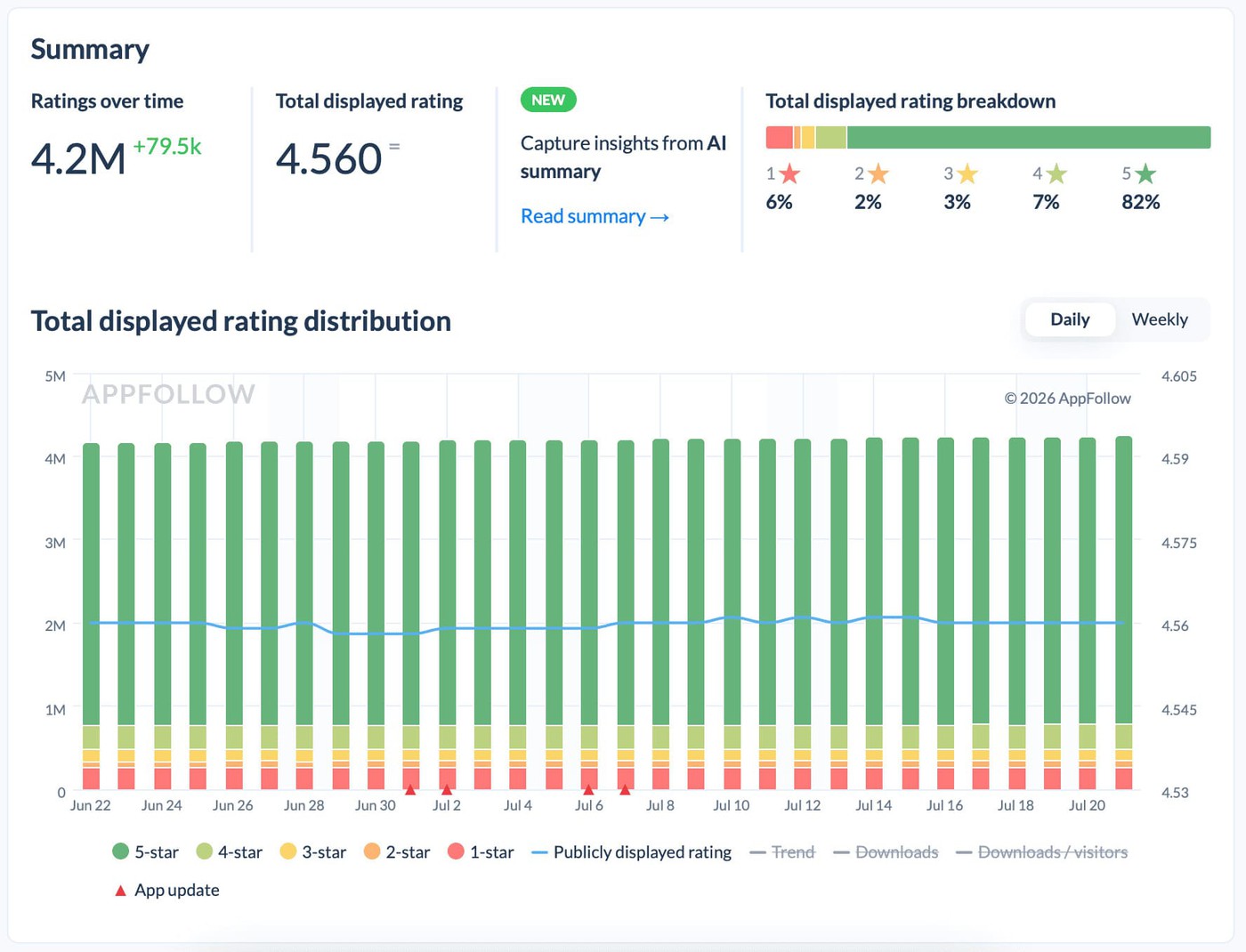
AppFollow's Gaming solution helps teams identify the signals worth acting on before they become obvious to the rest of the market.
Screenshot of the dashboard
- Phrase Analysis. Track the words and phrases players use most often in reviews. Useful for spotting new trend language, recurring complaints, monetization concerns, feature requests, and early signs of player frustration.
- Semantic Analysis and Semantic Tags. Group reviews by meaning, sentiment, and topic instead of reading them one by one. Helps teams detect dissatisfaction drivers, gameplay issues, bugs, pricing complaints, and UX problems before they become rating problems.
- Reviews Feed with multi-app selection. View reviews from several apps, stores, or platforms in one place. Useful for publishers managing a portfolio and comparing how players react across different titles, regions, or store ecosystems.
- Reviews Analysis. Analyze review and rating dynamics by country, tag, and timeframe. Helps teams validate whether a trend is isolated noise or a real pattern affecting player satisfaction.
- AI Summary and AI Summary Comparison. Turn hundreds of reviews into a clear summary of what changed. Teams can compare sentiment before and after an update, event, bug fix, monetization change, or live-ops campaign.
- App Update Timeline and Competitor Analytics. Monitor app updates for your own games and competitors. Useful for connecting release changes with review spikes, rating shifts, and player reactions.
- Feedback Summary Alerts. Send weekly or monthly review digests to Slack or email. Product, ASO, support, and live-ops teams can stay aligned on what players are saying without manually checking dashboards every day.
The teams that stay ahead of gaming trends are not always the ones with the biggest research budgets. They are the ones who notice meaningful player signals early, compare them against the market, and act before the trend becomes obvious to everyone else.
cta_free_trial_yellow
FAQs
What trends are shaping mobile gaming?
Four broad forces are shaping mobile gaming in 2026. Market shifts include hybrid-casual growth and expansion into regions such as LATAM and MENA. Design continues to move toward accessibility and cross-progression, while AI and cloud gaming are driving technology changes. At the same time, new privacy rules and app store policies are influencing how games are distributed and monetized.
What is the future of mobile gaming?
Mobile gaming is becoming less tied to a single device or storefront. Cloud gaming, console-quality experiences, AI-powered personalization, alternative app stores, and competitive mobile esports are all pushing the industry in that direction. Players increasingly expect to move between platforms without losing progress or purchases.
What are the AI trends in mobile gaming over the next 8 years?
The next few years will mostly be about practical uses of AI. Studios are already using it to analyze reviews, speed up customer support, and assist with content creation. Later in the decade, expect more procedural content, deeper personalization, and AI-assisted design tools, with regulation continuing to shape how those systems are used.
What are the current mobile gaming trends?
Right now, the biggest shifts are easy to spot. Hybrid-casual design continues to grow, cross-platform progression is becoming expected, D2C webshops are more common, live-ops calendars are getting busier, creator communities are expanding, and cozy games continue attracting players looking for lower-stress experiences.
What are popular mobile game trends in 2026?
Hybrid-casual games remain one of the biggest success stories, but they're not the only trend worth watching. Cozy games, AI-powered features, cross-progression, live-service content, and direct-to-consumer monetization are all shaping how new mobile games are built and operated.
What are the mobile gaming industry trends?
At the industry level, several long-term shifts are happening at once. Mobile remains the largest gaming segment by revenue, casual games continue to dominate downloads, markets such as LATAM and MENA are attracting more investment, and a relatively small group of publishers still appears near the top of global download rankings.
What are mobile game UI design trends in 2025?
Many of the interface ideas that gained momentum in 2025 are carrying over into 2026. Faster onboarding, vertical-first layouts, accessibility improvements, contextual interfaces, cleaner store screens, and fewer launch popups all reflect the same goal: helping players reach gameplay with less friction.
How do app store reviews predict mobile gaming trends?
Reviews often change before the dashboards do. Players usually start talking about new frustrations, feature requests, or gameplay preferences weeks before those patterns become visible in retention, ratings, or revenue. That's why review analysis can act as an early signal for product teams.
Where can I find mobile game trends news?
If you want to keep up with the industry, Newzoo, Sensor Tower, GameRefinery, Mobile Dev Memo, Deconstructor of Fun, and PocketGamer.biz are all reliable places to start. I also recommend following the AppFollow blog if you're interested in trends emerging directly from player reviews rather than market reports.
How can a small indie team use trend data without a research budget?
Start with your own reviews and a handful of direct competitors. Track recurring themes, follow one or two industry newsletters, and review App Store and Google Play featured collections regularly. Many trend signals are visible without expensive subscriptions.