App Store Optimization Case Studies: 8 Real ASO Wins (2026)

Table of Content:
App store optimization case studies are where ASO advice meets reality. Anyone can recommend updating metadata, testing screenshots, or replying to reviews.
The useful question comes later:
- What changed, and what moved because of it?
- Did search visibility improve?
- Did organic installs grow?
- Did the conversion rate increase?
- Were better app store rankings sustained over time?
That's what this article answers.
Inside, you'll find eight app store optimization case studies built around measurable outcomes, not opinions. Each one starts with a result, explains the change behind it, and ends with a lesson you can apply to your own ASO strategy.
The examples cover both the App Store and Google Play, across gaming, shopping, productivity, and consumer apps. Together, they show how keyword optimization, conversion improvements, and ratings and reviews influence long-term growth. Every app store optimization example comes from a team using AppFollow.
Before diving into the details, here's a quick comparison of all eight case studies and the growth lever each one focused on.
These eight case studies cover three different ASO growth levers: discoverability, conversion, and ratings & reviews. Scan the results first, then dive into the sections that match your current challenge.
App | Primary ASO lever | Headline result | Biggest takeaway |
Hepsiburada | Keyword & metadata optimization | Reached #1 App Store Shopping search visibility | Consistent keyword tracking and metadata updates compound over time. |
Komorebi | Google Play keyword optimization | Increased Google Play search visibility | Expanding indexed keywords improves discoverability. |
James Delivery | Search optimization | Grew search downloads and visibility | Ranking for relevant generic queries drives sustainable organic growth. |
Wachanga | Localization | Expanded visibility across multiple markets | Localized metadata consistently outperforms direct translation. |
Social Quantum | Conversion optimization | Improved store conversion through creative testing | Better visibility only matters if the store page converts. |
Aviasales | Store listing optimization | Increased installs with creative improvements | Creative assets should evolve alongside user intent. |
Toca Boca | Ratings & review management | 109% higher reply rate and 26.7K additional stars | Fast, consistent replies improve both ratings and customer trust. |
Optus | Review automation | Increased reply rate from 60% to 90% | Automation helps large teams maintain review quality without adding manual work. |
Key Insights: What the Best ASO Case Studies Have in Common
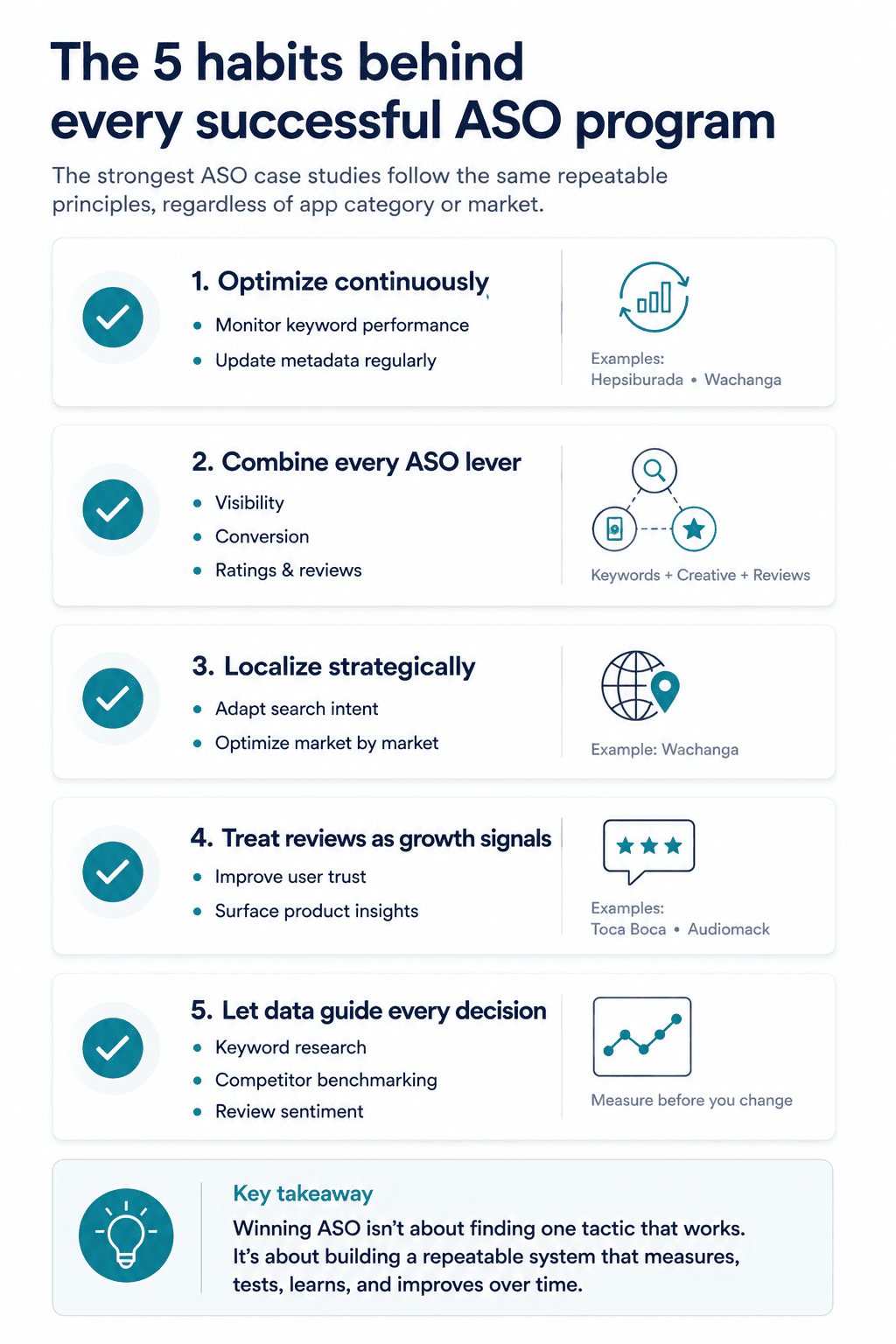
After reading dozens of customer stories, I noticed something reassuring. The biggest wins rarely came from a single breakthrough. They came from teams that built repeatable habits. These app store optimization case studies span different industries, app stores, and growth stages, yet they all followed the same underlying playbook.
- Treat ASO as an ongoing process, not a launch milestone. Hepsiburada didn't reach the top of the Shopping category after one metadata update, and Wachanga didn't expand into multiple markets by translating its listing once. Both teams kept refining keywords, monitoring performance, and iterating as search behavior changed. Continuous testing consistently outperformed one-time optimization.
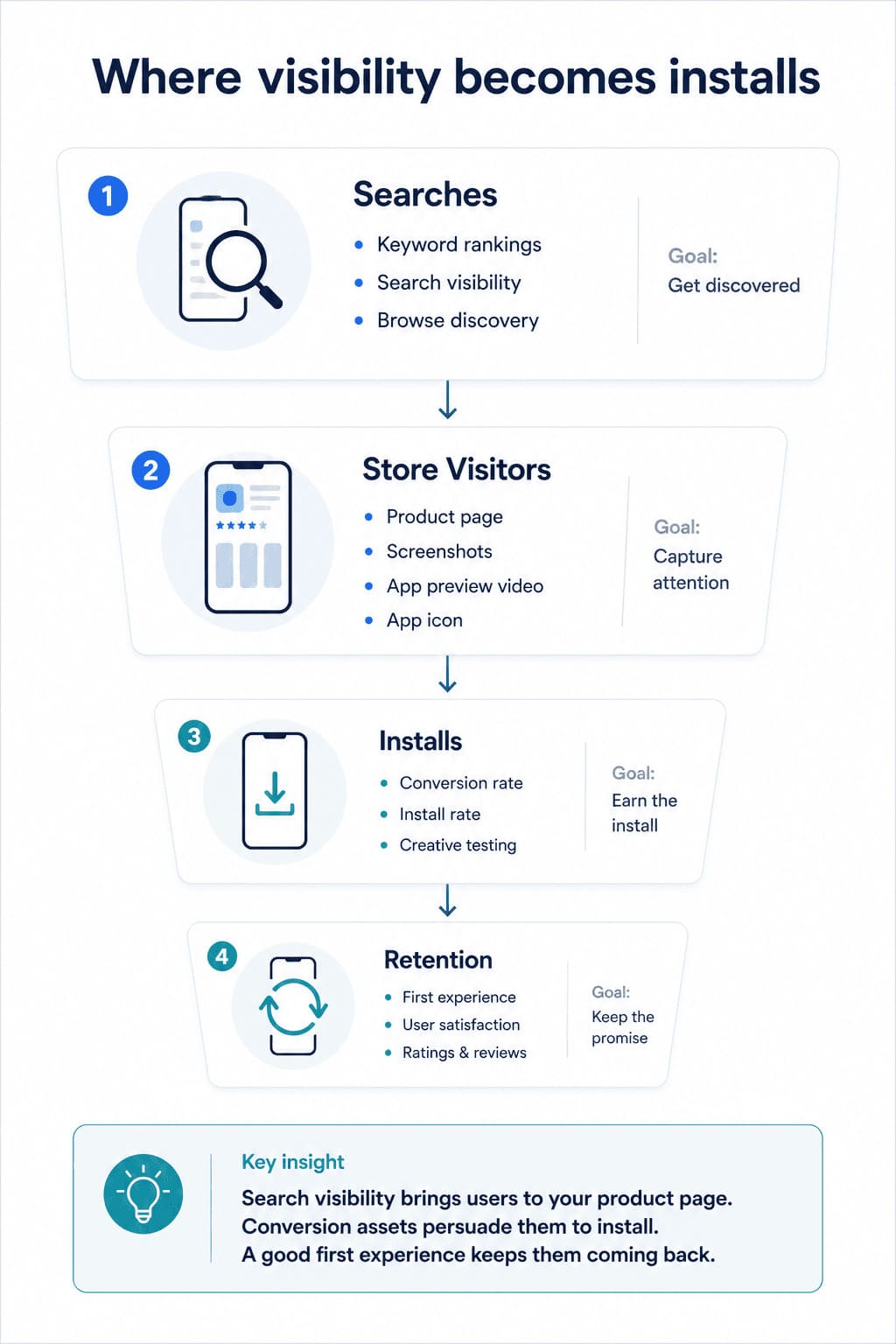
- Visibility, conversion, and reviews work together. Keyword rankings bring people to your listing. Creative assets persuade them to install. Ratings and reviews reinforce trust before they tap the download button. Focusing on just one of these levers limits growth. The strongest app store optimization examples improved all three over time because that's how sustainable gains compound.
- Localization is a growth multiplier, not a finishing touch. Successful localization goes far beyond translation. It adapts metadata, keyword targeting, and messaging to local search habits. Wachanga demonstrated how market-specific optimization accelerated international growth, while other multilingual apps showed that localized ASO creates stronger relevance and better KPI tracking across regions.
- Reviews belong in your ASO strategy. High star ratings improve social proof, while review sentiment reveals what users value and where the product falls short. Teams like Toca Boca, Aviasales, and Audiomack treated review management as a source of product insight rather than a support task. That mindset strengthened both conversion and long-term performance.
- Every meaningful improvement started with data. None of these teams optimized blindly. They relied on keyword research, competitor benchmarking, localization insights, and review sentiment to decide what to change next. The creative came later. The data came first.
"If there's one pattern across every one of these app store optimization case studies, it's the feedback loop: measure, change one variable, measure again. The tooling exists to make that loop weekly instead of quarterly. That's the real unlock."
— Ilia Kukharev, Product Manager, AppFollow
Keyword & metadata optimization case studies
These app store optimization case studies show how stronger metadata and keyword strategy increased discoverability long before conversion optimization entered the picture. Different categories, different markets, different goals.
The winning pattern stayed remarkably consistent:
- identify the right search demand,
- refine metadata continuously,
- then measure what changed.
The following app store optimization examples focus on the first growth lever in ASO: helping more users find the app in the first place.
Hepsiburada: Reaching #1 search visibility in the App Store Shopping category
Hepsiburada reached the top position for App Store Shopping search visibility through a long series of measured experiments, rather than one metadata refresh.
The team first benchmarked its Search Visibility against competitors such as Trendyol and n11, then used keyword and competitor research to iterate on Turkish and English text metadata. Creative testing ran alongside it, including new screenshots and icons, while dedicated analyses prepared the listing for high-intent periods such as Black Friday and New Year's.
The scale of that testing matters: over the partnership, the teams completed 17 text iterations, 15 traffic reports, four Custom Product Page analyses, two market analyses, and an In-App Events strategy. Performance was reviewed throughout, so each round of metadata or creative work could build on what the previous one had shown.
Those steady iterations helped increase App Store Search Visibility by 113% during the first year before eventually securing the number one position in the Shopping category. Downloads also climbed as visibility improved.
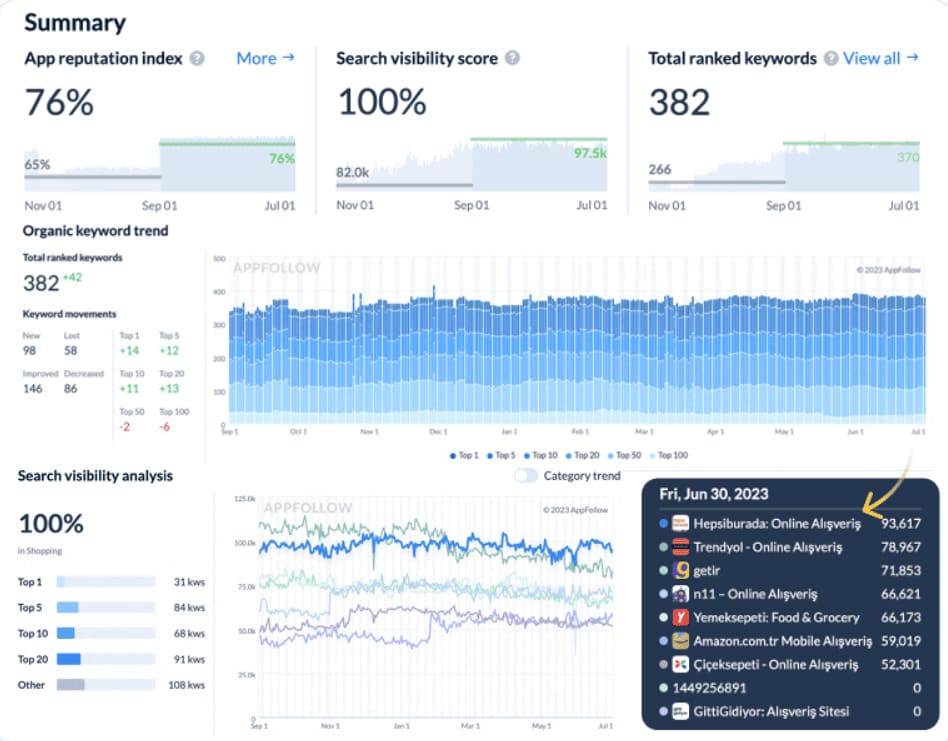
Hepsiburada reached #1 in App Store Search Visibility for the Shopping category after two years of continuous ASO optimization.
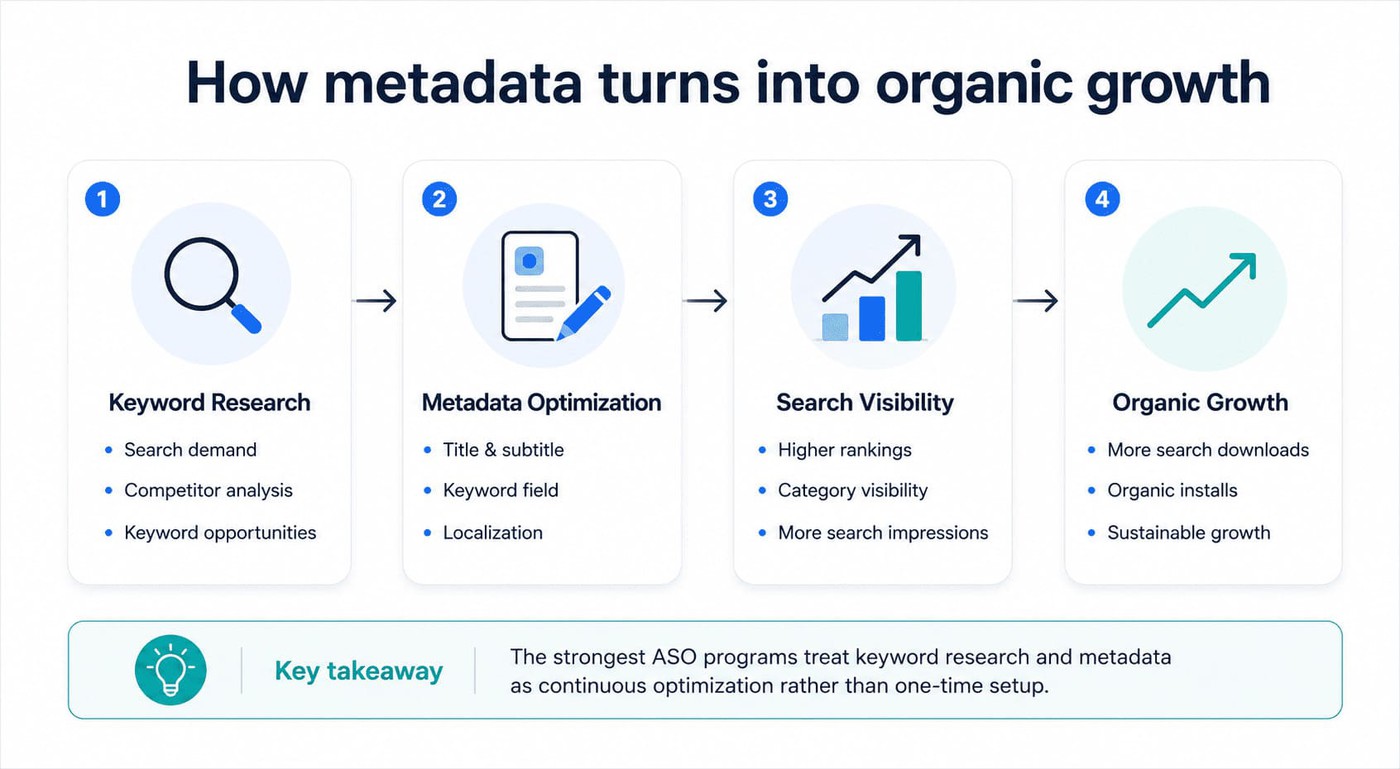
This is where disciplined keyword research pays off. Metadata isn't a document you finish. It's a living asset that evolves with changing search behavior.
Metadata is the highest-leverage surface in ASO because it feeds both the algorithm and the shopper. When we rebuild a title and keyword field around real search demand, then localize it market by market, visibility gains compound fast, exactly as they did across these accounts.
— Yaroslav Rudnitskiy, Senior Professional Services Manager (ASO), AppFollow
cta_get_started_purple
Komorebi: Expanding Google Play visibility across 15 locales
Komorebi transformed a simple shopping list app into a much more discoverable product by treating localization as part of its keyword strategy rather than a translation exercise.
Instead of relying on the same metadata everywhere, the team optimized its Google Play listings across 15 locales, adapting keywords and metadata to each market. The results followed: the number of indexed keywords grew fourfold and visibility increased 14×. Organic downloads grew by more than 180%, while page views rose 166%, all without increasing paid acquisition.
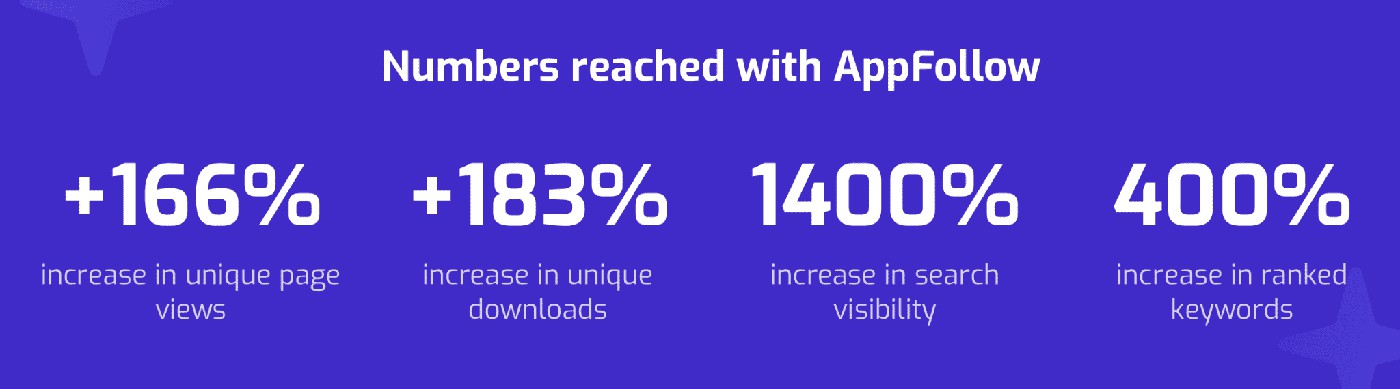
The takeaway is practical. Review indexed keywords inside Google Play Console, monitor keyword density, and adapt metadata to local search habits instead of copying the same app store listing into every market.
Teams new to Android ASO often underestimate how indexed keywords influence discoverability. Our Google Play ASO keywords guide breaks down how to prioritize and optimize them.
James Delivery: Growing search downloads through constant iteration
James Delivery built its ASO process around frequent measurement and experimentation rather than chasing a single high-volume keyword. The team monitored Search Visibility and keyword rankings daily, used the ASO Dashboard to spot changes quickly, and treated metadata updates as experiments. Results from each iteration fed into the next one, while dashboard data was turned into internal reports for executives involved in the company's growth strategy.
“ASO Dashboard can provide very useful and quick information. We are now able to quickly iterate with our app metadata as A/B tests and experiments are a big part of James Delivery’s culture. Additionally, ASO Dashboard helps us to create internal reports that we share with C-level executives involved in our growth strategy.”
— James Delivery
Within just six weeks, Search Visibility increased by 5.6% on iOS and 5.3% on Android, while Search Downloads grew 11.5% and 23.4%, respectively.
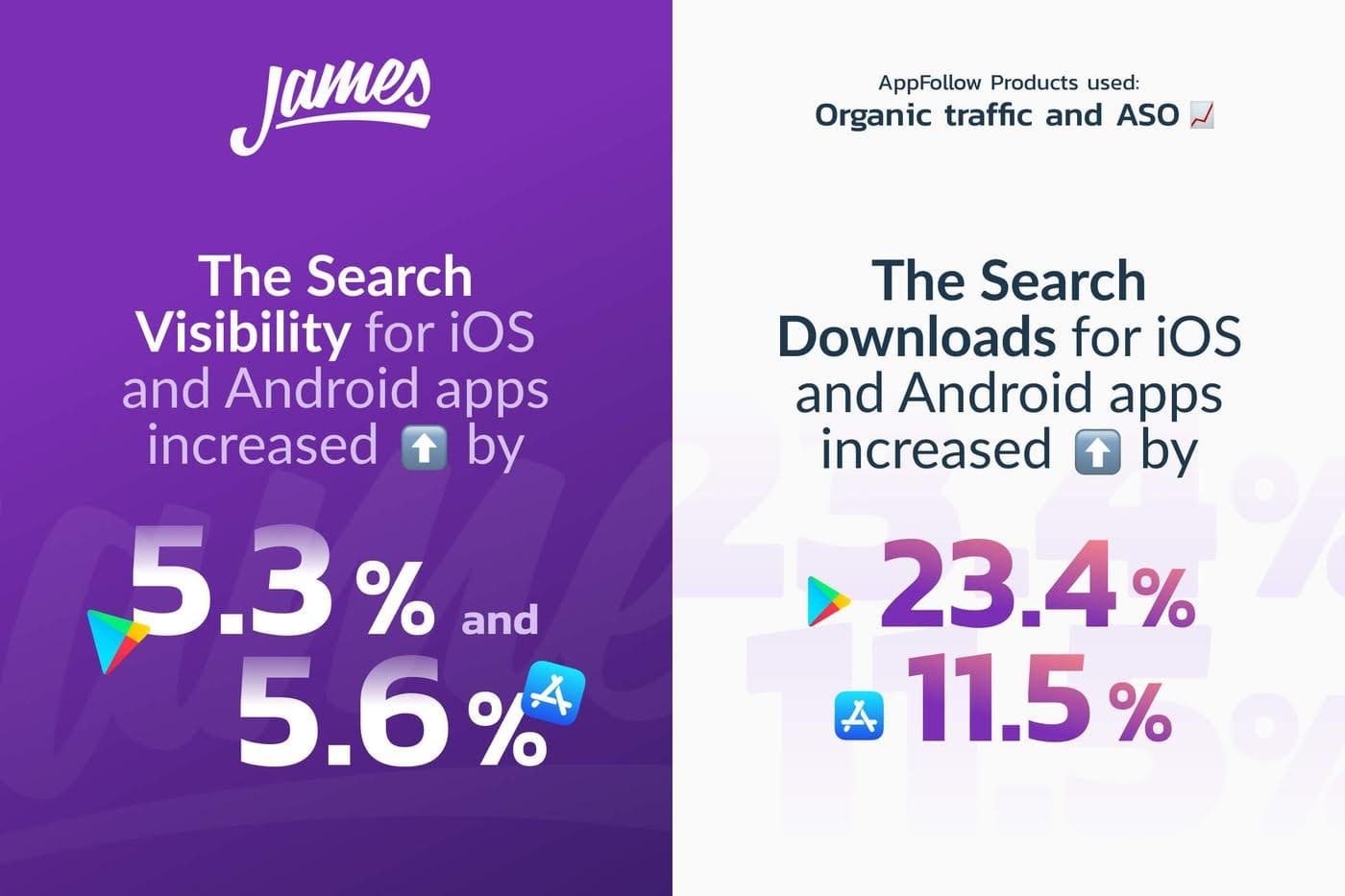
The team was also looking beyond branded traffic. Improving positions for relevant generic keywords expanded the app’s ranking portfolio and gave James Delivery more opportunities to capture users already searching for delivery services.
That’s the useful part for growth teams: measurement wasn’t the final reporting step. It determined what the team tested next.
Wachanga: Entering the top 50 across six countries after launch
Wachanga made localization part of Babycare’s ASO before launch. The team mapped competitors and their keywords, built a semantic core from real search terms and synonyms, then adapted the title, subtitle, keyword field, icon, and screenshots.
It also translated and localized the app for international markets and interviewed mothers in different countries to understand the language they used around breastfeeding and baby care.
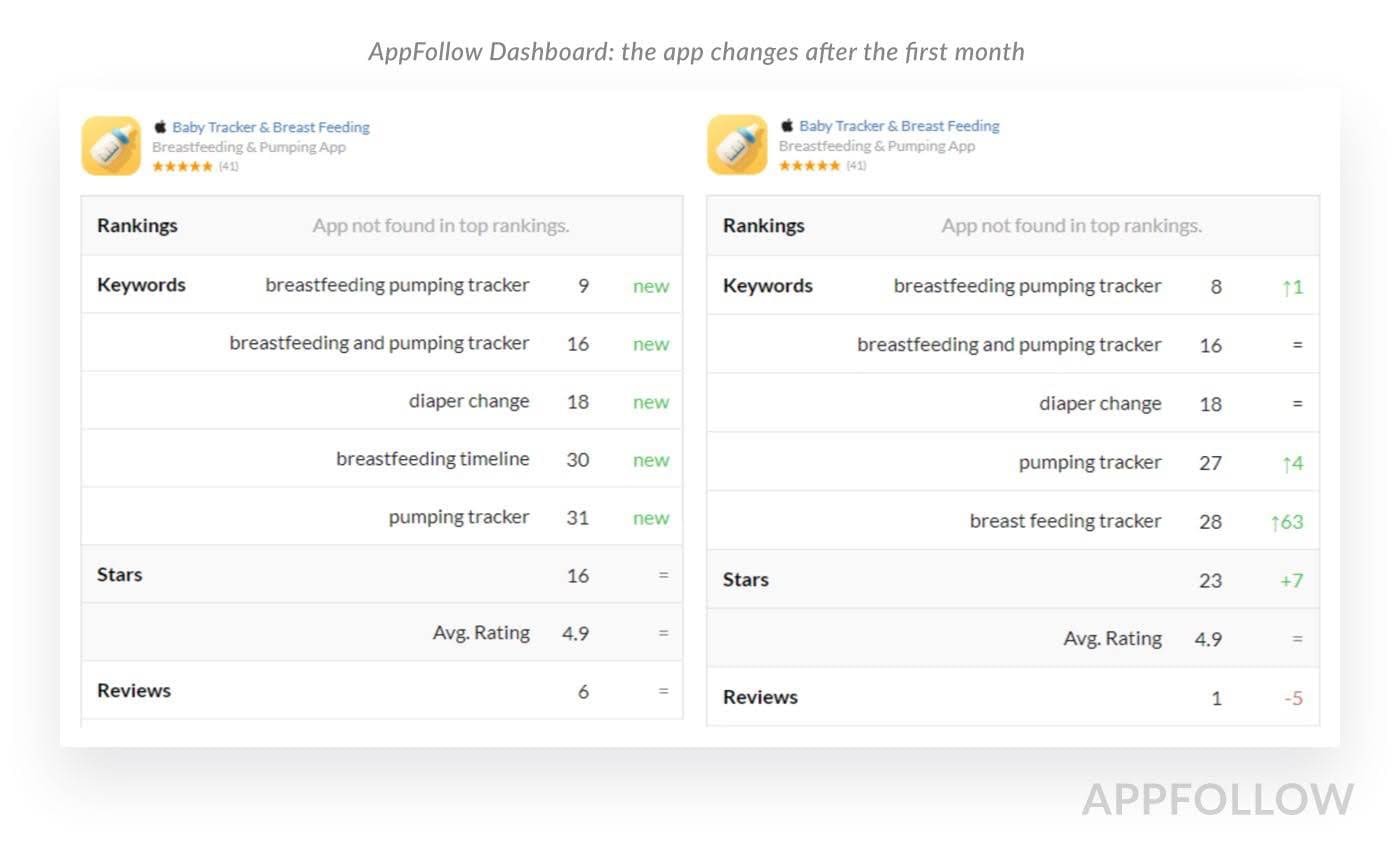
Crucially, Wachanga didn't maximize keyword volume for its own sake. In Russia, the team used only about 50% of the relevant keywords it had identified, finding that weaker terms brought a less relevant audience and hurt conversion.
Within the first month, Babycare entered the Top 30 for important search queries, with title keywords gaining as many as 63 positions in the US. Within nine weeks, the app reached the Top 50 in the Medical category in five countries, maintained a 4.8 average rating, and became profitable after two weeks.
"The mistake we correct most often is treating keyword research as a one-time setup. The teams that win, like the ones here, re-check keyword rankings and competitor moves every week and adjust metadata continuously."
— Ilya Kataev, Professional Services Team Lead, AppFollow
Conversion rate optimization case studies
Higher rankings don't guarantee more installs. They only get people to your product page. What happens next depends on the quality of your creative, your messaging, and how well your listing matches user intent. Many of those signals work together rather than in isolation, as we explain in our guide to App Store Ranking Factors.
The next app store optimization examples focus on that second growth lever. Every app store optimization example below shows the same pattern: improve the product page, measure the response, then refine it again.
Social Quantum: 110% more organic installs with an app preview video
Social Quantum increased Megapolis organic installs by 110%, but the preview video wasn't its first experiment. The team began by refreshing the store page, then worked on the icon and keywords to improve how Megapolis appeared in search. After testing several ASO approaches, it turned to the product-page creative and introduced an App Store preview video that showed the gameplay before users had to scroll.
That change produced the breakthrough. Over four months, organic installs increased 110% and impression-to-install conversion improved 82.7%. The team then localized the video for additional markets rather than assuming the original creative would perform equally well everywhere.
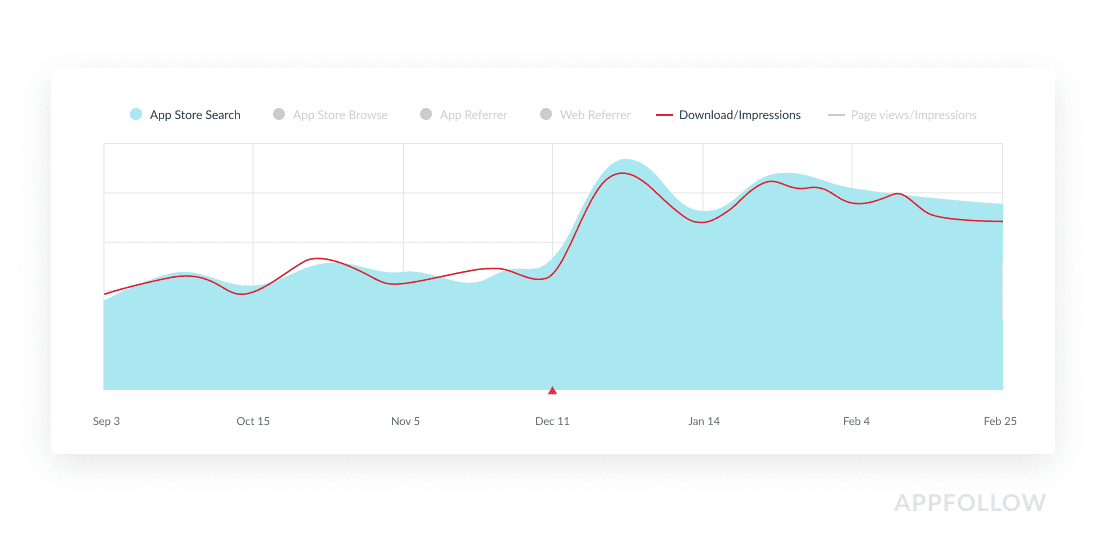
The useful lesson is the sequence: fix discoverability, test the store presentation, then isolate the creative that changes conversion. The video wasn't decoration. It was the experiment that finally moved the metric.
"Conversion is where ASO stops being a keyword game and becomes a messaging game. A preview video or a re-sequenced first screenshot can add double-digit percentage points to organic installs, but only if you A/B test it against real store traffic instead of guessing."
— Dzianis Shalkou, Senior Professional Services Manager, AppFollow
Earth Hero: Using ASO data to shape the product page and the product
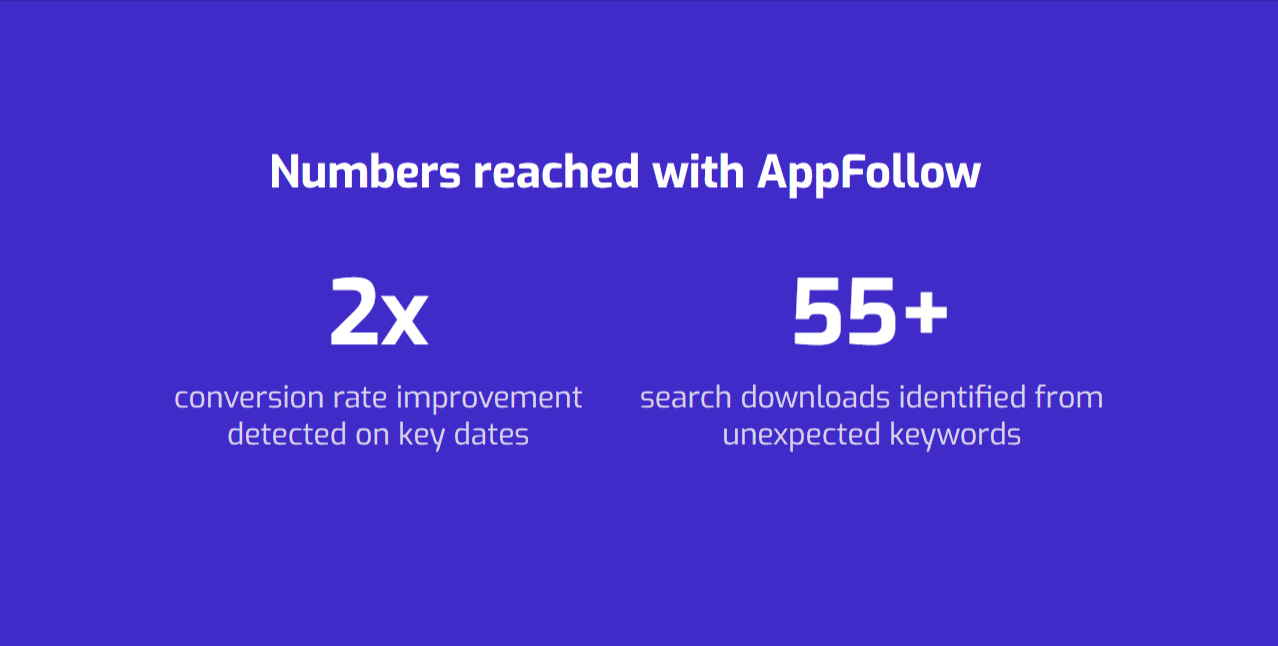
Earth Hero used ASO data as a research tool, not just a performance report. The team monitored search trends, semantic tags, visibility, downloads, and conversion, then investigated unusual movements instead of treating them as isolated numbers. That process uncovered an Earth Day spike they hadn't previously identified, which informed new campaign ideas. When downloads jumped and conversion rates doubled, the team could trace the dates and investigate what had driven the change.
Search language fed into product decisions too. When “sustainability reminder” began trending, Earth Hero used that signal when considering future app features. Those audience insights also helped the team refine its positioning and store messaging around what users were actually looking for.
"The data direction matters as much as the creative. We start from what users search and what reviewers praise, then design the product page to mirror that language. That's how Earth Hero kept messaging and store assets pulling in the same direction."
— Karen Taborda, Customer Growth Team Lead, AppFollow
For creative decisions, that same evidence can be paired with app competitor analysis to benchmark positioning and product-page assets before the next test.
cta_get_started_yellow
Ratings & Reviews Case Studies
Many articles treat reviews as customer support. These app store optimization case studies tell a different story. Ratings and reviews influence how users perceive an app before downloading it, while fresh feedback helps teams improve both the product and the store listing. That makes review management both a conversion lever and a long-term ASO signal.
Toca Boca: 109% higher reply rate and 26,700 additional stars
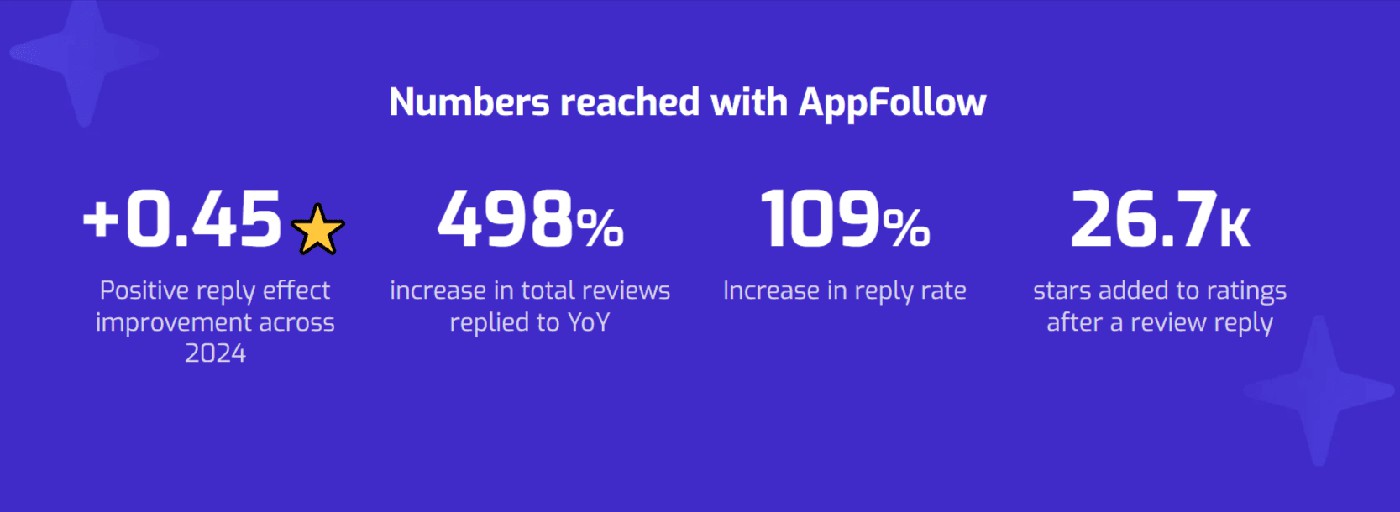
Toca Boca started 2025 with a 36.77% reply rate and a -0.3 reply effect, then rebuilt its review workflow in three phases. Instead of requiring high confidence before automating a response, the team expanded automation while using template folders and AI rephrasing to keep replies aligned with its tone of voice. Complex cases were routed to support rather than forced through automation.
One experiment was especially revealing: a universal automation for 1-star reviews handled 13,800 reviews and achieved a +1.71 reply effect. By the end of the period, Toca Boca's overall reply rate had reached 71.76%, with reply effect improving to +0.15. The team replied to 498% more reviews year over year, while replies contributed 26,700 additional stars in H2.
"Ratings are an ASO lever people forget. A higher star rating lifts conversion on every impression you already earn, and the 'reply effect' nudges users to raise their scores. That's why review management belongs in the same strategy as keywords."
— Veronika Bocharova, Customer Success Manager, AppFollow
Aviasales: Maintaining a 4.9-star average through smarter review prompts
Aviasales introduced an in-app rating request as part of its App Store conversion strategy, but the resulting surge in feedback created another problem: more reviews meant more negative feedback to monitor and resolve. The team responded with a three-step workflow.
Reviews were funneled into a dedicated Slack channel and tagged by topic, sending bugs to QA and feature requests to developers. AppFollow was also integrated with Aviasales' help desk, turning new and updated reviews into tickets so rating changes weren't missed. Twice a month, the team reported spam, ads, and offensive reviews, with 80% of those reports typically resulting in removal.
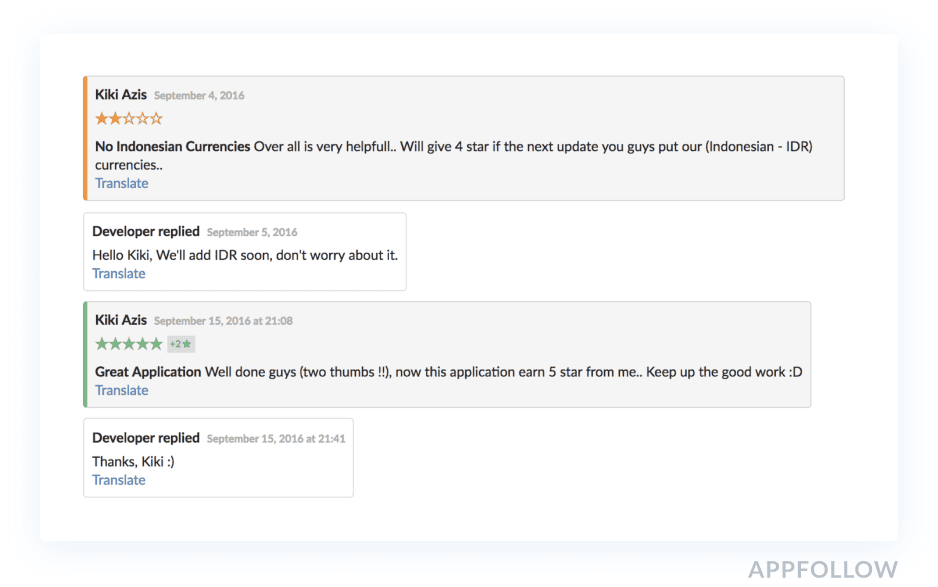
The workflow ran for eight months. Aviasales maintained a 4.8 average rating for almost a year, replied to more than half of all reviews, and found that 60% of users changed negative reviews to positive after a fast developer response.
Audiomack: 501% ROI from review automation
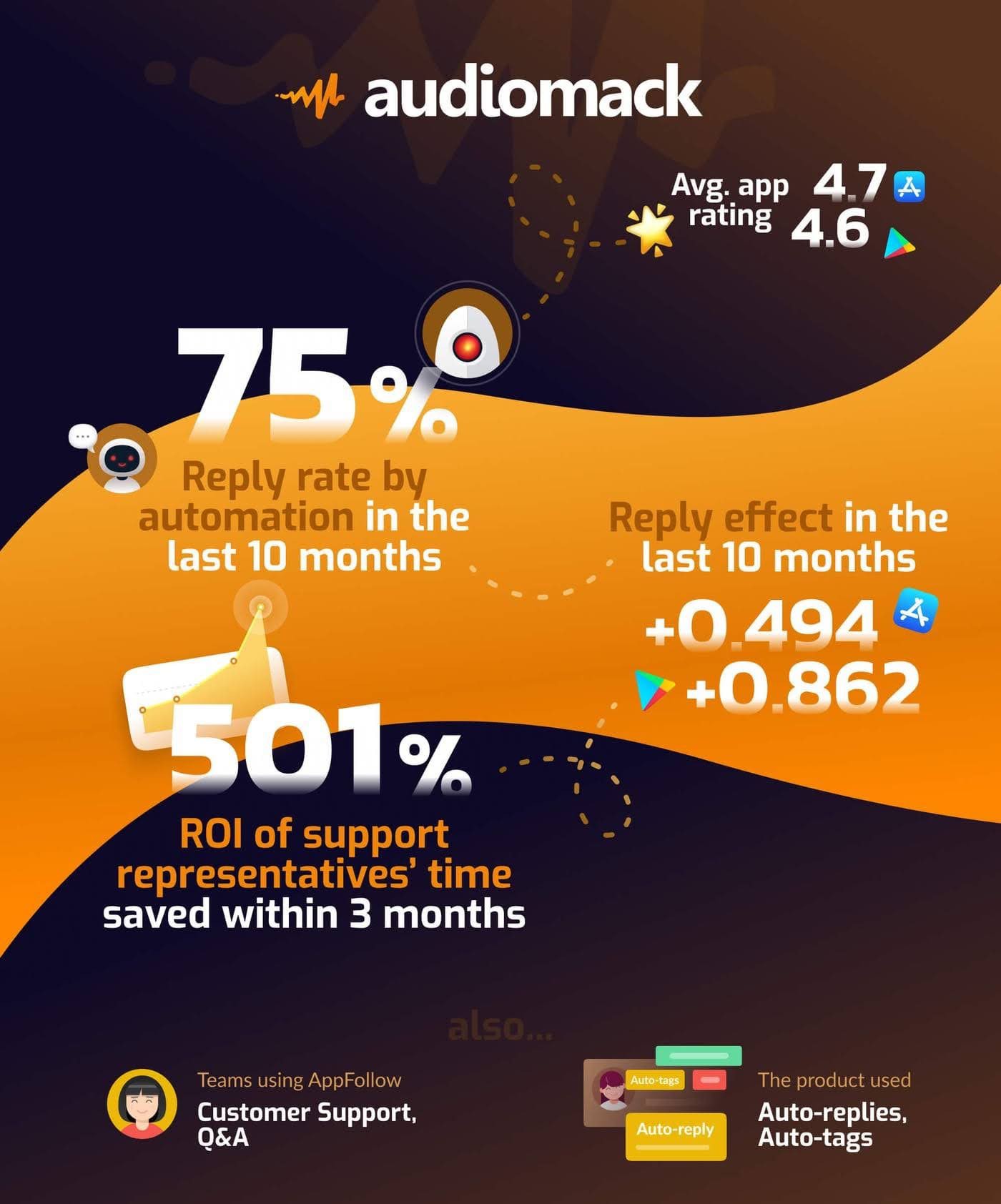
Audiomack needed to handle growing review volume without growing its support team at the same pace. Instead of automating everything at once, the team built around 50 auto-reply workflows for frequent cases and 30 auto-tag workflows to organize feedback. Tags helped QA and Customer Support track recurring bugs and technical blockers, while reporting showed where the workflows needed another iteration. Over 10 months, automation handled 75% of review replies.
“We cover the most frequent cases and always iterate. Reporting is crucial and the number one priority for the team, so AppFollow’s auto-tags really help us here.”
— Elizabeth McBride, QA Analyst, Audiomack
The operational savings translated into a measurable business result: 501% ROI from support representatives' time saved within three months. Reply effect over the 10-month period reached +0.494 on iOS and +0.862 on Android.
"At scale, you cannot reply manually. Toca Boca and Audiomack succeeded because automation let them respond quickly, in every language, without adding headcount. Speed is often what turns an unhappy one-star review into an updated five-star rating."
— Lucija Knezic, Senior CSM & Product Strategy Manager, AppFollow
Together, these cases make the strongest argument in the article. Keyword research helps users discover your app. Creative assets persuade them to install it. Ratings and reviews determine how much trust you've earned before they ever tap Download.
That's why teams increasingly rely on AI-powered review management and workflow automation to keep feedback flowing, identify emerging issues, and respond consistently as their apps grow.
Grow your app downloads in app stores with AppFollow
The teams behind these case studies — ASO managers, mobile marketers, and publishers — don't run optimization out of scattered spreadsheets. They use AppFollow to manage the full ASO cycle in one place: research keywords, track rankings, test store creative, and reply to reviews, then measure what each change actually moved. That's how the measure-change-measure loop turns from a quarterly project into a weekly habit — the difference between the apps that plateau and the ones you've just read about.
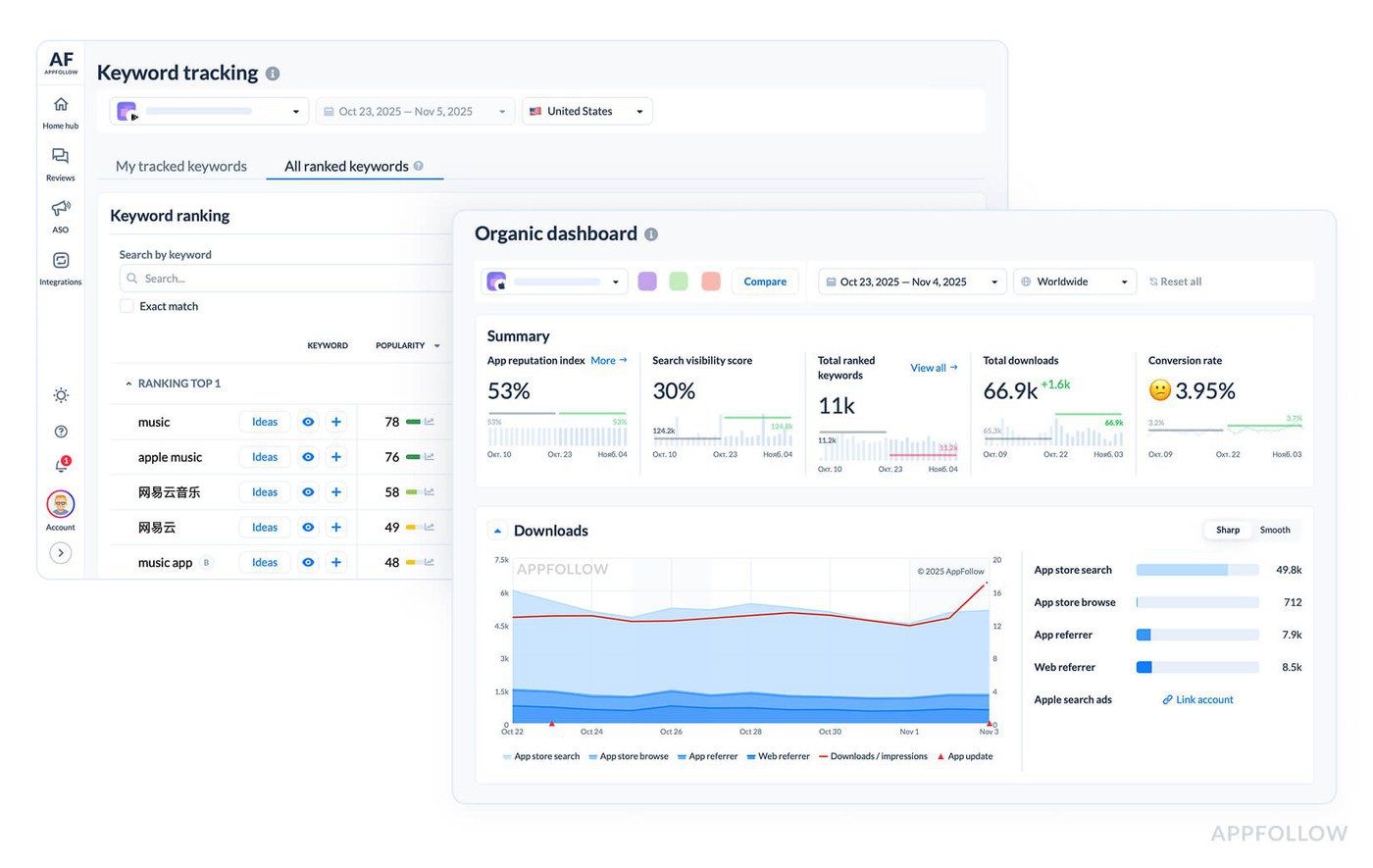
The capabilities that map directly to the wins above:
- ASO Tools — keyword research, rank tracking, and metadata management, with app store analytics to prove which change lifted visibility (the Hepsiburada and Wachanga lever).
- AI review management — monitor and reply to App Store and Google Play reviews at scale, with sentiment analysis that surfaces recurring themes (the Toca Boca and Aviasales lever).
- Workflow automation — auto-route and auto-reply in every language, so response speed scales without adding headcount (how Audiomack reached 501% ROI).
- App competitor analysis — benchmark keywords, creatives, and rankings against rival apps before you test a new product page (the Social Quantum and Earth Hero lever).
- ASO consultancy — hands-on help from the experts quoted in this article when you'd rather run the playbook with a specialist.
cta_get_started_purple
Frequently Asked Questions
What is an app store optimization case study?
An app store optimization case study documents how an app improved measurable ASO outcomes through specific changes. Instead of sharing general advice, it explains the challenge, the actions taken, and the results, whether that's higher search visibility, stronger conversion, more organic installs, or better ratings. The best case studies also show why those changes worked, making them easier to adapt to your own app.
What are some real app store optimization examples?
The app store optimization examples in this article highlight different growth levers. Hepsiburada reached the top search visibility position in the App Store Shopping category through continuous keyword optimization. Social Quantum increased organic installs by 110% after introducing an app preview video. Toca Boca improved its reply rate by 109% and generated 26,700 additional stars by automating review management. Each story demonstrates a different way to strengthen long-term app growth.
How long does it take to see ASO results?
It depends on what you're changing, but meaningful improvements often appear within a few weeks to a few months. Wachanga reached the Top 50 in six countries only weeks after launch with a localized ASO strategy, while Hepsiburada's search visibility grew steadily through continuous optimization over a longer period. Quick wins are possible, but sustained growth usually comes from ongoing iteration rather than one major update.
Do ratings and reviews affect app store ranking?
Yes, indirectly, and they have a direct impact on conversion. Higher star ratings and positive reviews increase user trust, making visitors more likely to install your app. Review management also helps identify recurring issues that influence future updates. While Apple and Google don't publish the exact weight of every ranking signal, consistently strong ratings and reviews are widely recognized as an important part of a healthy ASO strategy.
What tools do I need to run ASO like these examples?
Most successful ASO teams rely on the same core capabilities: keyword research, rank tracking, competitor analysis, app store analytics, and review management. The goal isn't to collect more data. It's to connect every change to a measurable outcome. Platforms like AppFollow ASO Tools bring those workflows together, helping teams monitor rankings, analyze competitors, manage reviews, and measure the impact of every optimization in one place.