Mobile Game Ads: 7 Ad Formats + Monetization Guide for Publishers

Table of Content:
- Key insights: the mobile game ad landscape in 2026
- Mobile game monetization models: IAP, ads, or hybrid
- The 7 popular mobile game ad formats
- Mobile ad mediation: running these formats at scale
- Ad creative best practices for mobile game campaigns
- Mobile game advertising trends worth watching in 2026
- See what your ads cost you in reviews, ratings, and rankings
- Frequently asked questions about mobile game ads
Mobile game ads pay the bills for most F2P games. The popular mobile game ad formats you choose, and more importantly, where you place them, can improve revenue or undo months of work on retention. Teams chase bugs and rebalance economies for months, then discover that an aggressive interstitial after the first session did more damage than either.
This guide explains the seven ad formats every publisher should know, including typical eCPM ranges, player-experience costs, and where each one fits within an ad monetization strategy. You'll also learn when hybrid monetization outperforms relying on ads or IAP alone, how ad mediation affects revenue, what separates effective creative from expensive noise, and which mobile gaming ad trends are shaping 2026.
One thing is worth keeping in mind from the start: the highest eCPM doesn't always produce the healthiest game. Every ad format asks players to make a trade-off. The better you understand those trade-offs, the easier it becomes to balance revenue with long-term engagement instead of sacrificing one for the other.
This isn't an ad network comparison or a mediation platform review. AppFollow doesn't serve ads or optimize monetization. It's a publisher-side reference that also shows how reviews, ratings, ASO signals, and competitor insights reveal whether your monetization strategy is helping your game grow or quietly driving players away.
We'll start with today's ad formats, then move through monetization models, mediation, creative strategy, and the trends shaping mobile game advertising in 2026.
Key insights: the mobile game ad landscape in 2026
If you've spent any time comparing mobile game ads, you've probably noticed that there isn't a universally "best" format. Every option trades revenue for player experience differently. The popular mobile game ad formats below cover almost every monetization scenario you'll encounter, whether you're optimizing ad ARPDAU, balancing hybrid monetization with IAP, or adapting to attribution changes introduced by SKAdNetwork.
If your priority is... | Start with... | Because |
|---|---|---|
Highest eCPM per impression | Rewarded video | Opt-in attention earns the top rate of any format |
Strongest install intent | Playable ads | Players try the mechanic before they commit |
Lowest player disruption | Native ads | Sits in menus and feeds rather than over gameplay |
Continuous background revenue | Banner ads | Small per impression, constant across long sessions |
Tentpole events and IP launches | Rich media | One slot carries multiple assets |
A few numbers are worth keeping in mind before diving into individual formats:
- Global mobile game ad revenue surpassed $80 billion in 2024, while hybrid monetization combining ads and IAP continued to outpace both ads-only and purchase-only models. (SensorTower)
- Rewarded video consistently delivers the highest eCPM, typically $10–30 per 1,000 impressions in top-tier markets.
- Interstitials usually generate $4–15 eCPM, while banner ads remain the lowest-paying format at roughly $0.10–1 eCPM.
- Playable ads often convert four to seven times better than static creatives, although production costs are several times higher. (AppsFlyer)
- Games showing more than three interstitials per session typically see 20–30% lower D7 retention than games that keep frequency under control.
- AppLovin, Unity LevelPlay (formerly ironSource), and Google AdMob account for well over half of revenue generated through mobile gaming ads, making mediation strategy almost as important as format selection.
"Publishers often separate ad monetization from ASO. In practice, they're connected. An intrusive ad shortens sessions, weaker sessions reduce retention, and weaker retention eventually affects store visibility. A short-term lift in ad revenue can quietly become a long-term discoverability problem. The strongest teams monitor both signals together."
— Yaroslav Rudnitskiy, Senior Professional Services Manager (ASO) at Appfollow
Mobile game monetization models: IAP, ads, or hybrid
Mobile games monetize in three shapes: pure IAP, pure ads, or hybrid. The right shape depends on your genre, session length, and whom you're trying to keep engaged.
Most publishers open with the wrong question: which monetization model makes the most money. The better question is which one fits how players already use the game. A better question is which one fits how players already use the game.
Pure in-app purchase models work well for mid-core and gacha titles, where a relatively small group of paying users drives most revenue. Games like Genshin Impact and Clash Royale fit that pattern.
At the other end of the spectrum, hyper-casual hits and lightweight casual games often rely almost entirely on mobile game ads because sessions are short and payer conversion is low. Titles from Voodoo or games like Mob Control are good examples.
Most publishers, however, land somewhere in the middle. Hybrid monetization combines IAP with advertising so that paying users spend directly while everyone else contributes through ad impressions. Games such as Candy Crush Saga and Wordscapes have shown how effective that balance can be.
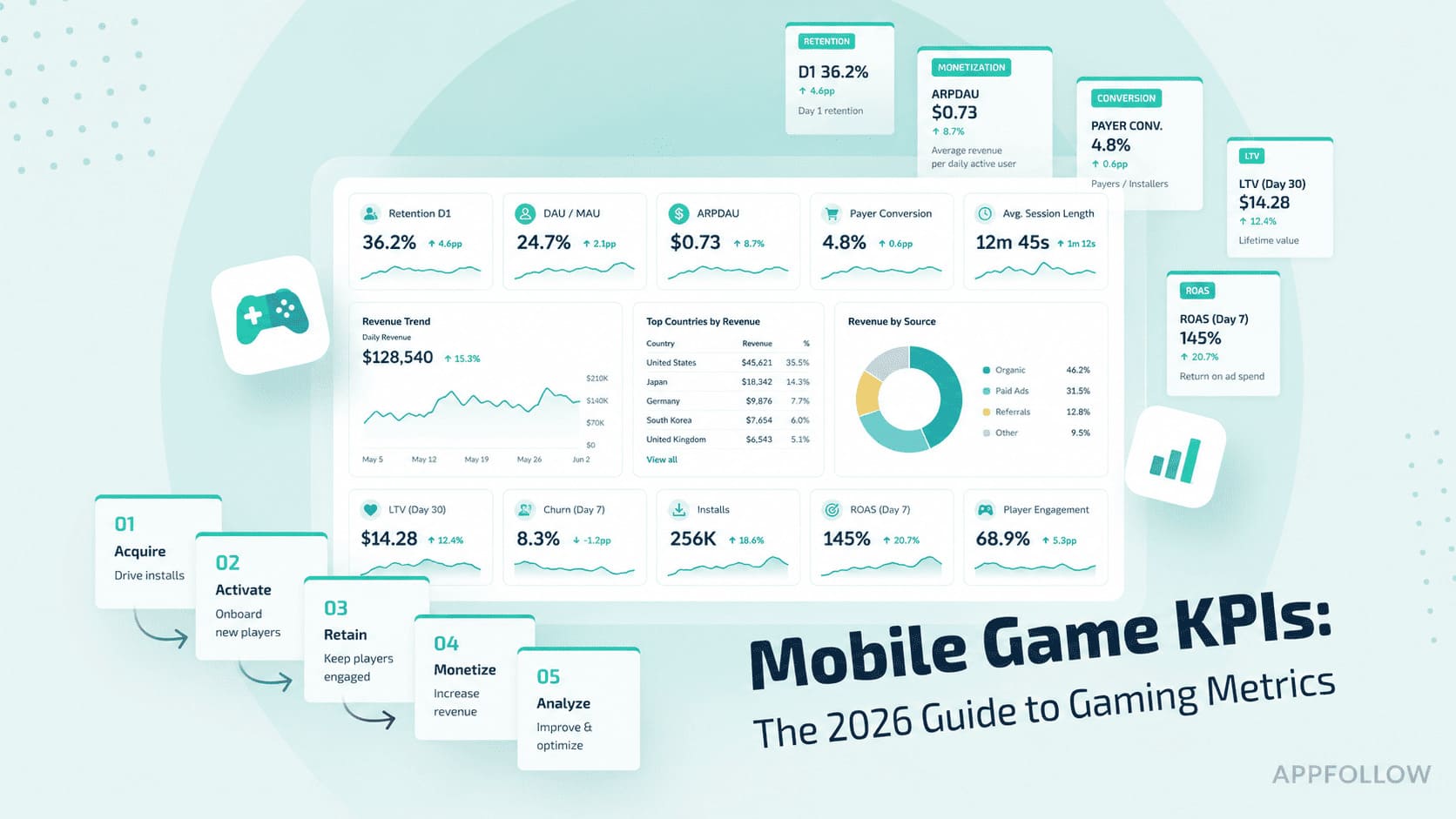
The success of each approach becomes much clearer when you track the right mobile game KPIs, including payer conversion, ad ARPDAU, retention, and lifetime value.
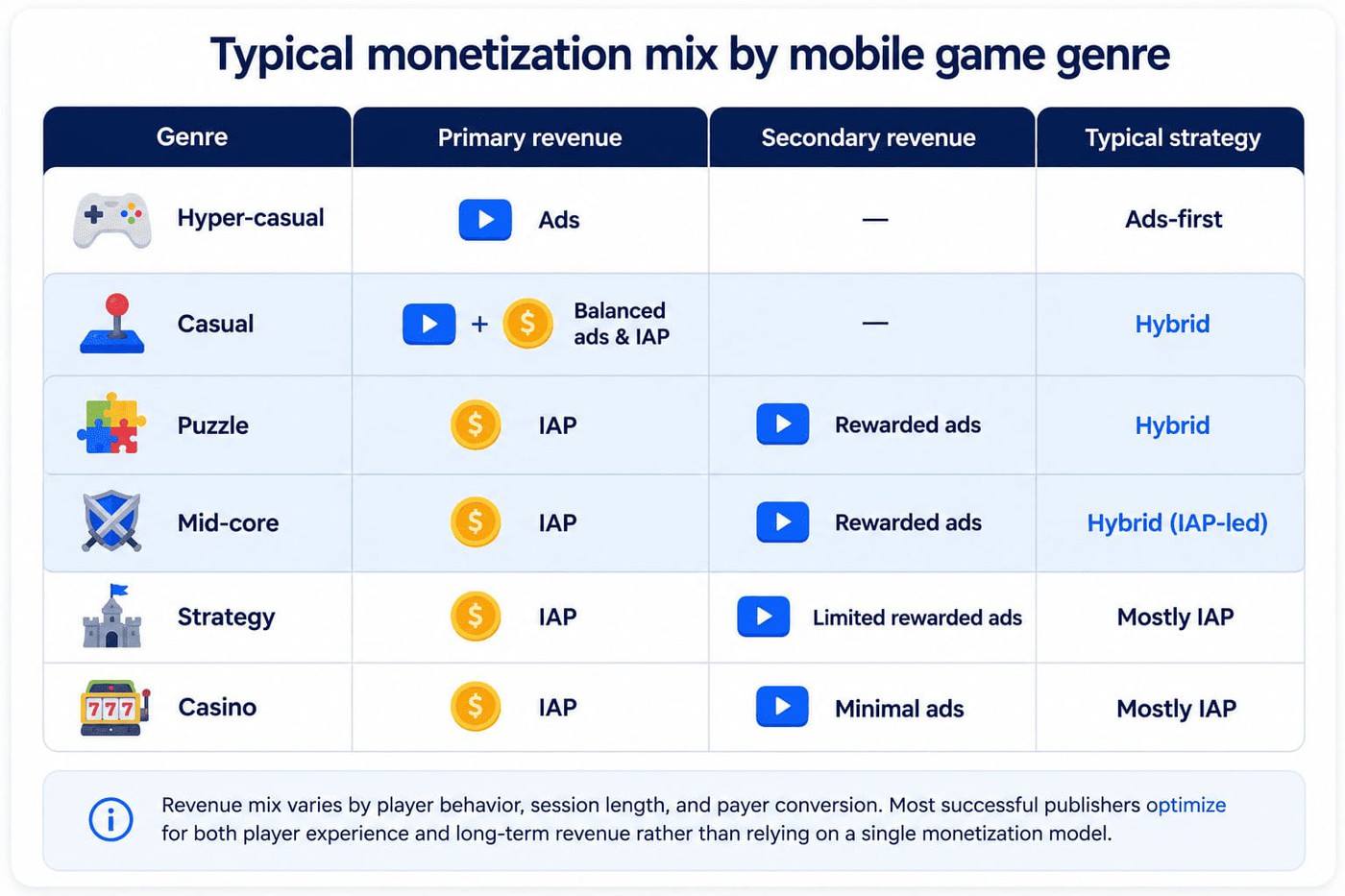
That mix increasingly reflects where the market is heading. Global ad revenue from mobile games surpassed $80 billion in 2024, while hybrid models continued to grow faster than either ads-only or IAP-only approaches.
Hybrid games monetize both ends of the player base instead of depending entirely on whales or ad impressions. High-value spenders continue making purchases, while non-paying players still generate revenue through mobile gaming ads. Many of the biggest mobile game companies have steadily expanded hybrid strategies across their portfolios because they diversify revenue without forcing every player into the same spending behavior.
Privacy changes have made those decisions more nuanced than they were a few years ago. Apple's SKAdNetwork and the broader iOS privacy updates introduced more uncertainty into campaign attribution, making ad lifetime value harder to measure with precision. Publishers increasingly rely on cohort modelling, incrementality testing, and Android performance to validate monetization decisions before scaling them globally.
That also changes how mediation is evaluated. Platforms that integrate SKAdNetwork effectively, including AppLovin MAX and Unity LevelPlay, reduce operational friction and improve reporting quality. As attribution becomes noisier, choosing a monetization model depends as much on measurement quality as revenue potential.

The 7 popular mobile game ad formats
Most publishers don't need to master dozens of ad units. In practice, these popular mobile game ad formats account for roughly 95% of ad impressions across today's mobile games. The difference is where you place them, how often they appear, and whether they fit the game's economy.
To make comparison easier, every format below follows the same six-part framework:
- best for,
- format description,
- typical eCPM,
- player experience impact,
- a real game example,
- and common mistakes.
The eCPM ranges reflect 2024–2025 averages for top-tier markets (US, UK, Japan, and South Korea). Expect figures to be around 30–60% lower in many tier-2 markets.
Ad format | eCPM (top-tier) | Player experience | Player control | Best for | Example game |
|---|---|---|---|---|---|
Rewarded video | $10 to $30+ | Low disruption, often welcomed | Opt-in | F2P games with reward loops | Coin Master |
Interstitial | $4 to $15 | Medium, drops fast with frequency | Forced | Level and session transitions | Subway Surfers |
Playable | $8 to $25 | Low, engagement is the point | Interactive | User acquisition campaigns | Mob Control |
Native | $2 to $6 | Lowest of any format | Passive | Shops, menus, feeds | Homescapes |
Banner | $0.10 to $1.00 | Low if placed clear of touch targets | Passive | Continuous background revenue | Wordscapes |
Offerwall | $15 to $60+ per completed offer | Low, players opt in for currency | Opt-in | Currency-heavy economies | Toon Blast |
Rich media | $5 to $20 | Medium, intrusive if it auto-expands | Expand on tap | Events and IP launches | Marvel Contest of Champions |
A side-by-side comparison of the seven most common mobile game ad formats. eCPM ranges reflect typical 2024 to 2025 performance in top-tier markets (US, UK, Japan, South Korea) and run 30 to 60 percent lower in many tier-2 markets.
Player experience is a qualitative assessment based on how intrusive each format feels when implemented to industry best practice, not a measured score.
What eCPM to expect by ad format
eCPM is what a thousand ad impressions actually earn you. It stands for effective cost per mille, and publishers use it as the single comparable number across formats, networks, and markets, because it normalizes away the differences in how each one prices inventory.
eCPM = (total ad revenue ÷ total ad impressions) × 1,000
The spread across formats is wider than most publishers expect. Rewarded video and offerwall sit at the top because attention is voluntary and intent is high. Banners sit at the bottom by a factor of thirty or more. That gap is why format mix, not network choice, is usually the bigger lever on ad revenue.
Read the ranges in the table above as directional, not as targets. Your actual eCPM moves with geography, genre, seasonality, fill rate, and traffic quality, and a tier-2 market will typically come in 30 to 60 percent below a top-tier one for identical inventory. For the wider set of ad-monetization metrics that sit around eCPM, including ad ARPDAU and ad LTV, see our guide to mobile game KPIs.
Rewarded video ads (games)
Rewarded video ads work best in free-to-play games where optional rewards support the core gameplay loop. Players willingly exchange 15–30 seconds of attention for extra lives, currency, hints, or bonus loot, making this the highest-earning format for many publishers.
Players choose to watch the ad, so the experience feels like a fair trade rather than an interruption. The strongest placements appear after a failed level, completed battle, or claimed reward, followed by an end card encouraging an app install. That opt-in model is what separates rewarded videos from forced formats.
Expect $10–30 eCPM in top-tier markets, with premium inventory occasionally exceeding $40 when advertiser demand, retention, and traffic quality are exceptionally strong.
Done well, rewarded videos improve the experience instead of disrupting it. They reduce frustration at the right moment and keep progression moving. Problems appear when publishers gate essential content behind ads or ask players to watch videos so often that the reward no longer feels worth earning. Our guide to player behavior and motivations explains why those moments matter.
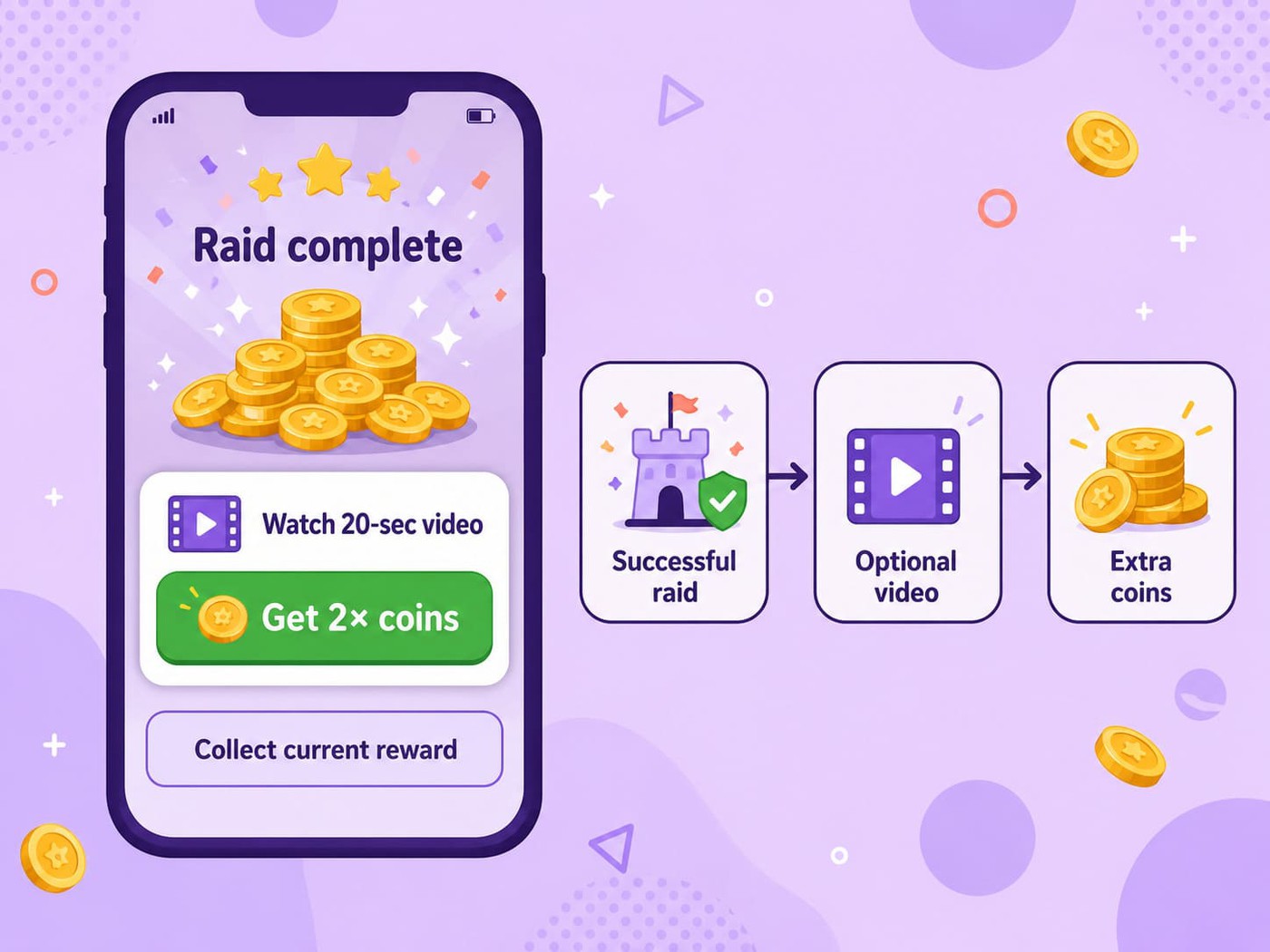
Coin Master is a good example. After a successful raid, players can voluntarily watch a rewarded video to double their coin bonus. The offer arrives at a natural pause, making the exchange feel timely rather than intrusive.
The biggest mistakes are over-frequency, weak rewards, and poor-quality creatives that reduce player trust and fill rate. Among all rewarded video ads games use today, the best implementations leave players feeling rewarded, not manipulated.
Interstitial ads
Interstitial ads are the workhorse of mobile game monetization. They perform best during natural session transitions, such as after a game over or between levels. Unlike rewarded videos, players don't choose to watch them, so success depends almost entirely on timing and frequency.
A typical interstitial is a full-screen static or video ad shown at a natural pause in gameplay. Most video interstitials last 5–15 seconds, with a skip button appearing after the first few seconds. Video inventory generally earns a higher eCPM than static creatives because advertiser demand is stronger.
Expect $4–15 eCPM in top-tier markets, with video interstitials commanding a premium. Performance varies by genre, geography, seasonality, and fill rate, but placement usually has a bigger impact on retention than small differences in revenue.
Player tolerance drops quickly when interstitials appear too often. A well-timed ad between sessions feels expected. One that interrupts active gameplay or a victory celebration feels intrusive. It's also the format that generates some of the highest volumes of negative review feedback, making it worth monitoring alongside your portfolio review management workflow.
Subway Surfers uses interstitials effectively by showing them between the game-over screen and the restart flow, typically with frequency capping to avoid disrupting every run.
Similar implementations appear in Candy Crush Saga after failed levels and Ludo King between rounds.
The biggest mistakes are serving too many ads per session, interrupting gameplay, or overlooking SDK issues that cause freezes and crashes.
Playable ads
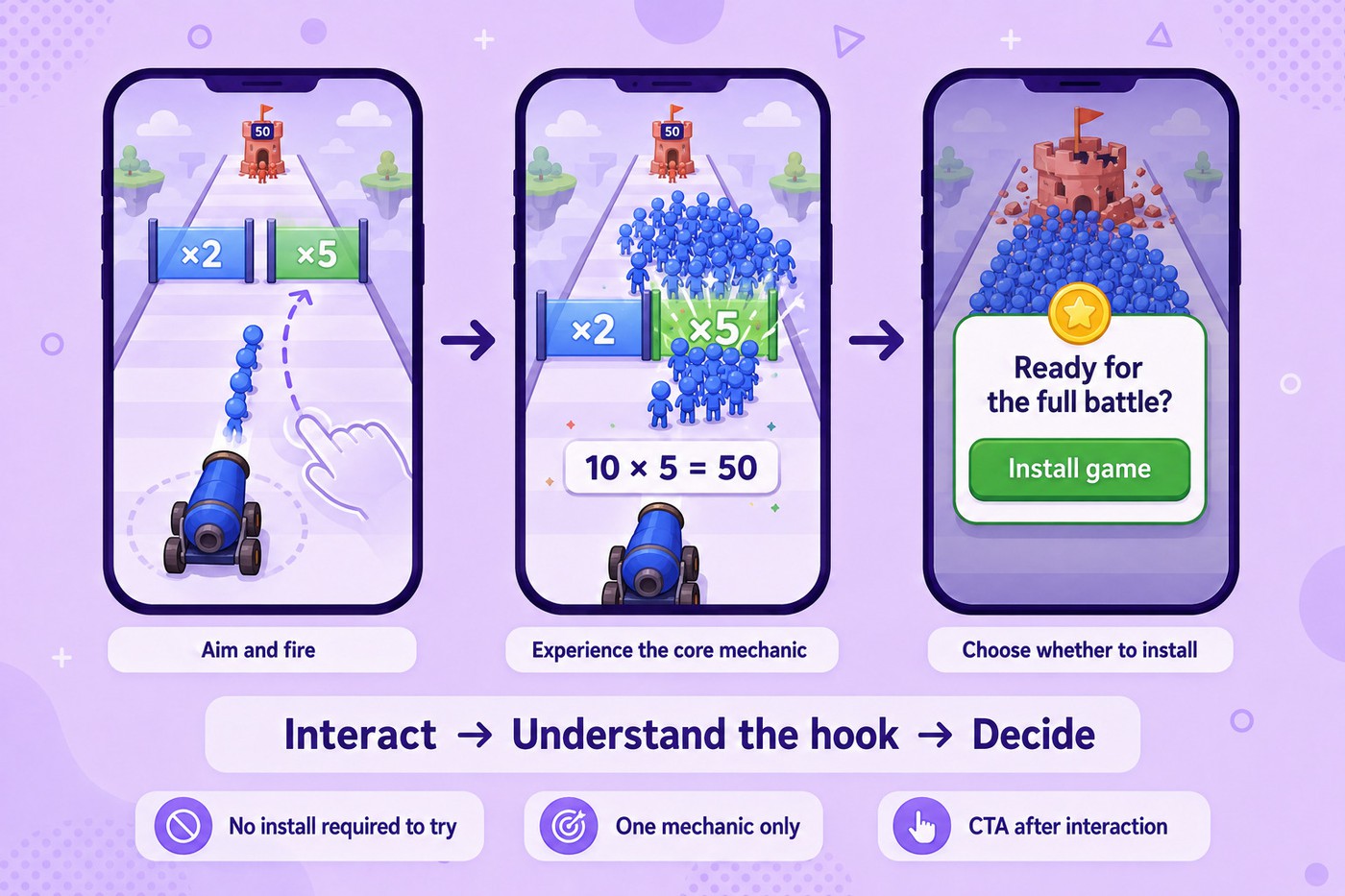
Playable ads are designed to answer one question before a player installs: Is this game actually fun? Instead of watching a trailer, players spend 15–30 seconds interacting with a simplified version of the core mechanic. They're used primarily for user acquisition, although some publishers experiment with limited in-app placements where interactive experiences feel appropriate.
Most playables are built on the HTML5-based MRAID 2.0+ standard, allowing them to run inside ad placements without requiring an install. The goal isn't to showcase every feature. It's to let players experience the game's hook before reaching the install prompt. The best ad creative mobile game campaigns use the same mechanic players encounter in the first few minutes of gameplay.
Because playables generate high-intent users, they typically command $8–25 eCPM, depending on placement quality and market. They also cost considerably more to produce than video ads, often requiring three to five times the creative investment.
Mob Control is a strong example. Its playable lets users swipe growing troops through multiplier gates before the install prompt appears. The interaction mirrors the real gameplay, creating accurate expectations instead of relying on exaggerated advertising.
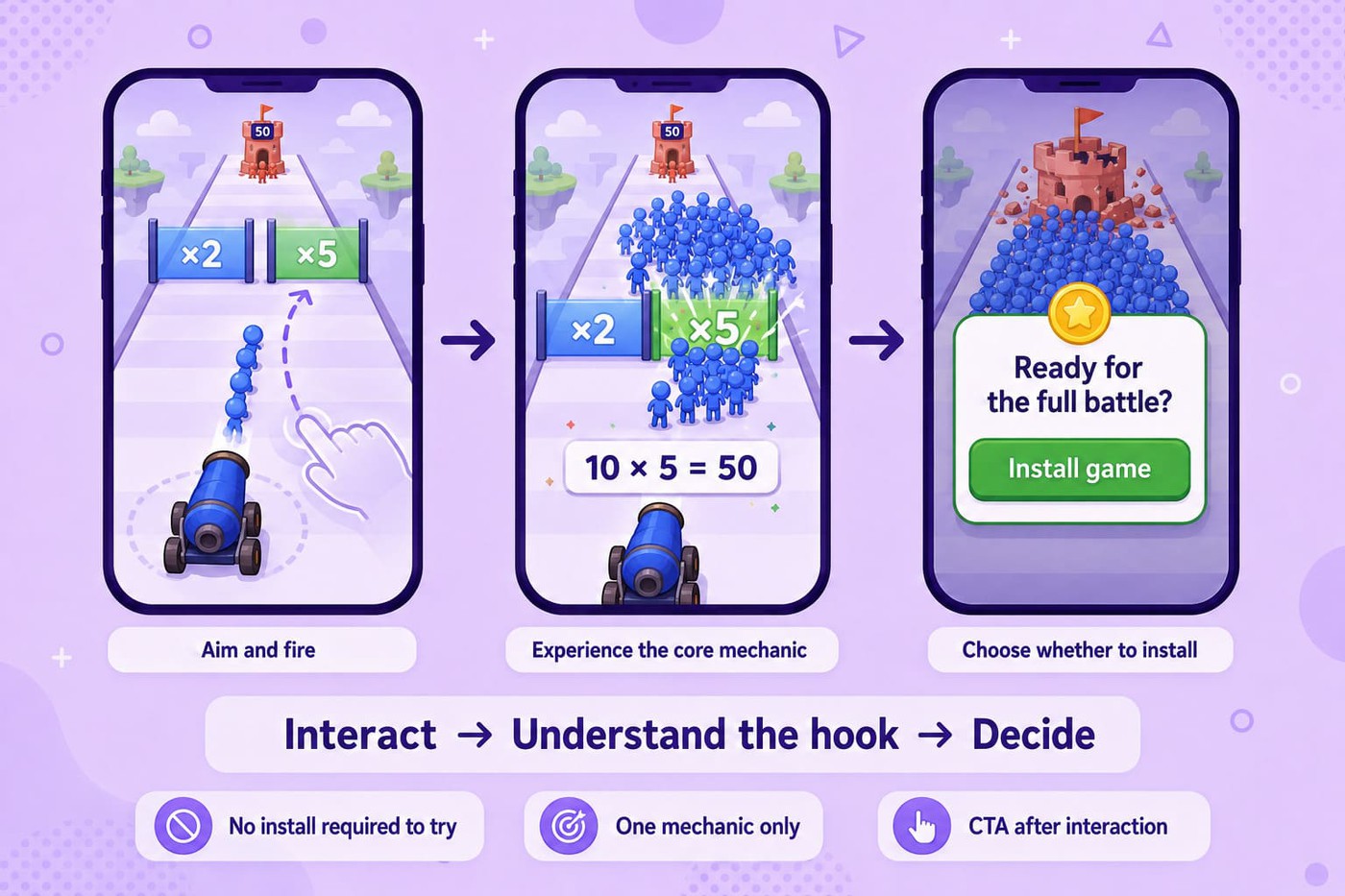
Similar approaches appear in playable campaigns for Royal Match and State of Survival.
The biggest mistakes happen before players even install the game. Bait-and-switch mechanics that don't reflect the real experience hurt retention, while slow loading times or overly short demos fail to communicate why the game is worth downloading.
Native mobile ads
Native mobile ads work best when preserving the player experience matters more than maximizing eCPM. Rather than interrupting gameplay, they blend into menus, shops, or content feeds, allowing players to discover them naturally while browsing the interface.
Instead of taking over the screen, native ads adopt the surrounding game's visual style. Colors, typography, and layout are designed to match nearby UI elements, making the placement feel like part of the experience rather than a separate advertisement. The difference is transparency: well-executed native ads always include a clear "Ad" label so players know they're viewing sponsored content.
Expect $2–6 eCPM in top-tier markets. While lower than rewarded videos or interstitials, native placements often deliver higher fill rates and a smaller impact on retention because they don't interrupt active play.
"Publishers often judge ads by eCPM alone, but the stores don't. Both Apple and Google reward strong retention and engagement over time. Push ad frequency past the tipping point, and those signals weaken. Revenue may look great this month, while your store visibility quietly starts slipping over the next few weeks."
— Ilia Kukharev, Product Manager at AppFollow
Homescapes offers a good example. Native promotional cards appear inside the in-game shop using the same warm color palette and visual language as the rest of the interface, while remaining clearly labelled as advertisements.
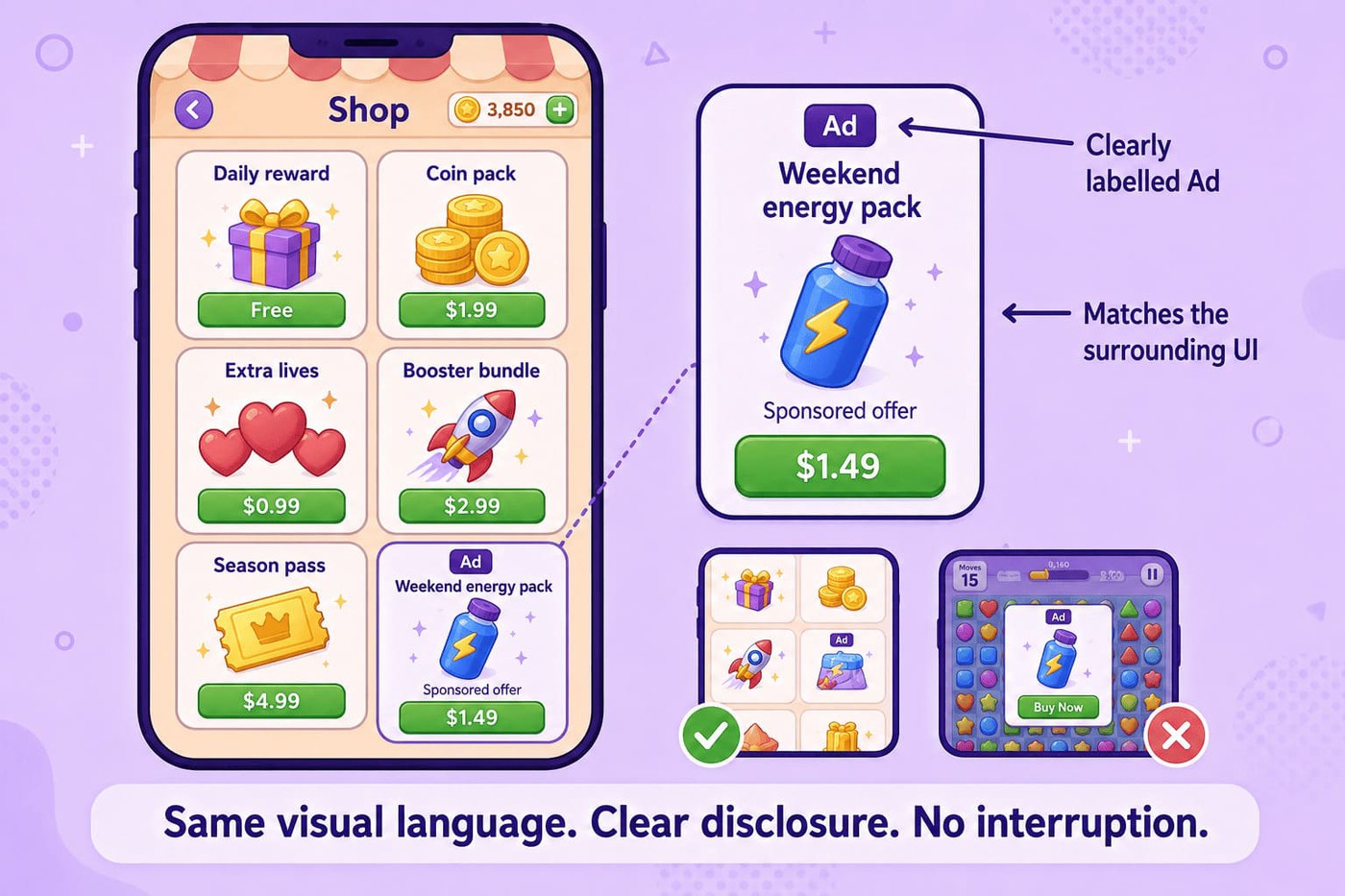
Similar implementations appear in Design Home's browsing experience and Sweatcoin's partner rewards catalogue, where sponsored offers sit alongside earned rewards.
The biggest risk is losing player trust. Native ads that closely resemble organic content can trigger complaints and create regulatory issues if they aren't clearly identified. That matters even more in children's games, where advertising rules such as COPPA require extra care. A placement that feels seamless should never leave players wondering whether they're looking at game content or an ad.
Banner ads
Banner ads are built for consistency rather than big payouts. They work best in casual and hyper-casual games with longer play sessions, where a small but steady revenue stream can add up without interrupting gameplay.
A standard banner is a 320×50 (or similar) display ad positioned at the top or bottom of the screen. Because banners don't take over the display, they're easy to implement and typically achieve high fill rates, even if advertiser demand is lower than for video formats.
Expect $0.10–1.00 eCPM in top-tier markets, making banners the lowest-earning mainstream ad format. Their value comes from generating continuous revenue with minimal disruption when placed thoughtfully.
Wordscapes is a good example. A banner sits below the puzzle board, away from the letter-swipe area where players interact with the game. Players who prefer an ad-free experience can remove banners through a one-time "Remove Ads" in-app purchase. Similar placements appear in many versions of 2048 and Solitaire TriPeaks.
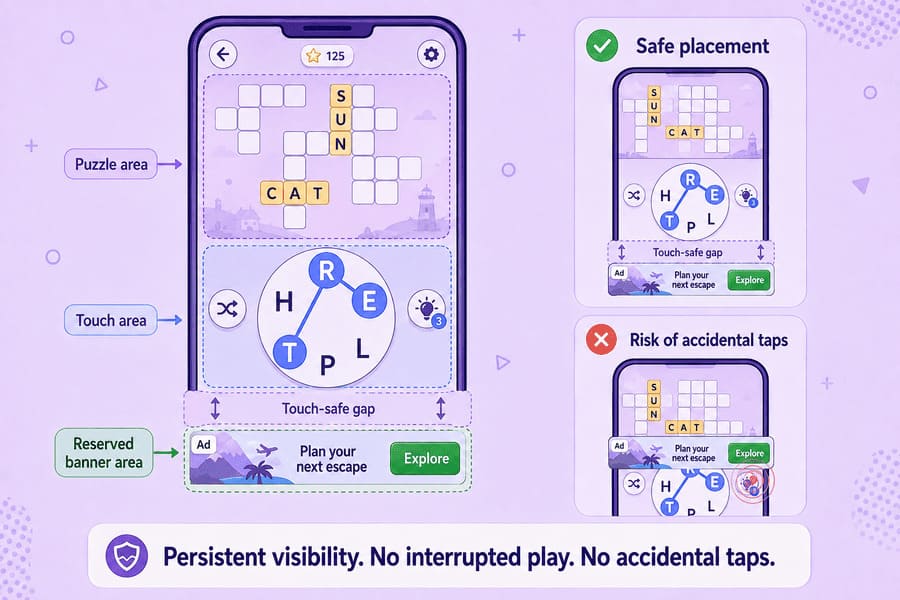
Banner ads rarely frustrate players because of their size. Most complaints come from poor placement, such as covering buttons or sitting too close to touch targets, leading to accidental taps. Children's games also require extra care because of stricter advertising regulations.
Offerwall
Offerwalls work best in games with valuable in-game currencies or gacha mechanics, giving players another way to earn rewards without spending money. Instead of interrupting gameplay, they create a dedicated moment where players choose how to progress.
An offerwall is a separate in-game screen listing advertiser offers, such as installing another app, reaching a milestone, completing a survey, or watching a video. Because participation is voluntary, the experience feels more like a rewards catalogue than a traditional ad.
Revenue is usually measured per completed offer rather than eCPM. Returns vary widely, but successful offerwalls can generate the equivalent of $15–60+ for high-value conversions, making them one of the strongest monetization formats when offers are well matched to the audience.
Toon Blast includes a Free Coins section where players complete partner offers in exchange for in-game currency. Depending on the region, these may include app installs, gameplay milestones, or subscription offers delivered through mediation partners.
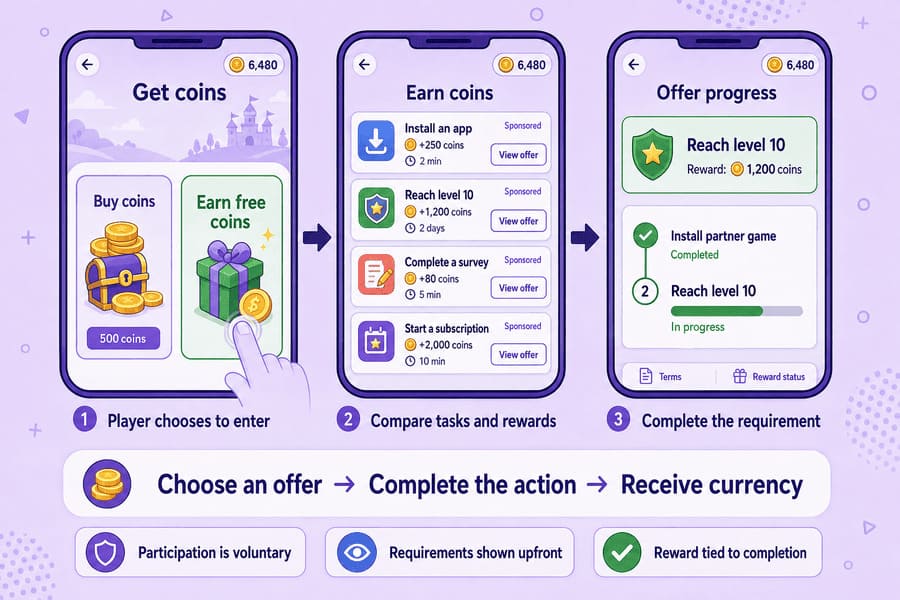
The format works especially well for collectors and progression-focused players.
Our guide to player behavior and motivations explains why these incentives resonate with different player types.
The biggest mistakes are poor offer curation, hiding the offerwall in confusing menus, or showing it to players who were already likely to convert through IAP.
Rich media / expandable ads
Rich media ads are built for moments that deserve more attention than a standard banner or video can deliver. Publishers typically reserve them for seasonal events, major content updates, IP collaborations, or high-budget user acquisition campaigns where creative quality directly influences performance.
Unlike static formats, rich media units expand after player interaction to reveal animations, swipeable galleries, videos, or other interactive elements. Most are built using MRAID-compliant custom creative, allowing advertisers to showcase multiple assets within a single placement without sending users away immediately.
Expect $5–20 eCPM in top-tier markets, although performance depends heavily on creative execution, audience quality, and campaign objectives. Well-designed rich media often outperforms standard display formats because it encourages deeper engagement before the install prompt appears.
Marvel Contest of Champions has used rich media effectively to promote character launches and crossover events. Expandable creatives let players browse multiple heroes, skins, or event visuals before deciding whether to install or return to the game.
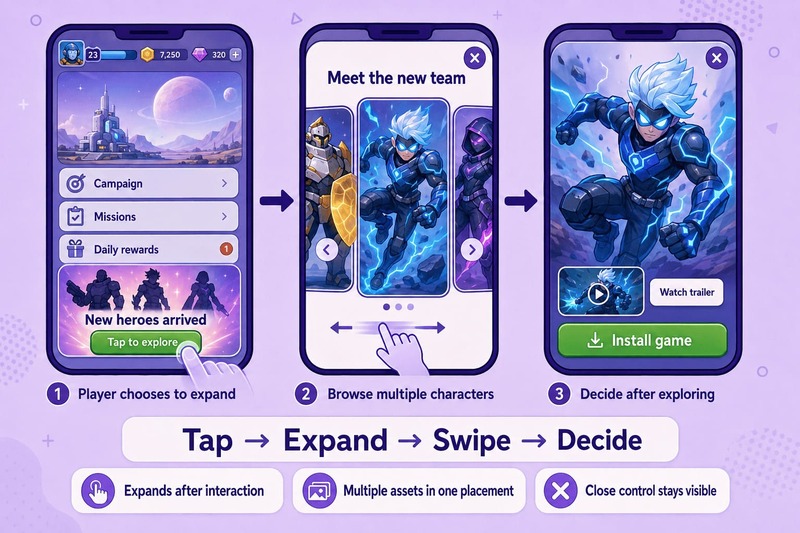
Similar approaches appear in campaigns for Fortnite collaborations and Genshin Impact character releases, where showcasing several assets is part of the appeal.
Rich media succeeds when players choose to engage. Auto-expanding ads, oversized creative assets, or placements that trigger accidentally quickly become frustrating. Heavy files also increase loading times and battery consumption, undermining the premium experience the format is supposed to create.
Mobile ad mediation: running these formats at scale
Mobile ad mediation is the layer that decides which ad network fills each ad request in your game, using waterfall bidding or in-app bidding to maximize revenue per impression.
What ad mediation does
Once you start running mobile game ads at scale, managing networks one by one quickly becomes impractical. Every ad request can potentially be filled by dozens of advertisers, each willing to pay a different amount for that impression.
A mediation platform sits between your game's SDK and multiple ad networks, running a real-time auction to decide who serves the ad.
Without mediation, publishers had to manually prioritize networks and assign them to specific placements, a process that dominated the industry until the mid-2010s.
Today, mediation is standard practice because it improves fill rate, reduces manual work, and helps publishers capture more value from every impression.
Waterfall vs. in-app bidding
Traditional waterfall mediation contacts ad networks one after another, following a predefined order based on historical eCPMs. If the first network declines, the request moves to the next until an ad is served. The approach is simple and easy to manage, but historical pricing doesn't always reflect what advertisers are willing to pay at that moment.
In-app bidding, sometimes called header bidding for mobile, asks participating networks to bid simultaneously in real time. The highest bid wins, creating a more competitive auction and often increasing revenue. The trade-off is complexity. Every participating network needs compatible SDK support, and publishers often combine bidding with a smaller waterfall for inventory that isn't yet fully integrated.
That's why many of today's top ad formats mobile gaming publishers use run through hybrid mediation setups.
"The game teams that consistently grow ad revenue don't optimize eCPM alone. Every couple of weeks, they compare ad frequency and creative performance with player retention. Teams that ignore those signals often gain revenue in the short term, then spend months recovering the engagement they lost."
— Ilya Kataev, Professional Services Team Lead at AppFollow
The main mediation platforms in 2026
Several mature mediation platforms support the formats covered in this guide, including
- AppLovin MAX,
- Unity LevelPlay,
- Google AdMob,
- Mintegral, Liftoff,
- and Chartboost.
Each provides an SDK that connects your game with multiple ad networks while handling auctions, reporting, and fill-rate optimization behind the scenes.
None is universally "best." The right choice depends on your existing technology stack, target markets, monetization goals, and advertiser relationships.
Ad creative best practices for mobile game campaigns
Ad creative mobile game campaigns succeed or fail long before a player reaches the App Store or Google Play. A high eCPM only matters if it becomes an install instead of a scroll. Winning mobile game ad creative converges on the same five rules, whatever the genre or the budget.
- Hook players in the first three seconds. Attention drops fast, so don't waste the opening on a studio logo or cinematic intro. Show the core gameplay immediately and save branding for the end card. Royal Match does this well by opening with its signature pin-pulling mechanic from the first frame, giving players an instant reason to keep watching.
- Choose playable-first when the economics support it. Playable ads cost more to produce than video or static creative, but they also attract users with stronger install intent. In high-LTV genres, that investment often pays for itself. Voodoo, for example, has repeatedly launched new titles using playable-first campaigns, with Mob Control demonstrating how interactive previews outperform passive formats.
- Match video length to the platform. A rewarded video can comfortably run for 15–30 seconds, while interstitials should stay closer to 15 seconds. On TikTok and Reels, aim for 9–15 seconds unless the creative delivers an exceptional hook and payoff. Genshin Impact's character-reveal videos are a good example. They focus on one memorable ability, then move directly to the call to action.
- Localize the creative, not just the copy. Translating text is only part of the job. Voice-over, music, visual references, thumbnails, and even pacing influence how an ad performs in different markets. Free Fire regularly adapts creative packs for Brazil, MENA, and Southeast Asia instead of relying on a single global version. Many of the biggest mobile game companies take the same approach because creative transcreation consistently outperforms simple translation.
- Make the ad match the first minutes of gameplay. Players notice when the experience after installation doesn't resemble the promise in the ad. That disconnect increases churn and weakens campaign performance over time. Toon Blast shifted away from misleading rescue-style creatives toward ads built around its actual block-blast gameplay, creating a more consistent journey from the first impression to onboarding.
cta_get_started_purple
Mobile game advertising trends worth watching in 2026
Mobile game advertising trends are shifting faster than the ad formats themselves. Four trends are reshaping the market in 2026, and all four are already visible in how leading publishers acquire users, monetize players, and measure performance.
- AI-generated creative becomes the default. AI is no longer just helping creative teams brainstorm ideas. Platforms from AppLovin, Meta, and Google now embed AI into ad production workflows, making it easier to generate, localize, and test dozens of creative variations in hours instead of weeks. That shift lowers production costs and gives smaller studios the ability to compete with publishers that once relied on much larger creative teams.
- Hybrid monetization keeps expanding. More publishers are combining ads and in-app purchases instead of choosing one model over the other. Casual and mid-core games increasingly introduce rewarded videos alongside Battle Passes, subscriptions, or premium currencies, while ad-first titles add simple purchases such as Remove Ads. The result is a more balanced revenue mix that gives players multiple ways to engage with the economy.
- User acquisition becomes more diversified. Five years ago, most mobile game ads depended heavily on Meta and Google. Today, TikTok has become a major acquisition channel, while Apple Search Ads, Snap, Reddit, Amazon Ads, and retail media networks continue gaining share. The strongest publishers aren't replacing one platform with another. They're spreading creative and budget across a broader acquisition mix.
- Privacy-first measurement matures. SKAdNetwork on iOS and Google's Privacy Sandbox for Android have fundamentally changed attribution. Rather than relying on deterministic tracking alone, publishers increasingly combine cohort modelling, probabilistic measurement, and in-app bidding data to understand long-term value. Teams that invested in these workflows early are now making monetization and acquisition decisions with greater confidence despite tighter privacy constraints.
See what your ads cost you in reviews, ratings, and rankings
Your ad platform tells you what the campaign earned. It cannot tell you what it cost you in the store. AppFollow does not measure ad revenue, mediate requests, or optimize bidding, and it is not trying to. What you get from it is the other half of the ledger: what players said, what your rating did, and whether the listing still converted while the ads were running.
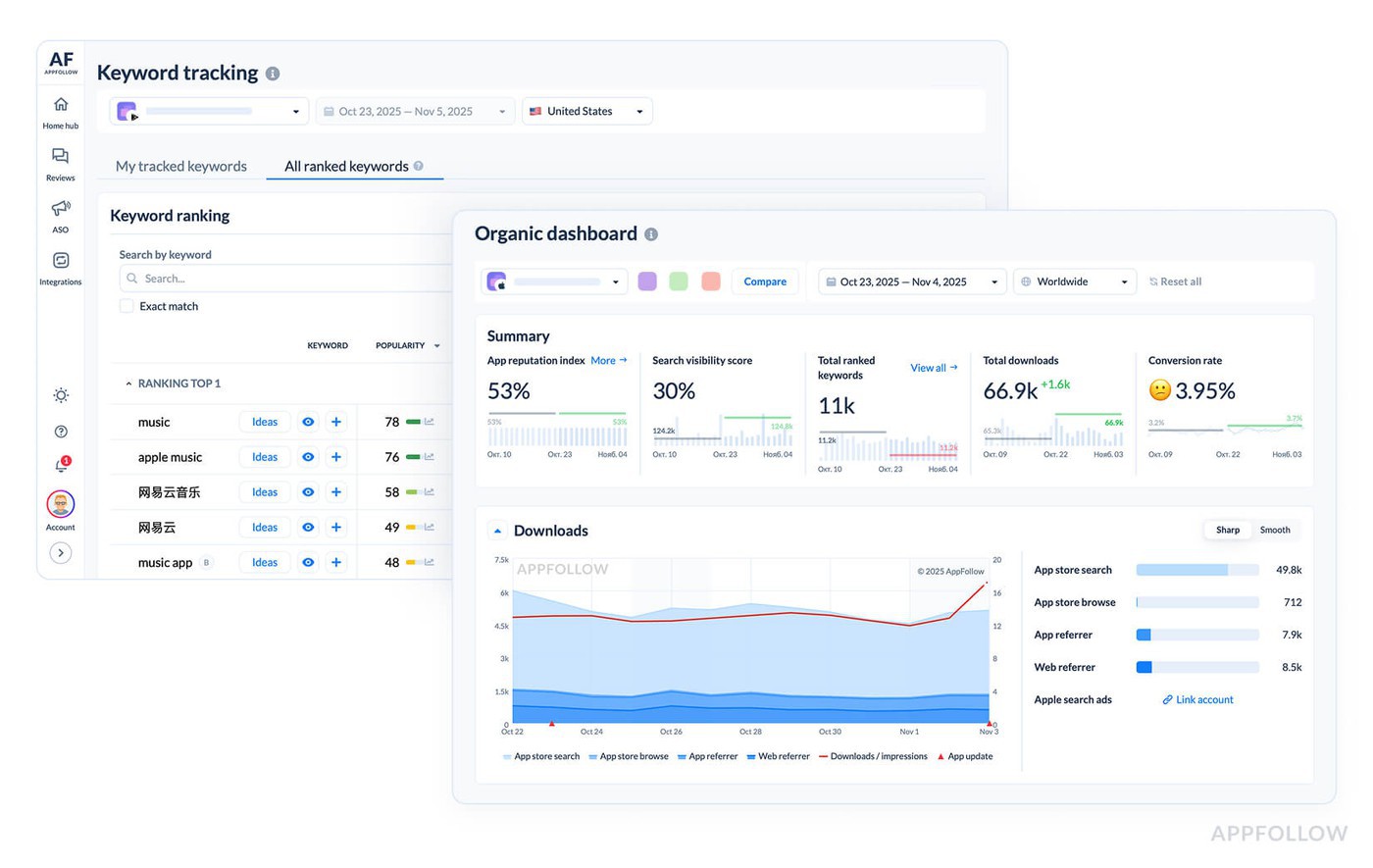
- Start with the reviews, because players complain before they churn. Track feedback across the App Store and Google Play for the ad vocabulary that matters ("too many ads," "forced ads," "pop-ups," "can't play without ads"), and you get a leading indicator rather than a postmortem. A jump in ad-complaint volume usually means you have crossed the tolerance threshold, and it shows up weeks before the rating slide or the retention dip that follows.
- From there you can prioritize responses and work the issue through a structured portfolio review management workflow before it spreads across the catalog.
- Then watch conversion while you are buying users. A paid push sends thousands of new visitors to your product page, and that page has one job. Monitor install conversion alongside visibility and keyword movement in the ASO platform, and you can tell the difference between a campaign that underdelivered and a listing that failed to close. If impressions triple and installs barely move, your screenshots and description are the constraint, and fixing them pulls more out of the same budget without raising spend.
- Our guide to app store optimization description covers the listing elements that carry the most weight.
- Finally, read your competitors the same way. Track screenshot, metadata and promotional-text changes across your market with app competitor analysis, and you can time their campaigns without any access to their ad dashboards. New screenshots tend to precede a UA push; new promotional text tends to precede a monetized event. Set that against review sentiment and your own conversion data and you can tell which of their patterns is worth borrowing.
cta_get_started_yellow
Frequently asked questions about mobile game ads
What are the most popular mobile game ad formats?
The seven most common mobile game ads formats are rewarded video, interstitial, playable, native, banner, offerwall, and rich media (expandable) ads. Rewarded video and interstitials generate the majority of ad revenue in most free-to-play games, while playable ads are used primarily for user acquisition rather than in-game monetization.
What is a rewarded video ad in mobile games?
A rewarded video ad is an opt-in 15–30 second video that players watch in exchange for an in-game reward, such as currency, an extra life, or a hint. Among rewarded video ads games use today, this format typically delivers the highest eCPMs, averaging $10–30 in top-tier markets.
What is a playable ad?
Playable ads are interactive mini versions of a game that let users try the core mechanic before installing. They usually last 15–30 seconds and generate significantly stronger install intent than static or video ads, although they generally cost three to five times more to produce.
What is mobile ad mediation?
Mobile ad mediation is the technology layer between a game and multiple ad networks. It decides which network fills each ad request by using waterfall mediation, in-app bidding, or a hybrid approach to maximize revenue. Common platforms include AppLovin MAX, Unity LevelPlay, Google AdMob, Mintegral, Liftoff, and Chartboost.
How much can a mobile game earn from ads?
Ad revenue varies by genre, audience, and monetization strategy. Hyper-casual games often generate $0.01–0.10 ad ARPDAU, casual games $0.05–0.50, and mid-core titles $0.30–1.50. Well-optimized hybrid games can exceed $2.00. Total revenue also depends on daily active users and your format mix. See our guide to mobile game KPIs for the metrics behind these benchmarks.
Do ads hurt mobile game rankings on the App Store and Google Play?
They can. Aggressive ad frequency reduces session length, retention, and player satisfaction, all of which influence long-term store performance. Games that overuse interstitials often experience lower Day-7 retention before rankings begin to soften several weeks later. Monitoring review sentiment helps identify those warning signs before declining visibility becomes a larger problem.