Build vs buy review management tool in 2026: what it costs at every team size

One engineer with an AI coding agent can build a working review tool in a sprint. So the build vs buy review management question in 2026 is about ownership. The three years after launch cost far more than the build, and that bill depends on how many apps and stores you run, which capabilities the team needs, and who owns upkeep. At the end of the day, the real choice is between paying a specialized vendor, paying developers to build an equivalent, or building with an AI coding agent and owning the upkeep that follows.
AppFollow is the cheaper option once owning the alternative costs more than the right plan. For teams running more than two apps or more than two stores, an AppFollow plan costs less over three years than building and maintaining an equivalent tool, even with an AI coding agent doing the build. Solo developers do best with the free consoles or AppFollow's Free plan.
For a vendor shortlist, use our roundup of app review management software to compare review management tools side by side.
TL;DR:
The cost to build an app review management system is mostly engineering time.
- A prototype takes days. One engineer with a coding agent can ship the first tier (two stores, LLM drafts, manual approval, Slack alerts) in about 32 hours, an AppFollow editorial assumption pending our engineering estimate.
- Inference is the smallest line item at typical volumes. One reply draft plus one tagging pass costs about $0.0008 per review on Gemini 3.1 Flash-Lite and about $0.016 on Claude Opus 5.5, at Google and Anthropic list prices checked October 2, 2026.
- Upkeep is the recurring cost. At a fully loaded $93.49 an hour (BLS median developer wage times the BLS benefits multiplier), each monthly hour of maintenance adds $3,366 to a three-year total. A coding agent can shorten each fix, and someone on the team still has to notice the break, review the patch, and hold the pager. Our working assumption is 4 hours a month per store connector and 2 per integration, an editorial estimate pending engineering input.
- The tool has to outlast its builder. An in-house tool depends on the person who built it, and it stops getting fixed when that person is on PTO or leaves the company. AppFollow runs around the clock for the whole team, with ISO 27001 certification, live support, and MCP access for your AI assistants.
- The official APIs set hard limits. Google's Reply to Reviews documentation says the API returns only reviews created or modified in the last week, so anything older has to come from Play Console CSV exports.
- The crossover depends on team size. Under Scenario C, a solo developer does best with the free consoles, a five-app team pays less for Essential billed yearly than for even a 32-hour prototype, and a 6-to-10-app team pays less for Team than for any operational-tier build.
- Building is the right call for data-residency rules no vendor meets, for teams whose own product sells review analysis, and for a platform team that already runs the plumbing and keeps upkeep under the crossover.
When building your own review tool makes sense
Four things decide it: how many apps and sources you manage, how many reviews you get, what data you need beyond new reviews, and who relies on the tool.
Factor | Build it yourself or start on the Free plan | Keep your own agent, add AppFollow data via MCP or API | Use AppFollow |
Apps and sources | 1 app on the App Store, Google Play, or both | 2 to 5 apps on the App Store and Google Play | 6+ apps, or Steam, Trustpilot, and other stores |
Reviews a month | Under 100: one person reads them all | 100 to 1,000 | More than 1,000 |
Data beyond new reviews | None: new reviews and replies only | Past reviews and ratings, or competitor and ASO data | Both history and competitor or ASO data |
Who uses it | Just you | One team, for example support | Several teams: support, product, marketing, leadership |
If most of your answers fall in one column, that's your setup. Needing history or competitor data moves you out of the first column on its own, since neither store API provides that data.
What one engineer can build in a sprint
Point a coding agent at the App Store Connect API and the Google Play Developer API, ask for a reply drafter with an approve button, and there's a screen to show the team by Thursday. Counting that demo as the whole product is the expensive mistake, because most of the hard parts in the table come from store rules and model behavior outside your control.
Apple's app review API expects each request to be signed with a JWT you generate from an API key, Google wants a service account with the "Reply to reviews" permission, and the two paginate differently (cursor links on Apple, a nextPageToken on Google, up to 100 reviews per page).
Tier | Includes | Time with an AI coding agent | Harder than it looks because |
Prototype | Pulls reviews from App Store and Google Play; LLM reply draft; manual approval; posts the reply; Slack alert on low ratings | About 32 hours (editorial assumption) | Two auth models and two pagination schemes; Google caps a reply at 350 characters |
Operational | Auto-reply rules; translation; sentiment tags; helpdesk handoff; several apps; stored history; edited-review handling | About 200 hours, or five weeks of one engineer (editorial assumption) | Google serves an edited review again under the same review ID; Apple overwrites an existing response on each post and can take up to 24 hours to show it |
Production | Extra stores; evaluation of reply and tag quality; reply-effect attribution per rule; anomaly alerts; roles, audit log, SSO; uptime monitoring; security review | 800 hours or more, well past one sprint (editorial assumption) | Each extra store has its own API and limits; quality drifts without warning when the model changes |
Store behavior per Apple's response endpoint reference, Apple's App Store Connect help, and Google's Reply to Reviews guide, checked October 1, 2026.
Per Google's guide, a user gets a notification only for the first reply to a new or edited review, and Google discourages posting automated replies you plan to fix by hand later. A sloppy first auto-reply is the one the reviewer sees in the notification.
Most "we built it in a sprint" stories describe the first row. For the architecture, see the ingest, classify and route pipeline in detail.
What you still own after launch
Someone on your team owns on-call, the Saturday when Google Play data stops coming in, and every connector patch after a store API change, for as long as the tool runs, so the price of in-house review management is mostly that person's calendar.
Continuous ingestion
Google's API keeps one week of reviews, so a pipeline that stalls for eight days loses reviews from the API feed for good. You can backfill from Play Console CSV exports, which adds a manual job to someone's list.
Store API changes
Microsoft's review response reference says its reviews API is "currently not in a working state" and sends developers to Partner Center. Amazon had retired developer replies to App Store reviews by January 2021, citing low usage, per Amazon staff on its developer forum, and it offers no customer reviews API either.
Reply state
Apple allows one response per review and overwrites it on each post, and Google's reply call replaces the previous reply too. A retried request from a flaky job can replace a colleague's careful answer with a draft, so the tool needs idempotency checks and an audit trail.
Measuring reply impact
Both store APIs return a review's current version, so checking whether a reply moved the rating means storing every version yourself and linking each change to the reply, the agent, and the automation rule behind it. AppFollow's reply effect metric counts rating or text updates within 30 days of a reply, and a homegrown tool needs its own definition and the logic to keep it consistent.
Quality evaluation
Tags and reply drafts need a fixed evaluation set that gets re-run each time you switch or upgrade the model. Without one, accuracy drifts quietly until a support lead flags a bad week. Topic trends also need the same taxonomy month after month, so renaming a tag or swapping the model breaks every chart drawn before the change.
Access for non-engineers
Support and marketing need an inbox, roles, saved filters, and reply templates. Each one is a small feature, and together they add up to a second product with its own backlog.
A single point of failure
An in-house tool works best for the people who built it, and every broken job needs a person at the keyboard. When the builder is on PTO or vacation, or leaves the company, a failed collection run stays broken until someone else learns the code, and the weekly report goes missing in the meantime.
Reporting from one source
A weekly report needs ratings, topics, summaries, and Google Play data side by side, and Google's rating history sits in Play Console's downloadable reports, outside the review API. Each source is one more job to schedule, join, and keep in sync.
Security and compliance
A system that publishes text under your brand enters your security review, with its API keys, service accounts, and LLM vendor all in scope.
Paid, fragile third-party sources
Feedback outside the stores (social, Reddit, review sites) often comes through data providers that charge by volume and change terms on their own timeline. Reddit, for one, has sold commercial Data API access only by written agreement since its June 2023 pricing change, at a widely reported $0.24 per 1,000 calls (Reddit).
No Report a Concern endpoint
Google's Reply to Reviews API documents list, get, and reply calls only, and Apple's customer review resources cover reading reviews and managing responses. Flagging spam or abusive reviews from a homegrown tool stays a manual console task.
No competitor or market data
Store APIs return data only for apps you own. Competitors' reviews, ratings, keyword positions, category benchmarks, and market-wide baselines require data from apps you don't own, so you can either scrape at scale or buy it. Third-party data for history and competitors is usually priced per app and per month, so the bill grows with every new competitor. Your own anomaly alerts also need months of stored history before a baseline means anything. Rating or ranking history from before your tool's launch is gone for good.
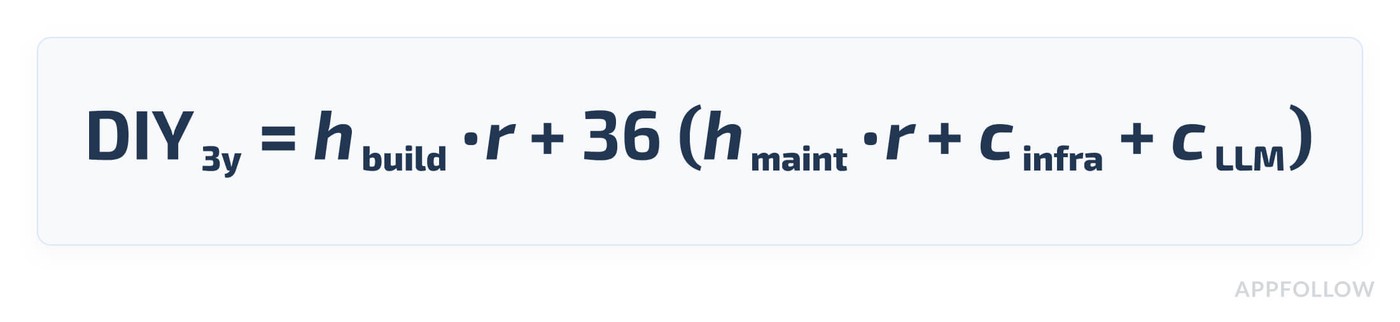
Three years of DIY cost is build hours times the hourly rate, plus 36 months of maintenance, infrastructure, and inference:
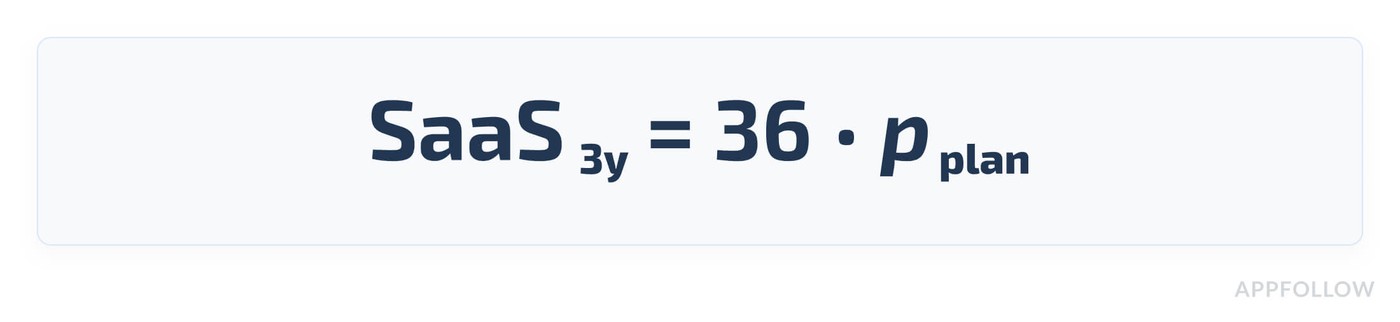
Three years of the subscription is 36 monthly plan payments:
Setting the two equal gives the crossover maintenance hours:
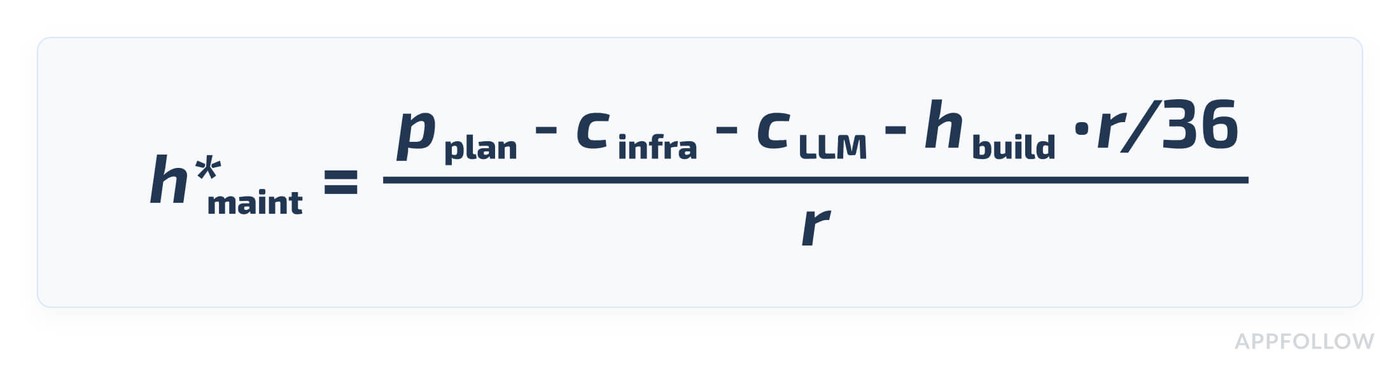
If your maintenance runs above h*, the subscription is cheaper. A negative h* means the amortized build plus hosting and inference already costs more than the plan.
Every hour in the model gets multiplied by the rate r, so the model runs three US builder scenarios. Scenario C sets the headline figures.
Scenario | Who builds | Rate | Source |
A / Founder | Founder or technical PM in their own time | Cash close to $0; you set the opportunity cost | Your own estimate |
B / Contractor | US development agency | $50 to $99 an hour | Clutch software development pricing guide, updated September 21, 2026 |
C / In-house engineer (default) | Salaried developer | $93.49 an hour | BLS median software developer wage of $135,980 (May 2025) × 1.43 ÷ 2,080 hours; the multiplier follows BLS ECEC, where wages were 70.0% of private-industry compensation in June 2026 |
Review volume barely changes the result on a budget model. With a Flash-Lite class model, going from 10,000 to 100,000 reviews a month adds about $2,600 over three years, less than one monthly hour of maintenance under Scenario C. On Claude Opus 5.5, the same jump adds about $52,000, so at high volume the model choice matters more than the review count. Below that, the number of stores, integrations, and people with access drives the total.
Offshore rates and what public research says about quality
Scenario B assumes a US agency. Clutch's location table puts development companies in Ukraine, India, and the Philippines at $25 to $49 an hour, and Polish companies at $50 to $99, the same band as US agencies (Clutch software development pricing guide, updated September 21, 2026).
Country | Clutch hourly band | Tech Skills, Coursera 2025 | English, EF EPI 2025 | Overlap with a US Eastern workday |
Poland | $50 to $99 | 71st percentile | About 2 hours | |
Ukraine | $25 to $49 | 44th percentile | 526, moderate | About 2 hours |
India | $25 to $49 | 22nd percentile | None in standard hours | |
Philippines | $25 to $49 | 21st percentile | None in standard hours | |
United States (reference) | $50 to $99 | 74th percentile | Not ranked (native speakers) | Full day |
At $25 an hour, the growing portfolio turns into a close call. An operational-tier tool beats Team billed yearly while upkeep stays under about 7.4 hours a month, against our 12-hour assumption for two store connectors and two integrations, and a prototype-tier tool breaks even at about 12 hours. At $49 the operational crossover falls to about 1.1 hours a month. The five-app segment barely moves, since Essential stays cheaper unless upkeep is under about 1.9 hours a month even at $25.
Read the quality columns as country averages. Coursera's Global Skills Report 2025 ranks 109 countries on technology skills. Still, only 25% of each score comes from learners' results on its platform, and the other 75% comes from innovation, labor-force, human-capital, and GDP-per-capita data, so the index partly tracks national income.
EF tests adults who choose to take its English exam. Neither measures the output of the agency you would hire, and we found no 2024 to 2026 study that scores working developers by country directly. National averages also say little about a single agency, so references, a paid pilot with code review, and verified client reviews tell you more than a ranking.
Build vs buy by team size
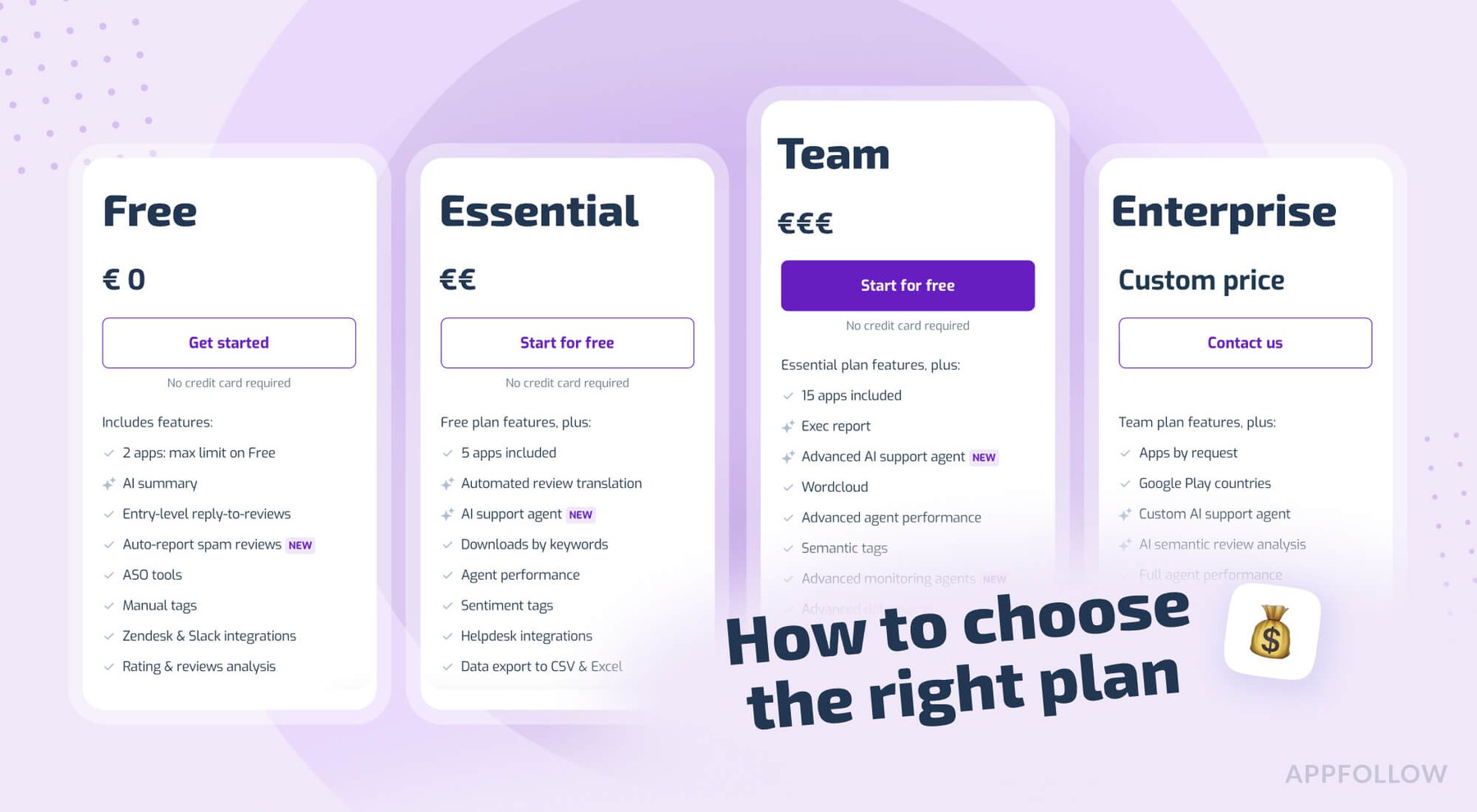
A three-app studio that needs semantic tags or Microsoft Store coverage already needs Team, while five apps replying in one language fit Essential, so AI review management for app stores prices by capability more than by app count. Each row shows the lowest plan that covers a need, with values from AppFollow's pricing page, and the auto-reply row follows how AppFollow's review automation is set up, with rules, priorities, and an approval mode.
Need | Free | Essential | Team | Enterprise |
Price, monthly (billed yearly) | $0 | $179 ($129) | $599 ($425) | Custom |
Apps included | 2 | 5 | 10 | By request |
Users | Unlimited | Unlimited | Unlimited | Unlimited |
Competitors tracked | 10 | 100 | 250 | Custom |
Review history | 7 days | 365 days | Full | Full |
Replies a month | 100 manual, 15 AI, unlimited automated | 500 manual, unlimited AI and automated | 1,500 manual, unlimited AI and automated | Custom |
AI knowledge bases | 1 | 1 | 5 | 50 |
Translation | Not included | Automated review translation | Yes | Yes |
Tagging and analysis | Manual tags, AI summary | Sentiment tags, detailed AI summary, custom AI summary topics | Semantic tags, AI summary comparison, wordcloud | Phrase analysis, anomaly detection, custom semantic tags as a paid add-on |
Automation triggers | All reviews | Adds rating, text and translation | Adds language, tag, length and featured | Adds country, app version and semantic triggers |
Stores | App Store, Google Play, Trustpilot | Same as Free | Adds Microsoft Store, Xbox, Amazon Appstore ratings | Adds Samsung Galaxy Store, Huawei AppGallery, Apple Arcade |
Spam reporting | Yes | Yes | Yes | Yes |
Reporting | Limited reply effect and agent performance | CSV and Excel export, reply effect, agent performance | Exec report, benchmark report, advanced agent performance | Full agent performance, automation performance |
Alerts | Reviews feed, AI summary | Same as Free | Adds new-review spike, rating change, weekly Feedback Summary | Adds review anomaly and tagged-review alerts |
Integrations | Slack, Zendesk, MS Teams, Telegram, Google Chat, email | Adds Helpshift, Freshdesk, Intercom, Help Scout, Front, webhooks | Same as Essential | Adds advanced Zendesk, Salesforce, Tableau |
SSO and SLA | Not included | SSO as a paid add-on | SSO as a paid add-on | SSO and a guaranteed SLA |
Support | Live chat, limited email | Slack and MS Teams support, dedicated success manager (paid add-ons) | Dedicated success manager, Professional Services onboarding |
Prices exclude VAT and apply to new users. Plan contents and limits come from the Business plans view of AppFollow's pricing page.
cta_get_started_purple
Solo developer with one or two apps
The alternative here is the pair of free consoles, App Store Connect and Google Play Console. At one or two apps, the daily volume rarely justifies anything more.
Under Scenario C, the 32-hour prototype comes to $2,992 before a single hour of upkeep, and under Scenario B it's $1,600 to $3,168. Scenario A costs close to nothing in cash, and the price is your evenings (plus the features your app didn't get that week).
Building wins when the build is the point: you want to learn the store APIs, or review analysis is part of your own product.
Start with the consoles or the Free plan, which covers two apps with seven days of history, 100 manual and 15 AI replies a month, and unlimited users.
Small portfolio of up to five apps
The buyer at this size is usually a support or marketing lead shopping for app review management software without an engineer on the team. The comparison is manual replies with ChatGPT drafts pasted into each console, or a script one engineer builds and keeps alive, which the formula prices.
A 32-hour prototype amortized over 36 months costs $83 a month under Scenario C, or $143 with hosting and inference, before anyone maintains it, against $129 a month for Essential billed yearly ($179 billed monthly). Five apps usually need row two of the tier table (translation, auto-reply rules, stored history), and 200 hours amortized comes to $519 a month, again before upkeep. At that tier, the amortized build alone costs more than the Essential subscription.
Scenario B changes little, since $50 to $99 an hour puts the same 200 hours at $10,000 to $19,800. Scenario A is the only case where the cash math favors the script, as long as the founder's hours have no better use.
Building wins only when those engineering hours have no other use, with one or two stores and one language.
Essential is cheaper than maintaining a small custom workflow.
Growing portfolio of 6 to 10 apps
The alternative is a small internal tool with a named owner, and this is where build vs buy review management gets contested. A platform team that already runs a scheduler, a database, and an LLM gateway can add review ingestion at a low marginal cost, and the prototype tier may be enough for a while.
Under Scenario C, a prototype-tier tool breaks even with Team at about 2.6 maintenance hours a month against the billed-yearly price of $425 (about 4.4 hours against $599 billed monthly). An operational-tier tool amortizes to $519 a month before upkeep, more than Team costs billed yearly. Under Scenario B the operational build costs $10,000 to $19,800, and Scenario A rarely applies at 10 apps. Above 10 apps, the app selector on the pricing page raises the plan limit and the price, so rerun the crossover with that quote.
A third store tips this segment toward the subscription, since it adds another connector to keep alive. Full history needs backfills from CSV exports. Executive reporting turns the tool into a dashboard project, and every extra person with access brings roles, audit logs, and onboarding.
Building wins with two stores, a strong platform team, and no reporting needs outside that team.
Team is cheaper than turning review management into an internal product.
Enterprise teams and groups with an in-house tool
At this size, the alternative is an internal platform or data team, sometimes with a warehouse that already ingests reviews. A second case comes up at renewals: a studio inside a group whose parent company already owns a review tool. That build cost is sunk, so the useful comparison is coverage. Check which rows of the needs matrix the group tool delivers today: reply effect per automation rule, consistent topic tags over time, feedback from outside the stores, competitors' ratings and reviews, cross-customer benchmarks, and Report a Concern. Then check who maintains each of those next year.
For a new enterprise build, run the model in reverse. Estimate the annual cost X of an enterprise-grade tool with SSO, an audit log, knowledge-base replies, anomaly alerts, and secondary stores:

With 800 build hours, five store connectors, four integrations and $300 a month for hosting and inference (all editorial assumptions), X comes to about $60,000 a year under Scenario C. Any subscription that costs less than X a year for the same scope is the cheaper option, and scope and compliance drive X far more than review volume.
Building wins with data-residency rules no vendor meets, review analysis inside your own product, or a data platform that already covers ingestion. For the commercial side of the same decision, read the wider case for buying rather than building.
Enterprise is the cheaper option when its quote comes in under X for the same scope.
The economics over three years
The plan column comes from published review management software pricing. The DIY column depends on maintenance hours, so it's only as good as your estimate of them.
Segment | Plan | 3-year DIY cost, Scenario C | 3-year plan cost | Crossover maintenance, hours a month | Verdict |
Solo, 1 or 2 apps | Free | $4,072 + $3,366 per monthly maintenance hour (prototype tier) | $0 | None, the plan is free | Start with Free |
Up to 5 apps | Essential | $5,152 + $3,366 per monthly maintenance hour (prototype tier) | $4,644 billed yearly ($6,444 monthly) | None at the yearly price; 0.4 at the monthly price | Essential |
6 to 10 apps | Team | $22,298 + $3,366 per monthly maintenance hour (operational tier) | $15,300 billed yearly ($21,564 monthly) | None for an operational-tier build | Team, unless the tool stays at the prototype tier with light upkeep |
Enterprise | Enterprise | About $179,800 (production tier, editorial assumptions) | Not published | Not applicable | Cheaper when the plan costs less than about $60,000 a year |
Build hours (32 for the prototype tier, 200 for the operational tier) are AppFollow editorial assumptions pending engineering input. Infrastructure plus inference is assumed at $30, $60, and $100 a month for the first three segments. Three-year plan costs use billed-yearly prices.
Thus, each row moves one variable and leaves the rest at Scenario C defaults.
Change | Effect on the 3-year DIY total | Verdict most likely to flip |
Rate moves from C to B ($50 to $99 an hour) | 200 build hours cost $10,000 to $19,800 (C: $18,698); each monthly maintenance hour costs $1,800 to $3,564 over three years | Growing portfolio, at the low end of B |
Rate moves to an offshore agency ($25 to $49 an hour) | 200 build hours cost $5,000 to $9,800; each monthly maintenance hour costs $900 to $1,764 over three years | Growing portfolio: an operational build wins below about 7.4 hours of monthly upkeep at $25 |
Rate moves to A (founder time) | Cash cost falls to infrastructure and inference | Small and growing portfolios, in cash terms only (Free still beats any build for solo developers) |
Maintenance halves (4 to 2 hours a month per connector) | Total falls by about $6,731 per store connector | None at the base assumptions; the growing portfolio's prototype tier gets closest |
Maintenance doubles (4 to 8 hours a month per connector) | Total rises by about $13,463 per store connector | None; the subscription only gets cheaper by comparison |
One store added | Adds about $15,700: 24 build hours ($2,244) plus 4 monthly hours ($13,463) | None; the growing portfolio moves further toward the subscription |
Review volume rises 10×, from 10,000 to 100,000 a month | About $2,600 with a Flash-Lite class model, about $52,000 on Opus 5.5 | None on a budget model; on Opus 5.5 every segment moves toward the subscription |
Maintenance hours and the hourly rate change the answer more than any other input, since each monthly hour carries $3,366 over three years under Scenario C. The small portfolio favors the subscription under Scenarios B and C unless monthly upkeep stays under half an hour. The growing portfolio is the segment that flips, toward building with a prototype-tier tool and light upkeep or a $25-an-hour agency, and toward the subscription with each added store.
What AppFollow replaces in the build
Rows two and three of the tier table are the parts teams underestimate.
Component you would own | AppFollow feature | Plan |
Store connectors and polling for App Store, Google Play, and secondary stores | Reviews feed with store connections | Every plan; secondary stores per the needs matrix |
LLM reply drafter with an approval step | AI replies, with auto-post or approval publication modes | 15 a month on Free, unlimited from Essential |
Brand-voice rules for AI drafts | AI reply styles and AI replies refinement | Every plan for manual replies; inside automation from Team |
Rules engine for automatic replies | AI support and rating protection agents, template support, advanced auto-replies | Every plan with an all-reviews trigger; more triggers on each plan up (see the needs matrix) |
Translation layer | Review translation | Essential and up |
Tagging and sentiment model with an evaluation set | Sentiment tags, semantic tags, custom semantic tags | Essential (sentiment), Team (semantic tags), Enterprise (custom tags as a paid add-on) |
Topic analysis with a consistent history | AI summary, custom AI summary topics, AI summary comparison | AI summary on every plan, custom topics from Essential, comparison from Team |
Reply-state tracking and edited-review handling | Reply statuses and stored review history | Every plan with replies |
Reply-impact measurement per agent and automation rule | Reply effect, agent performance, automation performance | Reply effect limited on Free and full from Essential; per-rule automation performance on Enterprise |
Weekly review report | Feedback summary reporting agent | Team and up |
Spam and abuse flagging | Reporting spam reviews (Report a Concern) | Every plan |
Executive reporting | Exec report and advanced agent performance | Team and up |
Anomaly baselines | Anomaly detection and review anomaly alerts | Enterprise; new-review spike and rating-change alerts from Team |
Helpdesk handoff | Zendesk, Helpshift, Intercom, Front and other helpdesk integrations | Zendesk from Free; other helpdesks from Essential |
Knowledge-grounded replies | AI knowledge base | Every plan: one base, five on Team, 50 on Enterprise |
Roles, audit log and SSO | SSO, custom reports and roles, guaranteed SLA | SSO as a paid add-on on Essential and Team; roles and the SLA on Enterprise |
Collecting competitors' ratings and reviews | Competitor analysis: ratings analysis, reviews feed (closed beta) and category ranking for tracked competitors | Every plan: 10 competitors on Free, 100 on Essential, 250 on Team, custom on Enterprise; competitor keyword tracking and update timeline from Essential; benchmark report from Team |
Stored history for trends and baselines | Historical data access | 7 days on Free, 365 days on Essential, full history on Team and Enterprise |
Team-wide access to review data from AI assistants | AppFollow MCP server and AI Toolkit | Every plan, billed to API credits (500 on Free, 1,000 on Essential and Team, custom on Enterprise) |
Feature names follow AppFollow's integrations page, the pricing page and the Q2 2026 product update, which moved Report a Concern to every plan. For app review management with these pieces already maintained, the product page covers review management in one place, and the AI side has its own page on AI-powered review management.
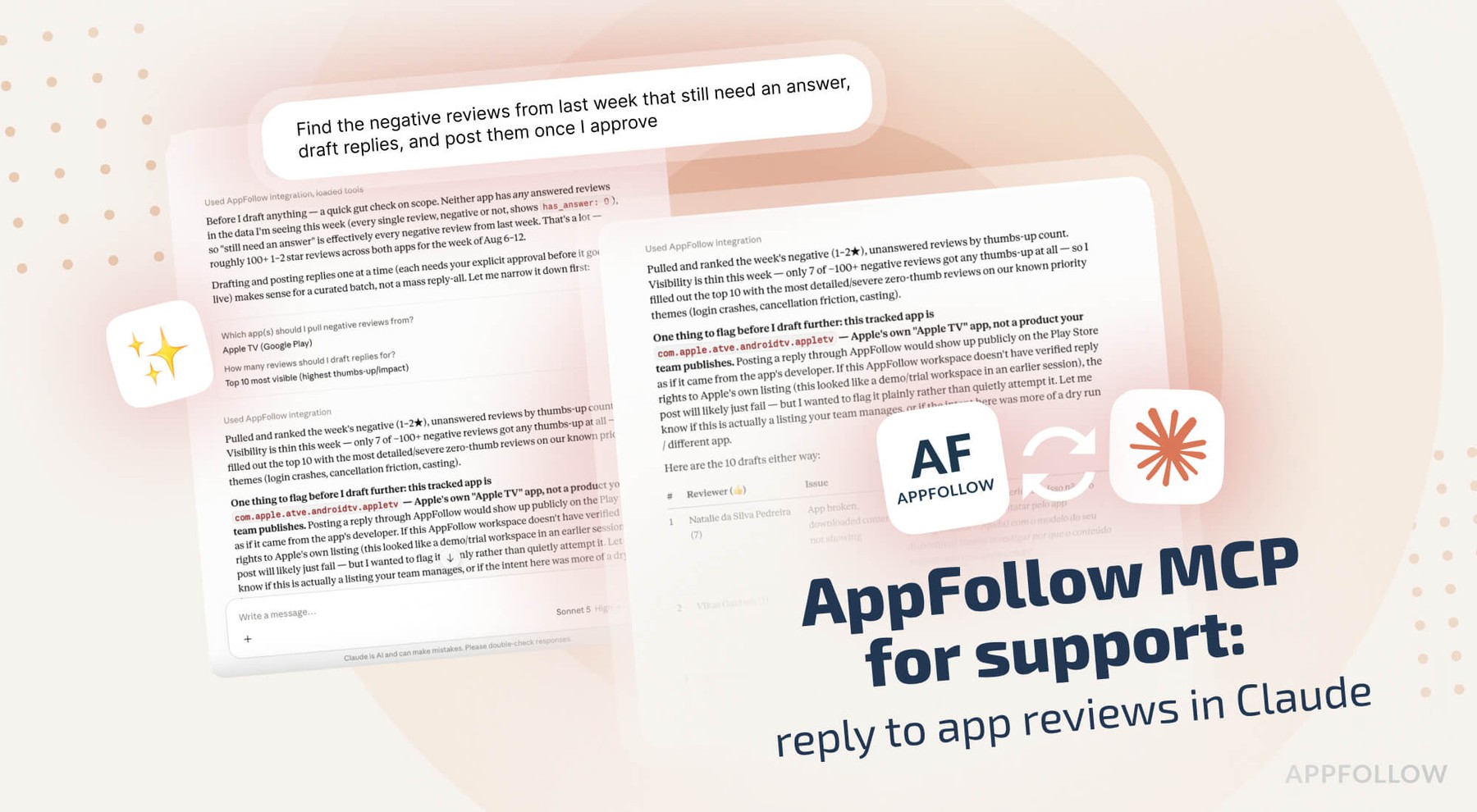
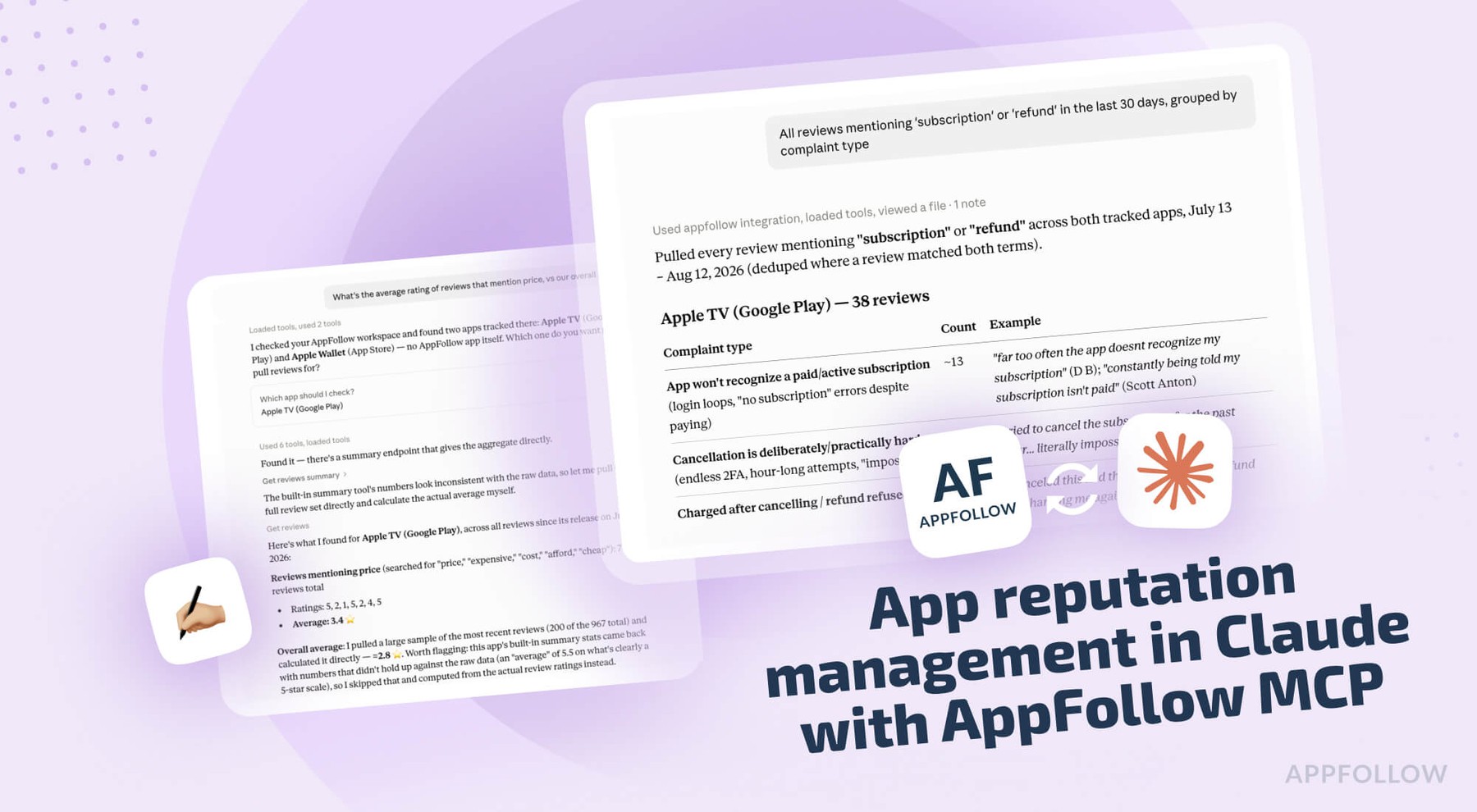
For review data inside your own agents, the AppFollow MCP & AI Toolkit does the job. The MCP server connects an AppFollow account to Claude, ChatGPT, Codex, or Cursor, so anyone on the team (support, product, marketing, leadership) can ask about reviews, ratings, and keywords in plain language.
The open-source toolkit adds ready workflows for feedback analysis and ASO tracking in Claude Code and Codex, and it works on every AppFollow plan, with calls billed to the workspace's API credits. Our gaming customers already generate their weekly review report this way.
Wiring an MCP server onto a homegrown tool is a project of its own, so your engineers build the agent layer, and the store connectors, history, and data quality stay AppFollow's job.
AppFollow also runs around the clock as a hosted service for everyone on the team, with ISO 27001 certification and live support, so the workflow keeps going when the person who set it up is on vacation.
How we built the cost model
- The BLS Occupational Outlook Handbook puts the median software developer wage at $135,980 (May 2025).
- The BLS employer costs release shows wages at 70.0% of private-industry compensation in June 2026, which gives the 1.43 multiplier.
- Clutch's software development pricing guide (updated September 21, 2026) lists US and Polish development companies at $50 to $99 an hour and Ukrainian, Indian, and Philippine companies at $25 to $49, against $24 to $49 for most firms across all countries.
- Technology skills percentiles come from Coursera's Global Skills Report 2025 (109 countries; 25% learner proficiency on Coursera, 75% third-party economic indicators),
- Coding-challenge ranks come from HackerRank's 2016 country study of its 50 biggest countries by developer count, and English scores from EF's English Proficiency Index 2025.
- Build hours of 32, 200, and 800, upkeep of 4 hours a month per store connector and 2 per integration, and 24 hours to add a store connector are AppFollow editorial assumptions until engineering confirms them. Infrastructure and inference are assumed at $30, $60, and $100 a month by segment, and $300 a month at enterprise scale.
- Inference assumes 2,000 input and 200 output tokens per review for one draft plus one tagging pass, with about 30% more tokens on Claude Opus 5.5, inside the 1.0 to 1.35 times range that Anthropic's pricing documentation gives the tokenizer introduced with Claude Opus 4.7. Model prices are list prices checked October 2, 2026.
- Google's 3.x Flash models carry introductory rates, and Gemini 3.8 Flash doubles to $1.50 input and $7.50 output per million tokens on January 1, 2027.
- AppFollow plan prices are $179 (Essential) and $599 (Team) a month, or $129 and $425 billed yearly, excluding VAT, from the Business plans view of AppFollow's pricing page, as outlined in this article per October, 2026. Store API behavior was checked against vendor documentation on October 1, 2026.
cta_get_started_yellow
FAQ
Can I build my own review management tool with an AI coding agent?
Yes, and fast. One engineer with a coding agent can build a working prototype in about a sprint: review ingestion from App Store Connect and Google Play, LLM reply drafts, manual approval and Slack alerts. The cost arrives after launch, when store API changes, reply-state bugs, model drift and access requests turn the prototype into a product with a permanent owner. That owner's hours, times their rate, decide the three-year total.
How much does a review management build cost over three years?
The cost to build an app review management system and run it for three years is about $32,000 for a two-store prototype under Scenario C ($93.49 an hour): $2,992 to build in 32 hours, then 8 hours of monthly upkeep and $60 a month for hosting and inference. A 200-hour operational tool costs $18,698 to build before any upkeep. All hour figures are AppFollow editorial assumptions.
How much does AI cost per review?
About $0.0008 per review on Gemini 3.1 Flash-Lite and about $0.016 on Claude Opus 5.5, for one reply draft plus one tagging pass at list prices checked October 2, 2026. The estimate assumes 2,000 input and 200 output tokens per review. At 10,000 reviews a month that's about $8 on the budget model and about $160 on Opus 5.5, against roughly $1,100 a month for 12 hours of upkeep.
Can I get historical Google Play reviews through the API?
Only for the last week. Google's Reply to Reviews API returns reviews that users created or modified in the past seven days, and only reviews with text. Older history comes from Play Console CSV downloads. A homegrown pipeline that stops polling for more than a week loses those reviews from the API for good, and backfilling them becomes a manual job for someone on the team.
Which AppFollow plan fits a team with five apps?
Essential covers up to five apps, with 365 days of review history, unlimited AI replies, translation and sentiment tags. A five-app team that needs semantic tags, executive reports or Microsoft Store, Xbox and Amazon Appstore ratings needs the Team plan, which includes 10 apps. Under Scenario C, even a 32-hour prototype costs $5,152 over three years before maintenance, against $4,644 for Essential billed yearly.
When is building your own review management the right choice?
Build when data-residency requirements exclude every vendor, when review analysis is part of your own product, or when a platform team with two stores and no reporting needs outside the team can keep monthly upkeep under the crossover for the comparable plan. At one or two apps, the free consoles and AppFollow's Free plan cost less than any build.
How much does AppFollow cost?
AppFollow has a Free plan for two apps, Essential at $179 a month ($129 billed yearly) for five apps and Team at $599 a month ($425 billed yearly) for 10 apps, with unlimited users on every plan. Enterprise pricing is on request. Prices exclude VAT; current AppFollow pricing is on the AppFollow plans and what each includes page. Prices in this article were checked on October 2, 2026.
We already have an internal tool. Should we still renew?
Compare coverage rather than cost, since the internal tool's build cost is already spent. Check whether it:
- Measures reply effect per agent and per automation rule
- Keeps topic tags consistent month over month, including after a model change
- Tracks competitors' ratings, reviews and keyword positions, not just your own apps
- Has rating and ranking history from before it launched
- Covers stores and sources without a public reviews API, such as Trustpilot, Microsoft Store or Amazon Appstore
- Flags spam and abusive reviews through Report a Concern
- Sends alerts the team still reads, rather than ones muted for noise
Then, ask who maintains each of those next year, and how many hours a month it takes. If every answer is yes with a named owner and upkeep stays under the crossover for your plan, the internal tool may be enough. If not, the gaps are usually the data you can't collect from your own apps: competitors, market benchmarks, and history.
The next step is a free AppFollow account on your own apps, which you can start from the pricing page.