App Store Optimization for Games: The 2026 Playbook for Indie Devs and Publishers

Table of Content:
- Key Insights
- What is ASO for games — and why is it different
- The state of game ASO in 2026 — key insights
- The game ASO framework — the five pillars
- Keyword research for games — a tactical walkthrough
- Optimizing creative assets for games
- Reviews, ratings, and player sentiment — the hidden ASO lever
- Localization strategy for mobile games
- Genre-specific ASO playbooks
- Generative Engine Optimization (GEO) for games — first-mover playbook
- Turn Game ASO into a repeatable growth system with AppFollow
App store optimization for games has become the difference between launching a title and actually getting found. The mobile gaming market keeps growing, but attention is getting squeezed. Mobile gaming returned to growth with in-app purchase revenue up 4%, while engagement climbed across sessions and time spent.
More players are showing up. More games are fighting for them, too.
Teams spend months refining mechanics, balancing economies, and polishing progression loops. Then the game hits the Apple App Store or Google Play and runs into the same problem: discoverability.
Great games disappear because players never tap. Organic installs never happen because the listing fails long before gameplay gets a chance.
This playbook will unpack what actually moves visibility and conversion rate in 2026, from keyword optimization and reviews to player language, LiveOps, and AI discovery. If you're building a repeatable process, not chasing one lucky spike, this is where to start.
Along the way, I’ll also point to workflows from AppFollow’s Gaming solutions and its ASO tools where they fit naturally.
Key Insights
- Game ASO has changed a lot over the last two years. Keywords still matter. Screenshots still matter. Yet the teams growing consistently in 2026 rarely treat optimization as a set of disconnected tasks. Discovery now stretches across app stores, LiveOps surfaces, reviews, and AI-driven recommendation engines.
- Game ASO starts with player psychology, not store fields. Utility users search for tasks. Players search around genres, mechanics, moods, and feelings. Terms like "cozy farming game" often reveal stronger intent than broad keywords.
- Think in five pillars, not isolated tactics. Keywords, creatives, reviews, conversion, and localization reinforce each other. Weakness in one area usually limits gains elsewhere.
- Review text is one of gaming's best keyword sources. Players naturally describe your game in language that often converts better than brainstormed marketing terms.
- Screenshots should tell stories, not explain menus. Strong listings lead with emotion, progression, and gameplay moments instead of settings screens and feature lists.
- Localization is market expansion, not translation. Metadata matters. Cultural adaptation of screenshots, creatives, and review replies often matters more.
- AI search created a second discovery layer. ChatGPT, AI Overviews, Perplexity, and Apple Intelligence increasingly influence how players discover games.
- Treat ASO like a flywheel, not a launch checklist. Better visibility creates installs. Installs generate reviews. Reviews improve discoverability and messaging. Momentum compounds over time.
What is ASO for games — and why is it different
App store optimization for games, often called Game ASO or ASO for games, is the practice of improving a mobile game's visibility and conversion on the Apple App Store and Google Play through keyword optimization, creative assets, reviews, and localization.
Game ASO vs. app ASO: five real differences
On paper, app store optimization games and utility apps use the same stores, fields, and dashboards. Open App Store Connect or Google Play Console, and the mechanics look familiar.
Same metadata fields. Same screenshots. Same ratings tab.
The difference shows up when real users enter the picture. Players search differently and react faster. They browse by genre, mechanics, and mood. They decide emotionally, then justify the decision afterward.
ASO for apps | ASO for games | |
Keyword behavior | Searches solve tasks: "budget planner", "calorie tracker" | Searches follow genre, mood, mechanic, or IP: "cozy farming game", "anime RPG" |
Screenshot intent | Explain features and functionality | Tell a story and create curiosity |
Review weight | Feedback often focuses on usability | Player sentiment shapes perception and surfaces keyword ideas |
Localization priority | Translation often comes first | Cultural adaptation and local player expectations matter more |
A/B test cadence | Larger refresh cycles | Faster iteration tied to events, updates, and LiveOps |
That changes what matters in game ASO, from keyword strategy to testing cadence.
Why ASO matters more for games than ever
Paid growth became harder to predict over the last few years. Privacy changes after IDFA reshaped targeting and measurement, while acquisition costs continued climbing. Mobile gaming user acquisition spend reached $25 billion in 2025, and competition for player attention keeps intensifying.
The math also shifted. Recent mobile gaming benchmarks place average iOS CPI between $2 and $6+, depending on genre, while blended gaming CPI increased roughly 30% year over year.
That changes how teams think about growth. Paid UA still matters, but organic installs now carry more strategic weight because sustainable growth increasingly depends on discoverability rather than media spend alone.
I’ve noticed the strongest teams no longer separate UA and ASO into different conversations. Rising acquisition costs turned visibility into a compounding advantage rather than a nice bonus.
"Most game studios borrow ASO tactics from utility apps and over-focus on feature language. Players rarely search that way. They search by feeling, genre, and mechanic. If I had one move to bet a launch on, I would mine player reviews and community comments for recurring phrases, then build screenshots and keywords around that language."
Yaroslav Rudnitskiy, Senior Professional Services Manager at AppFollow
The state of game ASO in 2026 — key insights
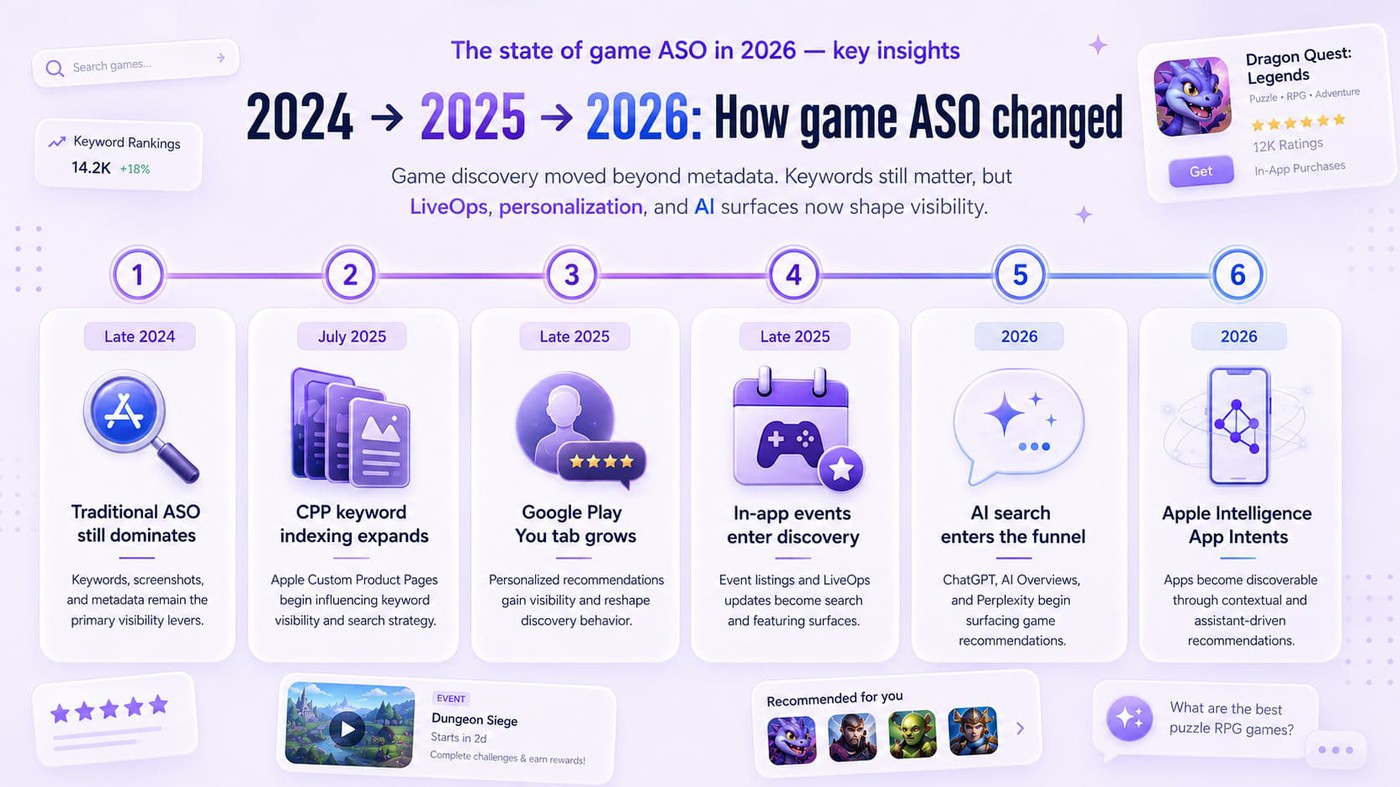
Game ASO changed more in the last 18 months than it did in several years before that. Discovery has expanded beyond traditional store fields and started showing up in places teams barely considered part of ASO a few years ago.
Algorithm changes that reshaped game discovery
Apple's changes around Custom Product Pages continued expanding through 2025, giving developers more ways to align audience intent with tailored store experiences. Apple documented new search and acquisition enhancements for CPPs in its Custom Product Pages updates and broader Custom Product Pages documentation.
Generic keyword stuffing suddenly became a weaker move.
Google shifted attention too, by positioning the You tab as a personalized "home base" built around recommendations, rewards, updates, and player behavior signals, reinforcing a broader move toward interest-based discovery rather than static browsing. Search still matters. Behavioral signals matter more.
"CPP keyword indexing surprised many game teams because it changed how metadata strategy works. Studios can finally stop forcing every keyword into a title or subtitle and instead build intent-specific landing pages.
For the next 90 days, I’d focus on identifying high-opportunity keyword clusters and mapping them to Custom Product Pages rather than expanding metadata endlessly."
Ilia Kukharev, Product Manager at AppFollow
In-app events and LiveOps as ASO surfaces
Store listings no longer end at the app page. In-app events, event listings, and LiveOps updates increasingly create featuring opportunities and fresh discovery moments.
A seasonal Halloween event, anniversary raid, or limited-time battle pass can appear directly in search surfaces and recommendation areas.
Both major stores have steadily expanded event visibility beyond the app page itself. Apple introduced In-App Events on the App Store as discovery surfaces that can appear in search results, editorial selections, and recommendations, while Google Play expanded LiveOps and promotional content surfaces to help games surface events and time-sensitive content directly in discovery experiences.
The rise of AI-driven discovery
Search itself is changing. Mobile game ASO now overlaps with generative search, AI Overview experiences, ChatGPT recommendations, Perplexity results, and Apple Intelligence surfaces.
Players increasingly ask for "a relaxing puzzle game for short sessions" instead of typing puzzle game keyword into a search bar.
Users increasingly express intent in natural language rather than compressed keyword strings, while longer, more conversational queries are significantly more likely to trigger AI-generated search experiences and summaries.
The game ASO framework — the five pillars
Many teams approach ASO like a checklist. Update a few keywords. Replace screenshots. Maybe answer reviews after a rough release. Then game publishers wonder why results feel random.
Strong ASO game programs usually look different than a classic framework. They operate more like systems where each part reinforces the others.
This is the mental model the rest of this guide follows. Five pillars sit underneath every sustainable game ASO strategy.
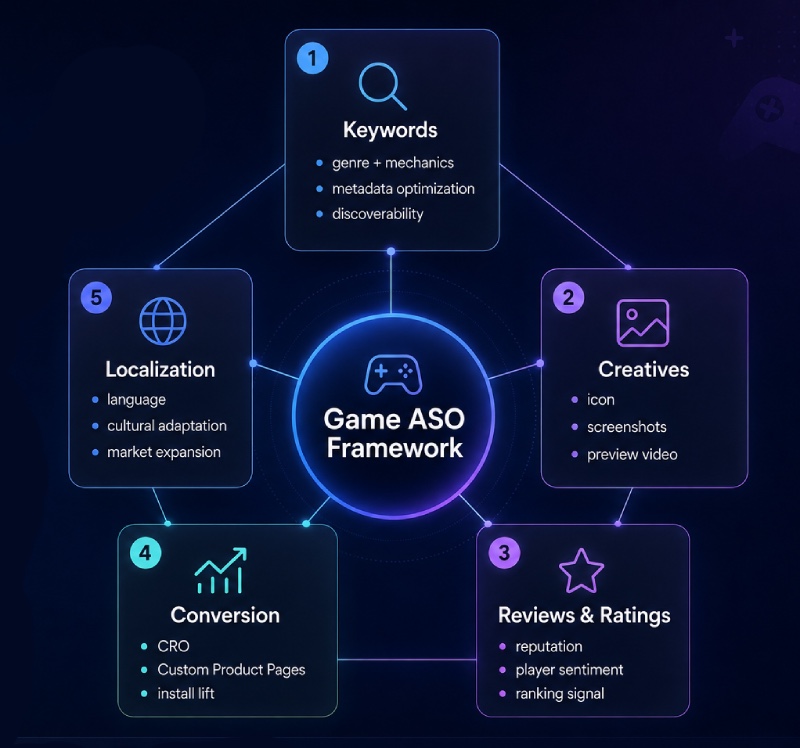
- Keywords — where players find your game. Genre terms, mechanics, mood signals, and competitor language all influence how a game appears in search. Metadata optimization starts here because ranking for "merge puzzle" and ranking for "cozy decorating game" can attract very different audiences.
- Creatives — The icon earns attention. Screenshots create interest. Preview videos remove doubt. Creative assets do more than look polished. They help players imagine the experience before downloading. Utility apps often explain features. Games sell a feeling.
- Reviews and ratings — your hidden ranking lever. Reviews affect reputation, but they also surface player language, frustration patterns, and keyword opportunities. I rarely think of reviews as customer support content anymore. They act more like ongoing market research with a built-in ranking signal attached.
- Conversion — turning impressions into installs. Visibility without conversion becomes expensive traffic. CRO inside app stores focuses on improving the journey from impression to tap to install. Small changes in screenshot order, messaging, or Custom Product Pages can create meaningful lift.
- Localization expands reach far beyond translation. Language matters. Cultural expectations matter too. Creative adaptation, regional player behavior, and local sentiment patterns often influence performance more than direct translation ever could.
Keyword research for games — a tactical walkthrough
I’ve watched game teams get stuck on keyword research because they start with tools. The tool opens first, somebody types "RPG game," exports a list of high-volume terms, and the whole process quietly turns into spreadsheet archaeology. A good ASO keyword strategy starts earlier. Players rarely search the way ASO teams expect.
Building a seed keyword list from genre, mechanic, and mood
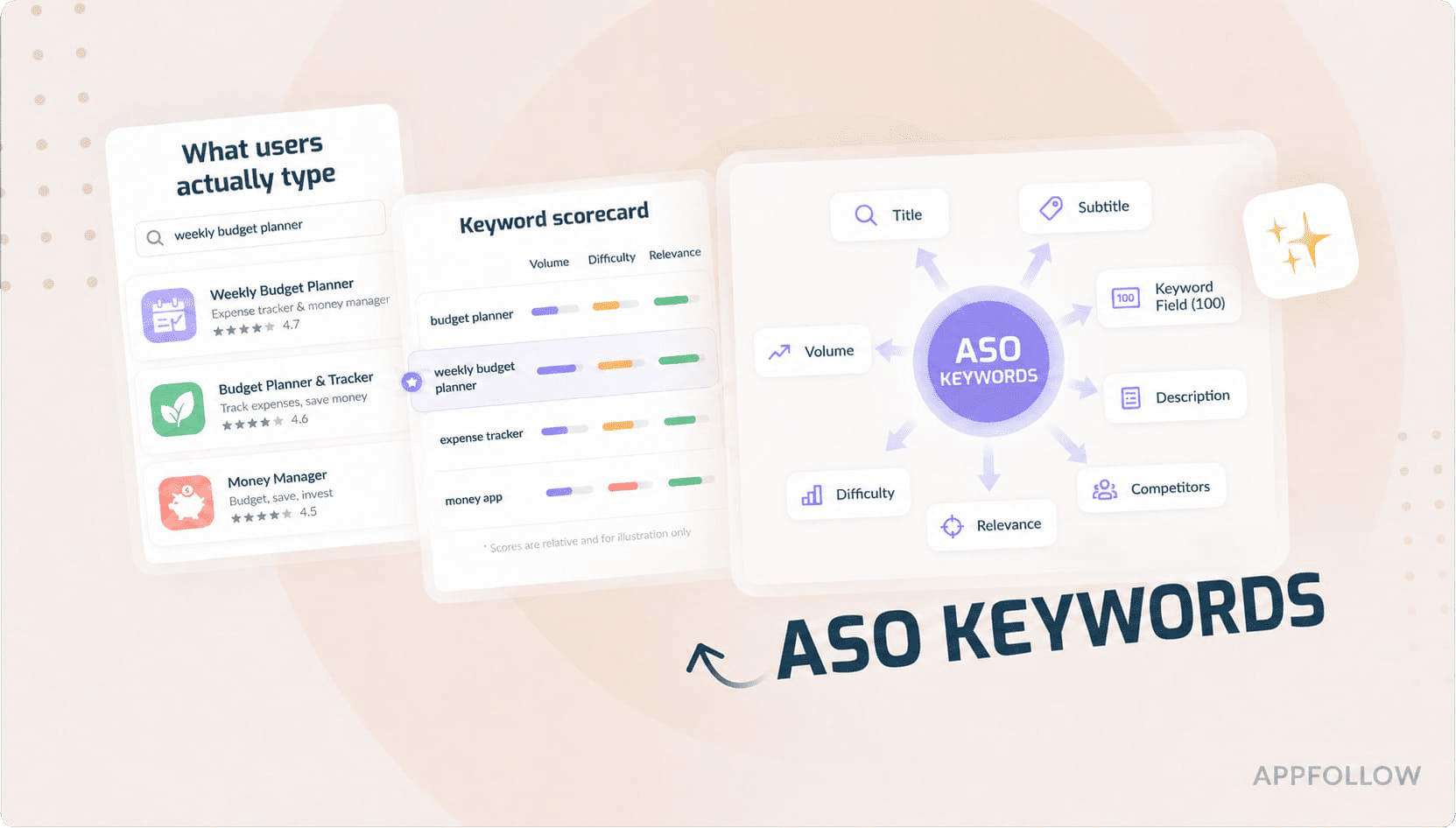
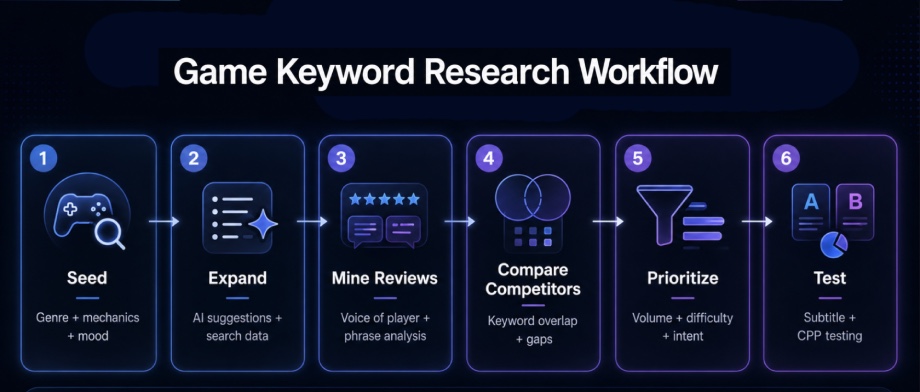
Start with three buckets: genre, mechanics, and mood. Genre keywords describe what the game is. Mechanic keywords explain how it plays. Mood keywords reveal why someone wants it.
A casual puzzle title might begin with:
- Genre keywords: puzzle game, merge game, brain training
- Mechanic keywords: match-3, decorate, idle progression
- Mood keywords: relaxing, cozy, satisfying
That combination usually creates stronger long-tail keywords than generic terms alone. "Puzzle game" is broad. "Relaxing decorating puzzle" tells a much richer story.
Expanding with tools — the AppFollow Keywords Intelligence workflow
Once the seed list exists, expansion becomes easier. This is where ASO for mobile games starts looking less like brainstorming and more like pattern recognition.
Start with AI recommendation workflow. Add your app to Appfollow, and the system will provide you a collection of the best keywords that match it.
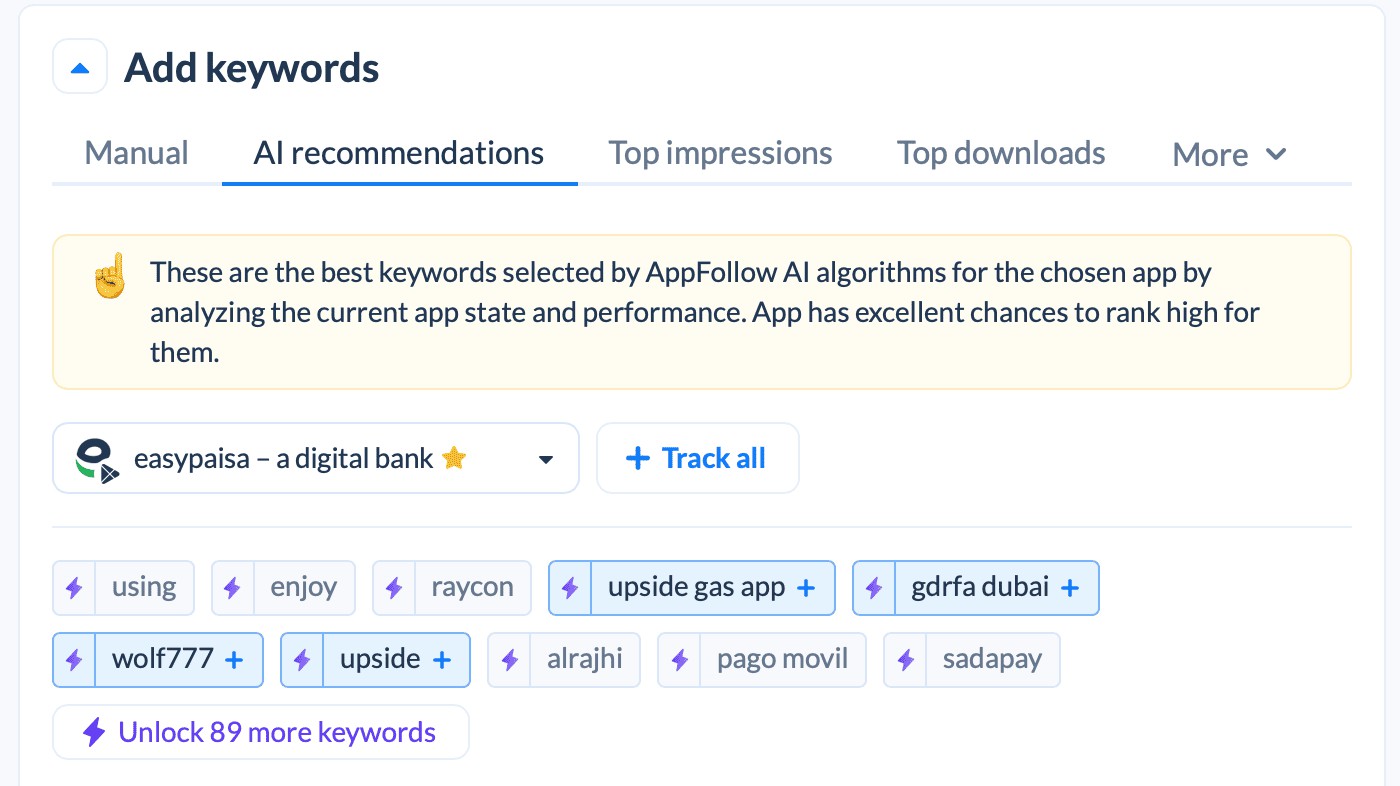
Sign up to research your game keywords 10-days free.
If you already have terms in mind, research them:
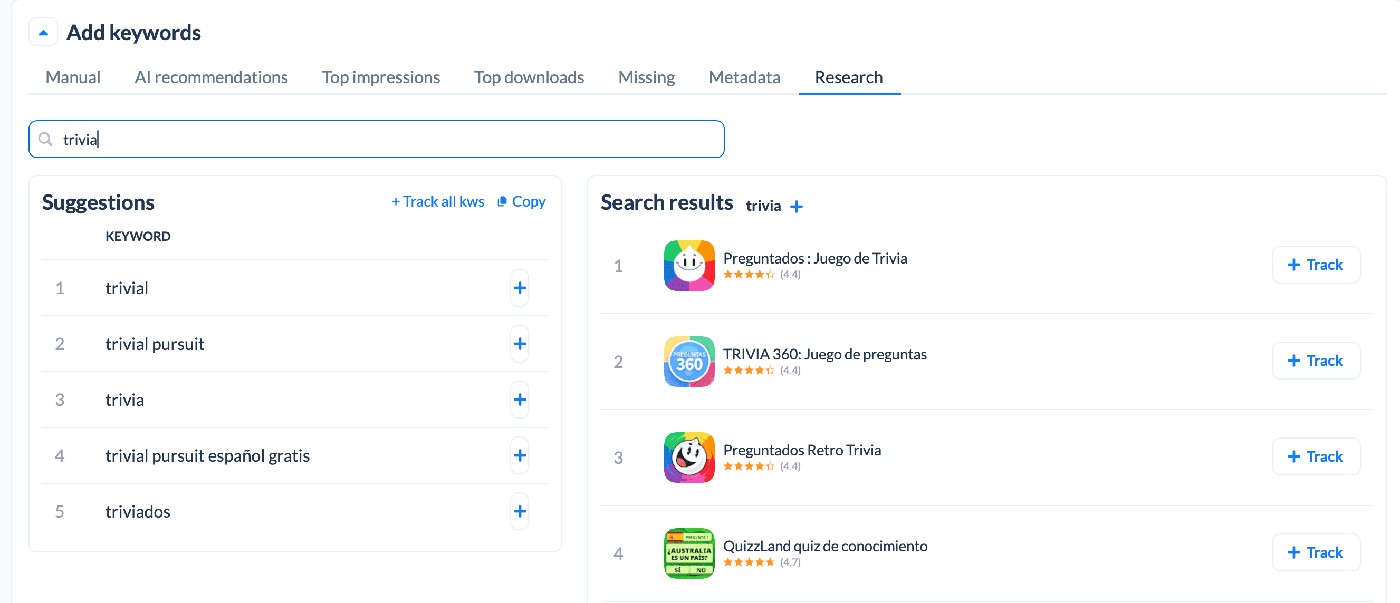
Sign up to research your game keywords 10-days free.
Check missing and metadata keywords as well.
As a result, you will get a list of keywords with all the data to make a final decision
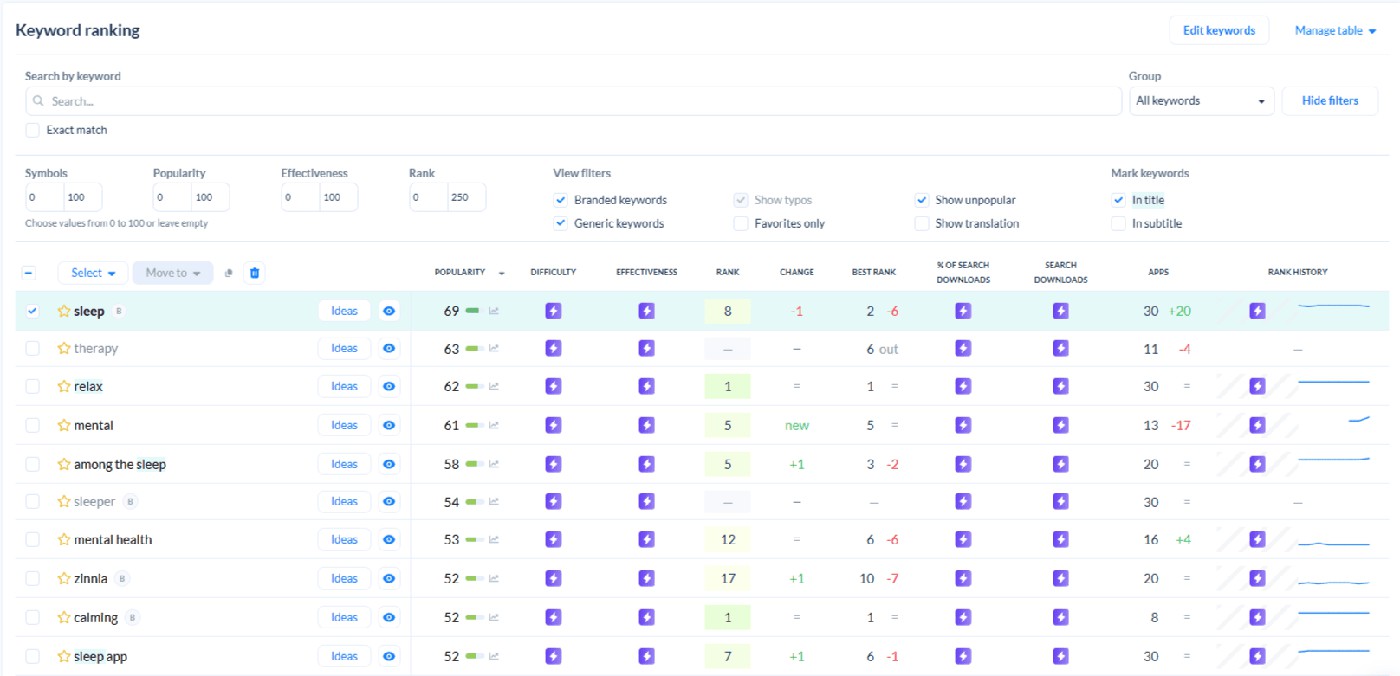
I usually avoid chasing the biggest numbers first. A keyword with massive volume and brutal competition often looks exciting in a spreadsheet and disappointing in reality. The stronger move is finding phrases where intent, achievable rank potential, and visibility opportunity overlap.
That is where recommendation systems become useful. They help uncover terms teams might never think to test on their own. Sometimes the highest-value keyword is not "RPG game." It ends up being something closer to "cozy hero collector" or "offline fantasy raid."
cta_get_started_purple
Mining player reviews for keywords competitors never see
Players describe games in ways marketers never do. Nobody writes "engaging asynchronous progression loop" in a review. They write things like "great game for relaxing before bed" or "love collecting dragons."
That language matters. Review mining uncovers the voice of the player rather than the voice of marketing. AppFollow AI Semantic Tags and Phrase Analysis can surface recurring themes and semantic tags automatically.
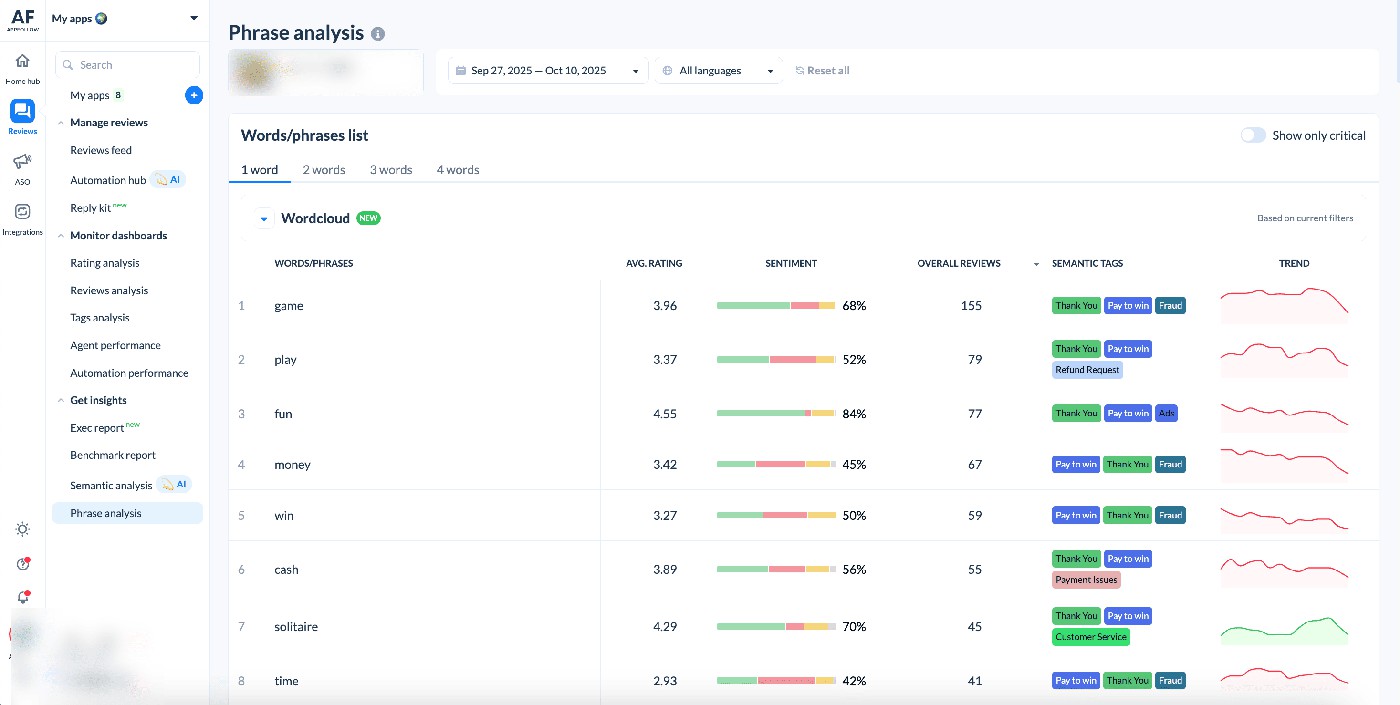
Pull the top 50 phrases players use to describe your game, then test those phrases in subtitles and Custom Product Pages.
Competitor keyword gaps — and how to capture them
Competitor analysis becomes more useful after building your own foundation. Keyword overlap matters, but the bigger opportunities often sit in terms that competitors ignore.
Inside AppFollow, start by adding a few direct competitors to your workspace or choosing them during keyword research:
Open Keywords Intelligence, pull their ranking terms, then compare visibility and overlap patterns against your own keyword set. The goal is not to copy everything competitors rank for.
I usually filter for phrases where competitors have moderate visibility but weaker positions, or where adjacent mechanics and player language create openings.
Use paid data to feed organic
Paid campaigns reveal intent faster than almost anything else. Apple Search Ads, especially Search Match campaigns, surface terms that generate installs rather than clicks.
"Teams often over-focus on volume and under-invest in intent. My first 30 days usually follow the same path: build a seed list, expand through tools, mine reviews, compare competitors, then prioritize and test. The highest-ROI input is almost always review language because real player phrases tend to convert better than terms chosen in a brainstorm."
- Dzianis Shalkou, Senior Professional Services Manager at AppFollow
Optimizing creative assets for games
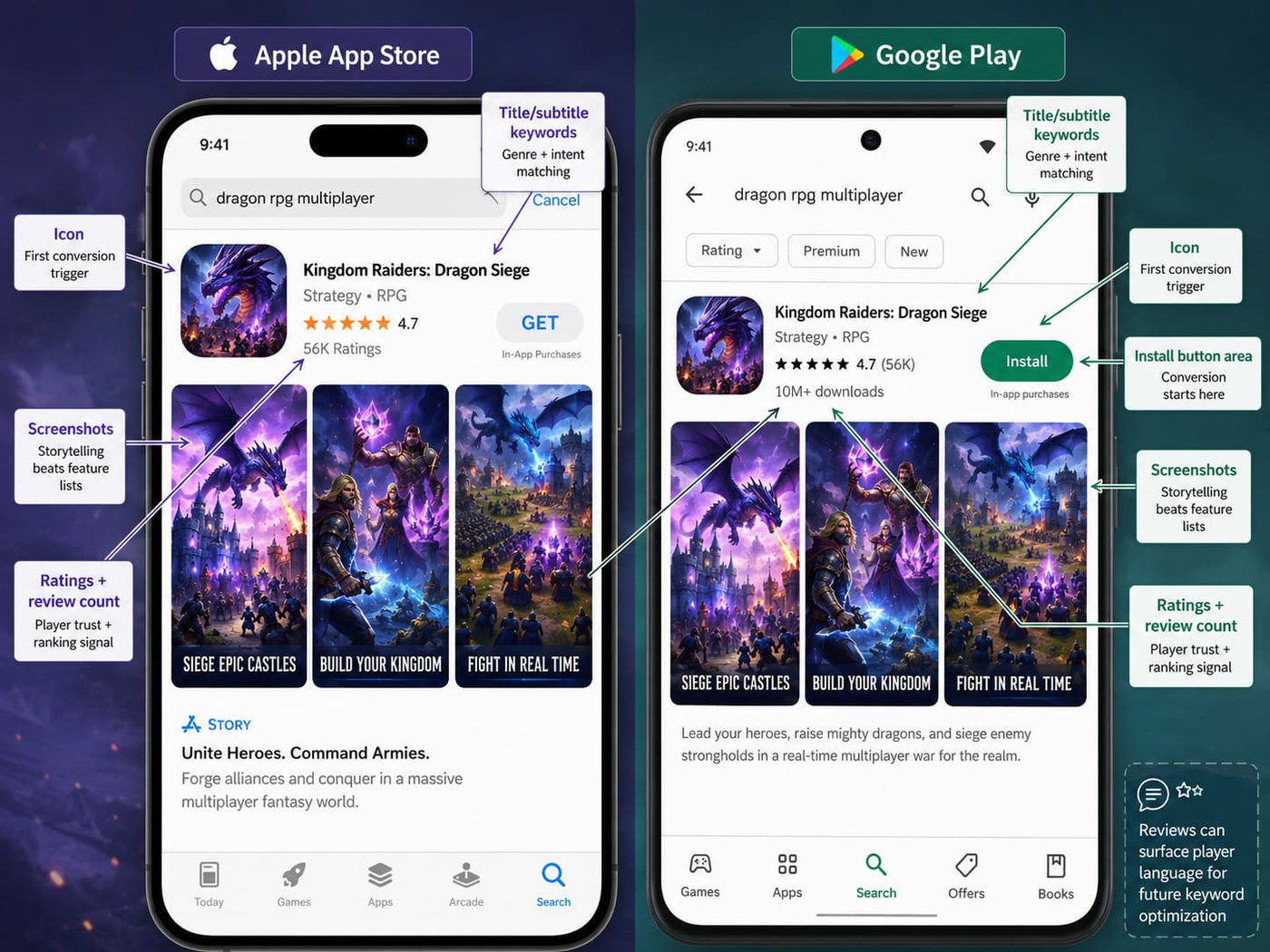
Creative assets decide whether visibility turns into installs. I’ve seen teams obsess over rankings and keyword positions while overlooking the thing players actually see first. Search gets someone to your listing. Creatives decide what happens next.
Games also operate differently from utility apps here. Nobody installs a game because a screenshot explained the settings navigation particularly well. Players respond to emotion, momentum, curiosity, and a promise of experience. Four creative levers tend to matter most: icon, screenshots, video, and audience-specific product pages.
The game icon — what wins in 2026
The icon works under brutal conditions. Tiny size. Fast scrolling. Split-second decisions.
Character-led icons continue to perform well because faces communicate emotion quickly. High contrast helps visibility in crowded search results. Clear focal points often outperform busy compositions. An icon should still read at thumbnail size inside the store.
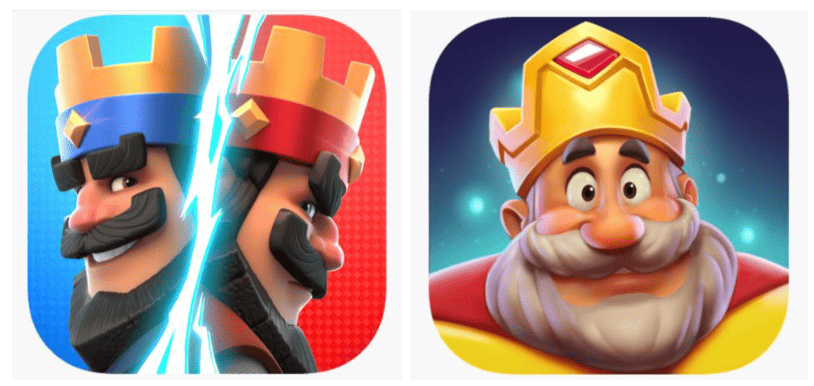
A/B testing matters here because assumptions fail constantly. I’ve seen simple changes outperform polished redesigns. Sometimes zooming in closer on a character's face beats a full battle scene simply because users can process it faster.
Screenshots — story, not menus
Many teams still lead with menus, inventory systems, or feature explanations. That usually misses the moment. Game ASO screenshots should create momentum.
The first image acts like a hook screenshot. It needs tension or curiosity. Show the dragon battle. Show the merge transformation. Show the reward moment.
Text overlay helps too, but only if it adds context rather than narrating the obvious. Players rarely need "Upgrade your character." They respond more to emotional framing like "Build your dream kingdom" or "Survive impossible raids."
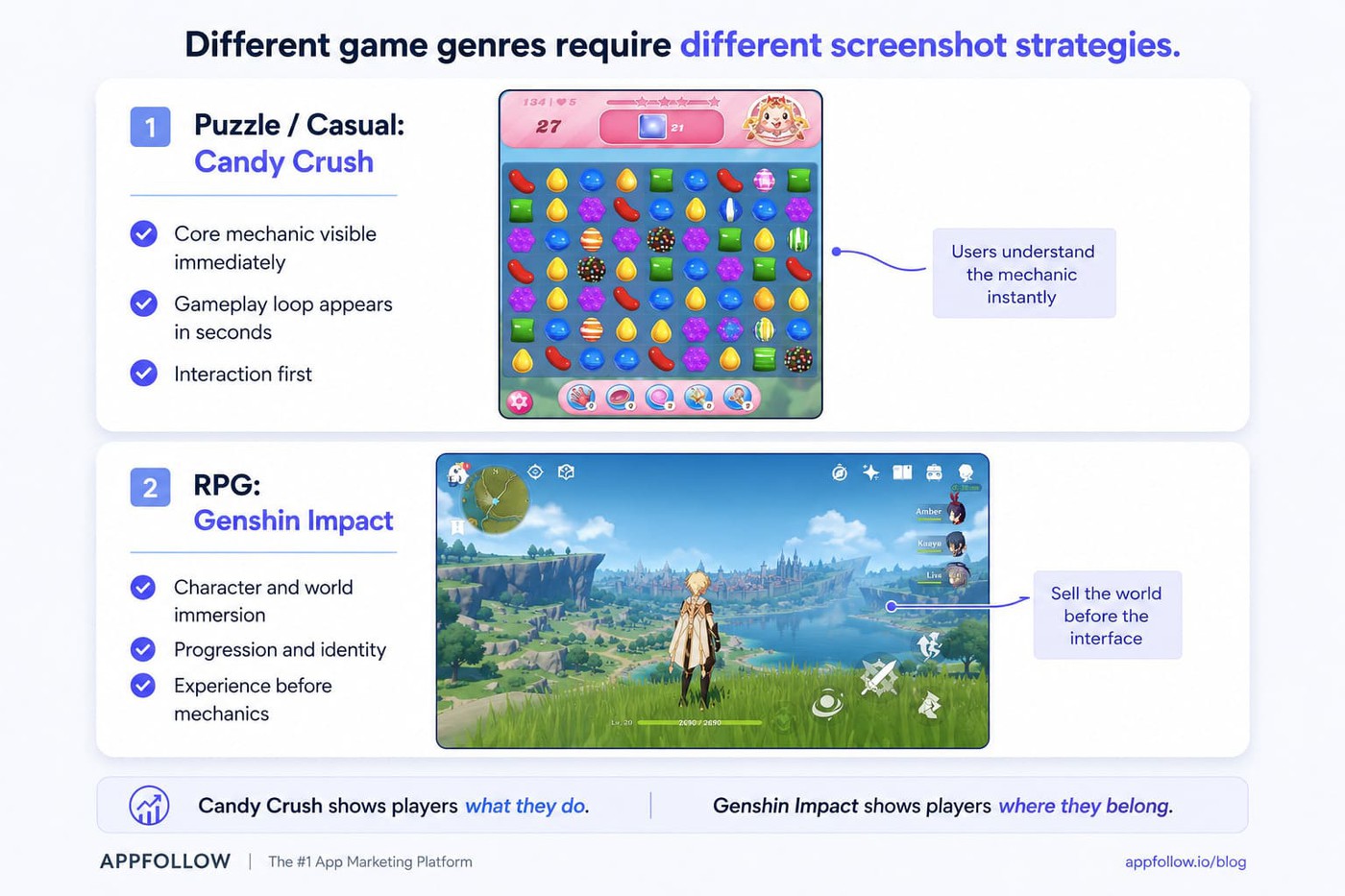
"The most common screenshot mistake is leading with menus or interface screens instead of gameplay moments. Some of the strongest conversion lifts I've seen came from replacing feature-focused screenshots with emotionally driven hooks that immediately showed action and stakes."
- Ilya Kataev, Professional Services Team Lead at AppFollow
App preview video / promo video — the 30-second hook
App preview videos and gameplay trailers rarely get much time. Autoplay behavior means viewers often decide within seconds whether to keep watching.
Start with gameplay immediately. Avoid logo sequences and slow intros. Strong promo videos establish stakes first, mechanics second.
The opening five seconds usually matter more than the remaining twenty-five.
For example, the Clash Royale gameplay trailer opens with gameplay almost immediately instead of spending valuable seconds on logos or setup.
Stakes become clear fast, mechanics reveal themselves naturally, and the trailer teaches players what the game feels like simply by showing action. That is usually the goal. Show first. Explain later.
Reviews, ratings, and player sentiment — the hidden ASO lever
Most ASO conversations spend a lot of time on keywords and screenshots. Reviews usually show up later, somewhere near customer support. I think that framing misses what is actually happening. Players leave a constant stream of language, emotion, frustration, and feature feedback inside reviews. That data influences visibility, conversion, and sometimes even product direction.
Games create stronger reactions than most apps. Nobody writes a two-paragraph review because a calculator worked correctly. Players absolutely do when a raid update breaks progression or a new character changes game balance.
Why ratings and reviews carry more weight for games
Ratings influence behavior long before someone installs. Average rating affects trust. Review velocity acts as a freshness signal. Store ranking signals increasingly factor in quality and engagement patterns, not just metadata.
Research on app store behavior consistently shows ratings influence install decisions. One widely cited study from Apptentive research on ratings and reviews found that users are significantly less likely to consider apps with ratings below four stars, reinforcing how review quality directly affects conversion behavior.
Games amplify those effects because emotions run high. A rough launch can create waves of negative feedback quickly. The opposite happens too. Strong communities generate review momentum that improves visibility and conversion impact over time.
A player comparing two similar titles may never read a description. They will notice a 4.8 rating beside a competitor sitting at 3.9.
Mining reviews for ASO insights — keywords, CR blockers, feature requests
Reviews reveal how players naturally describe your game. They expose CR blockers, surface feature requests, and uncover language that marketing teams often miss. AI semantic analysis helps make that process manageable at scale.
AppFollow AI Review Summaries and AI Semantic Tags can pull top themes and recurring issues by region. Phrase analysis often reveals patterns hidden inside thousands of comments. One market may repeatedly mention progression difficulty. Another may talk about rewards or social features.
Dzianis Shalkou, Senior Professional Services Manager at AppFollow, shared a pattern he has seen across game customers:
"One team kept optimizing around progression and competitive gameplay because that matched their positioning internally. Review analysis told a different story. Players repeatedly described the game as relaxing and easy to pick up before bed. After testing that language in screenshots and store messaging, conversion improved because the listing finally reflected how players actually experienced the game."
cta_get_started_yellow
Localization strategy for mobile games
Localization is where I see game teams either unlock a second growth curve or quietly waste budget. Translation alone rarely gets you there. A localized title and description might improve discoverability, but players decide to install based on whether the game feels made for them.
The best game teams treat localization like market expansion. First comes market sizing. Then creative adaptation. Reviews, events, and player communication follow. That sequence matters because every new locale becomes its own ASO environment.
Choosing your first 5–7 localization markets
Most studios do not need twenty languages. They need a shortlist with a business case behind it.
I usually start with a mix of market size, genre fit, ARPDAU, and existing MAU signals. Germany and France often perform well for Western markets. Japan and South Korea remain critical for many midcore and RPG titles because of spending behavior.
Brazil and Spanish-speaking markets can unlock scale. China deserves its own strategy because distribution and publishing requirements change the rules.
"Most studios invest heavily in translation and assume the work is finished. The bigger opportunity often comes later. I would sequence localization as metadata first, then creatives, then review replies, then LiveOps events. Teams usually over-invest in translating text and under-invest in adapting visuals and player communication for local audiences."
— Dzianis Shalkou, Senior Professional Services Manager, AppFollow
One thing I always check before adding a market: are players already finding the game there organically? A few installs today can signal a much larger opportunity tomorrow.
Going beyond translation — cultural and visual adaptation
Words travel. Context does not always follow.
I have seen teams translate screenshots perfectly and still miss because the creative language felt foreign. Visual expectations change by market. Japanese store listings often lean into denser information and character-heavy presentation. Western audiences frequently respond to cleaner layouts and faster value communication.
Example: The same game can need different screenshot logic by market.
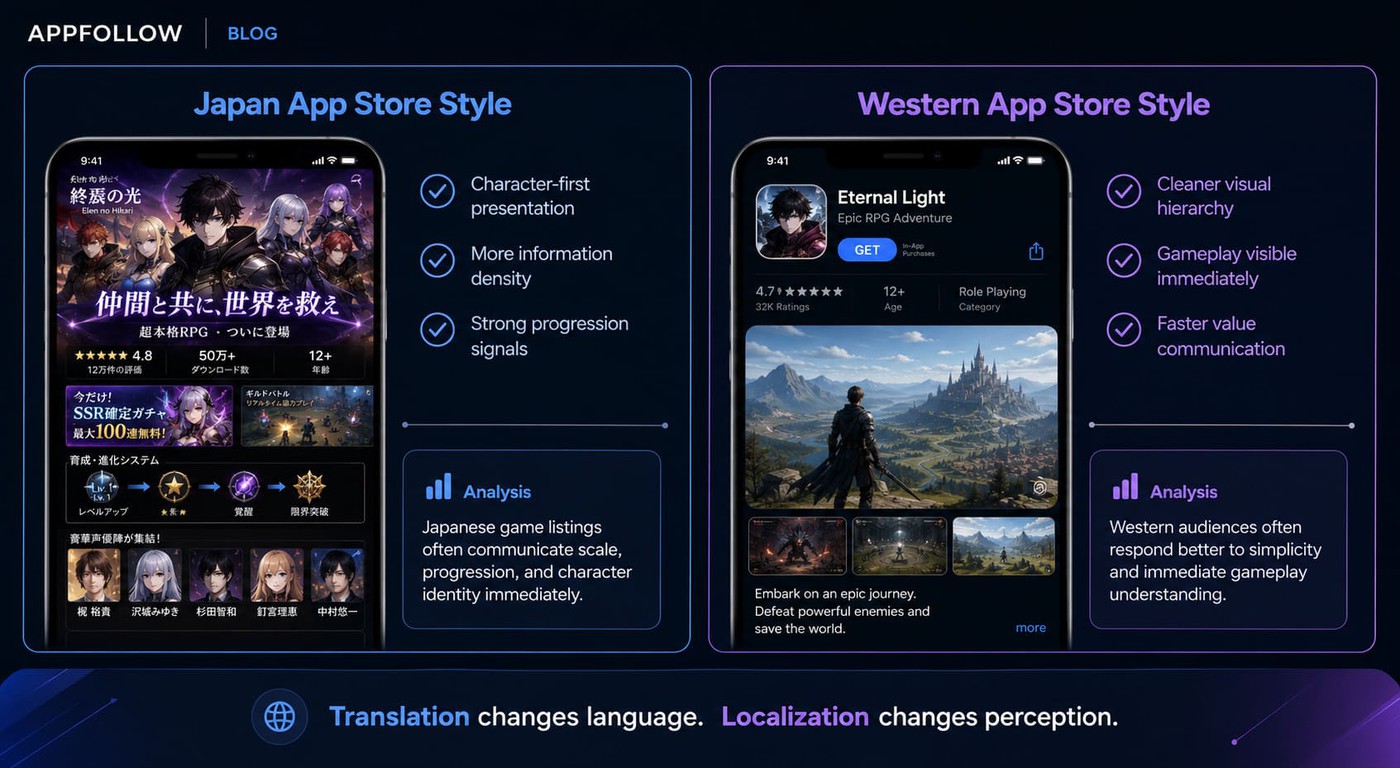
A soft launch can reveal these gaps quickly. Test localized screenshots, icon variants, and promotional messaging before committing to a larger rollout. Sometimes changing the first screenshot produces more impact than translating every line in the description.
Players notice when content feels adapted rather than copied.
Genre-specific ASO playbooks
Genre changes almost everything. I’ve seen teams borrow tactics from successful games and assume success will transfer automatically. Then a puzzle strategy gets applied to an RPG or a hyper-casual playbook lands inside a life simulation title. The stores may look identical, but player expectations shift fast.
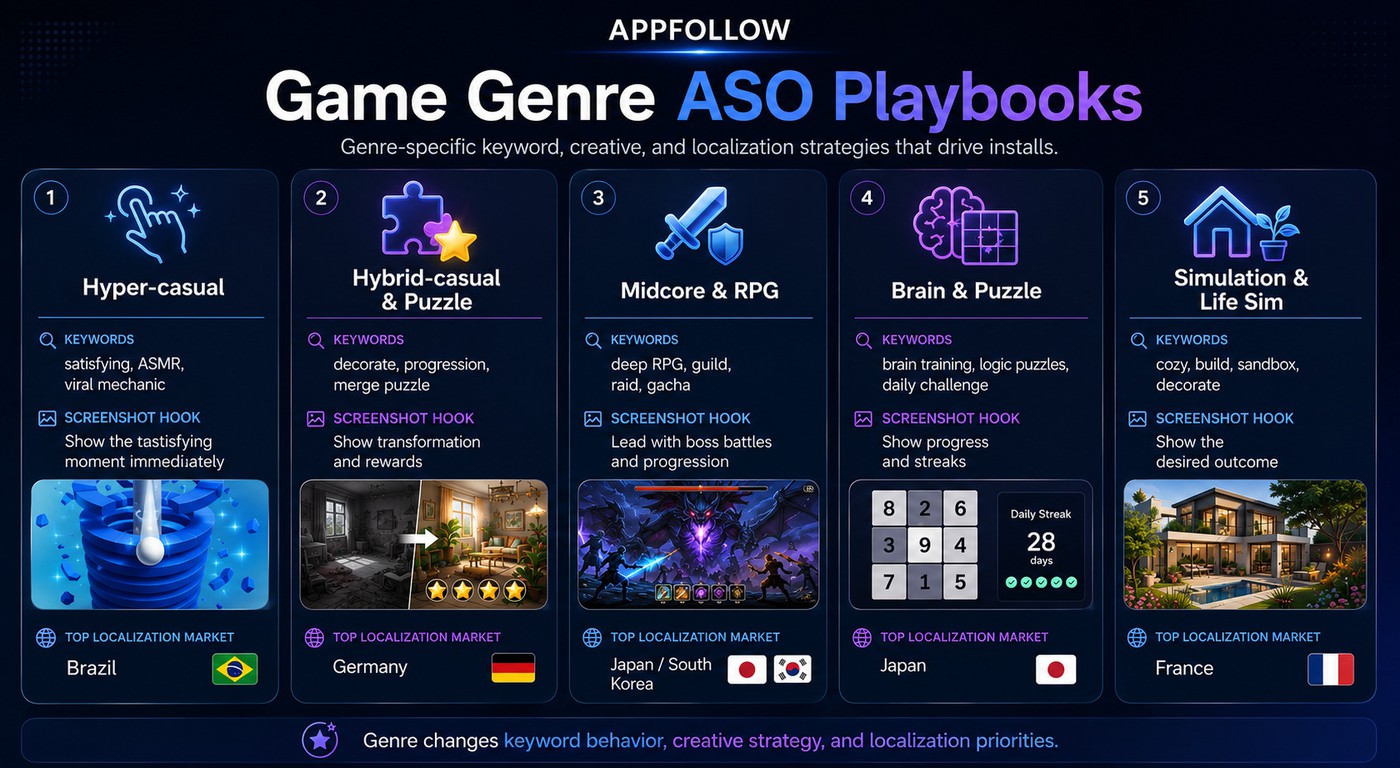
Keywords, creative hooks, review language, and localization priorities all change depending on genre. Think of these less like rigid rules and more like starting points.
Hyper-casual games
Hyper-casual discovery usually revolves around immediate gratification. Genre terms often underperform compared with mechanic and feeling language. Keywords such as "satisfying game," "ASMR cutting," or "viral challenge game" often reflect player behavior better than category labels.
The first screenshot should capture the core mechanic instantly. No onboarding flow. No menus. Show the oddly satisfying moment.
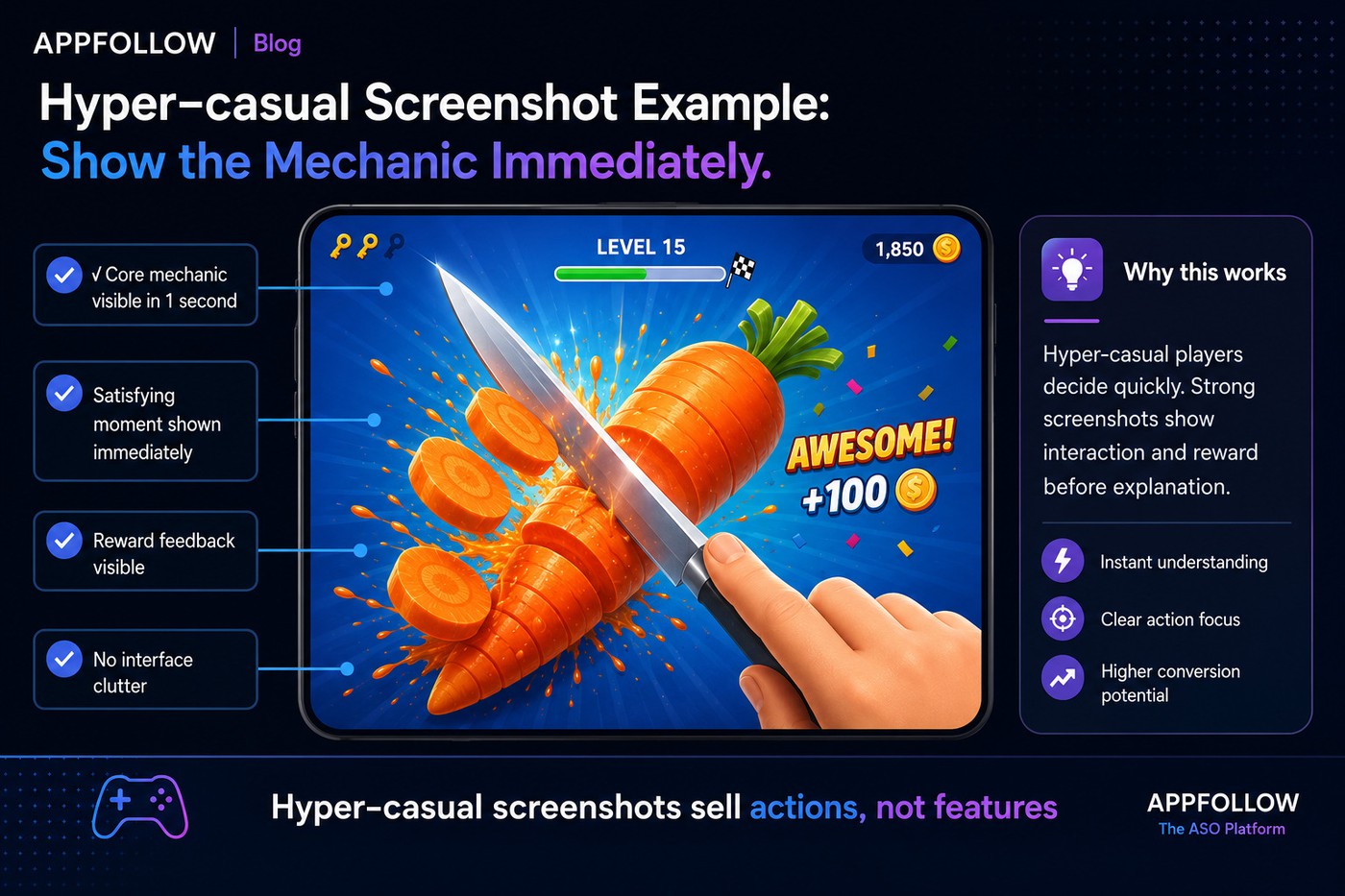
Review patterns often revolve around ad frequency and boredom signals because these games tend to be IAP-light. Brazil and Spanish-speaking markets frequently become strong localization opportunities due to scale and lower creative adaptation costs.
Hybrid-casual and casual puzzle
Casual puzzle titles rarely succeed on puzzle keywords alone. Meta layer terms often matter just as much. Players increasingly search around progression systems, decoration, collection, or social mechanics.
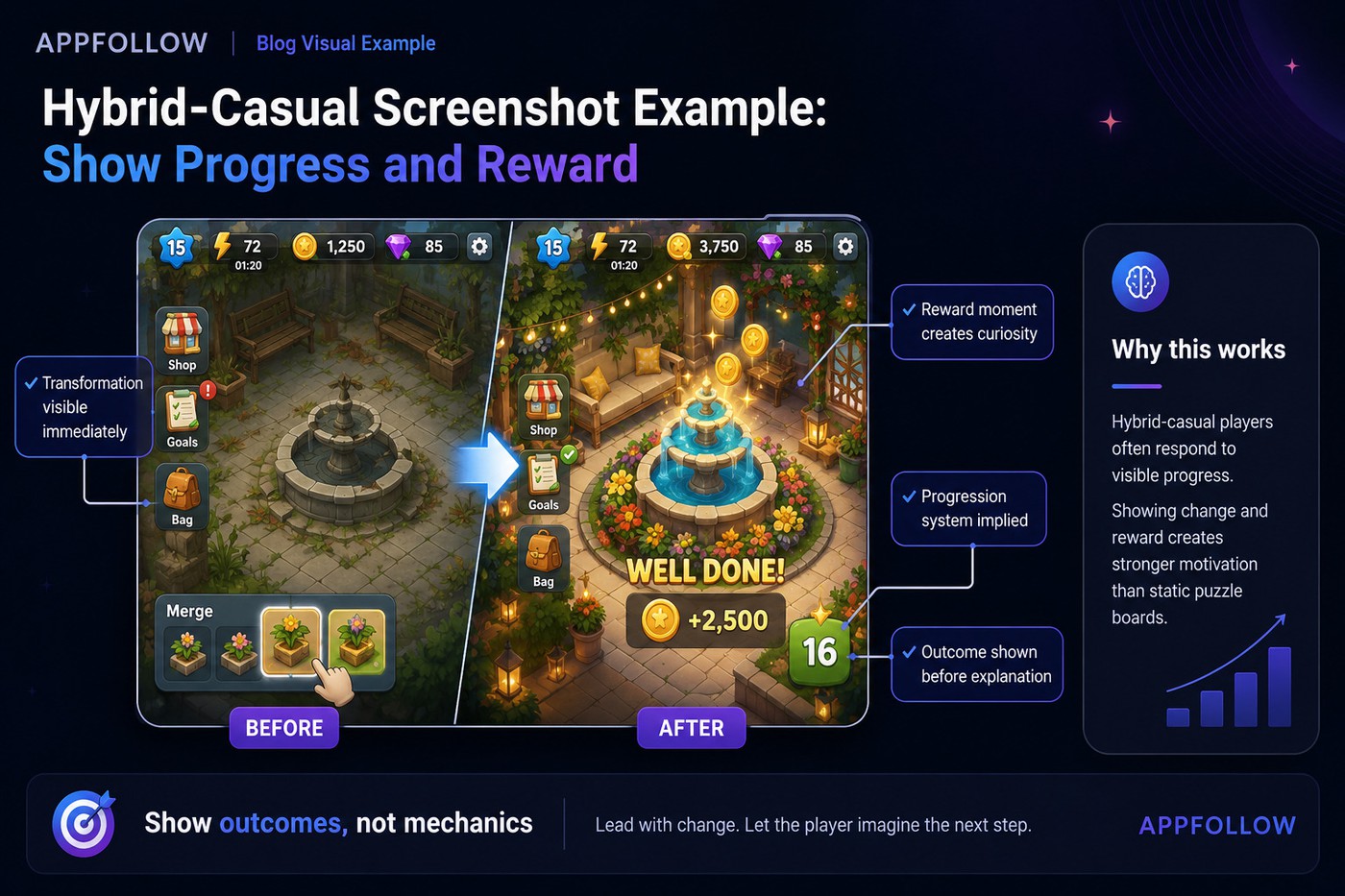
Screenshot hooks work well when they show transformation or reward moments. Before and after visuals outperform static boards surprisingly often.
Midcore and RPG
RPG audiences search differently. Mechanics and identity matter more. Terms like "deep RPG," "gacha hero collector," "guild wars," or "raid strategy game" often reveal stronger intent than broad category phrases.
Creative assets should establish stakes immediately. Character progression, boss encounters, and social gameplay tend to outperform feature explanations.
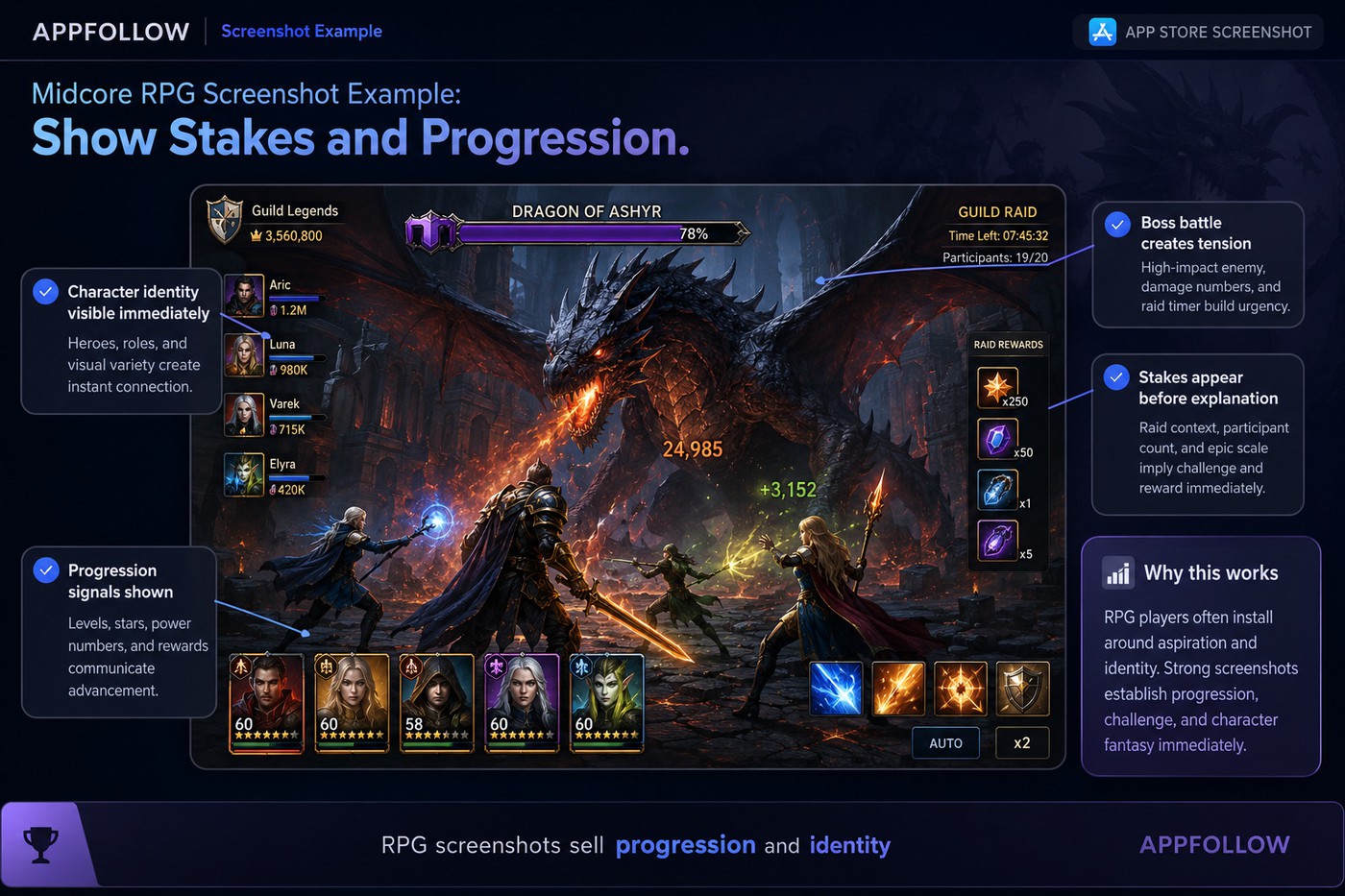
Reviews often mention balance, progression pacing, and event quality. Japan and South Korea usually become top priorities because spending behavior and player expectations create larger opportunities.
Brain & puzzle games
ASO for brain games (sometimes searched as ASO brain games) revolves around three audience signals: habit formation, learning value, and challenge level. Players often search for "brain training," "logic puzzles," "daily challenge," "memory game," "IQ test," "sudoku," or "crossword puzzle."
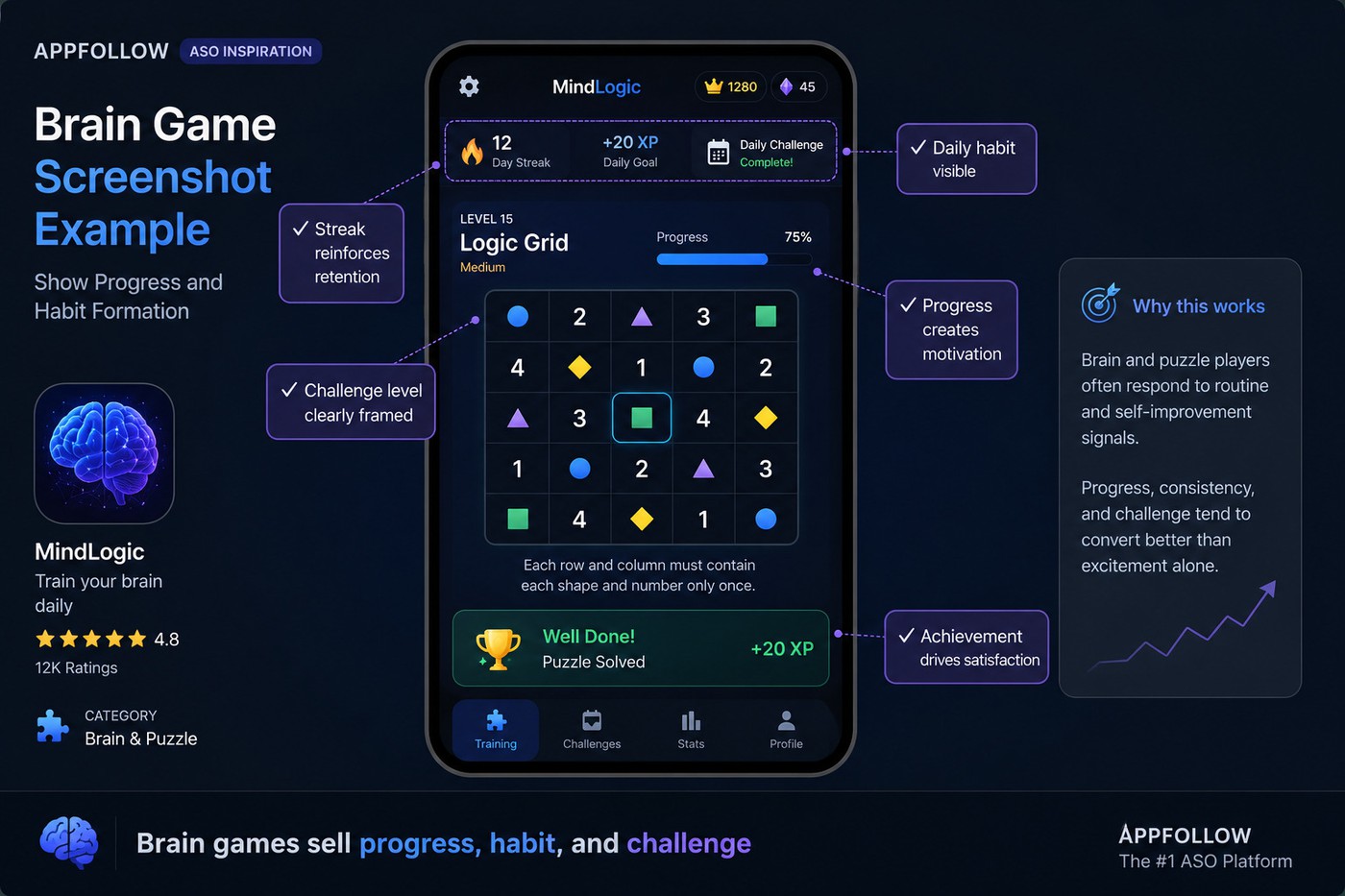
An effective ASO games approach for this category often leads with consistency rather than excitement. Screenshot hooks work well when they frame progress, streaks, or daily routines.
Simulation, sandbox, and life-sim
Simulation players often search around identity and aspiration. Terms like "cozy life sim," "decorate house game," "creative sandbox," or "build your dream town" tend to match intent better than generic simulation labels.
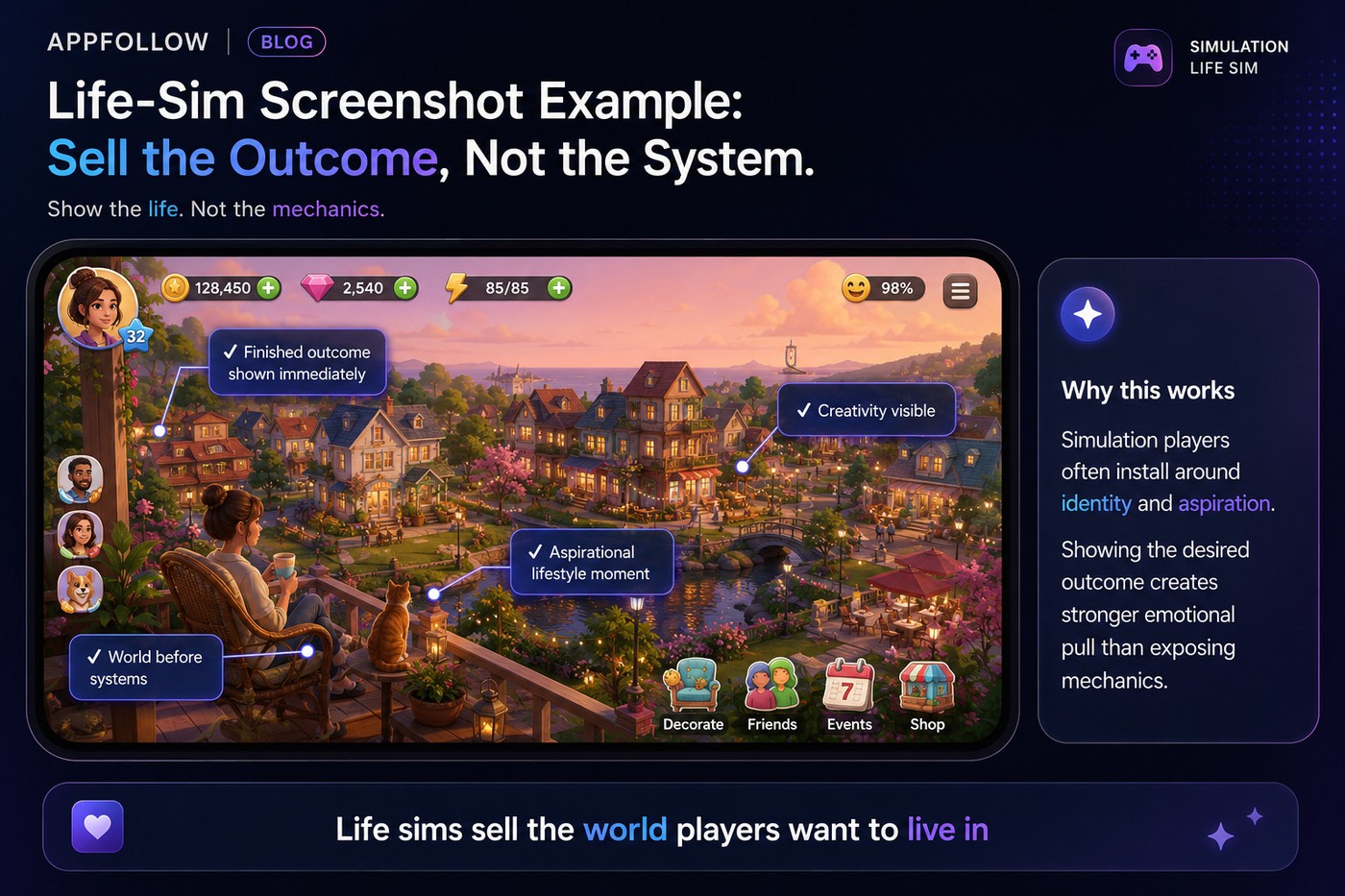
Screenshots should focus on outcomes players want rather than systems they use. A finished town usually performs better than a construction menu. Reviews frequently mention creativity, progression, freedom, and content variety. North America, Germany, and France often emerge as useful localization priorities.
"One thing translates across every genre: player vocabulary. Mine reviews and community comments because players tell you exactly how they describe your game. Emotion-first screenshots travel well, too. What almost never translates is feature-list creative. That might work for utility apps. For games, it kills curiosity."
Yaroslav Rudnitskiy, Senior Professional Services Manager at AppFollow
Generative Engine Optimization (GEO) for games — first-mover playbook
Classic ASO game strategies focused on store rankings, category placement, and keyword visibility. That still matters. Yet ASO games now exist alongside generative search environments where players ask questions instead of typing keywords.
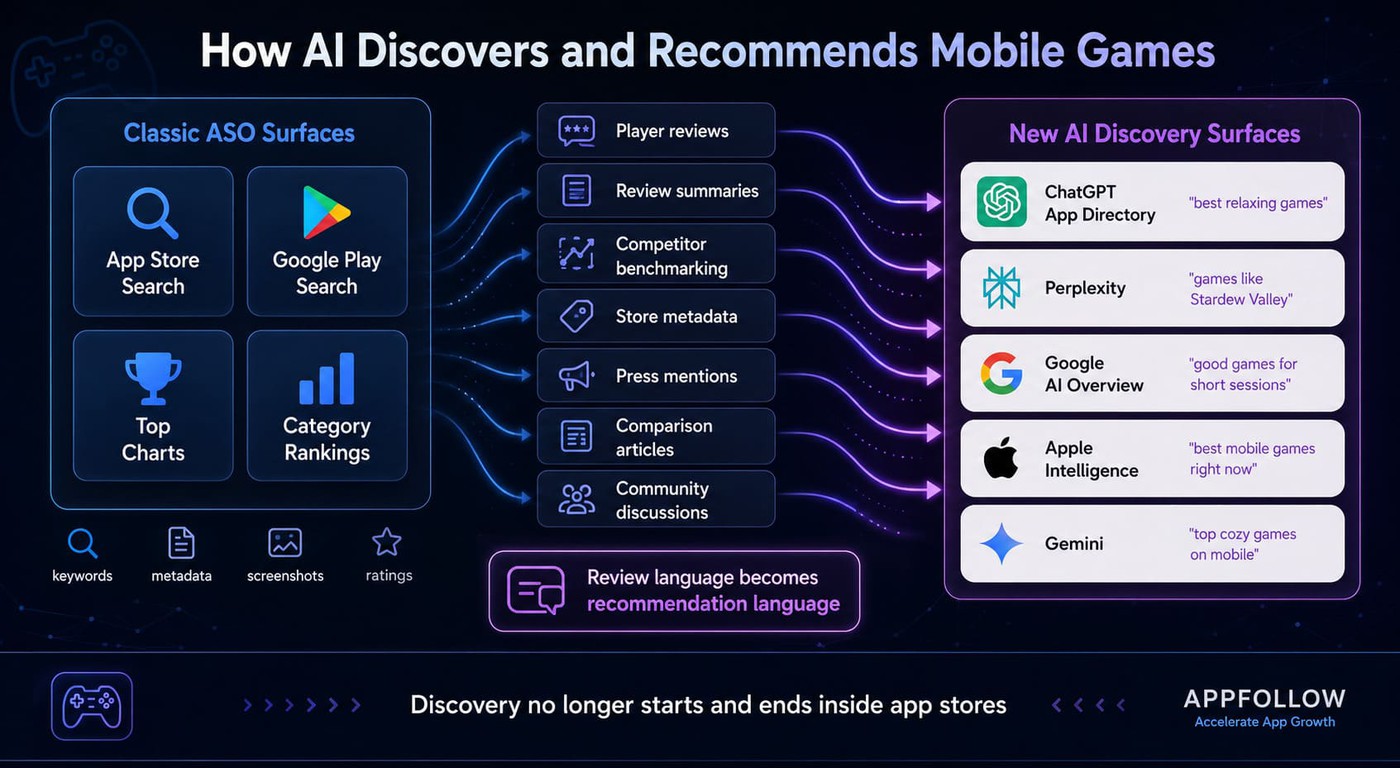
ChatGPT App Directory, Perplexity, Gemini, Apple Intelligence, AI Overview experiences, and broader Answer Engine Optimization workflows all depend on context-rich signals. Someone searching "best strategy game" behaves differently from someone asking, "What's a good raid game I can play with friends for twenty minutes before bed?"
That difference changes optimization priorities. AI systems often care less about exact keyword matching and more about understanding intent.
Optimizing your store listing for AI extraction
AI systems prefer language that explains things clearly.
Descriptions stuffed with fragmented keywords become harder to interpret. Strong long descriptions increasingly read like answers. Explain genre, mechanics, progression loops, audience fit, and gameplay style in plain language.
Structure helps too. FAQ sections, descriptive long descriptions, and clear metadata create signals that generative systems can extract and summarize. A listing should answer questions naturally:
- What kind of game is this?
- Who is it for?
- What makes it different?
Players ask those questions directly. AI systems increasingly do too.
Off-store signals AI engines reward — reviews, press, comparisons
Game discovery now reaches beyond app stores.
Third-party reviews, listicles, review aggregators, comparison articles, Reddit discussions, and creator coverage increasingly feed recommendation systems. AI engines build confidence through comparison patterns and repeated mentions across sources.
Turn Game ASO into a repeatable growth system with AppFollow
AppFollow gives game publishers, indie developers, and mobile marketers one place to see what is actually moving visibility and installs on Apple App Store, Google, Amazon Play Store, and Steam.
Not just “your rank changed.” More like: this keyword cluster is gaining traction in Brazil, your RPG competitor changed screenshots before climbing in category rankings, players keep saying “too many ads” in 1-star reviews, and your latest LiveOps event may deserve a metadata refresh before the next featuring window.
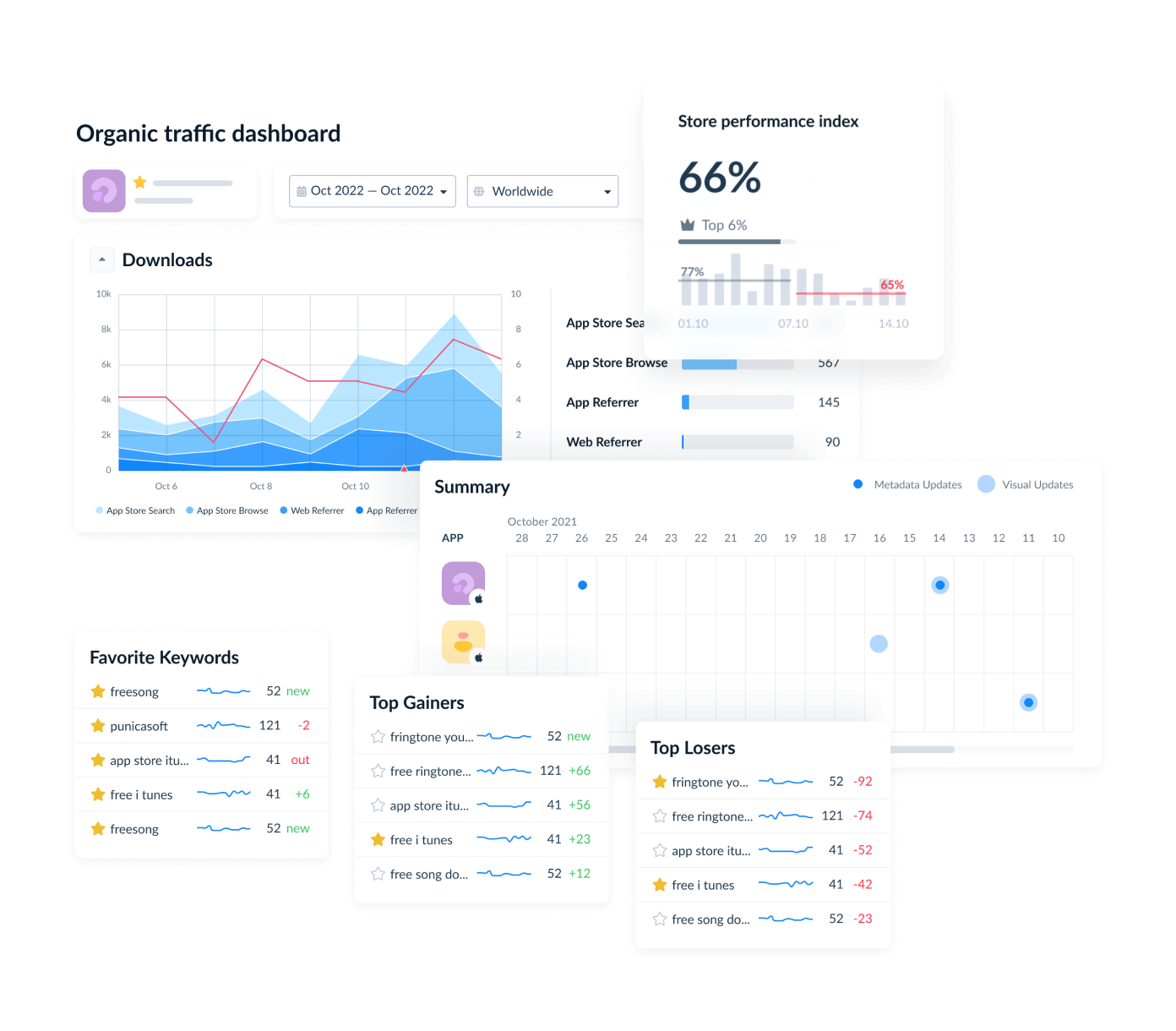
For a small studio, that means less guessing before launch. For a publisher with a portfolio, it means cleaner ASO workflows across many titles. For a growth team, it turns mobile game ASO from a once-a-quarter metadata task into a working loop: find demand, watch competitors, read player language, update the listing, measure what changed.
AppFollow is used by gaming teams including Riot Games, Gameloft, Wargaming, Playrix, Scopely, Toca Boca, Easybrain, Huuuge Games, Chess.com, Kolibri Games, MyTona, Amanotes, G5 Entertainment, and Azur Games. The platform tracks more than 1M apps and supports over 100,000 product teams, which matters when your ASO process needs to scale beyond one lucky launch.
AppFollow features for game ASO:
- Keywords Intelligence for genre, mechanic, and mood-based searches. Game keyword research rarely starts with tidy intent like “budget planner.” Players search by feeling, mechanic, IP memory, or genre. With Appfollow you can expand seed lists, check keyword popularity, visibility, rank, and difficulty, then prioritize the terms that can actually bring qualified players.
- Keyword ranking tracking across App Store and Google Play. Monitor keyword movement over time, so you can see whether your ASO game updates are pushing the right terms up, flattening, or stealing attention from higher-intent searches. For games, that 30 to 90 day window matters because metadata movement often appears before install growth becomes obvious.
- Track competitor metadata, keyword movement, benchmark comparisons, and share-of-voice signals, so your team can spot when another puzzle game changes its screenshot story, when a strategy title starts ranking for a new mechanic, or when a casual game climbs because its creative now matches player intent.
- AI-powered review management helps teams surface recurring themes with AI Summaries, Smart Tags, semantic analysis, and auto-replies. That matters after launches, balance changes, monetization updates, and LiveOps events, when thousands of players can tell you exactly why they stayed, churned, or changed their rating.
- Monitor reviews, ratings, rating shifts, and response workflows, so ASO and support are not working from separate realities. Toca Boca, for example, increased its response rate by 109% and added 26.7K stars after improving review workflows with AppFollow.
- Monitor top chart ranking, featuring signals, competitor movement, and in-app events, so ASO work can connect with launch calendars, seasonal events, new levels, battle passes, anniversaries, and major content drops.
- Localization and market-level performance views. A keyword that works in the US may be useless in Japan. A screenshot that converts in Germany may feel flat in Brazil. AppFollow lets teams filter performance by country, store, channel, and timeframe, which is exactly what game publishers need when one title grows through multiple markets instead of one global listing update.
- Workflow automation, alerts, reports, and integrations. ASO teams rarely work alone. Support sits in Zendesk or Helpshift. Product checks Slack. Leadership wants reports. AppFollow connects ASO, review management, alerts, custom reports, and integrations, so signals do not sit inside a dashboard while the next release decision happens somewhere else.
cta_get_started_purple