App Store Optimization Cost in 2026: What You'll Actually Pay for Tools, Agencies, and In-House

Table of Content:
- TL;DR ASO pricing table
- How ASO pricing actually works
- ASO tools pricing in 2026 comparison
- ASO agency and consultancy pricing (retainers, projects, performance)
- The real cost of building ASO in-house (TCO model)
- Hidden ASO costs nobody quotes
- ASO ROI and payback math
- Build vs. Buy decision matrix by app stage
- Grow your app visibility on app stores with AppFollow
App store optimization cost in 2026 ranges from almost nothing to well over $50,000 per month. Based on AppFollow's experience working with apps across different growth stages, a solo founder using a few ASO tools might spend $0–$200 monthly, while larger teams investing in enterprise platforms, agency support, localization, and experimentation can spend tens of thousands per month.
That range is exactly why app store optimization pricing feels confusing right now. Most articles either throw out vague retainers or pretend App Store Connect and Google Play Console are enough to run ASO at scale. In reality, how much ASO costs depends on three things:
- who does the work,
- how many markets you operate in,
- and how fast your app needs to grow.
We'll break down ASO services pricing across all three major models: DIY software stacks, ASO agencies, and the fully loaded cost of building an in-house team. Then we'll look at where each model starts breaking under operational pressure.
If you want the short version first, jump to the TL;DR pricing table below
TL;DR ASO pricing table
Here’s the short version before we get into the details. Most apps end up choosing between three operating models: software, agency support, or building ASO internally. The right one usually depends less on app category and more on scale, launch frequency, and how much execution capacity already exists inside the team.
The cost ranges below are based on publicly available pricing from ASO platforms, agency retainers, and salary data reviewed for this article, combined with AppFollow's experience working with app teams at different stages of growth. Actual costs vary significantly by market coverage, app portfolio size, and internal team structure.
Path | Cost (US, 2026) | Best for | Stops working when… |
ASO software (DIY) | $0 – $2,500+/mo | Founders, in-house growth teams, single-app startups through mid-market | You need execution capacity beyond tool data alone |
ASO agency / consulting | $2,000 – $50,000+/mo retainer | Apps without in-house ASO; multi-locale launches; portfolio publishers | Sustained spend exceeds the cost of a full-time hire |
In-house ASO team | $110K – $700K+/yr (fully loaded) | $10M+ ARR apps, gaming studios, late-stage growth | You can't recruit fast enough to keep up with launches |
Sources: Public pricing from leading ASO software vendors, publicly advertised agency retainers, salary benchmarks from Glassdoor, Salary.com, and comparable compensation databases, plus AppFollow customer experience across different app growth stages.
The pricing gaps look extreme at first glance. They are. But the bigger story is operational complexity. A solo founder tracking keywords in one market has a completely different problem from a publisher managing 40 store listings, weekly creative tests, localization workflows, and thousands of reviews after every release.
“The first question is never ‘what should we optimize next?' It's ‘where exactly is the loss happening?' Buying ASO before you've diagnosed your funnel is the most expensive form of optimization there is.”
— Yaroslav Rudnitskiy, Senior Professional Services Manager (ASO), AppFollow
How ASO pricing actually works
App store optimization pricing usually looks simpler than it really is. A tool says “starts at $99/month.” An agency says “from $3,000/month.” An in-house hire shows a salary benchmark on LinkedIn. Then the real operational costs start appearing.
The easiest way to understand ASO cost is to separate it into four delivery models: software, agency, in-house, and hybrid.
Model 1: Software (SaaS / monthly subscription)
This is the lowest-friction entry point, and usually the cheapest monthly ASO cost on paper. Most ASO platforms price around four levers:
- number of apps,
- tracked keywords,
- countries/locales,
- and user seats.
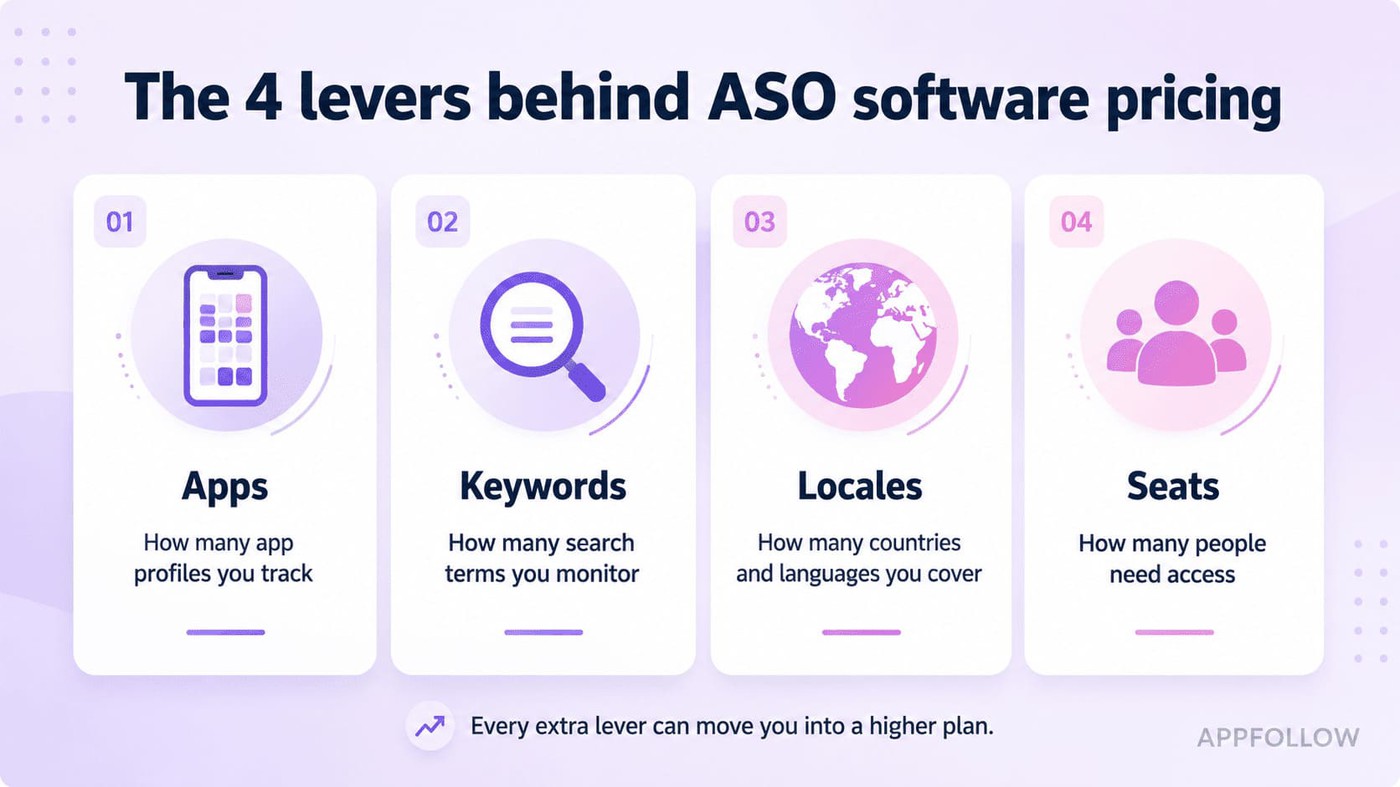
That last one catches teams off guard constantly. A tool that looks affordable for one ASO manager can become expensive once growth, product, support, localization, and leadership all need access.
Some platforms also gate exports, API access, or competitor tracking behind higher tiers, which quietly inflates the real ASO subscription cost.
For example, AppFollow pricing is primarily based on the number of apps and feature access rather than user seats. All plans include unlimited users, which means product, growth, support, localization, and leadership teams can access the platform without creating additional seat costs.
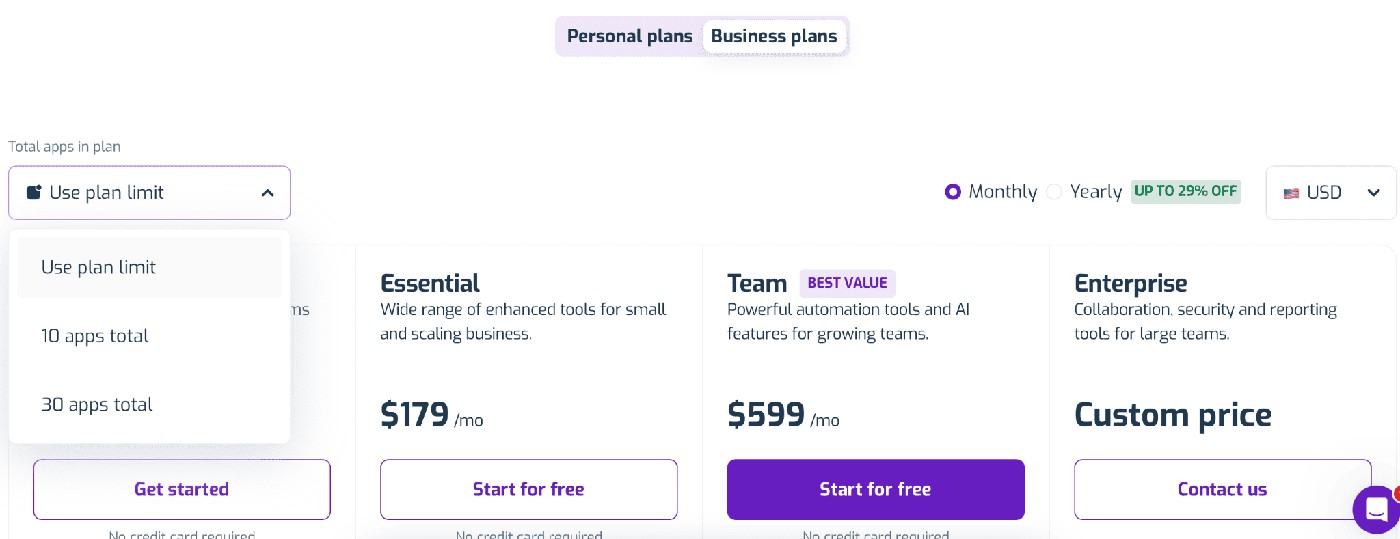
Plans range from a free tier for smaller teams to Essential, Team, and Enterprise packages, with higher tiers adding capabilities such as advanced automations, integrations, dedicated support, and enterprise-grade security.
The more detailed explanation is in the ASO tools pricing section ????
Model 2: Agency / consultancy (retainer, project, performance)
Most ASO agencies work on monthly retainers. This is the standard ASO retainer cost model and usually covers keyword tracking, metadata optimization, reporting, creative guidance, and release support.
Project-based pricing is different. Think launch support, store audits, localization projects, or creative testing. The ASO project cost is finite, but so is the engagement.
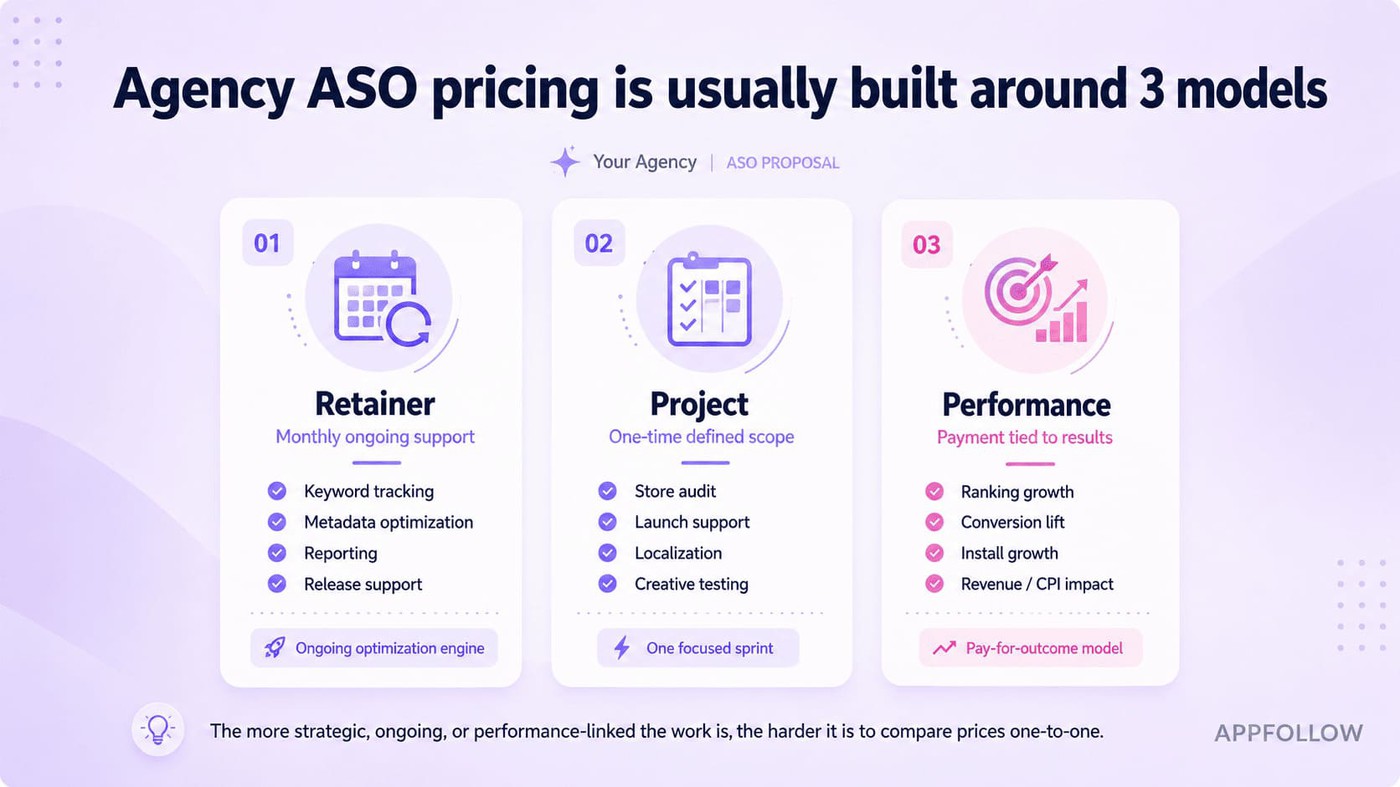
Example: What does a typical mid-market ASO agency retainer include?
A public review of agency service pages shows that retainers in the $5,000–$15,000/month range often bundle several deliverables together: keyword research, metadata optimization, competitor monitoring, monthly reporting, creative recommendations, and localization support.
Some agencies also include App Store and Google Play experimentation management, while others price creative production and localization separately.
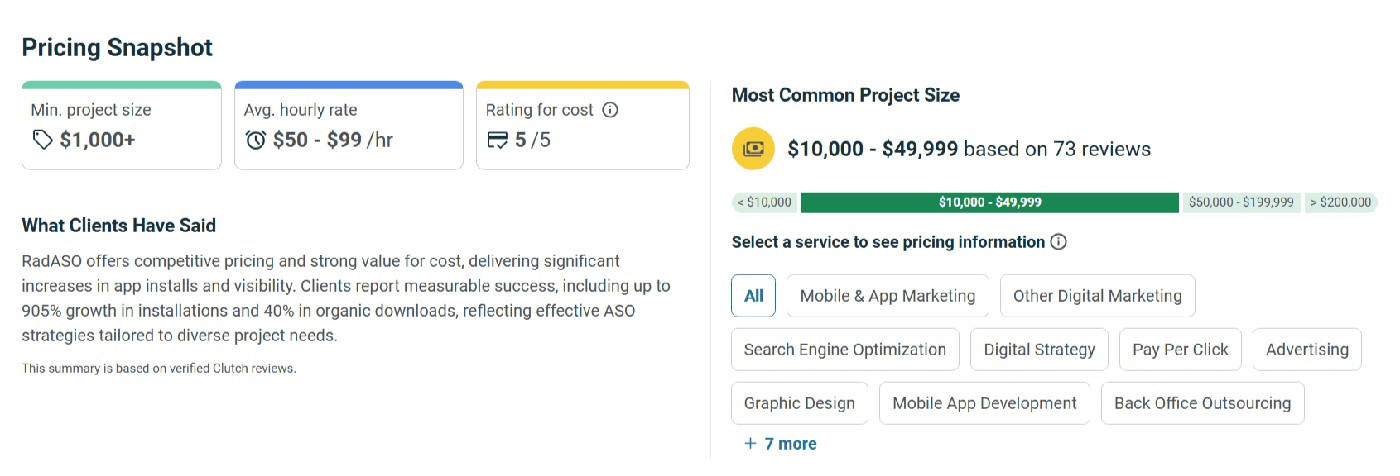
Source: Clutch profile, accessed June 2026. Third-party marketplace data should be treated as directional rather than official pricing.
Performance pricing exists too, though less commonly. Usually, it combines a base fee with bonuses tied to visibility growth, conversion lift, or install targets. It sounds attractive until attribution arguments start.
Model 3: In-house team (salary + tools + creative)
This is where most “how much does ASO cost” articles become misleading. They quote salary alone.
The fully loaded cost of an in-house ASO manager is usually salary multiplied by 1.25–1.4 once benefits, taxes, tooling, creative production, contractors, and management overhead enter the picture. A $120K hire can realistically become a $170K+ operational line item surprisingly fast.
Example: The real annual cost of a $120K ASO Manager
Cost component | Estimated annual cost |
Base salary | $120,000 |
Payroll taxes & benefits | $18,000–$24,000 |
Bonus / equity allocation | $6,000–$18,000 |
Laptop, software, equipment | $2,000–$4,000 |
ASO tools & subscriptions | $3,000–$10,000 |
Creative production support | $5,000–$20,000 |
Localization & translation | $2,000–$10,000 |
Training & conferences | $1,000–$5,000 |
Management overhead | $8,000–$15,000 |
Estimated fully-loaded cost | $165,000–$226,000 |
Illustrative example based on a US-based ASO Manager at a growth-stage software company. Actual costs vary by location, benefits package, tooling stack, and outsourcing model.
The hybrid model (tool + on-demand consulting)
This is where many mature app teams eventually land. The platform covers the day-to-day ASO workflow: tracking keywords, monitoring ratings and reviews, watching category movement, and managing the operational side of optimization. Then specialists step in only when the work calls for deeper expertise, like a launch, geo expansion, a metadata reset, a creative audit, or a sudden ranking drop.
That is also how AppFollow Growth Consulting works alongside the platform. Teams keep execution in-house, which helps avoid the ongoing cost of a full agency retainer, but they can still bring in expert support when they need it. Consultancy pricing starts from EUR 500 per app audit.
Existing paying customers can get discounts, and ASO projects longer than one month can use the promo code for a 10% discount. Audits are excluded from that offer.
ASO tools pricing in 2026 comparison
ASO pricing becomes messy fast once teams move beyond a single app and a handful of tracked keywords. Most ASO software pricing pages advertise an attractive entry number. The real bill usually depends on how many apps, countries, competitors, integrations, and team members you add later.
That’s why comparing only the headline price rarely works. The better question is: what breaks first as the operation grows?
Vendor | Free tier | Entry | Mid | Top public tier | Enterprise | Free trial |
AppFollow | Yes | $139–$179/mo | Team $599/mo | Team | Custom | 10 days |
AppTweak | No | $79–$99/mo | Multiple mid tiers | Pro $499/mo | Custom | 7 days |
Sensor Tower | No | Quote varies | Modular pricing | Quote-only | ~$30K+/yr common | Demo |
Asodesk | No | $41/mo | $83–$208/mo | Pro $208/mo | Custom | Limited |
MobileAction | No | $69/mo | Growth bundles | $599/mo | Custom | Demo |
App Radar | No | $69/mo | Multiple tiers | €699/mo | Custom | Trial available |
Appfigures | Limited | $7.99/mo | Multiple tiers | $599/mo | Custom | Limited |
ASOTools.io | No | $9/mo | Multiple tiers | $299/mo | Custom | Limited |
The AppFollow tier breakdown
AppFollow pricing is structured around operational scale rather than seat expansion. The free tier works for lightweight monitoring.
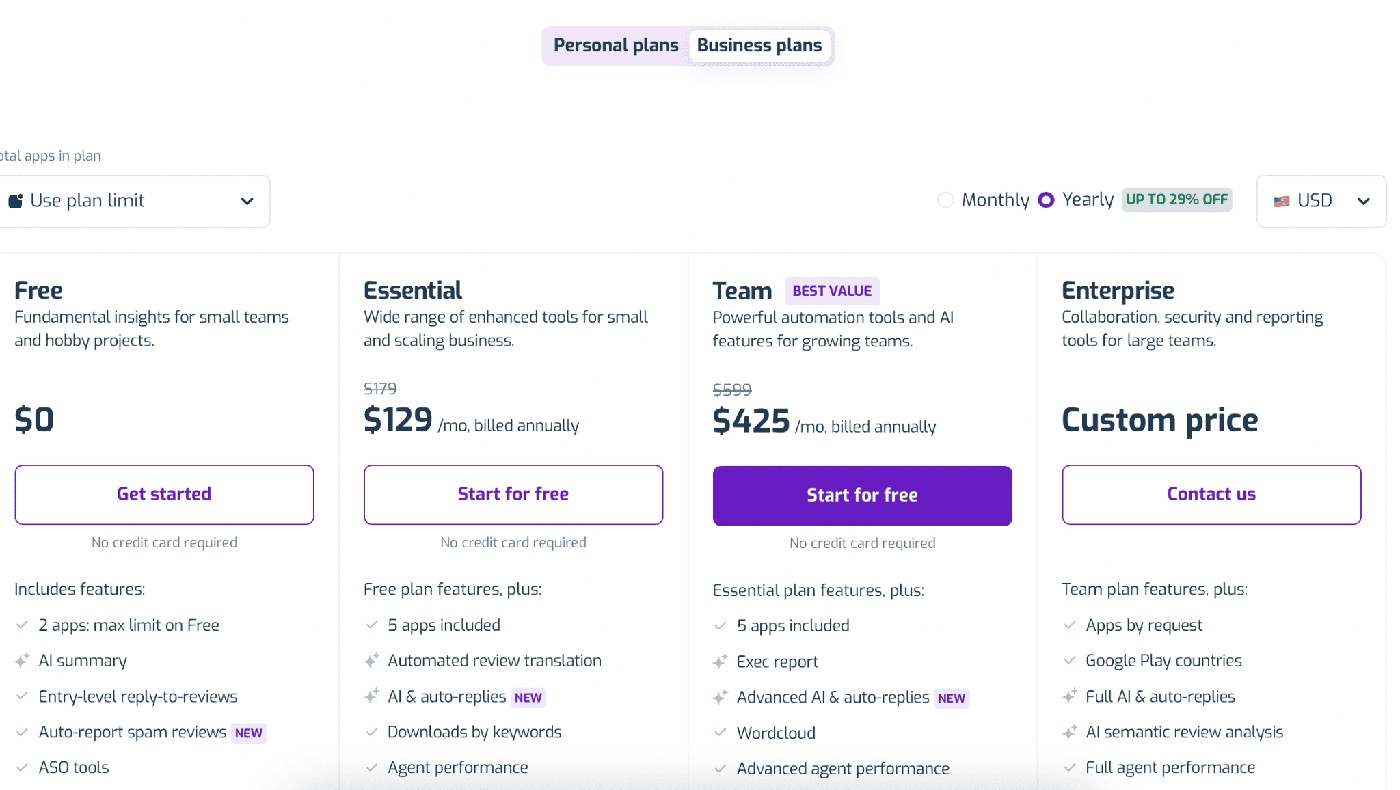
AppFollow offers two pricing tracks: Personal and Business.
Personal plans are designed for individual app developers, freelancers, and smaller teams that need core ASO functionality without advanced collaboration requirements. | Business plans are built for growing companies that need additional apps, integrations, workflow automation, team collaboration, and enterprise-grade controls. |
- Essential starts around $139–$179/month, depending on whether you choose a Personal or Business package. At this level, teams gain access to core ASO workflows, keyword tracking, review management, AI-assisted tooling, and integrations.
- Team plans at $599/month are where larger organizations usually land. This is also where features such as Service Level Agreements (SLAs), deeper automation, advanced collaboration workflows, and dedicated customer success support become increasingly important.
- Enterprise pricing is custom and typically scales based on app portfolio size, reporting requirements, integrations, security needs, and support expectations.
One major differentiator in the broader ASO tool comparison market is that AppFollow includes unlimited users across all plans. Many ASO platforms charge per seat, which can significantly increase costs as product, growth, support, localization, and leadership teams need access to the same data and workflows.
Annual billing reduces pricing by roughly 22%, and the platform includes a 10-day free trial without requiring a credit card.
AppTweak pricing
AppTweak pricing usually starts around $79–$99/month for a small setup: one user, one app, one country. The problem is scaling. Additional countries, users, and apps stack quickly, especially for publishers operating internationally.
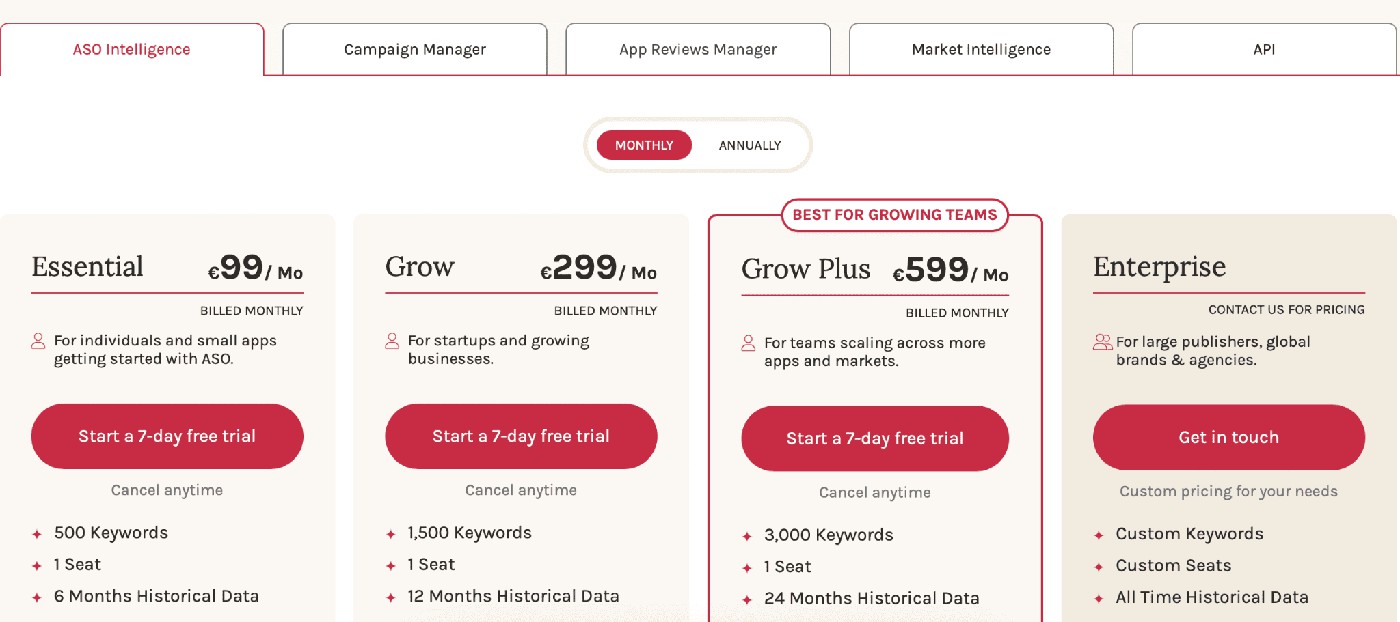
Screenshot is made 06.10. 2026
Mid-market plans exist between entry and Pro, while the public Pro tier sits around $499/month.
Sensor Tower pricing
Sensor Tower pricing is largely demo-gated. Third-party estimates often place smaller plans around $79–$399/month, depending on modules, while enterprise agreements can move beyond $30K annually. The biggest pricing lever is modularity. Teams often pay separately for Store Intelligence, Ad Intelligence, and Usage Intelligence.
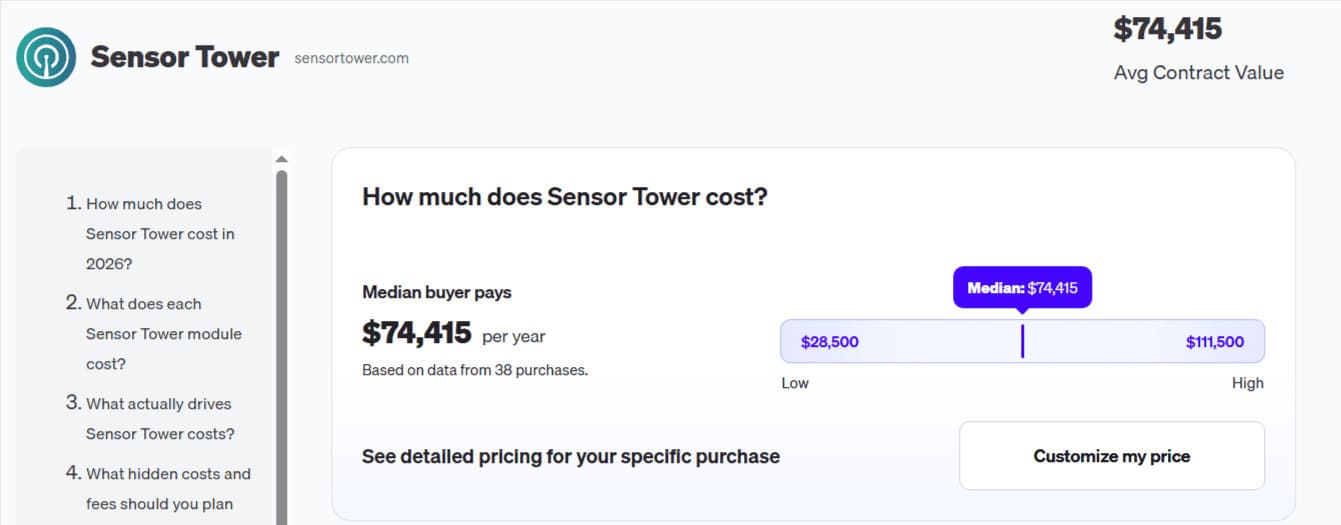
Third-party pricing estimates for Sensor Tower from Vendr Sensor Tower marketplace page, accessed June 2026. Sensor Tower does not publicly disclose pricing on its website.
Asodesk pricing
Asodesk pricing starts aggressively low at $53/month, with Growing Business choose $179/month and Pro at around $404/month.
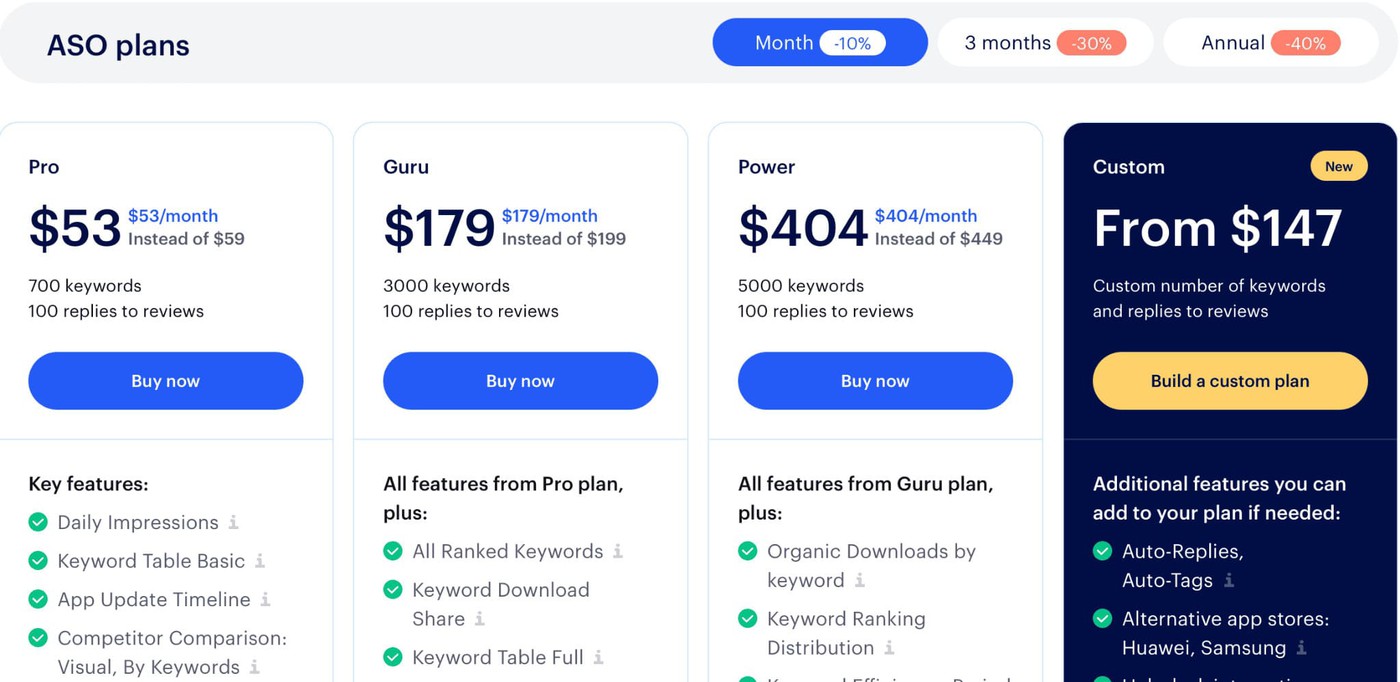
Accessed June 2026
It’s attractive for smaller teams, though keyword, market, and tracking caps matter more than the sticker price once ASO operations expand.
Mobile Action pricing
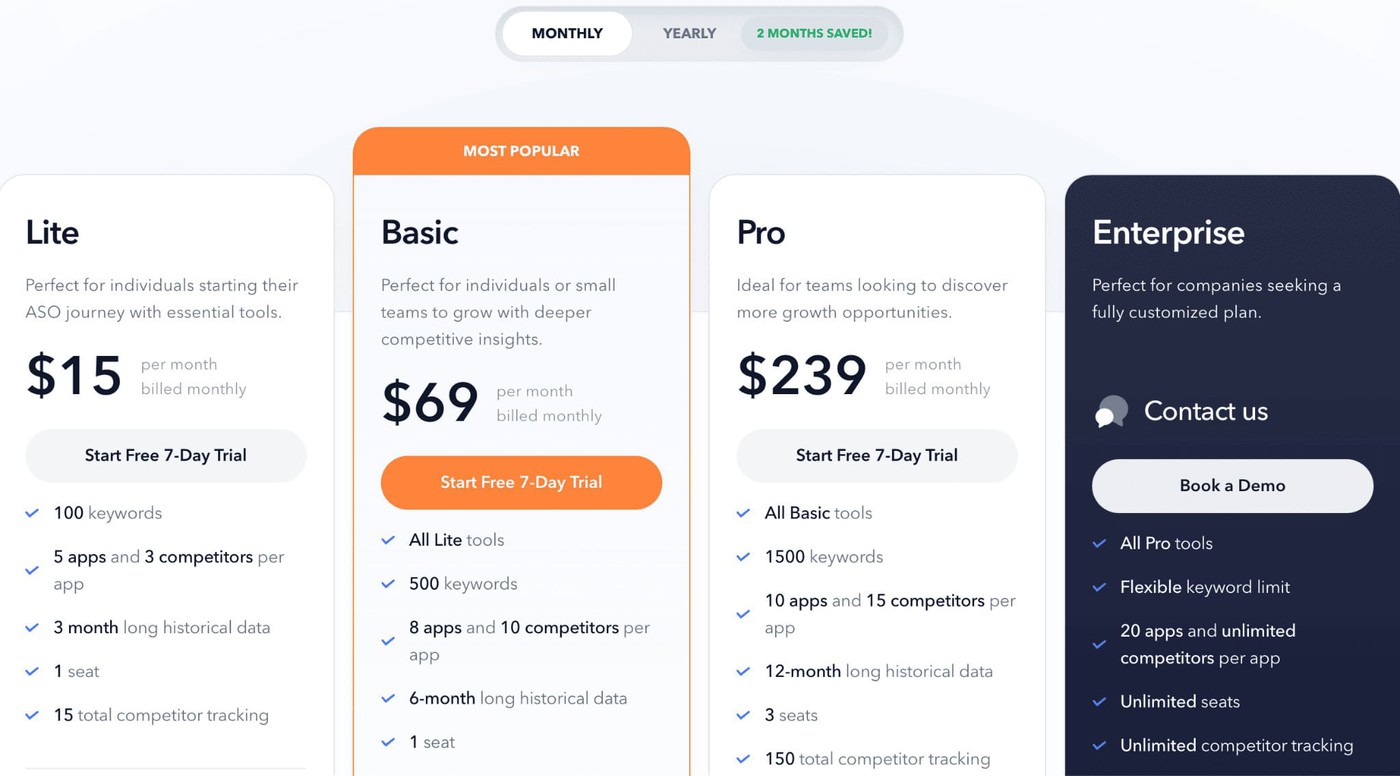
Mobile Action pricing starts around $15/month and scales into larger bundled packages near $599/month.
Accessed June 2026
The positioning is clear: ASO plus ad intelligence plus market intelligence in one stack. That works well for performance-heavy growth teams. It’s less efficient if you only need pure ASO functionality.
App Radar, Appfigures, ASOTools, and other adjacent tools
App Radar pricing ranges roughly from €69 to €699 monthly, depending on scale and automation needs.
Appfigures pricing starts extremely low at $7.99/month, and scales toward enterprise-style growth plans near $599.99/month.
ASOTools.io sits at the budget end of the market with plans between $9 and $299 monthly.
All three can make sense for lean teams. The tradeoff is usually depth: dataset size, automation, collaboration workflows, integrations, or enterprise reporting.
“A keyword is only valuable when three things line up at once. The app can rank for it, the store page can convert it, and the product can satisfy the user. An ASO tool that only solves the first one is not a complete tool. That's why we built AppFollow around the workflow, not the data feed.”
— Yaroslav Rudnitskiy, Senior Professional Services Manager (ASO), AppFollow
ASO agency and consultancy pricing (retainers, projects, performance)
ASO agency pricing varies more than tool pricing because you’re buying people, workflows, creative production, and strategic depth at the same time. A freelance ASO consultant and a full-stack mobile growth agency may both call themselves “ASO services,” but the operating model behind the invoice is completely different.
Monthly retainers: This is the most common ASO retainer cost structure. Boutique consultants and freelancers usually land between $1,500–$4,000 monthly.
- Mid-market agencies like Yodel Mobile, Incipia, RadASO, and AppAgent often sit in the $5,000–$15,000 range.
- Enterprise-focused firms such as Phiture, Gummicube, Moburst, and SplitMetrics can move beyond $15,000–$50,000 monthly once creative production, paid UA alignment, localization, and experimentation enter scope.
- Performance hybrids also exist, typically with a $3K–$10K base plus uplift bonuses.
Project-based pricing: One-off ASO project cost is more standardized than retainers.
- A full ASO audit usually ranges from $2,000–$7,500.
- A 90-day app launch package often lands between $5,000–$20,000.
- Creative-only ASO service packages for one locale generally cost $3,000–$12,000.
- Standalone keyword research projects usually cost around $1,500–$5,000.
Hourly consultant rates:
- Senior US-based ASO consultant rates usually land between $150–$400 hourly.
- Boutique and freelance specialists often charge $75–$175 hourly.
- Offshore consultant rates can fall to $30–$80 hourly, though quality variance becomes much wider at that level.
At some point, agencies stop being the economically correct answer. A good rule: once sustained ASO agency fees move beyond roughly $10K monthly, the fully loaded cost of an in-house ASO Manager starts becoming competitive.
“When teams come to us asking ‘should we hire an agency,' we ask three questions back: how often do you ship metadata changes, how many locales do you support, and what is the bottleneck — strategy or execution. Most teams call the strategy bottleneck a budget problem when it is really an operating-system problem.”
— Ilya Kataev, Professional Services Team Lead, AppFollow
That’s also where hybrid models become attractive. AppFollow Consulting combines platform workflows with strategic support for launches, audits, and geo expansion projects across 500+ optimized apps and 40+ localized languages.
The real cost of building ASO in-house (TCO model)
Most articles underestimate the total cost of ownership (TCO) for ASO because they quote salary alone. In reality, the fully-loaded cost includes benefits, payroll taxes, tooling, creative production, localization, management overhead, and performance bonuses.
Role | Typical US base salary (2026) |
ASO Specialist | $55K–$130K |
ASO Manager | $90K–$160K |
Mobile/App Growth Manager | $75K–$190K |
Head of ASO / Director of Mobile Growth | $170K–$250K+ |
Mobile Designer | $65K–$145K |
The fully-loaded multiplier
Most SaaS companies use a 1.25–1.4 multiplier to estimate fully-loaded employee cost. That means a $120K ASO Manager usually costs the business closer to $150K–$170K annually once equipment, benefits, taxes, software, training, and management overhead are included.
Company stage | Typical ASO structure | Estimated loaded cost |
Sub-$1M ARR | Founder-led ASO | Minimal direct spend |
$1M–$10M ARR | 1 ASO Manager | ~$140K–$190K/year |
$10M–$50M ARR | 2–4 person pod | ~$400K–$700K/year |
$50M+ ARR | Full mobile growth org | ~$1M–$3M+/year |
Then comes the tooling layer. Mid-sized ASO stacks usually add another $15K–$60K annually across keyword intelligence, review management, experimentation, and competitor monitoring. Enterprise teams can spend well beyond $100K yearly on overlapping subscriptions alone.
That’s part of the appeal of platforms like AppFollow ASO Tool: ratings, reviews, ASO workflows, competitor intelligence, and monitoring operate inside one system instead of across disconnected tools and vendors.
Hidden ASO costs nobody quotes
Most ASO budget discussions stop at software subscriptions or agency retainers. The operational reality is messier. The indirect costs are usually what turn a “cheap” ASO setup into a surprisingly expensive one six months later.
- Store-side costs: The Apple Developer Program costs $99 yearly and is required to publish on the App Store. Google Play Developer accounts cost a one-time $25 fee per developer account. Small numbers individually. Mandatory costs operationally.
- Localization costs: App localization costs scale aggressively once teams move beyond metadata translation. Translation alone usually ranges from $0.08–$0.25 per word. A metadata refresh per locale often lands around $150–$500. Native-speaker QA adds another $50–$150 per language. Full creative and cultural adaptation can push costs toward $2,000–$8,000 per market.
- Creative production: Screenshot production cost ranges from roughly $300–$1,500 through freelancers and $3,000–$12,000 through agencies. App preview video cost usually sits between $1,500–$10,000 per video, before localized voiceovers or per-market adaptations enter scope.
- Testing and experimentation: Product Page Optimization and Store Listing Experiments are free natively now, which reduces reliance on external testing platforms. Tools like SplitMetrics Optimize still exist for paid pre-launch testing and can add another $1,000–$5,000 monthly.
- Paid ASA validation: Many teams quietly use Apple Search Ads to validate converting keywords before committing to metadata changes. Typical US CPI ranges from $1–$8. That spend belongs in the ASO budget conversation, even if finance labels it paid UA.
- The invisible cost: internal time: DIY ASO often consumes 8–20 hours weekly. At a blended internal rate of $60–$100 hourly, that becomes $25K–$100K annually in hidden opportunity cost. This is where automation starts mattering. AppFollow ASO tools and AppFollow Review Management helped teams save more than 185K hours of manual work with AI in 2025, while G5 Entertainment reported a 24% reduction in repetitive operational work after automation rollout.
ASO ROI and payback math
The easiest way to explain ASO ROI to leadership is to stop treating it like branding and start treating it like acquisition efficiency.
A simple ASO ROI calculator looks like this:
ASO investment ÷ (incremental installs × LTV - incremental installs × CAC saved) = payback period
The variables matter more than the formula itself:
- LTV = lifetime value
- CAC = customer acquisition cost
- CPI = cost per install
- incremental installs = the organic growth created through ASO
Here’s the simplest version. A $5M ARR app using a $599/month ASO platform spends $7,188 yearly. If improved rankings and conversion rates generate 200 additional organic installs monthly at a $30 LTV, that equals roughly $72,000 yearly in incremental revenue.
Even before factoring in paid UA savings, the ASO payback period lands comfortably under two months.
The math changes at agency scale, but the principle stays the same. A $10K monthly ASO retainer becomes a $120K annual investment. At a $30 LTV, the app needs roughly 4,000 incremental installs yearly to break even.
That’s realistic during multi-locale launches or aggressive growth phases, but much harder for mature single-market apps already close to visibility ceilings on the Apple App Store or Google Play.
This is also why ASO vs paid UA cost comparisons matter. Average US iOS CPI reached roughly $5.28 in recent benchmarks, while Android averaged closer to $1.22. Every organic install generated through ASO that would otherwise require paid acquisition effectively becomes CAC avoided.
“Monthly reporting is for pattern recognition, not first discovery. If a cost decision is the first time your team learns ASO is not paying back, the loss has already had time to spread.”
— Dzianis Shalkou, Senior Professional Services Manager, AppFollow
That operational visibility is part of why enterprise customers using AppFollow ASO tool report estimated ROI improvements averaging more than 850% across the customer base. Not as a guarantee, but as a reflection of how fast store visibility compounds once workflows become systematic.
Build vs. Buy decision matrix by app stage
The right ASO budget depends less on app category and more on operational scale. A pre-launch indie app does not need the same setup as a multi-market fintech or gaming publisher running weekly experiments across dozens of locales.
Stage | Annual | Recommended approach |
Pre-launch / <$500K ARR | <$15K | Founder-led ASO using AppFollow pricing plans, free tier plus App Store and Google Play native tools. Add one $3K–$5K freelance audit around launch. |
$500K–$3M ARR | $25K–$80K | AppFollow Essential plus freelance consultant support ($2K–$5K monthly) or boutique agency support ($4K–$7K monthly). |
$3M–$15M ARR | $80K–$250K | First dedicated ASO Manager (~$150K loaded) plus AppFollow Team plan and occasional creative agency support. |
$15M–$50M ARR | $250K–$700K | In-house pod of 2–3 specialists plus AppFollow Team or Enterprise. Creative agencies mainly used for localization, launch bursts, or redesign projects. |
$50M+ ARR / global gaming, fintech | $700K–$3M+ | Full in-house mobile growth team with AppFollow Enterprise, SLA support, SSO, and dedicated customer success management. |
The most useful heuristic in this entire article is probably this one:
Once a sustained ASO agency retainer would exceed roughly $10K monthly, hiring an ASO Manager internally is usually the economically correct move. Keep the agency for creative production, launch support, and audit-stage projects instead of day-to-day operations.
That’s usually the point where “build vs buy ASO” stops being theoretical and becomes an operational scaling decision tied directly to ARR, release cadence, and team velocity.
Grow your app visibility on app stores with AppFollow
Most teams do not lose visibility because they lack data. They lose it because the workflow becomes fragmented across keyword tools, spreadsheets, review platforms, localization files, release notes, and competitor monitoring tabs.
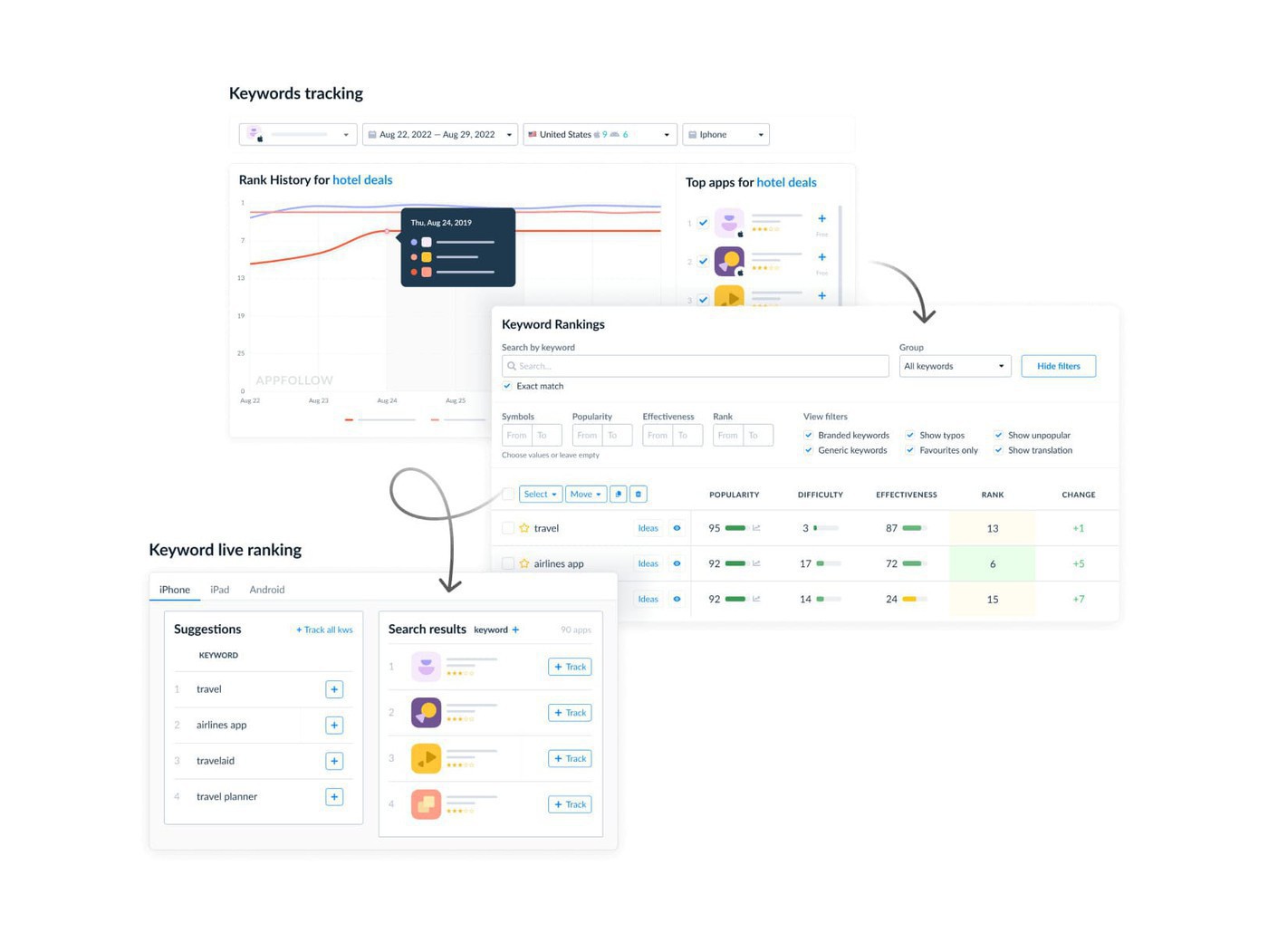
The AppFollow ASO platform brings those workflows into one system. ASO tracking, ratings and reviews, competitor monitoring, metadata analysis, automation, and reporting operate together instead of through disconnected tools and manual exports.
That matters once the release cadence accelerates.
Apps using AppFollow include publishers and brands like Discord, King, Wise, Yousician, and G5 Entertainment. Across the customer base, AppFollow reports estimated ROI improvements averaging more than 850% through workflow automation, review management, and ASO optimization.
What AppFollow includes
- Keyword research & tracking across App Store and Google Play
- Competitor Intelligence and visibility monitoring
- AI-powered review management and reply automation
- Metadata optimization workflows
- Ratings and sentiment analytics
- Localization support across 40+ languages
- App Monitor alerts for ranking and rating changes
- Team collaboration with unlimited users across all plans
- Enterprise security features, including SSO, SLA support, ISO 27001, GDPR, and PCI DSS compliance
- Dedicated Customer Success Manager (CSM) support on Enterprise plans
AppFollow pricing starts with a free tier for smaller teams, scales through Essential and Team plans, and expands into enterprise ASO platform pricing for global publishers and large mobile growth organizations.
For teams that need strategic support alongside the platform, AppFollow Consulting provides launch audits, localization strategy, metadata optimization, creative guidance, and geo-expansion support.
cta_get_started_purple