ASO vs SEO: key differences between app store optimization and SEO

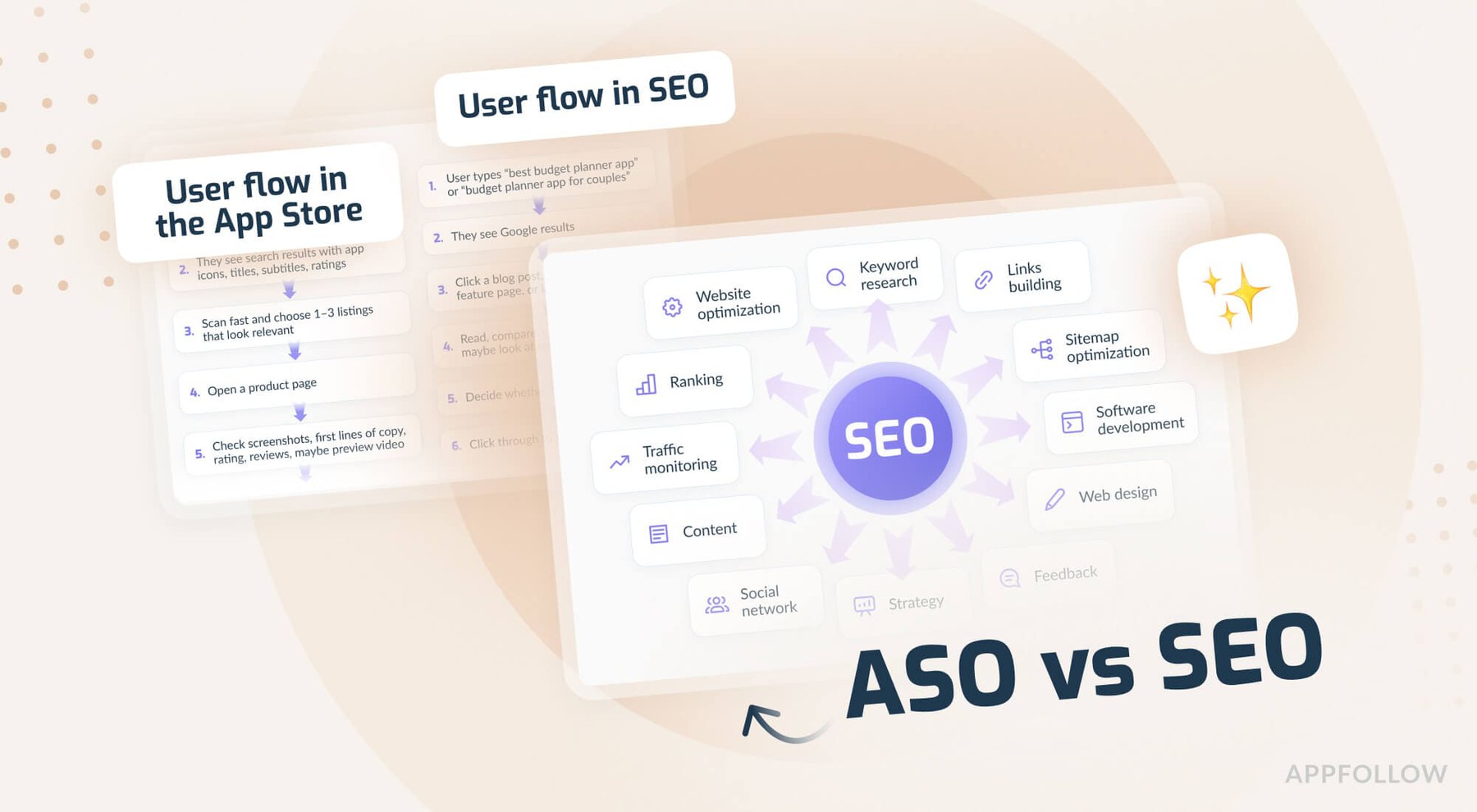
Table of Content:
- TL;DR
- What is ASO?
- What is SEO?
- Why “app store optimization SEO” is not the right way to think about it
- Key differences between ASO vs SEO
- Ranking factors: what affects visibility in ASO vs SEO
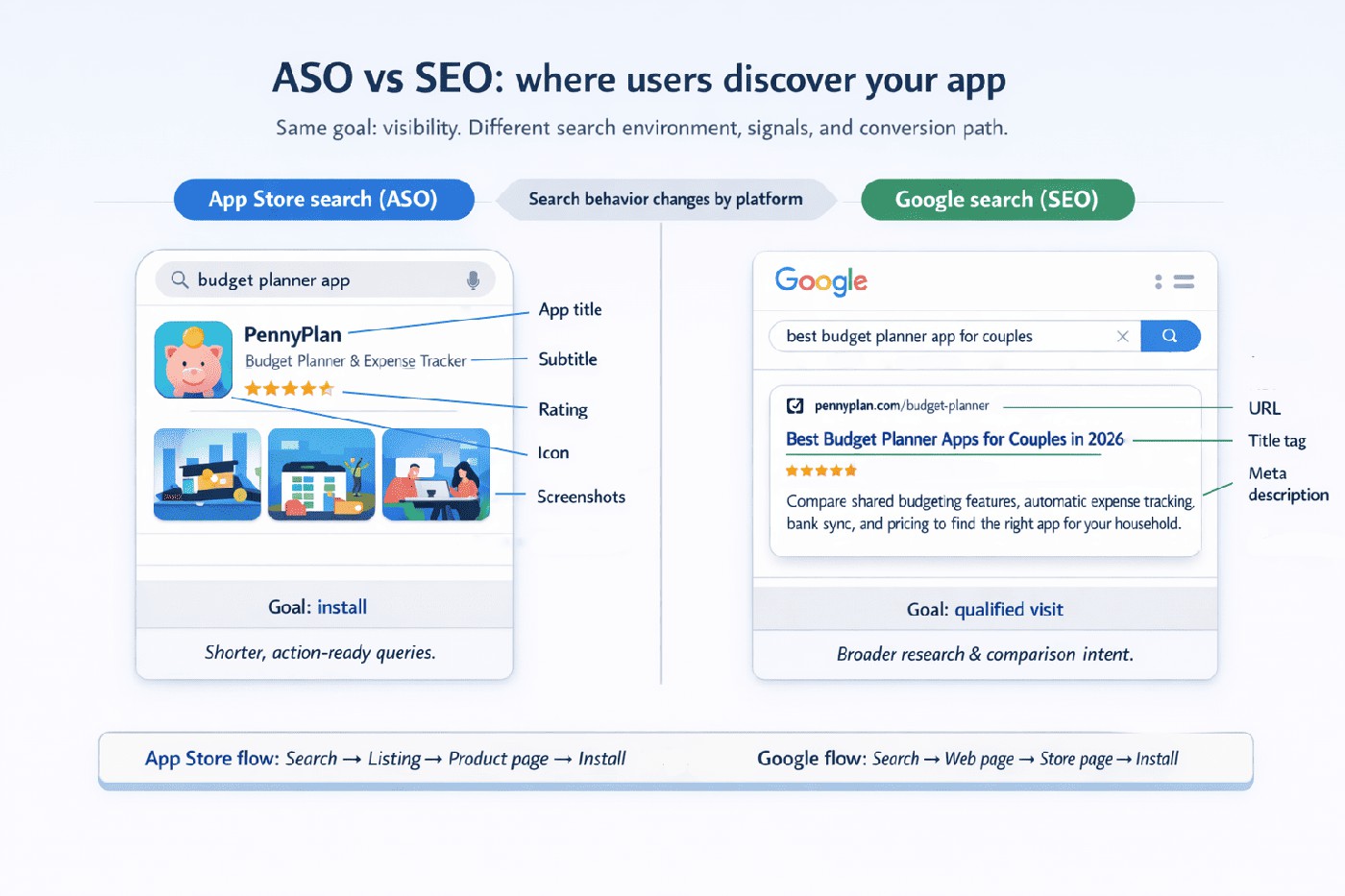
- Search behavior is different in app stores and search engines
- KPIs that matter in ASO vs SEO
- When ASO and SEO should work together
- 5 mistakes app teams make when mixing ASO and SEO
- How to decide whether a topic belongs to SEO, ASO, or both
- How AppFollow helps with ASO and app visibility
- FAQs
Over 65% of app downloads on the App Store come directly from store search, yet most app teams spend less time optimizing their store listing than their ad campaigns. That gap is exactly what ASO vs SEO strategy is really about.
People love calling ASO “SEO for apps” because it sounds simple. It also creates the wrong playbook fast. ASO vs SEO gets messy the moment you look at how users search, what each platform rewards, and what counts as a win. A Google click and an app install do not happen on the same path, and the signals behind them are different from day one.
Together with ASO guru Yaroslav Rudnitskiy, we built this practical breakdown for app teams that want the real mechanics, not a watered-down version of ASO SEO.
- Which ranking factors , move visibility in the App Store and Google Play?
- Where do web SEO tactics help, and where do they quietly fail?
- Which KPIs matter if your goal is installs, not just traffic?
- And how should growth teams use both channels without mixing up the strategy?
TL;DR
- ASO and SEO both help users find you, but they work in different environments. SEO wins visibility on the web. ASO wins visibility inside the App Store and Google Play, then has to convert that attention into installs.
- Search intent shifts by channel. Google users often research, compare, and read before acting. App store users are usually much closer to the decision, so the listing has to prove value fast.
- Ranking signals are not interchangeable. SEO leans on content relevance, internal linking, backlinks, crawlability, page structure, and page experience. ASO depends more on metadata, screenshots, ratings, reviews, download momentum, retention signals, and category fit.
- Store visibility alone does not drive growth. A listing can rank well and still underperform if the icon is weak, screenshots are generic, ratings are shaky, or the messaging does not match the intent behind the search.
- Keyword research principles transfer across both channels. The discipline of understanding user language absolutely helps. Backlink logic does not carry over cleanly, and long-form copy does not solve the same problem inside store pages.
- KPIs tell two different stories. SEO looks at impressions, rankings, CTR, organic sessions, and landing-page conversions. ASO looks at keyword rankings, search visibility, app page views, install conversion, ratings, review sentiment, and organic downloads.
- The strongest app growth teams use SEO before the install and ASO at the install moment. Feature pages, comparison pages, and use-case content warm up demand on Google. Metadata, screenshots, review quality, and localized creatives close the decision inside the store.
- Reviews are part of ASO performance, not just customer support noise. A rating drop, a spike in complaint themes, or repeated mentions of the same bug can hurt conversion fast, even when keyword visibility looks healthy.
What is ASO?
ASO stands for App Store Optimization. In plain English, it’s the work of making your app easier to find in the App Store and Google Play, then giving people a strong enough reason to install once they land on the page. That matters because visibility alone does not grow an app. You can rank, get the impression, and still lose the install if the listing does not do its job.
The teams closest to ASO are usually
- growth marketers,
- ASO specialists,
- product marketers,
- mobile developers,
- and app publishers.
Sometimes, customer support and CRM teams get pulled in too, especially when reviews and ratings start shaping how the app is perceived in-store.
All these people are working toward the same outcome: stronger discoverability, more qualified traffic to the listing, and better conversion from visit to install.
A lot of people casually call this app store SEO optimization, but the mechanics are more specific than that. You are working with store-native signals like the app title, subtitle, short description, keyword targeting, screenshots, preview video, icon, ratings, review sentiment, and localization. Those are the assets that influence how the algorithm reads your app and how a user reacts in that split second before deciding to tap.
App store optimization - app store SEO connects keyword visibility with conversion psychology. The right search term gets a user to your page. The right creative, message, and proof points get them to install.
When those pieces line up, ASO stops being a metadata task and starts becoming a system for compounding organic growth.
What is SEO?
SEO, aka Search Engine Optimization, is the practice of improving how a website appears in search engines like Google so the right people can find your pages when they’re actively looking for answers, products, comparisons, or solutions.
The goal is to increase qualified visibility, earn clicks from relevant searches, and turn that traffic into the next step, whether that’s reading, signing up, booking a demo, or downloading an app.
The people who usually own SEO are
- content marketers,
- SEO managers,
- growth teams,
- product marketers,
- web teams,
- and sometimes developers, because technical setup matters more than many brands expect.
A page can target a strong keyword, but if it loads slowly, has weak internal links, or misses the search intent behind the query, it struggles to perform. Good SEO sits at the intersection of content, site structure, technical health, and user behavior.
Unlike ASO, which works inside app store ecosystems, SEO lives on the web. Its core elements include:
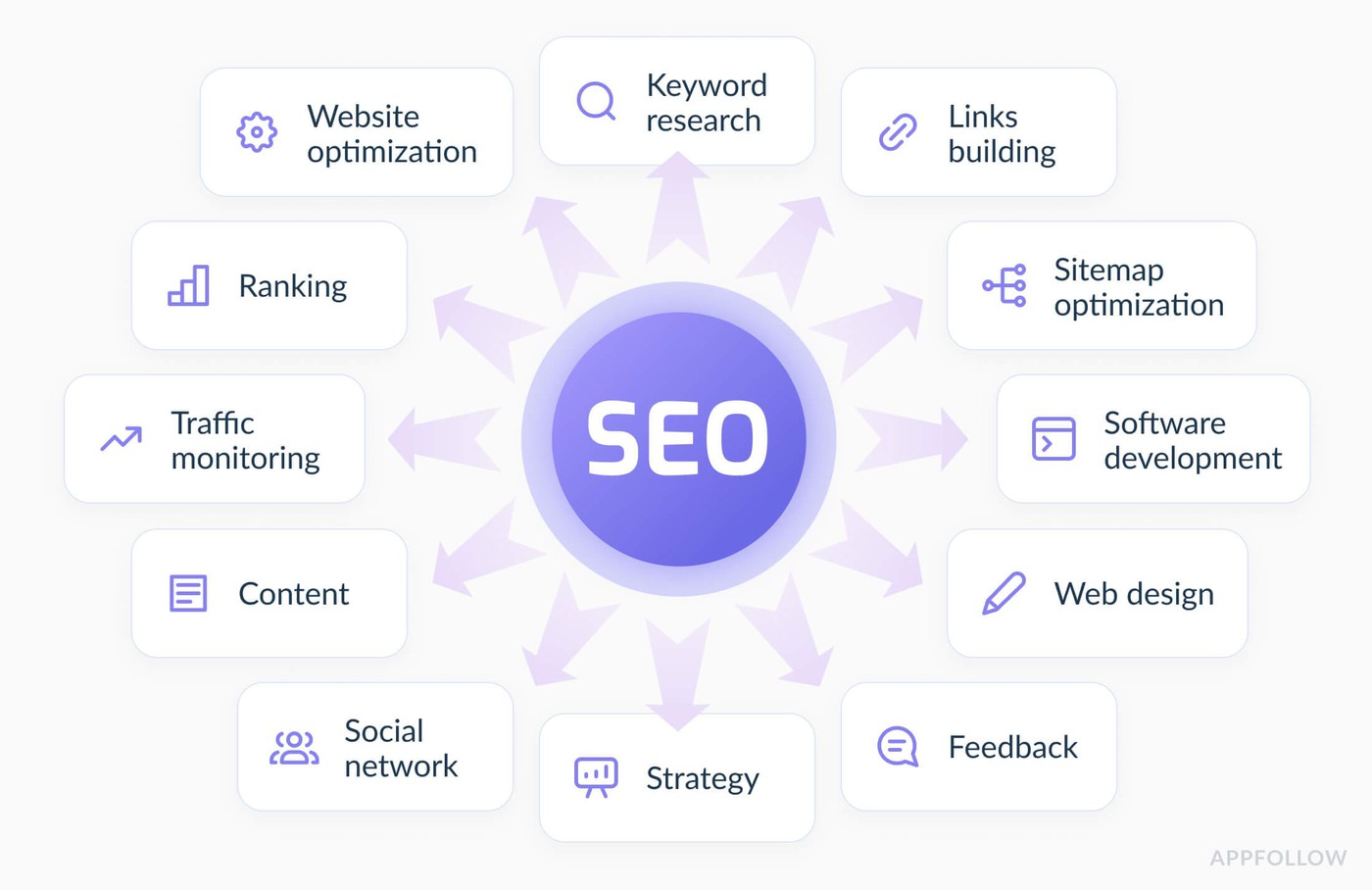
This is what helps search engines understand what a page is about, how useful it is, and whether it deserves to rank for a given query. When those signals line up, SEO improves content discovery and brings consistent traffic to the site instead of relying only on paid campaigns or branded demand.
In an ASO vs SEO comparison, SEO is the part of the growth system that captures demand earlier in the journey. Someone searches Google for a problem, a feature, a comparison, or a “best tools” list. They land on a web page first, not an app listing. That makes SEO especially valuable for education, category awareness, competitor comparisons, and bottom-funnel pages that help users move closer to conversion.
Why “app store optimization SEO” is not the right way to think about it
Calling app store optimization SEO a version of SEO sounds convenient. That’s exactly why so many teams use the phrase. It gives people a familiar shortcut. The trouble starts when that shortcut turns into strategy.
The label feels logical because both disciplines care about visibility. Both start with keyword research. Both try to match user intent with the right message. From a distance, that makes ASO look like search optimization in a smaller box.
But an app store listing does not behave like a web page. The user journey is tighter. The surface area is smaller. The decision window is shorter. On Google, someone might read, compare, scroll, leave, and come back later. In the store, the question gets answered fast: does this app look relevant enough to tap, trust, and install?
What SEO-trained teams focus on
| What ASO teams also have to win:
|
That’s why app store SEO optimization needs its own mental model. Keywords matter, yes. They are only one layer. Creative assets, review quality, and store-specific conversion signals often decide whether visibility turns into growth. A listing can rank and still underperform. That’s the part the SEO shortcut misses.
A better way to think about ASO is that it borrows the discipline of search, then adds a conversion environment built for app stores, and that changes everything.
Key differences between ASO vs SEO
When people search ASO vs SEO, they’re usually trying to figure out whether these are basically the same growth channel with different packaging.
They overlap in one important place: both are built around visibility. After that, the mechanics start to separate fast.
ASO is the practice of improving how an app gets discovered and chosen inside the App Store and Google Play. It focuses on keyword visibility, browse visibility, and install conversion. That means the job is only partly about ranking. The rest happens on the product page, where screenshots, icon, ratings, reviews, and metadata have to convince a user to install. | SEO is the practice of improving how web pages appear in search engines like Google. It’s built around earning relevant traffic from search results and guiding that visitor toward the next action, whether that’s reading, signing up, comparing, or eventually downloading an app. Content quality, search intent match, internal linking, backlinks, crawlability, and page experience all play a bigger role here. |
The core distinction is simple once you see it clearly. App store optimization SEO sounds like a useful shortcut, but it hides the fact that ASO happens inside a closed store environment with store-specific fields, assets, and conversion pressure. SEO works in the open web, where content depth, site structure, and link authority have far more influence.
One channel wins the install page view. The other often wins the discovery moment that happens before a user ever reaches the store.
ASO vs SEO comparison table:
ASO | SEO |
Primary goal: Increase app visibility in the App Store and Google Play, then improve install conversion | Primary goal: Increase website visibility in search engines, then drive qualified traffic and downstream conversions |
Platform: App Store, Google Play, sometimes alternative app marketplaces | Platform: Google and other search engines across websites and landing pages |
Main conversion action: Install | Main conversion action: Click to site, signup, lead, purchase, or assisted app download |
Core ranking signals: App title, subtitle, keyword field where available, short description, ratings, reviews, download velocity, retention signals, localization, conversion rate | Core ranking signals: Relevance, search intent match, content quality, backlinks, internal linking, page speed, crawlability, mobile usability, site architecture |
Traffic source: Store search, browse, category rankings, featured placements, brand search inside stores | Traffic source: Organic search results, SERP features, branded and non-branded queries |
User intent: Usually closer to action, often looking for a specific solution, app type, or brand | User intent:Broader range from informational to comparative to transactional |
Creative assets: Critical. Icon, screenshots, preview video, promo text, app page design all influence install rate | Creative assets: Helpful but secondary. Page layout, images, UX, and snippets matter, though text depth and structure usually carry more weight |
Technical dependencies: Store field optimization, localization, release cadence, app page structure, product quality signals | Technical dependencies: Crawlability, indexing, site speed, Core Web Vitals, structured data, internal linking, mobile friendliness |
That’s the real shape of ASO SEO when you zoom in. Both channels help users discover you.
They just do it at different moments, with different signals, and with different pressure points. SEO usually captures demand earlier. ASO finishes the job when the user hits the store and decides whether your app deserves the tap.
Ranking factors: what affects visibility in ASO vs SEO
Visibility comes from two layers working together: relevance signals that tell the platform what you’re about, and performance signals that show whether users respond well once they see you.
That’s where ASO vs SEO gets interesting. Both channels care about matching the right result to the right search. After that, the signals start behaving very differently.
ASO | SEO |
Primary relevance signals: App title, subtitle, keywords, primary category, store listing quality | Primary relevance signals: Content relevance, page structure, intent match, internal linking |
Behavior signals: Downloads, ratings, reviews, install conversion, retention, brand demand | Behavior signals: Click behavior, engagement, satisfaction signals, overall page experience |
Creative influence: Very high. Screenshots, icon, video can change install rate fast | Creative influence: Moderate. Visuals help UX and CTR, but text and structure usually carry more ranking weight |
Authority layer: Brand searches, category fit, store momentum, user response | Authority layer: Backlinks, site reputation, topical authority |
Technical layer: Store field setup, localization, release quality, compliance with store rules | Technical layer: Crawlability, indexability, page speed, Core Web Vitals, mobile usability |
Update sensitivity: Metadata and creative changes can move conversion quickly | Update sensitivity: Content and technical changes often take longer to compound |
ASO ranking factors
Inside the App Store, Apple is unusually clear about what feeds search relevance:
- matches in the title, subtitle, keywords, and primary category,
- plus user behavior signals such as downloads, ratings, and reviews.
That gives you a very specific ranking foundation to work with. Text fields help the algorithm understand relevance. Behavior tells it whether users choose the app once it appears.
Google Play frames it differently. Its documentation leans on a thorough, optimized store listing and repeatedly ties discoverability to quality, relevance, and user satisfaction. It sets a clear structure for your text assets: the short description is 80 characters, the full description is up to 4,000 characters, and both should clearly explain the app’s benefits.
Google Play also rewards apps that perform well in Android vitals, crash rates, ANR rates, and battery usage, all feed into discoverability. Store listing experiments let you A/B test icons, screenshots, and short descriptions directly in the console.
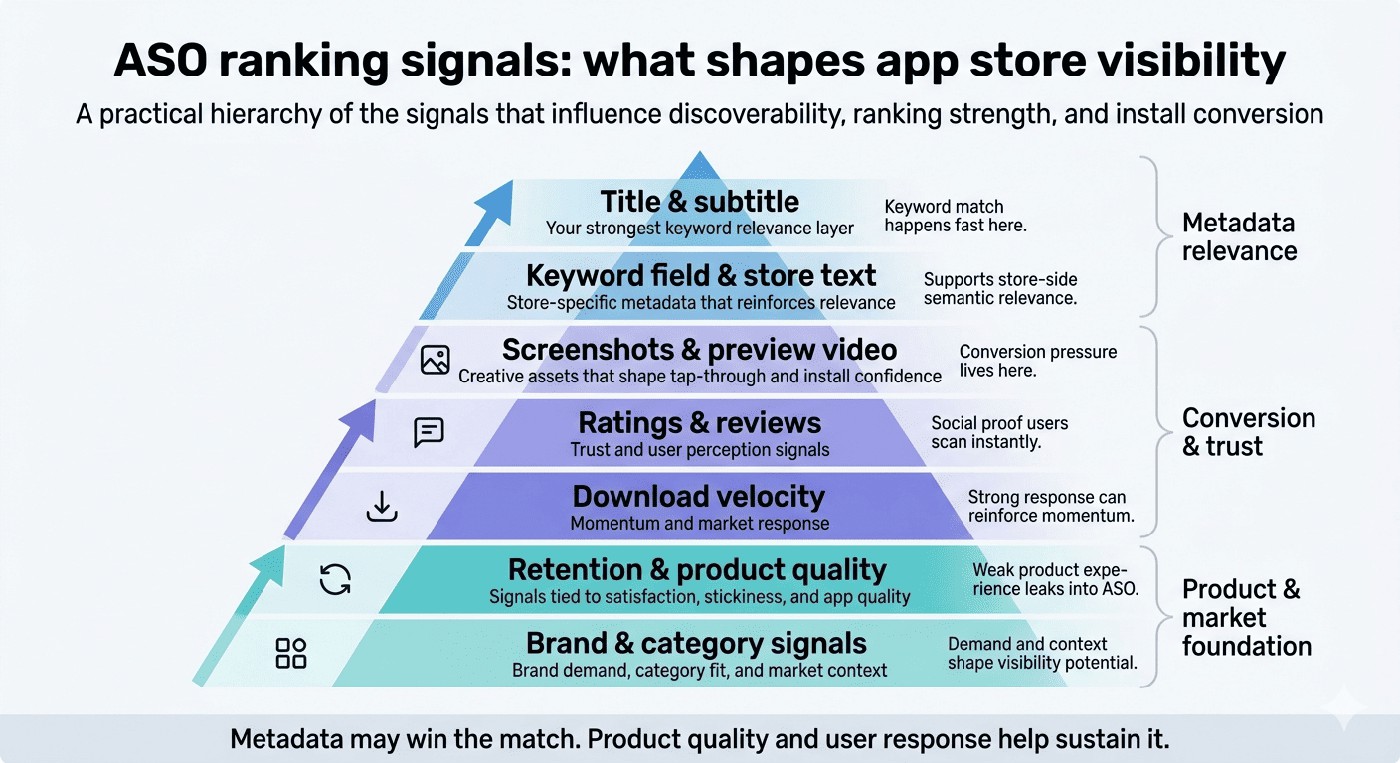
So when people reduce ASO to app store optimization SEO, they usually miss the store-specific reality: visibility is shaped by both metadata quality and how strongly the listing converts once discovered.
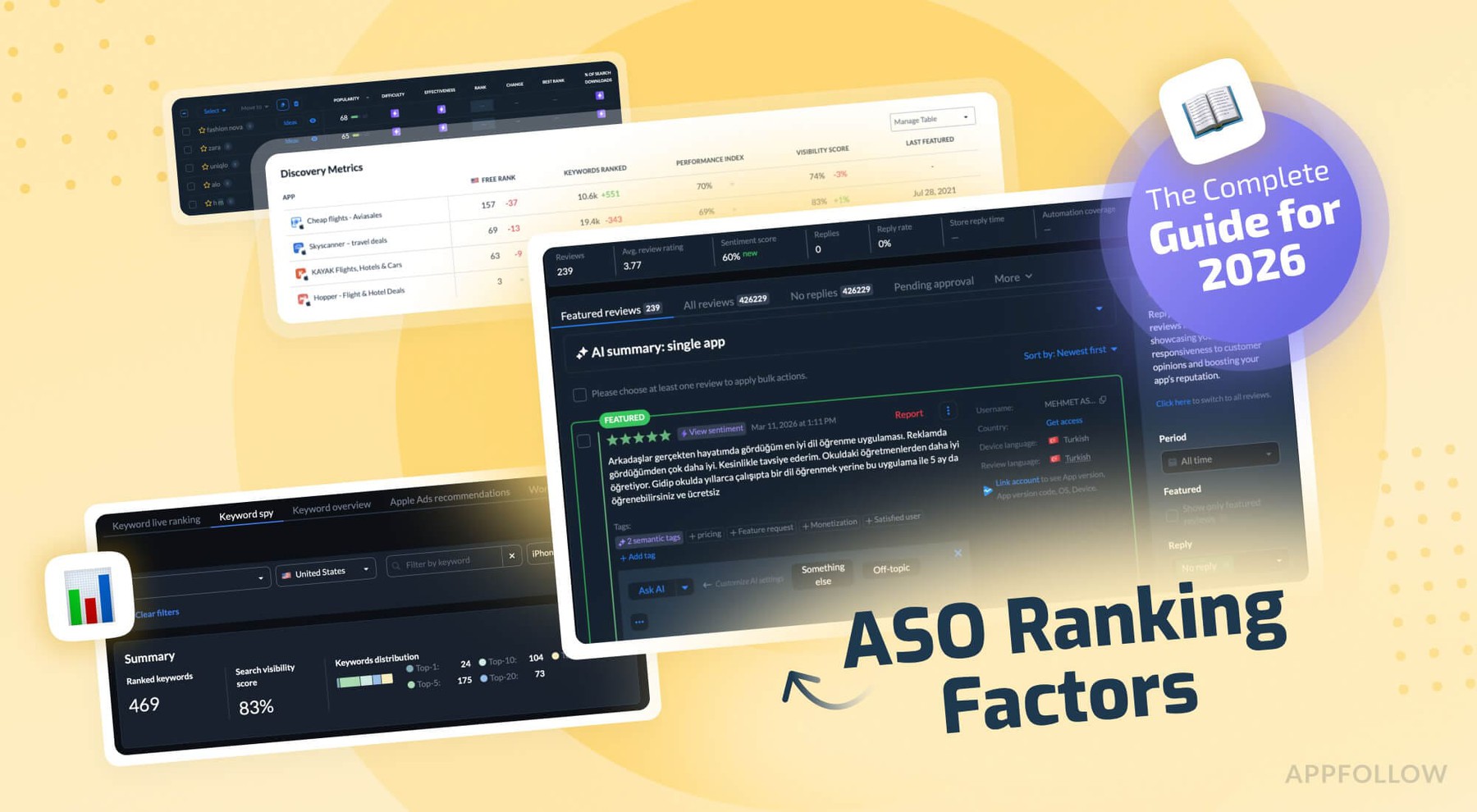
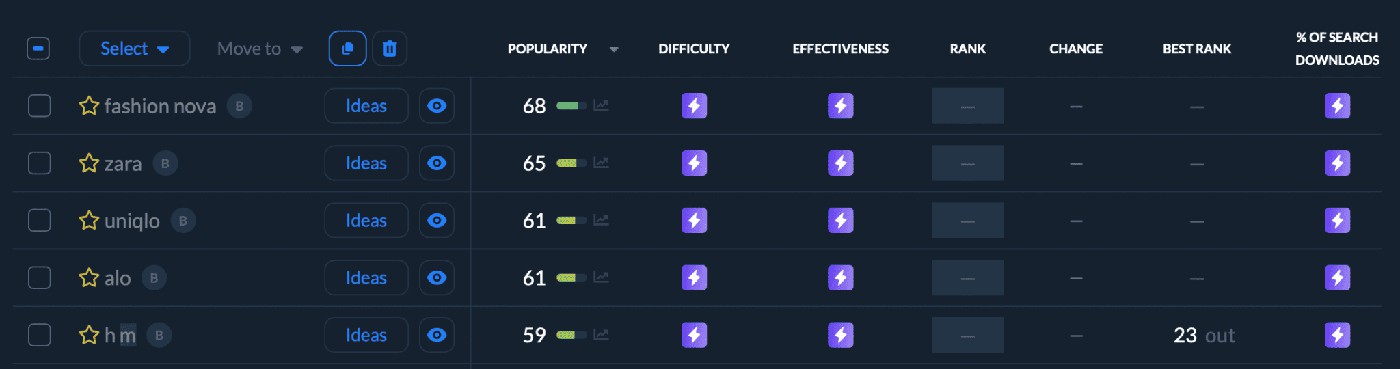
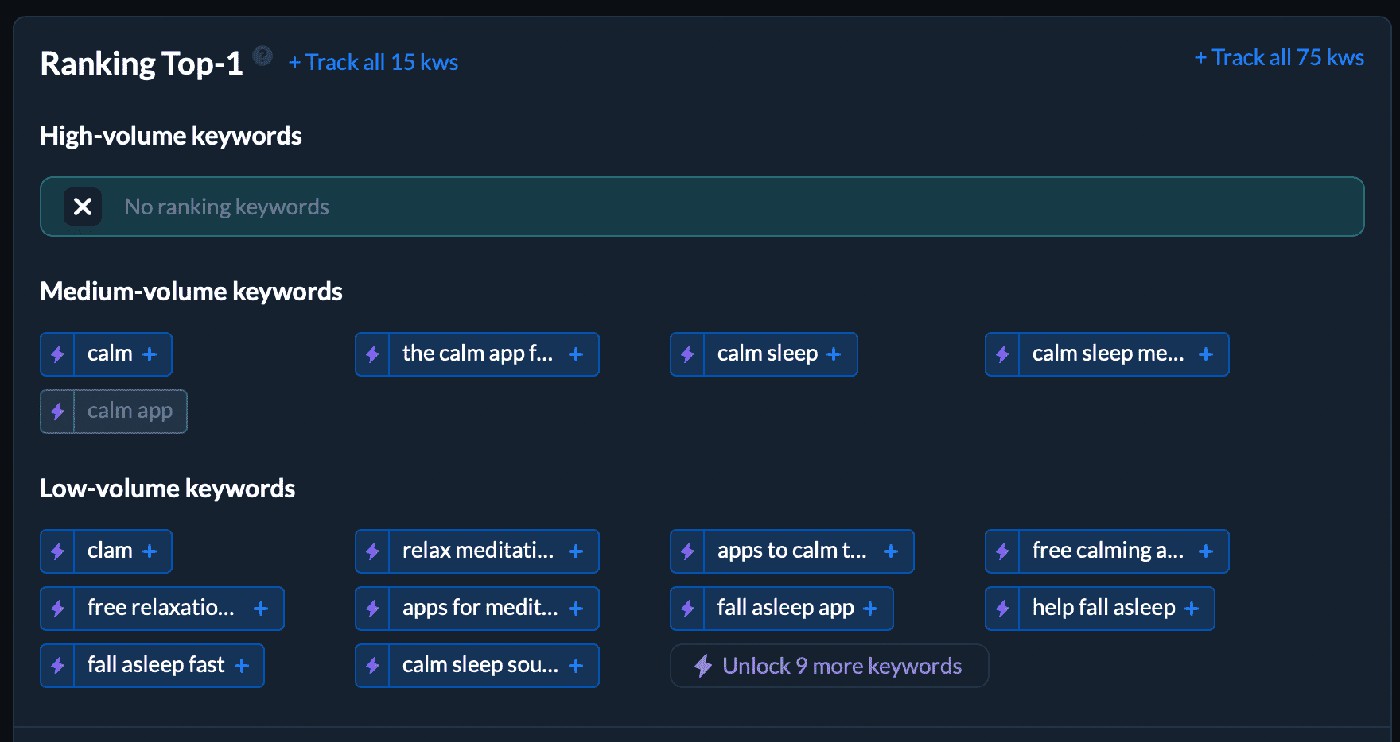
Here is an example of how AppFollow's users track it with Keyword Overview. The feature pulls search volume estimates and keyword difficulty scores separately for iOS and Google Play.
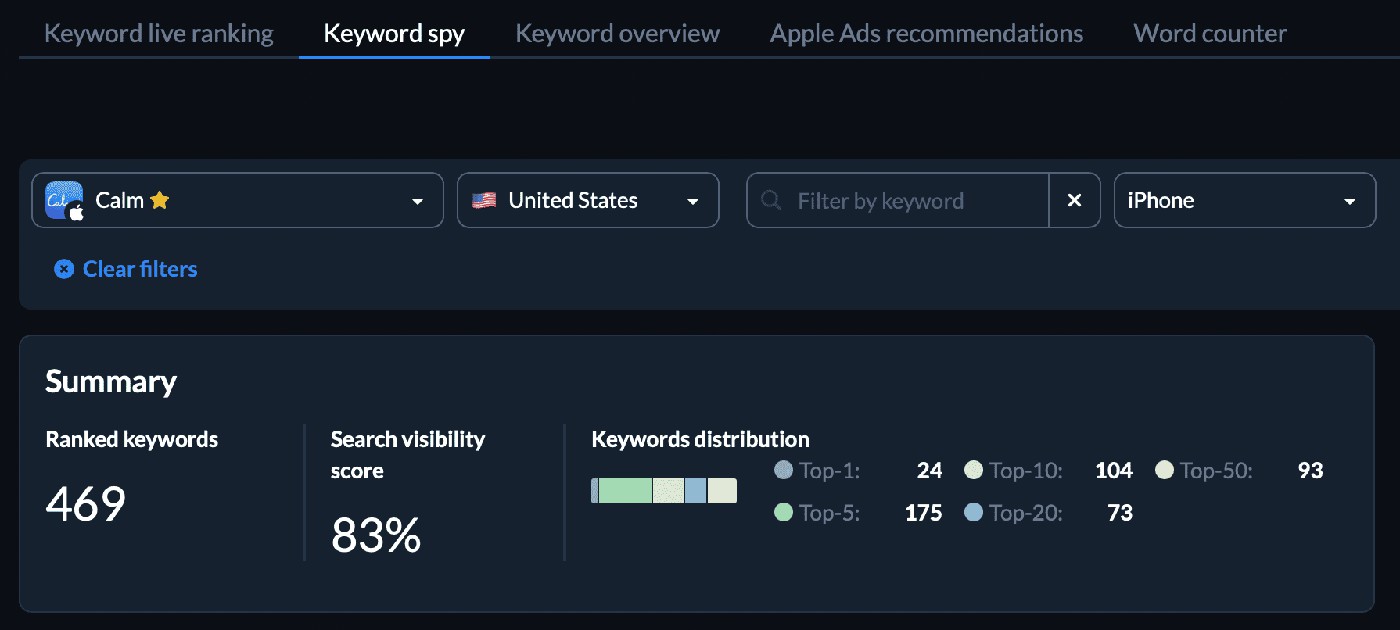
Additionally, it surfaces terms your competitors are ranking for that you haven't targeted yet.
SEO ranking factors
Search engines are evaluating a much wider surface. Google defines SEO as helping search engines understand your content and helping users decide whether they should visit your site. That means rankings on the web depend on a broader mix of content quality, site architecture, accessibility for crawlers, and overall page experience.
The main SEO ranking levers look like this:
- Content relevance: the page has to clearly answer the query and match what the searcher , wants. Google’s guidance is built around helpful, people-first content and strong relevance.
- Search intent match: a page can be technically clean and still underperform if it targets the wrong stage of intent. Google repeatedly centers usefulness and satisfaction.
- Internal linking: this helps users navigate and helps crawlers understand site structure and page importance. Google has long tied internal linking to crawlability.
- Backlinks and authority: Google does not publish a simple “link score” formula, but links remain one of the clearest authority and discovery signals in SEO practice, especially at competitive query levels. Google’s own documentation consistently discusses links as part of discoverability and site understanding.
- Page speed and Core Web Vitals: Google says Core Web Vitals are used by its ranking systems and recommends achieving good scores for Search success.
- Crawlability and indexability: if Google cannot access the page, return a proper response, and find indexable content, the ranking conversation barely gets started.
- Page structure: headings, logical organization, and clean architecture help both comprehension and discovery.
So while ASO compresses ranking and conversion into a tighter store page environment, SEO spreads visibility across a deeper content and technical ecosystem.
Which SEO ideas transfer to ASO, and which do not
Some SEO instincts travel beautifully. Others fall apart the second they hit the store.
- What transfers well is the discipline behind keyword research. You still need to understand how users phrase the problem, what modifiers they use, how brand and non-brand demand split, and which terms align with actual intent. Relevance still matters. Messaging still matters. Clear positioning still wins. That part of ASO SEO thinking is useful because it keeps teams grounded in search language instead of internal product jargon.
- What does not transfer neatly is backlink logic. Web search uses links as a major clue for authority, structure, and discovery. App stores do not have an equivalent lever that you can build the same way. You cannot “link build” your way to stronger App Store rankings with the same direct cause-and-effect mindset. Store visibility leans far more on metadata, user behavior, quality signals, and conversion performance.
- Content depth is another big split. On the web, a rich page can rank because it answers the query in full, covers related subtopics, and signals usefulness. Store pages do not give you that kind of canvas. Searchers who type messy phrases like app store optimization app store SEO are usually trying to fit both systems into one frame, but the execution layer is different.
- In ASO, screenshots, icon clarity, ratings, review themes, and localized creative often carry more practical weight at the conversion point than extra text ever could. Apple explicitly ties product page elements to downloads, and Google Play points developers toward compelling listings and preview assets for discovery and conversion.
That’s the cleanest way to think about it: borrow SEO’s research discipline, keep its intent awareness, then switch mental models when you enter the store. On the web, depth and architecture do a lot of the heavy lifting. In app stores, packaging and proof step much closer to center stage.
Read also: 10 customer sentiment analysis tools to decode app reviews
Search behavior is different in app stores and search engines
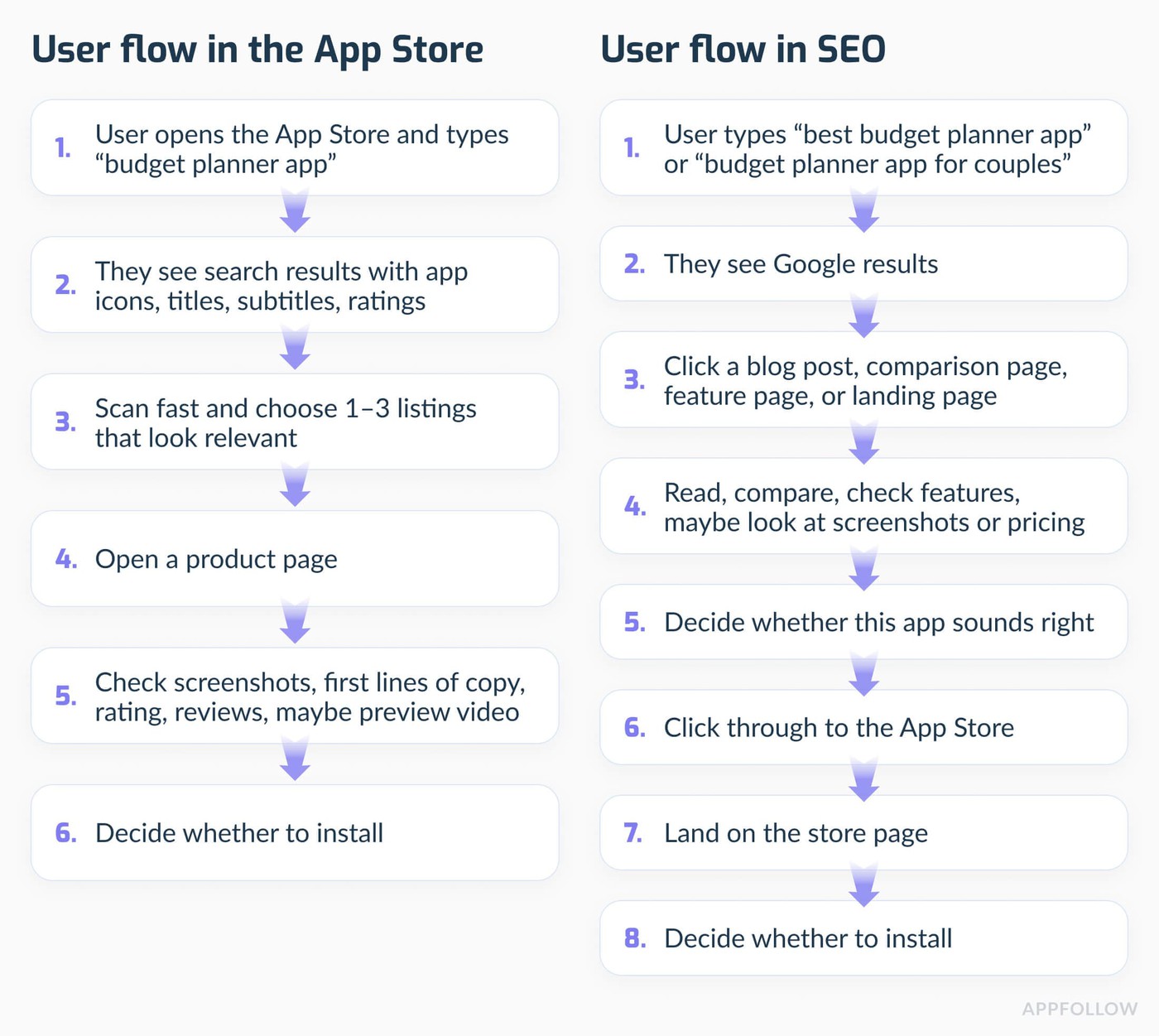
Search behavior is where the gap between SEO vs ASO becomes impossible to ignore. Same category, same product, sometimes even the same user, but the intent shifts the second the platform changes. That shift affects which keywords matter, how people phrase them, and what kind of page or listing can , convert.
How users search in app stores
App store search is tighter and more action-driven. Queries are usually shorter. Users lean toward branded queries, feature-based queries, and utility terms because they already know the type of solution they want. Think “habit tracker,” “VPN,” “period app,” or a specific brand name they heard in a podcast, ad, or TikTok.
The speed of that search matters. People are often trying to solve something quickly, which means install intent shows up early. They scan the listing, check whether the title feels relevant, glance at the screenshots, notice the rating, and decide fast. That compressed behavior is exactly why ASO depends so heavily on metadata, visuals, and trust signals.
How users search on Google
Google search usually starts earlier in the journey. The user is more likely to research, compare, learn, and validate before taking action. That’s why you see broader phrasing, more informational intent, and more comparison intent in search queries.
A person might look for “best budget app for couples,” “apps to reduce anxiety,” or “how to track calories without ads.” Those searches are doing more than hunting for a product. They’re helping the user frame the problem, compare approaches, and narrow the field. That’s where web content has room to work harder. It can explain, reassure, differentiate, and answer objections before the user ever reaches an app store.
And that’s the bridge into the next point: once you see how different the search mindset is, it becomes obvious why one keyword list rarely performs well everywhere.
The same keyword strategy rarely works in both places
“This is one of the biggest mistakes I see,” says Yaroslav Rudnitskiy.
“Teams pull a keyword from Google Search Console or an SEO brief and assume it belongs in the store. Or they take a strong store term and try to build web content around it without checking whether the search intent is even comparable.
Google handles a lot more research behavior. Users search with questions, comparisons, and problem-led phrases because they want context before they commit. In app stores, the language gets shorter, more functional, and much closer to action. You see more branded queries, more feature-based queries, and stronger install intent.
So a keyword that performs well on the web can still bring weak store conversion if it’s too broad or too early-stage.”
KPIs that matter in ASO vs SEO
When teams compare ASO vs SEO, they often lump the metrics together because both channels deal with visibility, traffic, and conversion.
That sounds neat on paper. In practice, it blurs the picture. App stores and search engines reward different behaviors, so the KPIs that matter most tell different stories, too.
Quick comparison: ASO KPIs vs SEO KPIs
KPI area | ASO | SEO |
Visibility | Keyword rankings, search visibility, category rankings | Impressions, ranking positions |
Visit / interest | App page views | Organic sessions |
Conversion | Conversion to install, organic downloads | CTR, landing-page conversions |
Trust / authority | Ratings, review volume, sentiment shifts | Backlinks, engagement metrics |
Cross-channel context | Brand demand, keyword visibility by market | Brand demand, assisted conversions |
Read also: 9 Customer Sentiment Examples - From App Reviews to Socials
ASO KPIs
Among the key metrics app companies track are
- Keyword rankings. This tells you where the app appears for the search terms you care about inside the store. Simple metric, big consequence. If the app is buried, discoverability is weak from the start.
- Then there’s search visibility, which gives you the wider view. One keyword can move and make everyone feel productive for a day. Visibility tells you how present the app really is across the broader keyword set. That’s a stronger signal of market presence.
- Category rankings add another layer. They show how the app is performing inside its category, where browse behavior and competitive pressure matter a lot. A climb here often reflects momentum beyond a single query.
- App page views show that visibility turned into interest. Someone saw the listing and cared enough to tap. That makes this metric a useful bridge between discoverability and conversion.
- From there, conversion to install becomes one of the most important numbers in the whole ASO stack. This is where app store SEO optimization becomes real performance work. A listing can rank beautifully and still underdeliver if the page fails to convince the user.
- The trust layer matters just as much. Ratings shape first impression fast. Review volume adds credibility. A 4.7 average built on twelve reviews feels very different from a 4.7 average built on 120,000. Sentiment shifts show whether perception is improving, slipping, or reacting to specific releases and feature changes.
- Finally, there’s organic downloads. This is the outcome metric. It tells you whether visibility, page appeal, trust, and conversion are , turning into growth.
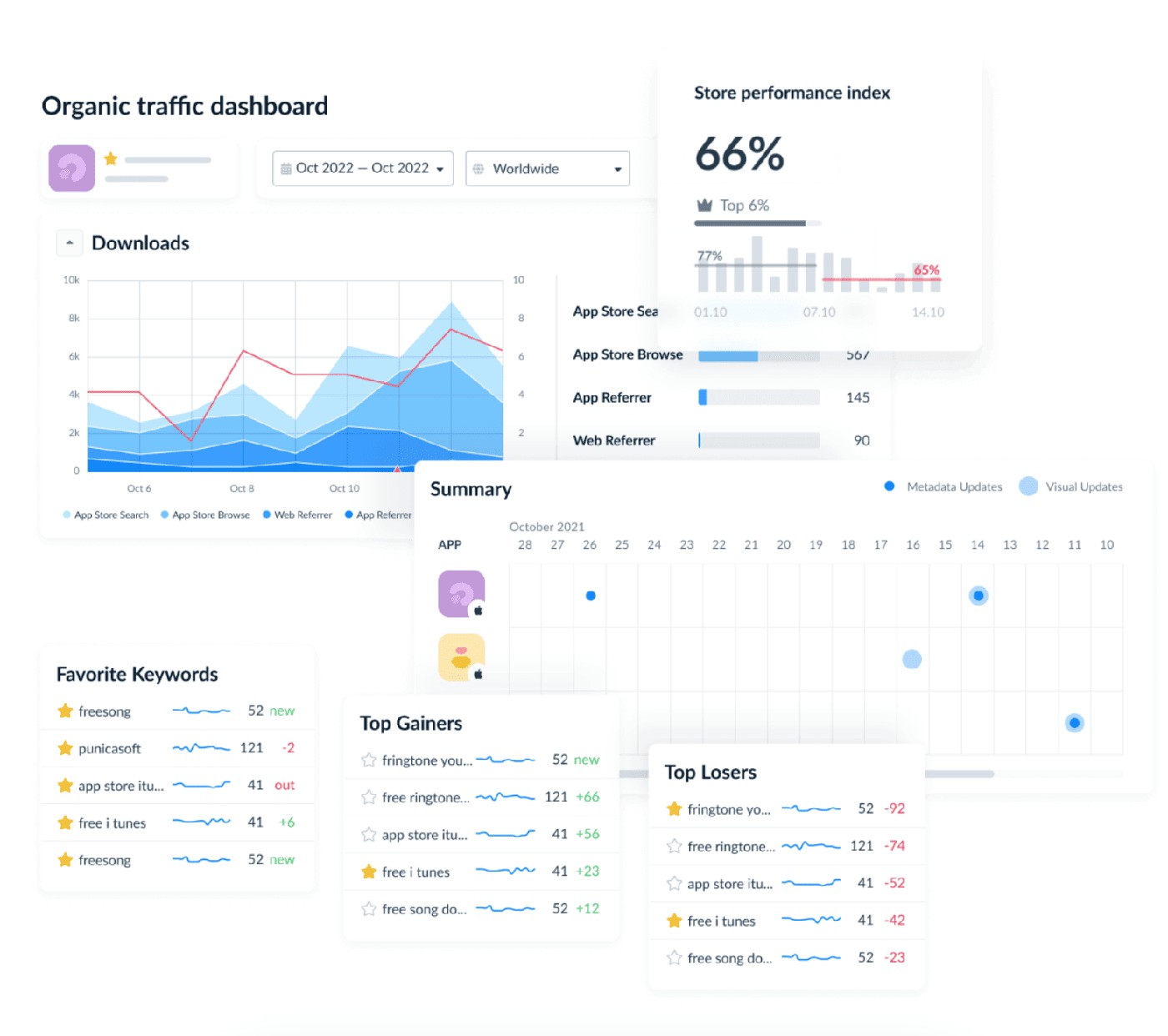
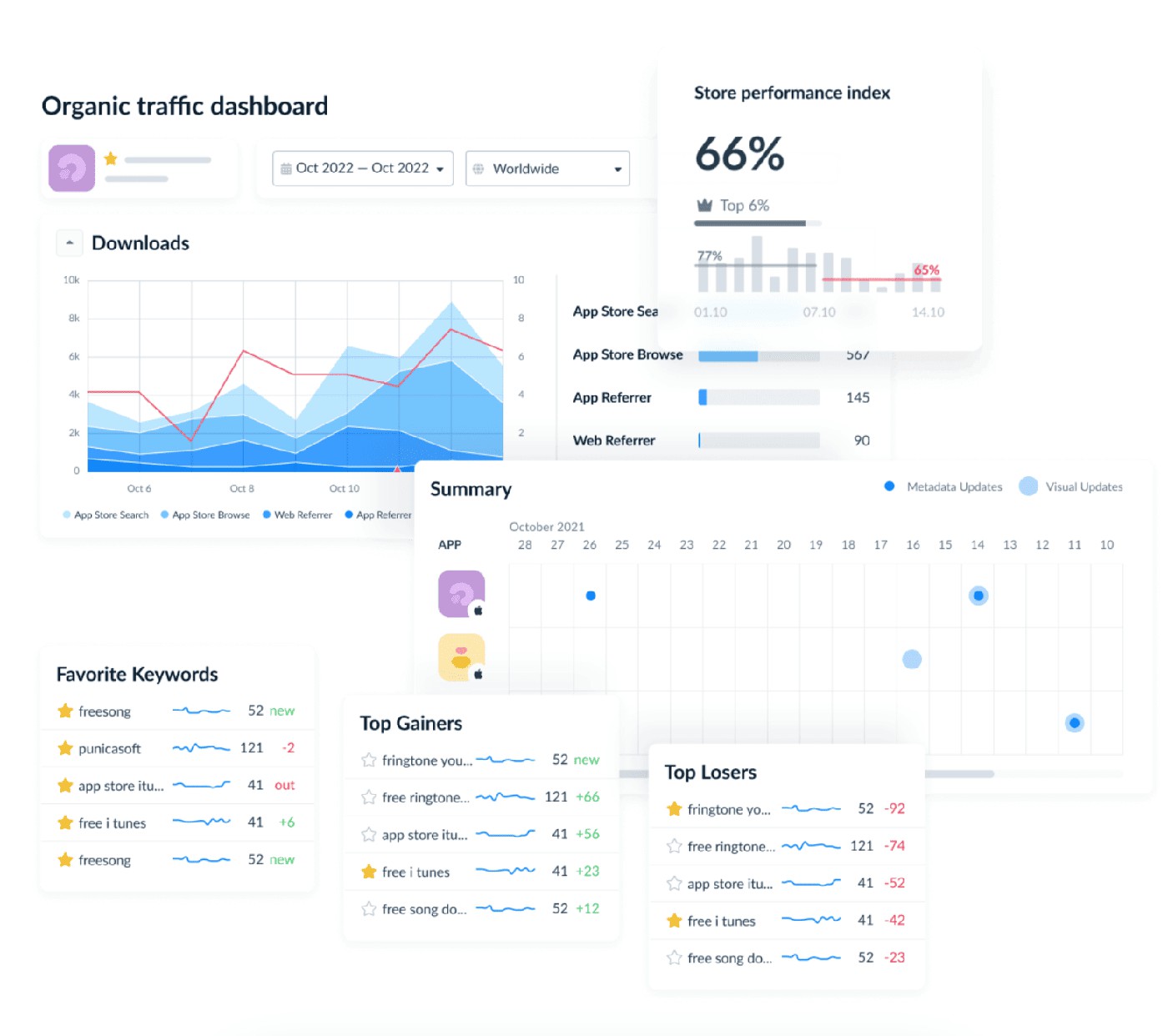
Here is for example some of the dashboards AppFollow users use to track them:
Dive deeper into ASO metrics with Appfollow. Start a free trial.
SEO KPIs
SEO tells a different story, because the journey is longer and the search environment is wider.
- Impressions show how often a page appears in search results. That’s your first clue that Google sees the page as relevant for a query.
- Ranking positions tell you where that page sits in the results. The gap between position 3 and position 11 is huge in terms of click opportunity, so this number carries real weight.
- Next comes CTR, or click-through rate. This is where headline quality, SERP fit, and search intent start showing up in plain numbers. A page can rank well and still miss the click if the title or angle feels weak.
- Organic sessions measure the visits coming from unpaid search. That turns visibility into actual traffic. Useful, yes, but still only part of the picture.
- What matters next is landing-page conversions. That’s where SEO starts proving business value. The page did its job if the visitor took a meaningful step, whether that was signing up, requesting a demo, reading deeper, or moving toward an app download.
- Then you have backlinks, which still act as one of the clearest authority signals in SEO. They help explain why one page earns trust in competitive search landscapes while another stalls.
- Last, engagement metrics add context. These can show whether users stay, interact, and keep moving through the site or bounce quickly because the page did not meet expectations.
What app teams should track together
Some metrics become much more useful when you look at the two channels side by side.
- Brand demand is one of them. If people are searching for your app or company name on Google and inside the store, that tells you awareness is growing.
- Web-to-store visits help connect content discovery with install intent. This is where SEO starts feeding the app journey more directly.
- Review sentiment by feature gives you language straight from users. That’s incredibly useful because it shows what people praise, what frustrates them, and which product themes deserve more visibility in both store messaging and web content.
- Keyword visibility by market matters too, because performance can shift hard between countries, languages, and local competitors.
- And then there’s conversion by channel. Different traffic sources behave differently. Someone arriving through branded search, informational content, or store search is not coming in with the same mindset, so the conversion story changes with the path.
That’s where ASO SEO becomes genuinely useful as a comparison. Separate KPIs help you understand each channel clearly. Shared signals help you see how both channels support the same growth journey from discovery to install.
Read also: AI Customer Sentiment Analysis - How Teams Turn Feedback Into Action
When ASO and SEO should work together
As the earlier sections already showed, SEO vs ASO is not a fight over which channel matters more. It’s a sequencing question. Based on what we’ve seen across AppFollow client work, the strongest app growth programs use SEO and ASO at different moments of the same journey. One channel captures interest before the store visit. The other turns that interest into installs once the user lands on the listing.
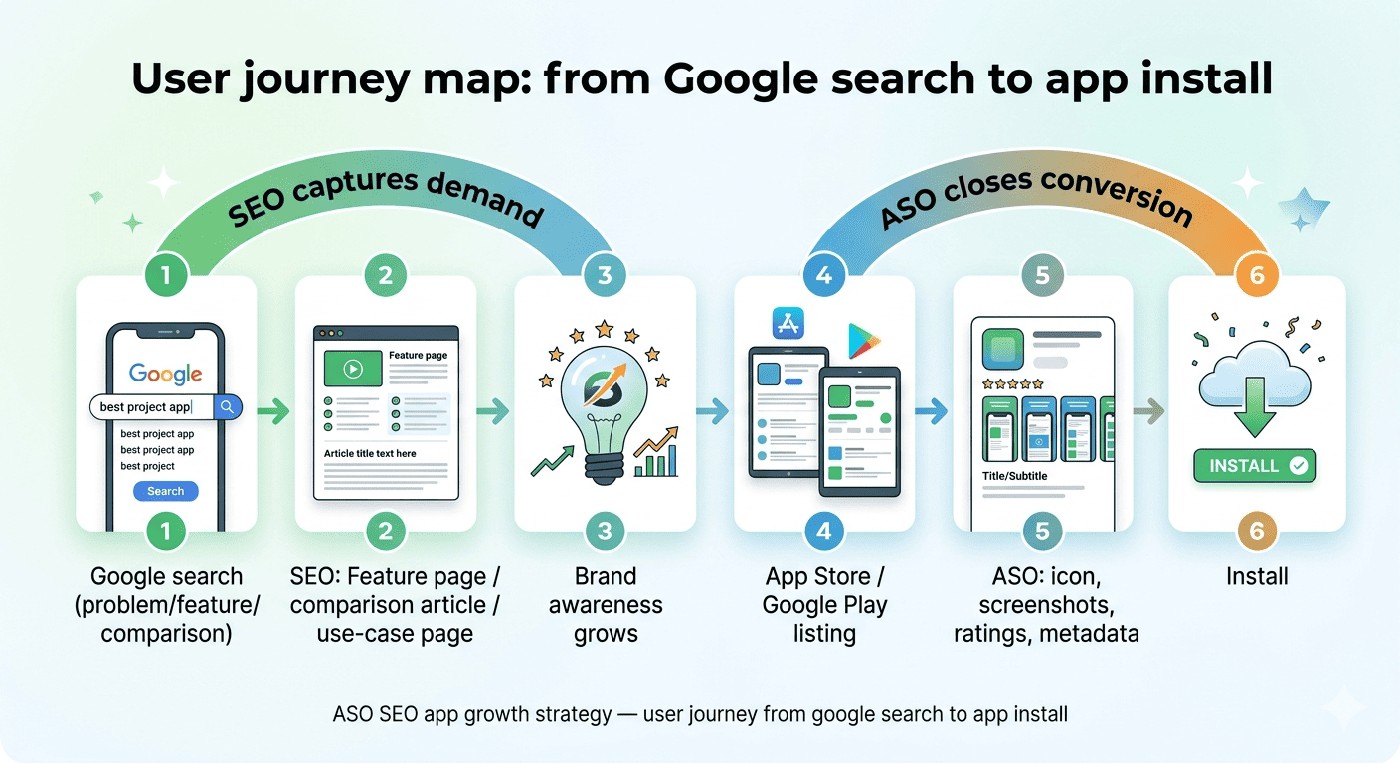
SEO supports discovery before install
Search usually enters the picture earlier. A user is not always ready to open the App Store and download on the spot. Sometimes they’re still figuring out the problem, comparing options, checking whether a feature exists, or looking up a brand they’ve already heard about.
That’s where SEO does real work. Feature pages can rank for capability-driven queries. Comparison pages can catch people evaluating alternatives. Use-case pages can pull in intent from users searching for a specific outcome, not just a product category. Branded searches matter too, especially once awareness starts growing across paid, PR, influencer, or app store campaigns.
When those pages are built well, SEO becomes the channel that frames the category, answers objections, and warms the user up before the store ever appears in the journey.
ASO closes the install conversion
Once the user reaches the store, the job changes fast. Now the question is no longer “Does this app exist?” It becomes “Do I trust this enough to install it right now?”
That decision gets shaped by metadata, screenshots, review language, rating quality, and localized creatives. The title and subtitle need to confirm relevance instantly. Screenshots have to show value in seconds. Reviews add proof. Ratings reduce hesitation. Localized assets matter because a listing that converts in one market can fall flat in another, even when the keyword visibility looks strong.
“The biggest mistake I see is when teams treat the store page like a final step that takes care of itself. It doesn’t. By the time a user gets there, they are already making a speed decision. If your screenshots are generic, your rating is shaky, or your metadata does not match the intent that brought them in, you lose the install even after doing the hard part of winning attention.”
— Yaroslav Rudnitskiy, ASO guru
That’s the piece teams underestimate. Store visibility opens the door. Conversion assets decide whether the user walks through it.

Shared messaging makes both channels stronger
This is where good teams start compounding results. The same core promise should show up across both channels, but the packaging has to adjust to the environment.
On the web, you have room to explain. You can lean into comparisons, use cases, deeper objections, and category language. Inside the store, the message has to land much faster. Fewer words. More visual proof. Stronger immediate clarity.
The smartest teams keep the strategic center consistent. Same value proposition. Same product truth. Same user pain point. Then they reshape that message based on intent. Search pages answer the question in detail. Store pages confirm relevance and reduce friction. That’s when ASO SEO starts working like a connected system instead of two disconnected workflows.
5 mistakes app teams make when mixing ASO and SEO
From AppFollow team experience, this is one of the patterns we see most often. Teams understand that search matters across web and app stores, but then they apply the same logic everywhere and expect the same result.
Treating ASO as “just SEO in an app store”
“The moment a team treats ASO like mini-SEO, the strategy gets sloppy.
They overfocus on keywords and underweight the parts that decide installs: screenshot sequence, rating quality, review themes, visual clarity, and how tightly the metadata matches store intent.
A web page can rank because the content is deep and the site has authority.
A store page has a much shorter decision window. If the first impression is weak, visibility alone won’t save performance.
That’s why ASO needs its own operating logic, even when the keyword research starts from similar user language.”
— Yaroslav Rudnitskiy, ASO guru
What to do instead: Run ASO and SEO as parallel disciplines that share research but operate separately. Build your store listing around conversion psychology, not content depth. Evaluate screenshots, icon, and rating as primary performance assets, not afterthoughts.
Read also: 10 Best App Analytics Tools - Features & Pricing Comparison
Stuffing SEO-style long copy into store metadata
“I see this all the time. A team takes the logic that works for web pages and pushes it into the store listing, so the description turns into a bloated wall of features, benefits, and repeated phrases.
On the site, extra context can help. In the store, that usually creates friction. Users skim fast. The algorithm also reads store fields differently from a search engine page.
So when the copy gets padded with every possible keyword variation, relevance gets fuzzy and the message loses sharpness. Good metadata feels compressed, intentional, and clean. It confirms what the app does, matches the search intent behind the visit, and supports the screenshots instead of competing with them. If the listing reads like an over-optimized landing page, install conversion usually pays the price.”
— Ilia Kukharev, Product Manager
What to do instead: Treat every character in your store listing as premium real estate. Short description: one strong benefit statement with the primary keyword. Full description: lead with the outcome, support with 3–4 proof points, and let screenshots carry the conversion weight. Test variations with Google Play’s store listing experiments.
Ignoring ratings and reviews in an ASO discussion
“The second a team treats ratings and reviews like a support metric instead of a visibility and conversion signal, ASO starts leaking performance. I’ve seen apps improve keyword coverage, refresh screenshots, even lift page views, and still stall because the review layer was working against them.
Users do read that feedback.
A drop from 4.6 to 4.2 changes how safe the install feels, especially in crowded categories where listings look similar at first glance.
Reviews also tell you which feature, bug, or promise is shaping perception right now. If users keep mentioning crashes, paywall friction, or broken onboarding, that message becomes part of the store page whether your team likes it or not. Strong ASO work reads review themes as conversion intelligence, not background noise.”
— Veronika Bocharova, Customer Success Manager at AppFollow
What to do instead: Set up real-time rating drop alerts and build a weekly review triage workflow. AppFollow’s review monitoring automatically surfaces trending complaint themes and flags anomalies, so teams can respond and escalate before a rating dip hits conversion. Treat review sentiment as a living KPI alongside keyword rankings.
Read also: Customer Sentiment Score - How to Calculate, Track & Use It
Ignoring web content in an app-growth discussion
“When teams talk app growth and leave web content out of the room, they cut off a huge part of pre-install discovery.
Users often search Google before they ever hit the store. They look for comparisons, feature explainers, pricing, trust signals, or answers to a specific pain point. If your site has nothing useful there, you lose that demand before ASO even gets a chance to work.
Strong feature pages and use-case content do more than drive traffic. They shape expectation, reinforce relevance, and send warmer visitors into the store.”
— Lucija Knezic, Senior CSM & Product Strategy Manager at AppFollow
What to do instead: Build a content map that covers the full pre-install journey. Identify the top 5–10 queries your potential users type on Google before they search for an app. Create feature pages, comparison pages, and use-case articles for those terms. Link each page to your App Store and Google Play listing so the discovery-to-install path is smooth.
Not localizing app-store strategy separately from web strategy
“This is where teams quietly lose growth market by market. They translate website copy, drop it into the store, reuse the same screenshot logic, and expect conversion to hold. It rarely does. Search behavior shifts by country.
So does feature language.
So does what users trust on first glance.
A term that brings qualified web traffic in one market can miss store intent completely in another. Creative can slip too. Screenshot order, proof points, even the emotional trigger behind the install can change from region to region. That’s why store localization needs its own keyword research, its own visual testing, and its own conversion logic.”
— Karen Taborda, Customer Growth Team Lead at AppFollow
You see the gap fast in ASO vs SEO work. Teams that treat localization as shared translation usually weaken store performance. That shortcut hurts app store optimization SEO more than most people expect.
What to do instead: Run separate keyword research for each target market using country-level store data. AppFollow’s keyword data is broken down by country and language, so you can see which terms have volume in JP vs. US vs. DE and build localization from actual store search behavior, not translated web copy. A/B test screenshot layouts per region.

How to decide whether a topic belongs to SEO, ASO, or both
One of the fastest ways to waste effort is to send the right topic into the wrong channel. That happens a lot in SEO vs ASO planning. A team finds a valuable keyword, gets excited, then pushes it into a blog post when it belongs in store metadata. Or they force a store term into a landing page and wonder why the traffic never turns into meaningful intent.
A simpler way to think about it is this: start with the user’s question and the stage of the journey. If the user needs explanation, education, or comparison, the topic usually leans web. If the user is already close to install and deciding between listings, it leans store. When the topic shapes both discovery and conversion, it belongs in both places, just packaged differently.
Topic framework: SEO, ASO, or both
SEO-led topics | ASO-led topics | Shared topics |
Educational problems | Store discoverability | Branded queries |
How-to guides | Metadata optimization | Feature terms |
Comparison articles | Screenshot testing | Competitor comparisons |
Troubleshooting content | Preview video testing | Localization themes |
Category explainers | Ratings and review strategy | Core value proposition |
Use-case pages | Category positioning | Messaging around major features |
FAQ pages | App title / subtitle choices | Seasonal campaigns |
Glossary content | Conversion-focused creative updates | Market-specific search language |
SEO-led topics
These topics work best when the user needs context before making a decision. Think educational searches, feature explainers, troubleshooting, and side-by-side comparisons. Someone searching “best meditation apps for anxiety” or “how to track habits daily” is often still researching. They want answers first. That makes web content the stronger format because it gives you room to explain, compare, build trust, and capture longer-tail demand.
ASO-led topics
Some topics belong much closer to the install moment. That’s where ASO SEO strategy needs a different lens. Metadata choices, screenshot sequencing, rating strength, review themes, category placement, and creative testing all live inside the store environment.
These are not blog topics in the usual sense, but are conversion topics. They influence whether a user taps, trusts, and installs once the app is already in front of them.
Shared topics
Then you have the topics that travel across both channels. Branded queries are the obvious one. Feature terms often belong here too, especially when users search them on Google and inside the store. Competitor comparisons can work in both places, though the format changes. Localization themes are another big one because search language, value framing, and conversion triggers shift by market.
That’s the practical test: ask where the topic sits in the user journey, what format gives it the best chance to perform, and whether the same idea needs two versions for two different moments. That’s when SEO vs ASO stops feeling like a theoretical comparison and starts working like a real content framework.
ASO + SEO alignment checklist for app teams
Use this as a starting point for your next planning cycle. Check off what’s in place and tackle what’s missing.
- Run separate keyword research for web (SEO) and store (ASO), don’t just translate one into the other
- Audit your app title and subtitle: do they contain your primary search term and clearly describe the app?
- Check your App Store and Google Play short descriptions, every character should earn its place
- Review your screenshots as a conversion sequence, not a feature list, does the first frame answer "why install this?"
- Track your average rating and review volume, are they above category benchmarks?
- Set up review monitoring alerts for rating drops and repeated complaint themes
- Build at least 3 web pages targeting pre-install queries: one feature page, one comparison page, one use-case page
- Verify that each web page has a clear CTA linking to the App Store / Google Play listing
- Run keyword research per market for your top 3 countries, do you have localized metadata for each?
- Test screenshot layouts in Google Play Store Listing Experiments
- Track organic download trends by country alongside keyword visibility, are they moving together?
- Check competitor keyword rankings monthly, which terms are they gaining that you are not?
Read also: The top 10 app store optimization tools in 2026 (and when to use each)
How AppFollow helps with ASO and app visibility
As an ASO platform, AppFollow is built for the part after the strategy deck. The platform ties keyword performance to actual download impact, surfaces visibility, popularity, rank, and difficulty, and gives teams a clearer read on how an app performs across downloads, traffic, and conversion by country, time frame, channel, and store.
It also pulls reviews, ratings, and ASO data into workflows across Slack, Zendesk, Tableau, webhook, and 20+ other services, which matters when ASO is shared across growth, support, product, and CX teams.
- James Delivery used AppFollow to boost search downloads and search visibility. Miro’s cross-device product team used it to manage reviews and ASO.
- Komorebi used AppFollow in a growth push that led to a 1916% jump in app installs in three months.
- TechStyle used the platform to track trending topics and sentiment from app reviews.
- Audiomack used AppFollow automation and reported 501% ROI.
ASO and SEO can absolutely support the same growth journey, but AppFollow helps most at the store side of that system, where teams need to understand whether keyword visibility is improving, whether ratings and reviews are helping or hurting install conversion, and how competitor movement is changing the landscape around them.
AppFollow’s own ASO page frames that clearly through keyword intelligence, app store performance analysis, and organic download growth.
Features AppFollow offers
- Keyword intelligence with visibility, popularity, rank, difficulty, and download impact data
- App store performance monitoring across visibility, downloads, traffic, and conversion rates
- Competitor and market intelligence to spot opportunities and differentiation points
- Ratings and review monitoring to understand user sentiment and protect conversion quality
- AI-powered review management and workflow automation for responding, sorting, and reporting reviews
- Integrations with Slack, Zendesk, Tableau, webhook, email, and 20+ other services
cta_free_trial_yellow
FAQs
What is the main difference between ASO and SEO?
The biggest difference in ASO vs SEO comes down to where the user is and what the platform rewards. ASO works inside app stores, where visibility and install conversion depend on metadata, screenshots, ratings, reviews, and store behavior. SEO works on the web, where rankings lean more on content relevance, site structure, backlinks, and technical performance. Same growth funnel, different environment.
Can SEO help app downloads?
Yes. Strong web SEO can absolutely support app growth. It helps users discover your brand, compare options, understand features, and build trust before they ever open the store. That’s where ASO SEO starts working together. A useful feature page or comparison article can warm up demand, then send more qualified visitors into the App Store or Google Play.
Is ASO just SEO for apps?
That phrase sounds helpful, but app store optimization SEO is too simplified to guide real strategy. Keyword research overlaps, sure. After that, the execution changes fast. Store rankings respond to app-specific fields and store behavior, and install conversion depends heavily on screenshots, ratings, reviews, and visual clarity. So the logic partly overlaps, but the playbook is different.
Which is more important for app growth: ASO or SEO?
That depends on where the bottleneck is. When the problem is weak store visibility or poor install conversion, app store SEO optimization matters more right away. When people are still researching the category, comparing tools, or searching for solutions on Google, SEO can do more work earlier in the journey. Most mature app teams need both. One captures demand. One closes it.
How do ASO and SEO KPIs differ?
ASO and SEO measure different moments of intent. With app store optimization - app store SEO, the important split is this: ASO KPIs focus on keyword rankings, search visibility, app page views, install conversion, ratings, review sentiment, and organic downloads. SEO KPIs focus on impressions, ranking positions, CTR, organic sessions, landing-page conversions, backlinks, and engagement. The overlap is visibility. The outcome metrics are different.
Can one tool track ASO performance, competitor keywords, and app-store visibility?
Yes. An ASO platform like AppFollow can track keyword performance, visibility, competitor movement, ratings, reviews, and broader app-store signals in one place. That’s useful because ASO gets messy fast when keyword tracking, sentiment analysis, and competitor monitoring live in separate tools. One connected view makes decisions much easier.