How App Store Optimization Tools Enhance App Visibility?

Table of Content:
App store optimization tools enhance app visibility by working directly on the signals app stores use to decide what gets seen. They connect real search demand to your metadata, shape creatives that turn views into installs, and track how ratings and reviews evolve.
When relevance improves and more people convert, algorithms take notice, with all the benefits of that.
It happens because ASO tools turn vague assumptions into measurable actions, what to change, where to test, and when to intervene.
In the next sections, we’ll break down these mechanics one by one:
- Keyword alignment
- Conversion performance
- Review signals
- Competitive context
You’ll see how each layer influences visibility, and why optimizing one without the others rarely moves the needle.
But first, let’s check if we are on the same page about basics.
What “app visibility” means in app stores
App visibility is the frequency and quality of placements your app gets across App Store Search, Google Play Search, category lists, and editorial surfaces, and how often real users see those placements.
So when you work on ASO, you’re really working on three main visibility buckets.
- Search visibility: how often you appear, and where you rank, when people type queries into App Store Search or Google Play Search. This is where keyword alignment and conversion signals really bite.
- Browse and category visibility: showing up in category rankings, “Top charts”, “You might also like”, and similar lists where users are in discovery mode, not typing exact keywords.
- Editorial and featured visibility: curated collections, stories, and promo spots. You can’t buy your way in, but consistent quality, strong ratings, and clean metadata all help you stay eligible for those editorial surfaces that can spike installs and lift your baseline exposure long-term.
And here is how tools like AppFollow help here.
How do ASO tools improve app visibility in app stores?
ASO tools improve visibility by getting your app to “speak the same language” as real users in App Store and Google Play search. They replace gut feeling with query data, then connect that demand to the way your title, subtitle, short description, and keyword fields are written. The result is simple: you show up more often for the searches that matter, in markets where you can realistically win.
1. Improving keyword relevance for app store search
The process starts with keyword research: tools pull real queries, volumes, and difficulty, so you can see that “budget planner” in the US and “expense tracker” in the UK are two different battles. From there, you align metadata, title, subtitle, description, keyword field, around the highest-opportunity terms instead of stuffing every synonym.
Keyword density alone doesn’t drive relevance. Matching intent does. When your page structure, copy, and semantic variations reinforce the same core topics across locales, algorithms read that as a strong match.
Layer localization on top, native phrasing, local brands, regional pain points, and those relevance signals get even stronger.
The outcome: more qualified search impressions for the queries you targeted on purpose, and less wasted visibility on terms that never convert.
2. Increasing conversion rates on app pages
Once people land on your page, visibility depends on how many of them install. ASO tools treat your icon, screenshots, and videos as performance assets, not decoration. They show you which creatives attract taps, which layouts keep people scrolling, and where users drop off.
Most teams win or lose here. Change a static screenshot set to a simple “problem → solution → proof” sequence and you can move CVR by several percentage points. Swap a generic icon for something that clearly communicates category and value, and your tap-to-install rate shifts again.
With built-in A/B testing, you run variants, see which version drives a higher conversion rate (CVR), then roll it out to the full audience. Higher conversion rates signal app quality to app store algorithms, increasing visibility. Over time, that loop, test, learn, ship, is what stabilizes rankings and lifts your baseline exposure across search and browse.
Read also: 5 Review Management Software For Google Play Store Compared
3. Leveraging ratings and reviews as trust signals
App stores watch what users say about you and how often they say it. ASO tools plug into that layer and turn chaotic feedback into usable signals.
You’ve got rating volume (how many people rated), rating velocity (how fast new ratings come in), and review sentiment (what the text says). A jump from 200 to 2,000 ratings with a stable 4.6★ score is a very different trust signal than sitting at 4.6★ with 15 reviews. In many categories, even a small move from 4.1★ to 4.5★ can lift conversion rates noticeably.
Tools matter because they:
- Monitor trends: star averages, spikes, and dips by country, version, or device.
- Support responding at scale: templates, workflows, and integrations so every key review gets a timely reply.
- Detect drops early: alerts when a new release tanks ratings or a bug triggers a wave of complaints.
When ratings stay high, fresh, and actively managed, algorithms read your app as lower risk, and more worth showing.
4. Tracking competitors to find visibility gaps
ASO tools also help you see where visibility is already “taken” and where there’s still room to grow. Think of it as market mapping, not spying.
- You start with keyword overlap. Tools show which search terms you share with your closest competitors, where they outrank you, and which high-intent queries they’re ignoring. Maybe everyone is fighting over “budget planner”, while “shared family budget” has decent volume and almost no strong players.
- Next comes category movement. You can track who’s climbing or dropping in your category rankings, then correlate those shifts with releases, promos, or creative changes.
- Finally, metadata changes: title tweaks, new subtitles, fresh screenshots. ASO tools log these updates over time, so when a rival’s visibility improves, you can see what changed and evaluate whether it’s worth testing in your own strategy.
5. Monitoring performance to prevent visibility loss
Visibility doesn’t usually disappear in one dramatic crash. One update goes live, rankings wobble, ratings dip, reviews spike… and two weeks later the team is asking, “Wait, when did installs start sliding?”
This is where ASO tools and AppFollow are especially strong, doing the unsexy work that saves your growth. You monitor the signals that predict a drop before it becomes your new baseline:
- Rank drops after updates. Track keyword positions and category rankings by country right after release. If version 6.2 coincides with a slide on high-intent queries, you’ve got a lead to investigate.
- Rating dips. A small average drop (even 0.1-0.2 stars) can hurt conversion, which then feeds back into visibility. Tools catch it early and tie it to the exact version and market.
- Review spikes. A surge in 1-2★ reviews often point to a specific bug, pricing change, or onboarding fail. You see the spike, read the theme, and react fast.
- Algorithm sensitivity. Stores react to shifts in conversion, retention proxies, and user feedback faster than humans do. Monitoring turns “we think something changed” into “here’s the day it started, here’s what moved, here’s what to fix.”
The outcome is simple: fewer blind spots, faster recovery, and way less ranking decay after releases.
Read also: Top 5 Review Management Software for Apple App Store
Why ASO tools outperform manual optimization
Manual ASO is guessing with a spreadsheet. ASO tools turn it into an actual system.
Tools like Appfollow pull live data from App Store and Google Play, show real keyword demand, and reveal how often you appear for those terms. They track:
- category rankings,
- page conversion rates,
- and review trends.
All in one place, so you’re not stitching screenshots together and hoping you see the pattern.
They also watch competitors for you, when they change metadata, climb a chart, or suddenly outrank you, you see it.
And because everything is tracked over time, you can run tests, measure impact, and roll out what works instead of relying on “we think this helped”.
What types of ASO tools matter most for visibility
When visibility is the goal, tool categories matter more than brand names. You want coverage across the full loop: get discovered → convert → protect trust → adapt → recover fast.
Here’s the short list that moves rankings and impressions.
ASO tool type | What it helps you do | Visibility impact |
Keyword intelligence tools | Find real search demand, pick winnable terms, align metadata by market | More search impressions in App Store Search + Google Play Search |
Conversion optimization tools | Improve icons, screenshots, videos; run A/B tests; lift CVR | Higher conversion rates reinforce rankings and exposure |
Review & rating analytics | Track star trends, sentiment themes, version-driven issues, reply faster | Stronger trust signals support discoverability and installs |
Competitive intelligence | See keyword overlap, category movement, and metadata changes over time | Identify visibility gaps and realistic opportunities to win |
Performance monitoring | Catch rank drops after updates, rating dips, review spikes; set alerts | Prevent visibility loss and recover before the dip sticks |
How AppFollow supports app visibility growth
AppFollow doesn’t replace ASO work; it gives you the data and workflows to run it like a system.
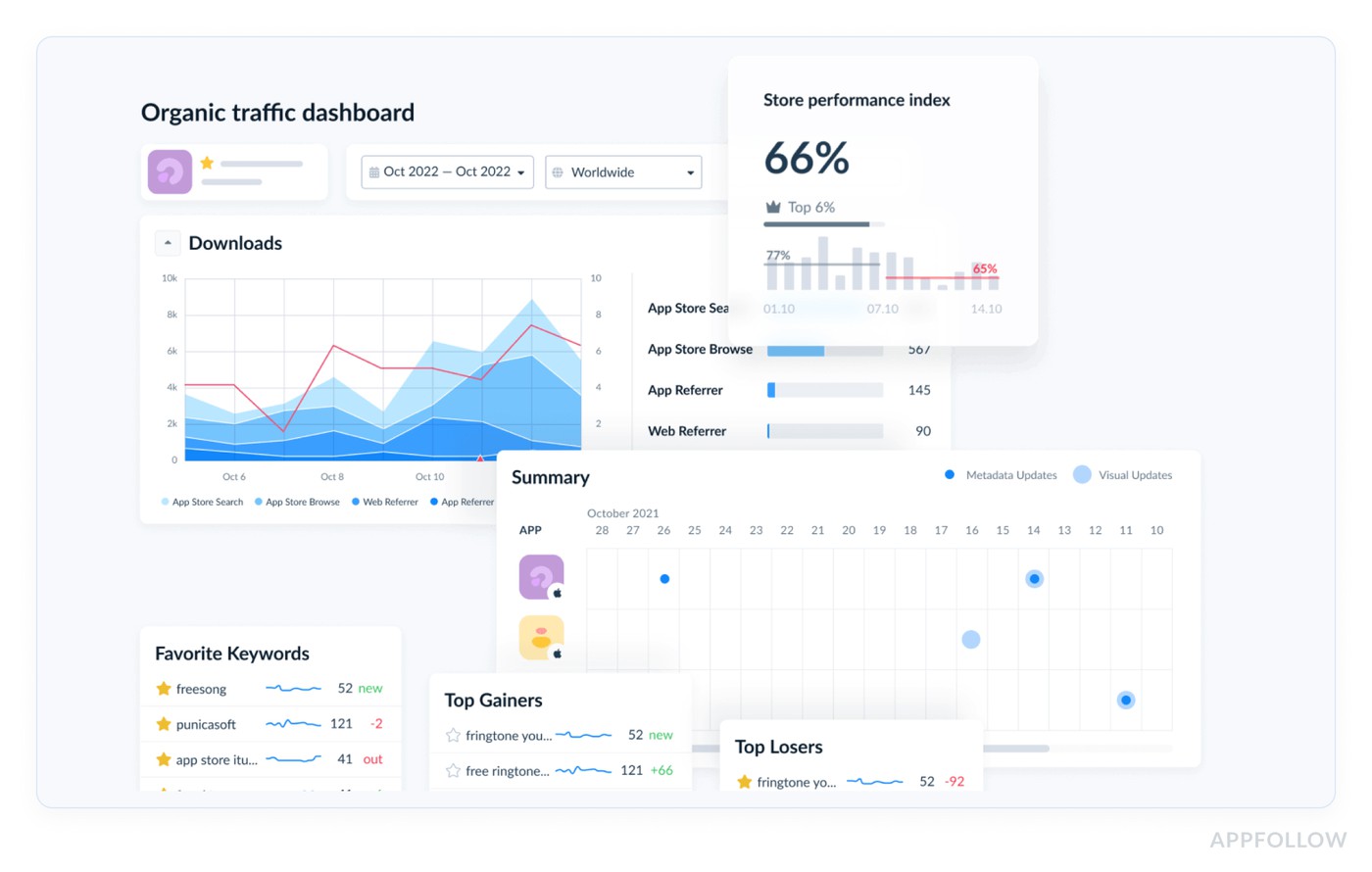
- For keyword relevance, AppFollow’s ASO reports combine keyword popularity, difficulty, and estimated impact with actual rank and download trends. You can see which terms drive meaningful traffic today, which ones are slipping, and where competitors are gaining share.
- For conversion signals, AppFollow tracks how changes to your title, subtitle, screenshots, or descriptions correlate with page views, installs, and category rankings over time. That history helps you understand which listing iterations likely contributed to a lift - and which were just noise.
- For ratings and reviews, AppFollow centralizes feedback from all stores, surfaces trends, and connects them to versions and countries. Tags, filters, and automation make it easier to respond at scale and stabilize trust signals that feed back into visibility.
- On the competitive side, you get category rankings, keyword positions, and featured history in one place, which makes visibility gaps and realistic targets much easier to spot.
- Finally, performance monitoring and alerts flag rank drops, rating dips, and review spikes early and push them into the tools your team already uses, so you can react before small issues turn into lasting visibility loss.
Gain in-depth ASO data paired with user insights for the success of your mobile apps and games.
cta_free_trial_purple
FAQs
How long does ASO take to improve visibility?
You usually see early signals in 2-4 weeks (rank shifts, impressions) once metadata is indexed. Meaningful, stable visibility gains often land in the 4-12 week range, depending on competition, ratings, and how aggressively you test.
Do ASO tools affect rankings directly?
No. Algorithms don’t “see” the tool. They only see the changes you ship: metadata, creatives, ratings, and behavior. ASO tools matter because they show where to focus, what to change, and whether it moved rankings or conversion.
Is ASO more important than paid UA?
ASO sets the baseline efficiency of every visit, paid or organic. If your store page underperforms, paid UA just buys expensive leaks. Strong ASO makes all traffic cheaper and more effective; UA then becomes a volume and testing lever, not a band-aid.
Can ASO tools help after an app update?
Yes, that’s one of their most useful jobs. They correlate version releases with rank drops, rating changes, and review spikes, so you can see if an update hurt visibility, identify the cause, and decide whether to fix, roll back, or adjust messaging.
When do ASO tools have the biggest impact on visibility?
They have outsized impact during launches, new market expansions, and after major product or pricing changes. They’re also crucial once you’re past the basics and need to protect visibility: monitoring updates, ratings, and competitors so small issues don’t turn into long-term ranking losses.