Your reviews are everywhere. Your review management should be too.

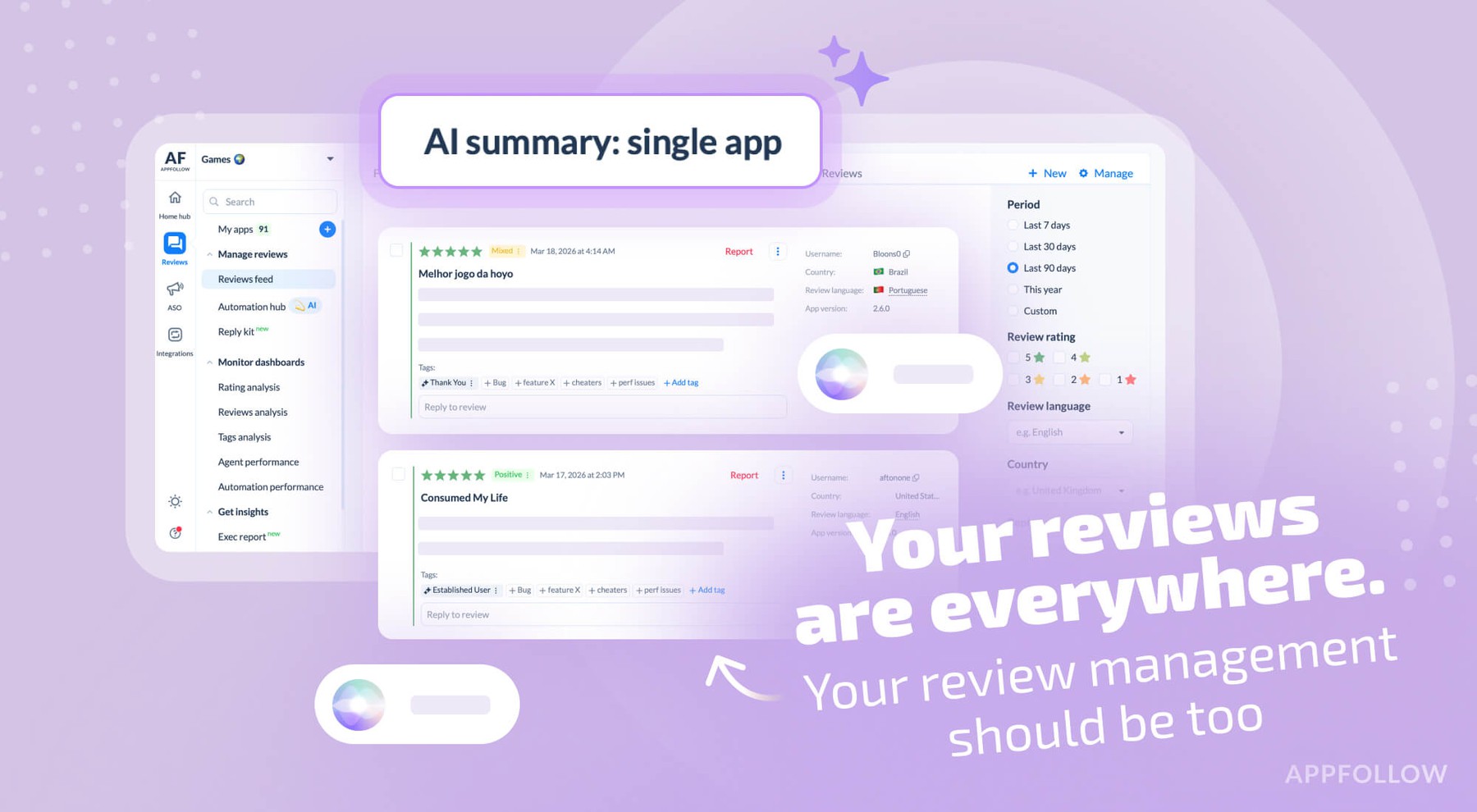
Table of Content:
A mobile game pushes an update, something breaks. Story old as time. Maybe the login flow, maybe a beloved feature gets removed, maybe the new UI is just ugly. Within hours, the internet has an opinion, and that opinion shows up everywhere.
App Store reviews, sure. Google Play, obviously. But also Reddit threads, TikTok stitches, YouTube comments, Discord servers… Sometimes in the replies to your own paid ads, which is a special kind of fun. Someone drops a one-star review in the App Store and a 200-word rant on Reddit, and a sarcastic TikTok, and your team finds out about the TikTok three days later from a friend, if at all.
That's the reality for product managers, support leads, and marketers who care about how their app is perceived. The feedback isn't in one place. It hasn't been in one place for years. But for some reason, most of the tools built to manage app reputation still behave like the app store is the whole universe (or some other platform!)
Feedback is previous (obviously)
For a product manager, each channel is a signal. A Reddit thread about a confusing onboarding flow is just as valuable as a one-star review saying "app is broken." A TikTok showing a bug in real time is arguably more useful than a vague App Store review. A Discord conversation where power users discuss workarounds for missing features is as valuable as it gets, and it’s common sense.
The problem is that looking everywhere manually is a full-time job that nobody signed up for. Most teams either ignore everything outside the app stores, or they assign someone to scroll through Reddit and TikTok when they have a spare moment, which is never.
The speed problem
When something goes wrong with your app, the clock starts ticking immediately. A bug in the latest update, a server outage, a pricing change that people hate. The longer it takes you to notice, the worse it gets.
This is where alerts matter. If you have a system that detects a review spike within minutes and pings your team on Slack, you can start responding and investigating before things go downhill. If you're relying on someone to manually check the review feed once a day, you've already lost the window where a fast response could have made a difference.
AppFollow already does this for all major app stores and Trustpilot. When review volume spikes, when your rating drops, when specific keywords start trending in feedback, you get notified. You can set up alerts by semantic tags, so if crash reports suddenly double, your engineering team knows about it before your support queue explodes.
A 24-hour solution to what used to be a 7-day problem in the industry.
Now imagine that same alerting system covering Reddit, Discord, YouTube, TikTok, and wherever else your users congregate. That's the direction things are heading. Steam and Discord integrations are coming first, with more social platforms on the roadmap after that.
Responding used to be expensive…used to be.
For a long time, a lot of companies just didn't bother, and the ones that did often wished they hadn't, because it was slow, expensive, and the return on investment was hard to measure.
You'd hire support agents or ask your existing team to spend hours crafting individual responses to reviews, and at the end of the quarter nobody could tell you whether any of it mattered.
The cost is in the cognitive overhead of categorizing reviews, writing templates, iterating on those templates, keeping them fresh so they didn't sound robotic, managing translation for international users, and doing all of this across multiple storefronts. For a lot of teams it just wasn't worth the hassle.
That equation has changed pretty dramatically with AI-powered replies, automation rules, smart templates, and built-in translation, as you can get to 80-100% reply coverage without adding headcount. Set up your automation rules, configure your AI reply instructions, plug in your knowledge base if you have one, and let the system handle the bulk of it.
Check in every now and then, tweak the instructions, review the KPIs on reply rate and rating trends, and move on with your life. It's cheaper than hiring an extra support agent. Cheaper than most things, really. Set it and forget it, with the occasional tune-up.
Feedback happens everywhere and your reputation follows
When you run ads on TikTok, Reddit, Facebook, YouTube, or anywhere else, the replies to those ads become part of your app's public reputation. Someone sees your ad, scrolls to the comments, and finds people complaining about your latest update. That's a reputation problem that lives completely outside the app store and no amount of app store review management is going to fix it.
People respond to ads with reviews. They do. They use the comment section of a promoted post as a feedback channel. And businesses need to know when this is happening, because those comments influence purchase decisions just as much as a star rating does. Right now, monitoring all of this is entirely manual. Someone on the marketing team has to go check. Nobody knows anything when it comes to aggregating this data in one place, because the tools for it barely exist yet.
This is one of those areas where an all-in-one solution is the only way to keep up. As marketing spend continues to spread across more channels, the surface area for public feedback grows with it. You need one place where all of this rolls up.
All-in-one is what everybody wants (and needs, even if they don’t realize that).
AppFollow today covers all major app stores, which includes App Store, Google Play, Mac App Store, Microsoft Store, Apple Arcade, HUAWEI AppGallery, Samsung Galaxy Store, and Trustpilot on top of all that. For the app store piece, the tooling is mature. Review management with filtering, tagging, semantic analysis, AI replies, automation rules, alerts, analytics, the whole works. This is not our first barbecue.
The all-in-one vision is bigger than app stores though. Steam and Discord integrations are coming soon, with other social and community platforms following after. The goal is that product managers, support teams, and marketers can see everything in one feed, get alerted in one place, and respond or automate responses from one dashboard. Whether the feedback comes from a Google Play review, a Trustpilot complaint, a Discord server, or a Reddit thread.
Nobody else in this space is building this exact thing. Most review management tools stop at the app stores. Most social listening tools don't touch app stores. The gap between these two worlds is wide, and whoever bridges it first wins. AppFollow is in a strong position because the app store foundation is already solid, and extending it to other platforms is a natural next step rather than a ground-up rebuild.
Other platforms handling multi-source reviews
Several other platforms handle reviews from multiple sources with different approaches. Honest comparison:
BrandBastion covers app stores, TrustPilot, and social media (Facebook, Instagram, TikTok, X, LinkedIn, YouTube). They started as social media management so that is where they shine. AI moderation removes harmful comments automatically.
Around $229 to $825 per month. Good for teams running heavy social campaigns.
Sprout Social handles app stores, TrustPilot, Yelp, TripAdvisor, Facebook, Google My Business. Primarily a social media tool with reviews added. Unified inbox shows everything in one stream.
Works well if you already use Sprout for social.
ReviewTrackers pulls in reviews from 100+ platforms. The massive platform coverage is notable.
Around $49 to $59 per month per location. Per-location pricing can add up for single apps.
Birdeye covers Google My Business, Yelp, Facebook, and other platforms with app stores included. Built for local businesses but handles app reviews too.
Around $299 per month per location. Works for companies with both physical locations and mobile apps.
AppFollow handles app stores (iOS, Google Play, Amazon, Huawei) and TrustPilot with expansion to social media, Reddit, and YouTube coming. Built specifically for mobile apps and then expanded outward. Auto-tags, semantic analysis, AI summaries, bulk reply, reply effect tracking, ASO tools in the same platform.
Different platforms started from different places. Some began with local business tools and added app stores. Others started with social media management and added reviews. AppFollow started with mobile apps which shapes how the features work.
What this means for you right now
If you're managing an app today, here's the practical takeaway: start with what's available. AppFollow already handles the app store and Trustpilot side of things thoroughly, from review collection and analysis to automated replies and alerts. Get that running, because it's the foundation. The automation alone, the reply coverage, the AI-powered categorization, the spike alerts, all of that pays for itself quickly.
Then, as new platform integrations roll out, you add them to the same setup. Same dashboard, same alerting rules, same automation logic. No new tool to learn, no new vendor to evaluate, no new budget line to justify. You build the muscle now, and it gets stronger as the platform grows.
Your app exists far outside the app store. The conversations about it happen in places you might not be watching. Do yourself a favor and get a system in place that watches for you, because the alternative is throwing shit at the wall and seeing what sticks, and that was barely a strategy five years ago. It's definitely not one now.
cta_get_started_purple
FAQ
What is all-in-one app reputation management?
It’s the idea of managing your app’s public image from a single platform instead of jumping between tools. That means collecting reviews, feedback, and mentions from app stores, review sites like Trustpilot, and community platforms like Reddit and Discord, and handling all of it in one dashboard. You get a unified view of what people are saying, you can respond or automate responses from one place, and you set up alerts that cover everything instead of monitoring each channel separately.
Why is app store review management not enough anymore?
Because your users don’t limit their feedback to app stores. They post on Reddit, comment on TikTok and YouTube, talk in Discord servers, and leave replies on your ads across social platforms. If you’re only watching the App Store and Google Play, you’re missing a big chunk of the conversation. And sometimes the most actionable feedback, the stuff that tells you exactly what’s broken and how people feel about it, lives on these other platforms.
How does automated review response work and is it worth it?
Automation tools like AppFollow let you set up rules that match reviews by rating, keywords, language, sentiment, and other conditions, then send a reply automatically using templates or AI-generated responses. You can get to 80–100% reply coverage without adding headcount. The system handles translation, rephrasing so replies don’t sound repetitive, and routing different types of reviews to different response strategies. It’s cheaper than hiring an extra support agent and the reply rate improvements tend to show up in your app rating over time.
What platforms does AppFollow support?
AppFollow currently supports App Store, Google Play, Mac App Store, Microsoft Store, Apple Arcade, HUAWEI AppGallery, Samsung Galaxy Store, and Trustpilot. Steam and Discord integrations are on the roadmap and coming soon, with additional social and community platforms planned after that.
Read also: AppFollow Privacy Policy