AppFollow vs. DIY: should you build your own ASO tool with AI?

You asked Cursor to build an ASO dashboard. An hour later, you had keyword tables, ranking charts, and a pretty decent interface. Not too bad, eh?
Sadly, then your ASO manager asked a simple question: which keywords did your biggest competitor gain in Germany over the last six months?
Your new dashboard has no answer. It wasn't collecting that data six months ago, and no prompt can bring back rankings from before your first collection run.
That's the point where building your own ASO tool gets interesting, and expensive. AI coding agents have made the interface cheap. Market data, history, and daily upkeep still carry their old price. This article walks through what you can build, what you can't know without outside data, and what you'd pay over three years of ownership.
Should you build your own ASO tool with AI? The short answer
Yes, AI can help you build an ASO dashboard and automate parts of keyword reporting. Replacing a dedicated ASO platform is a bigger job, because it also means sourcing competitor data, keeping ranking history, and running the system every day. We model the three-year cost of that work below and show when DIY, AppFollow or a hybrid AI workflow makes the most sense.
Can you build your own ASO tool with AI?
Yes. Claude Code, Cursor or ChatGPT can help you build keyword dashboards, metadata tools, custom reports, and small integrations, as long as you already have the data. What you get is a custom interface, and an ASO intelligence platform is a much bigger product.
What you can realistically build in a weekend
A narrow prototype is a fair weekend goal. With exported data and an AI coding agent, one person can get this far:
- You import keyword positions from a CSV export.
- You group and filter keywords by app, country, store, and date.
- You chart ranking movements from that imported data.
- An LLM drafts title and subtitle ideas.
- An LLM summarizes the ranking changes in the file.
- A script sends a weekly report to Slack or email.
None of that gives you competitor history, measured search popularity or a tested keyword difficulty score. And "a weekend" here describes scope, with no promise about delivery time.
Where the weekend prototype stops being enough
Trouble starts when the team wants more: daily rankings in more countries, competitor comparisons, months of history, correct handling of missing data, and the same report every week.
Here's a common failure: the nightly collection job breaks on Sunday. On Monday, the AI report reads the missing keyword position as a ranking collapse and tells the team to rewrite the title. Without data-quality flags and monitoring, the report is confident and wrong.
Here's the scope of each stage:
Scope | Coverage | Requirements |
Prototype | Imported CSV data, filters, charts, AI summaries and a weekly export | One builder and your own exported data |
Operational | Daily collection for tracked keywords, stored history, alerts and missing-data flags | A scheduler, a database, monitoring and a named owner |
Production | Many markets on both stores, competitor tracking, validated metrics, team access and a security review | Collected or licensed market data, quality checks, on-call support and steady engineering time |
For most teams, the hard part of an ASO tool is the market data behind the charts.
The biggest limitation: ASO data outside your control
The hardest part of a DIY ASO tool is data about other people's apps. You can get your own app's numbers through official channels. Competitor rankings, history, and market-level metrics take repeated collection, a licensed source, or both.
Your own app data is easier to reach than competitor data
App Store Connect and Google Play Console give you data about your own apps: downloads, some acquisition sources, and your own metadata. Exports and authorized connections make that data easy to pull into a custom tool.
None of that gives you complete competitor rankings, their movement over time, or organic performance you can compare across apps. A competitor's public store page shows today's listing. A history of that listing exists only if someone saved a copy every day.
Keyword demand is a partial exception. Apple's Apple Ads Platform API insights endpoints return search term popularity on a 1 to 100 scale by country or region and genre, in weekly or monthly views. They apply to App Store app campaigns, so you need an Apple Ads account, and they cover the App Store only.
Competitor keyword tracking means collecting data again and again
Take a budgeting app that watches five competitors in the US, the UK, and Germany. The team wants answers to four questions:
- Which competitor entered the Top 10 for "expense tracker"?
- What was the date of that move?
- Who else held those positions?
- Did the competitor change its metadata or get featured around the same time?
Answering them takes the same observation every day. Even a small setup adds up fast: 100 keywords x 3 countries x 2 stores x 365 days = 219,000 keyword-country-store-day combinations a year. Everybody thinks it’s simple until it starts happening.
These are monitoring combinations, meaning records you have to collect and store for years. They aren't API calls or API cost units, and the number of requests behind them depends on your collection method. Each record also needs an app ID, the search query, the market, the store, a timestamp, and a status flag for the collection run.
Depth matters too. AppFollow's Keyword Tracking lists ranked keywords up to the Top 30 on Google Play and the Top 100 on the App Store. A keyword outside that range shows as unranked. An unranked keyword and a missing observation are two different facts, and a DIY tool has to store them differently.
Historical ASO data can't be invented after the fact
A tracker you launch today starts with zero days of history. You may be able to buy or license older records, or find them in a tool your team already pays for. An LLM can't fill in observations from days when nobody collected anything.
History also comes in separate pieces: rank history, rating history, metadata history, featuring observations, and in-app event observations. Each one starts on its own collection date.
Established providers have start dates too. AppFollow's App Update Timeline documentation says in-app event collection began in Q3 2025, so earlier event history isn't available.
Keyword difficulty is a data product
An LLM will happily propose a keyword difficulty formula. The number it produces means little without reliable inputs and calibration against store search results.
For comparison, AppFollow's Keyword Difficulty Score estimates how hard it is to reach the Top 10 on the App Store or Google Play, on a scale up to 100. It uses more than 15 parameters. The first is the Store Performance Index of the apps already in the Top 10. Others include how many of those apps use the keyword in their titles and whether the keyword belongs to a brand.
Related metrics follow the same logic. Keyword Popularity scores relative search demand on a scale up to 100. The Keyword Effectiveness Index weighs popularity against difficulty for one specific app. The Search Visibility Score combines more than 10 metrics, including indexed keywords, positions, and popularity.
One detail matters for any comparison: AppFollow calculates difficulty and KEI on current data and keeps no historical snapshots of either score.
Metadata, featuring, and in-app events add another data pipeline
Back to the budgeting app. Say a competitor changed its screenshots and title, and two weeks later it climbed to third place for "budget planner".
To check that story, you need two records: the listing change history and the daily rankings. Even with both, the timing shows correlation only, and the metadata change may have nothing to do with the move.
Store features add more limits. Custom Product Pages on the App Store and Custom Store Listings on Google Play show different versions of a listing to different audiences. An outside observer sees only part of that picture.
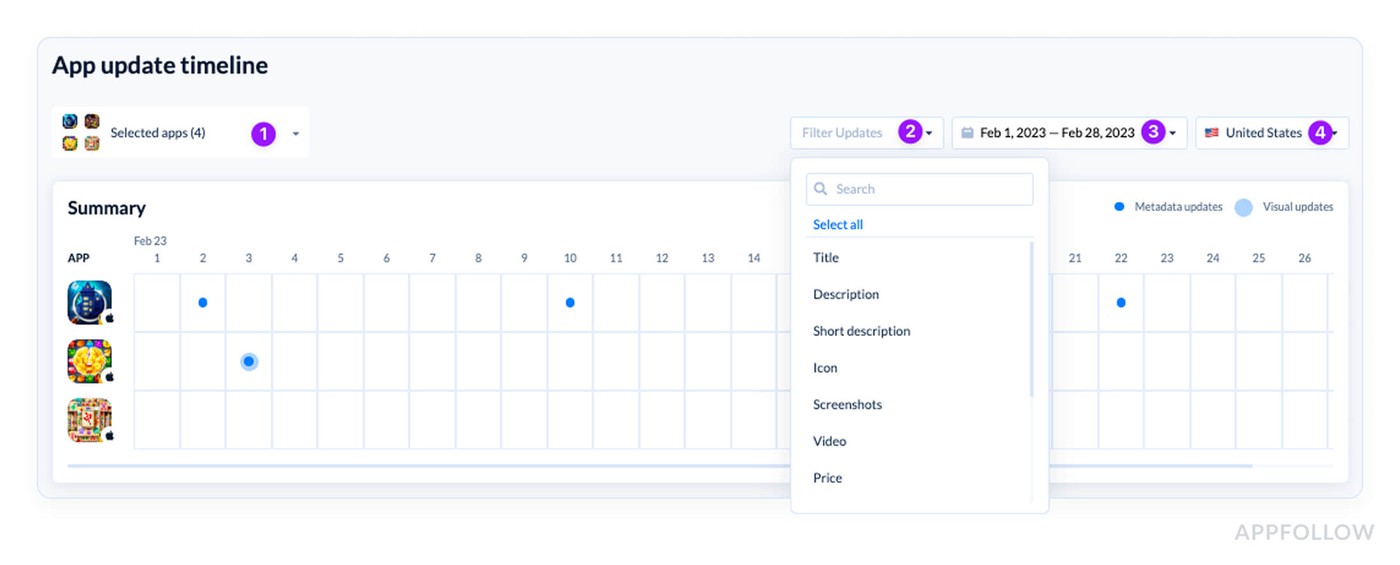
For comparison, AppFollow's App Update Timeline records changes to title, description, icon, screenshots, video, price, in-app purchases, category, and version, plus App Store featured stories, Google Play featuring, and in-app events.
The hardest thing to recreate in an ASO tool is a reliable, preserved record of what competitors did in the stores.
What does it take to turn an AI prototype into a working ASO tool?
It takes five layers of engineering work, and the dashboard everyone demos is the fifth.
Connect and normalize data sources
Store APIs, exports, third-party providers, and permissions all use different formats. Two ranking values that look alike may come from different devices, countries, or collection times, so they need normalizing before any comparison. Search results also differ by device, so an iPhone rank and an iPad rank for the same keyword are two separate numbers.
Build a collection and history pipeline
Rankings need scheduled collection, storage, rate-limit handling, retries, timestamps, and a backfill plan where backfills are possible. You also need a way to notice when observations go missing. When a store changes its result pages or rate limits, the collector needs a fix within days, or the history develops holes.
Add calculation and quality controls
The system has to catch stale snapshots, schema changes, missing markets, and metrics that don't match from one day to the next. An old ranking should never show up as today's value. Show the collection date next to every number, and mark a missing day as missing in charts and AI prompts alike.
Build dashboards, alerts and AI analysis
Once the inputs are dependable, add charts, commentary, recommendations, and scheduled reports. Keep three steps apart in your design: retrieving data, computing metrics, and interpreting results. An LLM is good at the third step and unreliable as a substitute for the first two. Give it the data-quality flags along with the numbers, so it can say "no data for Germany on Sunday" instead of inventing a trend.
Maintain the system after launch
Someone has to own broken connectors, expired credentials, data incidents, security reviews, LLM spending, and report accuracy for the whole life of the tool. Write the owner's name in the runbook before launch, because "the team" doesn't fix broken jobs at 6 a.m.
The first report is proof of working code. The fiftieth report, with complete data and no silent failures, is proof of a product.
How much does it cost to build and maintain an ASO tool with AI?
In our illustrative model, a small internal ASO tool costs about $32,825 over three years before any data licensing, and most of that money goes to monthly maintenance.
Development time is only the first expense
Start with the hourly rate. The BLS puts the median US software developer wage at $135,980 a year (May 2025). Its employer cost data shows wages at 70.0% of private-industry compensation in June 2026. Spread over 2,080 working hours, that gives a fully loaded cost of about $93.49 an hour. That's a modeled employer cost and won't match every market rate.
Agencies are the other route. Clutch's software development pricing guide (updated September 21, 2026) lists US and Polish development companies at $50 to $99 an hour. Ukrainian, Indian and Philippine companies come in at $25 to $49. These are published bands and say nothing about any one vendor's quality.
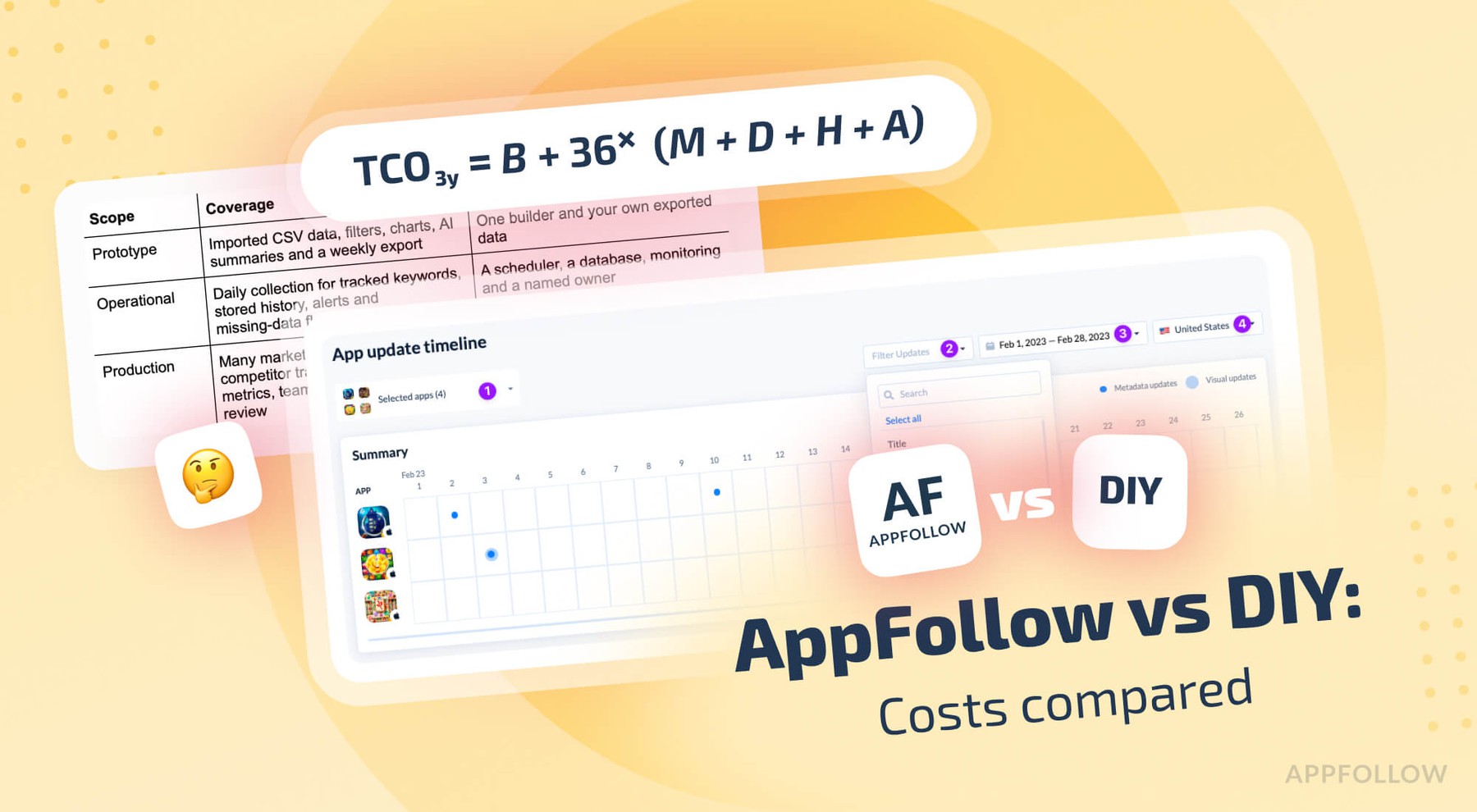
Calculate three-year total cost of ownership
The formula has five inputs:
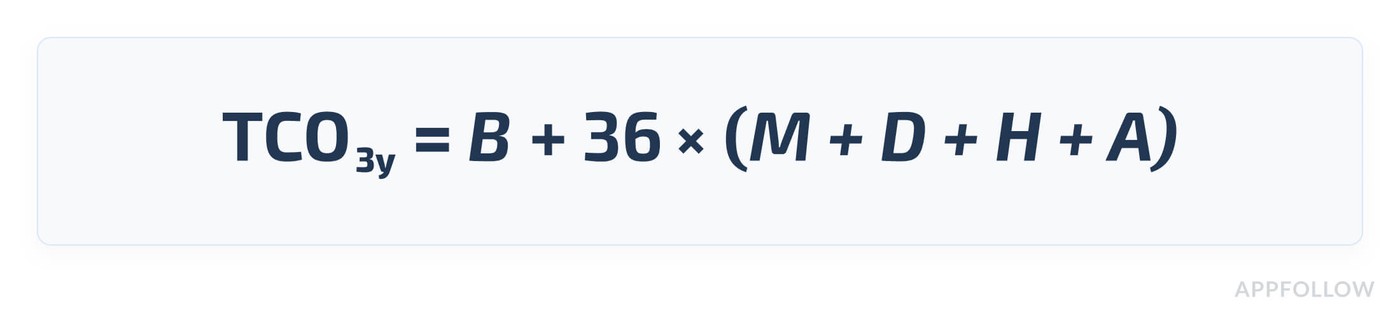
- B is the initial build labor, M monthly maintenance labor, D data licensing, H hosting, and A AI and API costs. Labor includes the first build, QA, and fixes. Data licensing covers purchased competitor or market data. Hosting covers storage, scheduled jobs, and monitoring. AI and API costs cover inference, paid endpoints, and the work of switching models when a provider retires an old version.
Keep opportunity cost out of the formula. It's the same labor hours seen from another angle, and counting it twice inflates the total. Two inputs often go missing from internal estimates. Data licensing can turn a cheap tool into an expensive one. Model changes call for fresh prompt and output checks every time a provider updates a model.
Our methodology: what's included in the three-year comparison
The AI model subscription is rarely the whole budget. In our three-year model, engineering maintenance repeats every month, while the first build is a one-time expense. We use 36 months because maintenance, hosting, and data costs repeat, and a one-year view shows only a third of that spending.
The inputs are hourly labor cost (BLS-based, $93.49), monthly maintenance hours, infrastructure, data licensing and AI or API spend. The hours and infrastructure figures are assumptions for illustration, and AppFollow plan prices come from its pricing page. This stays an illustrative model until engineers approve estimates for a specific scope.
An illustration of how small costs add up
Take a hypothetical internal ASO tool with a limited scope: 40 hours of initial development, 8 hours of maintenance a month, $93.49 an hour, and $60 a month for infrastructure, over 36 months.
Component | Cost |
Initial build (40 hours × $93.49) | $3,740 |
Maintenance (8 hours × 36 months × $93.49) | $26,925 |
Infrastructure ($60 × 36 months) | $2,160 |
Total | $32,825 |
The total leaves out competitor or market data licensing, extra paid APIs and AI inference, and any of those can change it a lot. It's an illustration, with no claim to be a verified price for a production ASO build.
Maintenance hours move the total more than anything else:
Monthly maintenance | 3-year labor cost |
1 hour | $3,366 |
4 hours | $13,463 |
8 hours | $26,925 |
12 hours | $40,388 |
At this US labor rate, every hour of monthly maintenance adds about $3,366 over three years.
The cost you don't see on your AI subscription invoice
A developer who maintains an internal ASO collector isn't shipping customer-facing features or running experiments during those hours. We won't put a revenue figure on that, because it depends on your roadmap. Ask a simpler question instead: what would this engineer have shipped without your ASO reporting infrastructure to look after?
Our build vs buy article on review management article runs the same cost model for review tooling. Its hour estimates apply to review management only and don't carry over to ASO.
In a DIY ASO tool, three years of monthly upkeep cost far more than the first build.
When does building your own ASO tool make sense?
Building makes sense when the scope is narrow, the data already exists inside your company, or the tool is part of your product.
You need a narrow workflow
An indie developer imports ranking exports and wants one weekly AI report for personal use. A script or a basic dashboard may be enough.
Your company already owns the data infrastructure
A large publisher with ingestion pipelines, a warehouse and internal BI pays little extra for a custom interface or analysis layer. Complete competitor intelligence is still a separate question for that team.
You're building a one-of-a-kind capability
The tool is part of your own product, strict governance rules require special handling, or no configurable tool or integration covers the workflow. For the wider picture beyond ASO, AppFollow's in-house solutions comparison covers the same decision for review management.
Build when the custom capability is your advantage, and remember that an internal interface can run on a licensed data source.
Can Claude or ChatGPT replace AppFollow?
Claude or ChatGPT can replace parts of an ASO workflow, especially custom dashboards, summaries, and repetitive reporting. On their own, they don't provide a complete, maintained record of competitor rankings or calibrated ASO metrics. The answer for your team depends on the data you already own, the history you need, and the people who will maintain the integrations.
Test the idea against three everyday requests:
Request | Where the data comes from | The AI's job | Who fixes missing inputs |
Competitor ranking movements over six months | A collector you ran for six months, or a provider with that history | Compares and summarizes stored positions | Your data owner or the provider |
Keyword difficulty in Germany | A calibrated scoring model on current market data | Explains and sorts the scores; without the model, any number is a guess | The team that maintains the model |
A dependable weekly report for five markets | Daily observations for every market | Writes the summary and flags anomalies | Whoever owns the pipeline |
AI tools can call licensed data sources, and a custom AI front end works well on reliable data. AppFollow, or another provider from our ASO tools comparison, can serve as the data source behind your AI front end.
AppFollow vs. building your own ASO tool: what's in each option?
AppFollow gives you collected ASO data, history, and scoring that its team maintains, within your plan's limits. A DIY tool gives you more freedom in the interface, along with the job of sourcing and keeping that data.
Capability | DIY with AI | AppFollow |
Basic ASO dashboard | Buildable with your existing data | Ready-made dashboards |
AI metadata ideas | Easy to prototype | Supported ASO workflows, including AI keyword recommendations |
Keyword rankings | Needs a ranking source and storage | Keyword Tracking with rank history |
Keyword popularity | Needs data access and a method | Keyword Popularity score |
Keyword difficulty | Needs market signals and calibrated scoring | Keyword Difficulty Score with 15+ parameters, current values only |
Competitor tracking | Needs ongoing observations | Competitor apps in Keyword Tracking, App Update Timeline and other tools, within plan limits |
Metadata changes | Needs listing collection and comparison | App Update Timeline |
Featuring and in-app events | Collection limits by store and market | App Update Timeline, with in-app events since Q3 2025 |
Historical data | Only records from your own collection, a license or another source | Depends on feature, source and plan |
Custom interface | Full flexibility | Dashboard, exports, API and MCP |
Ongoing maintenance | Your team owns the system | AppFollow maintains the platform |
AI workflows | You build the tool connections | AppFollow MCP and AI Toolkit |
Possible doesn't mean easy, and AppFollow doesn't cover every market data point. Its competitor apps documentation notes ongoing work to expand competitor support in the API and MCP.
Three approaches at a glance
Here's a short orientation across three dimensions:
Dimension | AI-coded DIY | AppFollow | AppFollow + MCP |
Main strength | Flexible custom workflows | Supported ASO data and ready-made analysis | Custom AI conversations on supported AppFollow data |
Data dependency | You source and validate it | Provider coverage and plan limits | Same coverage and plan limits as AppFollow |
Maintenance | You own the pipeline | AppFollow maintains the platform | AppFollow platform plus your workflow upkeep |
Full cost | Build, data and ongoing upkeep | Subscription within plan limits | Subscription, API credits and setup time |
The three-year cost model above shows where the balance shifts for your scope.
What about subscription cost?
AppFollow's pricing page lists these plans, before VAT (checked October 2026):
Plan | Billed yearly | Billed monthly | Apps | Tracked keywords | Competitors | 3 years, billed yearly |
Free | $0 | $0 | 2 | 500 | 10 | $0 |
ASO | $19 a month | $29 | 2 | 500 | 30 | $684 |
Essential | $129 a month | $179 a month | 5 | 3,000 | 100 | $4,644 |
Team | $425 a month | $599 a month | 10 | 9,000 | 250 | $15,300 |
Enterprise | Custom | Custom | By request | Custom | Custom | Quote |
Feature access differs by plan. Keyword difficulty, KEI, popularity history, App Update Timeline, and downloads from search start on the ASO plan. In-app event tracking starts on Essential, and the benchmark report on Team. API credits are 500 on Free and ASO and 1,000 on Essential and Team.
The three-year totals assume stable yearly prices for all 36 months, and future prices may differ. Before you compare a plan with a DIY build, check that it includes the keywords, competitors, history views, API or MCP calls, and other ASO functions on your list. For scale, the limited DIY illustration above reaches $32,825 before any data licensing, so match the scope before you compare the two numbers.
The smarter alternative: use AppFollow data with your own AI
Yes, you can connect your AI assistant to AppFollow instead of building an ASO platform. Buying maintained ASO data doesn't mean giving up AI, and an AI-first team has three ways to combine the two.
Option 1: use AppFollow's ready-made ASO tools
An ASO manager opens Keyword Tracking, picks Germany, and checks ranking changes for the tracked keywords. Difficulty and competitor positions show in the same view, and the App Update Timeline shows what the competitor changed in its listing. The team runs no collection pipeline of its own for that workflow.
Option 2: connect AppFollow MCP to your AI assistant
The AppFollow MCP Server lets compatible AI clients use your AppFollow data and tools through an authenticated account. Supported clients include Claude, ChatGPT, Codex, Cursor, and other MCP-compatible tools. Depending on your plan and permissions, the tools cover reviews, ratings, rankings, keywords, ASO data, and reports. The open-source AI Toolkit adds ready workflows such as /aso-analysis.
Setup needs an Owner or Admin role on the AppFollow account, a compatible client, enough API credits, and plan access to each method in your workflow. The MCP setup guide has the steps for each client, and ASO in Claude and MCP for app store optimization show more ASO workflows.
Here's the prompt for the test run:
"Review keyword ranking changes for my tracked app over the last 30 days in the US and Germany. Show the biggest gains and losses, compare available competitor rankings, and highlight opportunities worth investigating. Flag missing data rather than making assumptions."
Whatever the assistant returns, a person still checks whether missing data got flagged or guessed, and whether a ranking shift has a cause or only a nearby date.
Option 3: build custom AI workflows on the AppFollow API
The architecture looks like this: AppFollow data, then your own analysis and first-party acquisition metrics, then an AI summary, then your team's workflow.
For example, a publisher merges AppFollow keyword rankings with its own acquisition data in BI and asks an LLM to summarize the most important changes. The publisher builds the interpretation and keeps market data sourcing with AppFollow. API and MCP coverage can differ, and method availability depends on the plan and API credits.
cta_get_started_purple
An AI-first team can keep its own assistant and still use AppFollow as its ASO data source.
Should you build or buy an ASO tool? A practical decision framework
Build for narrow scopes and existing infrastructure, buy for continuous market data and history, and combine the two when you want your own AI analysis on maintained data.
Situation | Recommended approach | Reason |
One app, simple CSV reports | DIY or free tools | Narrow scope |
Existing warehouse and custom reporting | Build the analysis layer | Infrastructure already in place |
Competitor keywords across markets | AppFollow or another data provider | Needs continuous market collection |
Historical rankings and metadata | An established platform or a licensed historical source | AI can't reconstruct missing history |
Reports inside Claude or ChatGPT | AppFollow MCP plus your AI | Uses an existing data source |
Custom BI plus market intelligence | Hybrid | Reuse the data and customize the analysis |
Strict data residency or unique product needs | Evaluate DIY | Requirements may justify ownership |
A narrow tool may cost less to build, and for ongoing competitor intelligence and market history, dedicated infrastructure is usually the better deal. A hybrid setup keeps your AI in the picture.
Final verdict: build, buy or combine
Back to the opening demo. The interface was the easy part. The work that remains is keeping accurate, timely market data flowing into that interface.
- Build if the workflow is narrow or gives you an edge nobody can buy, and your team has hours for its upkeep.
- Buy if recurring competitor data, market metrics, and historical tracking are essential to your work.
- Combine if you want your own AI analysis without recreating market data infrastructure.
AI can help you build a useful ASO tool. That's no longer the hard part. The hard part is collecting the right market data, preserving its history, validating your metrics, and keeping everything running long after the first demo.
If what you want to customize is the analysis, there's a simpler option: use AppFollow's ASO data and bring your own AI workflow. You can try AppFollow for free on your own apps and competitors today.
Frequently asked questions
Can I build an ASO tool using ChatGPT, Claude, or Cursor?
Yes. AI coding agents can build dashboards, keyword workspaces, summaries, and report automation from data already in your hands. A competitive intelligence tool also needs ongoing collection, validated market metrics, and long-term storage, and those account for most of the cost.
Can AI track competitor keyword rankings without an ASO platform?
AI can interpret ranking observations once you provide a source. Something still has to collect or supply those observations every day, in every market and store on your list. Without that source, the AI has nothing to compare and can't recreate rankings for dates with no collection run.
Can AI calculate ASO keyword difficulty?
An LLM can propose a difficulty formula. A dependable score needs solid competitive data, validation, and calibration. AppFollow's Keyword Difficulty Score, for example, uses more than 15 parameters, including the strength of the apps in the Top 10 and keyword use in their titles.
What does it cost to build an ASO tool?
It depends on the first build, monthly maintenance, and any purchased data. Maintenance usually matters most: in our model, each monthly hour adds about $3,366 over three years at a US labor rate. The cost section above has the full three-year breakdown and sensitivity table.
Is it cheaper to build an ASO tool than subscribe to AppFollow?
It depends on scope, engineering rates, data access, and upkeep. A narrow tool can be cheap. Rebuilding competitor intelligence is a much larger project. Our three-year DIY scenario and plan comparison show the assumptions and the cases that change the verdict.
Can I use AppFollow with Claude or ChatGPT?
Yes. The AppFollow MCP Server connects compatible assistants, including Claude, ChatGPT, Codex, and Cursor, to your AppFollow tools and data. Access depends on your plan, an Owner or Admin role, and your API credits. The setup guide covers each client step by step.