Fake app reviews are tanking your app rating and nobody is catching them

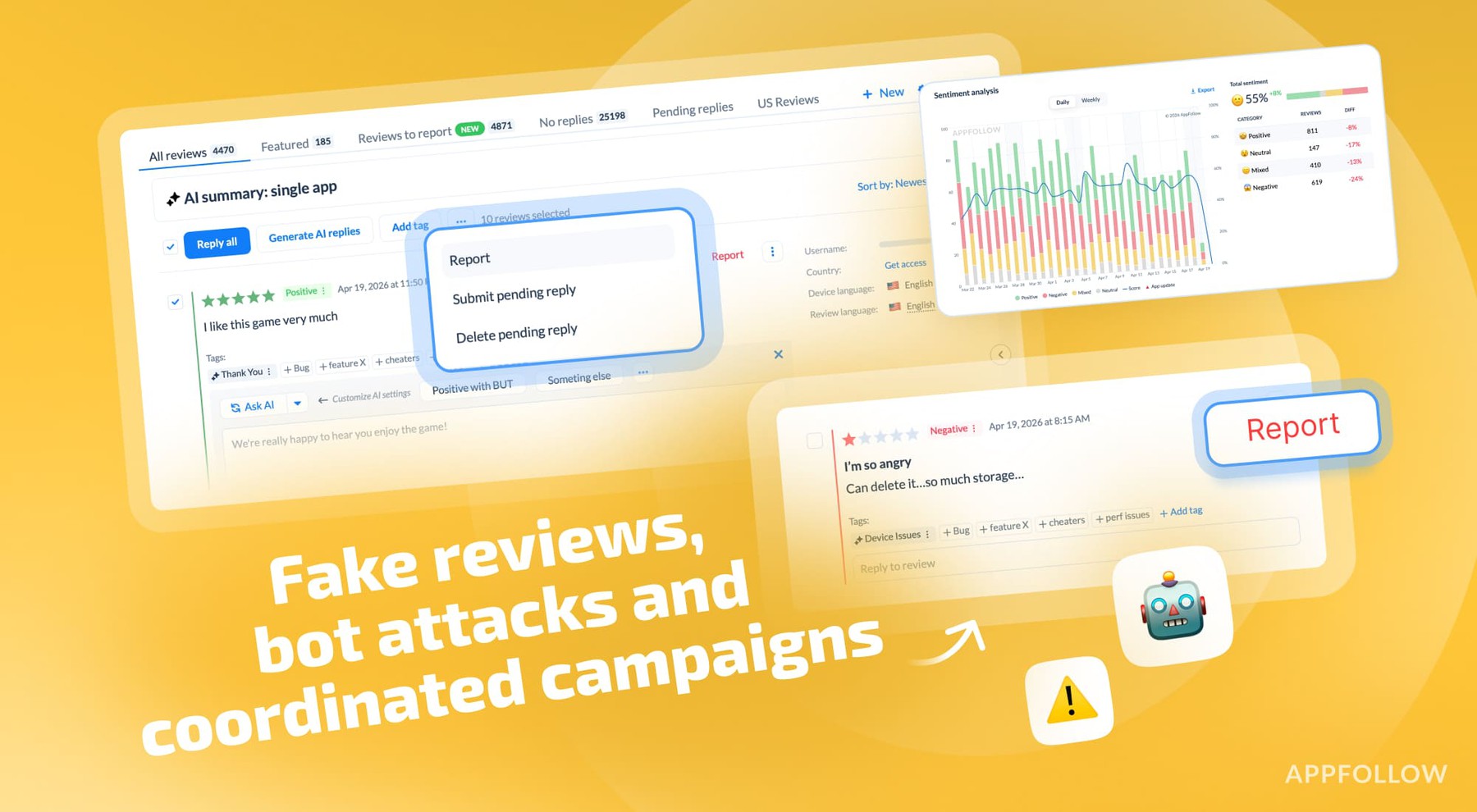
Table of Content:
- What fake reviews look like
- How detection works when you pay attention
- The damage adds up faster than you think
- How AppFollow catches this before it spirals
- Catching coordinated attacks early
- What good looks like
- Why manual approaches fail here
- Setting up detection that works
- You can't afford to ignore this anymore
- FAQ
Your game dropped from 4.6 stars to 3.9 in two days. Engineering swears they didn't push anything broken. You checked the reviews and saw 200 one-star ratings that all sounded vaguely similar, posted within six hours, from accounts with zero review history. You just got hit with fake reviews!
They come in different flavors.
Bot spam floods your ratings with generic garbage, coordinated attacks from competitors or trolls will bury you in negative sentiment, and review farms pump out paid fakes that look almost real until you start checking the patterns.
The app stores catch some of it but plenty slips through and sits there dragging down your rating while you're bleeding downloads.
The bots got smarter, writing reviews that sound human, spacing out their posts to avoid detection, using real-sounding account names. The old tricks for spotting fakes don't work as well anymore. So what do you do?
What fake reviews look like
Bot spam is easiest to spot.
Generic language like "terrible app" or "do not download" with no specific details. Real players will mention level 47 being impossible or the energy system being too restrictive. Bots say "worst game ever" and that's it.
The writing feels slightly off. Weird syntax, stuff that repeats, grammatical mistakes. The same review shows up from different accounts with minor word changes. "This game is horrible" becomes "This is a horrible game" becomes "Horrible game do not install." Same complaint, shuffled words, different bot.
Coordinated attacks are different in a way: a competitor pays a review farm, or a Discord server decides to tank your game for laughs. Some controversy spills over into your app reviews when your game has nothing to do with it. Suddenly there's 50 to 200 negative reviews in a tight window making similar complaints.
Review bombing campaigns usually happen within 24 hours. The reviews mentioned external issues rather than gameplay. "Developer supports X political position" instead of "matchmaking takes too long." The accounts had minimal history. They wrote one review for your game and nothing else.
How detection works when you pay attention
Bots struggled with natural language variance; real humans will use different words for the same complaint. Bots recycle phrases. If 15 reviews said "crashes on startup" using identical phrasing, someone copy-pasted that or a bot generated it.
"Crashes when I try to buy premium currency on my Samsung Galaxy S23" versus "app crashes." One came from a player who hit a real bug. The other might be fake.
A spike after a bad update makes sense. A spike with no corresponding update does not. If reviews jumped from 20 per day to 200 and nothing changed, something is wrong. Check when accounts were created. New accounts posting immediately are suspicious.
Algorithms analyze review volume, sentiment distribution, account age, posting frequency, device fingerprints. They spotted review clusters from the same IP ranges or data centers, and identified bot networks posting across multiple apps.
The damage adds up faster than you think
App store algorithms used ratings for search visibility. Lower ratings meant lower rankings which meant fewer organic installs. You're paying more for user acquisition to make up for lost downloads. The fake reviews cost you in ad spend even after removal because your rating takes time to recover and that's a pain in the neck.
Going from 4.2 to 4.0 stars can mean a 20 percent drop in downloads. A coordinated attack that tanks your rating from 4.6 to 3.9 could cut installs in half until you fix it. Recovery takes weeks or months. You report fakes, the stores investigate, maybe they'll remove 60 percent. Your rating climbs back slowly. You lost thousands of potential players who saw your rating while it was tanked.
How AppFollow catches this before it spirals
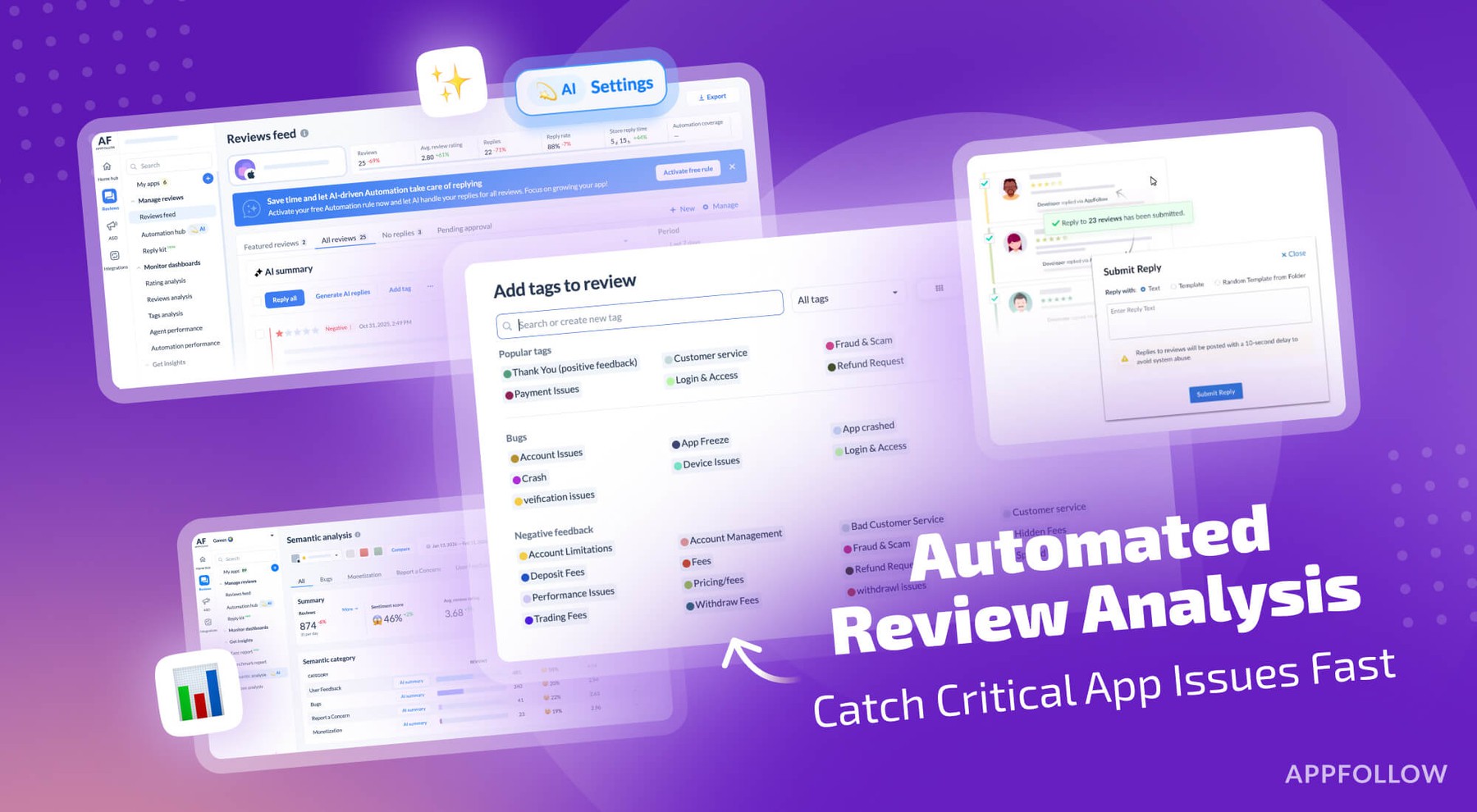
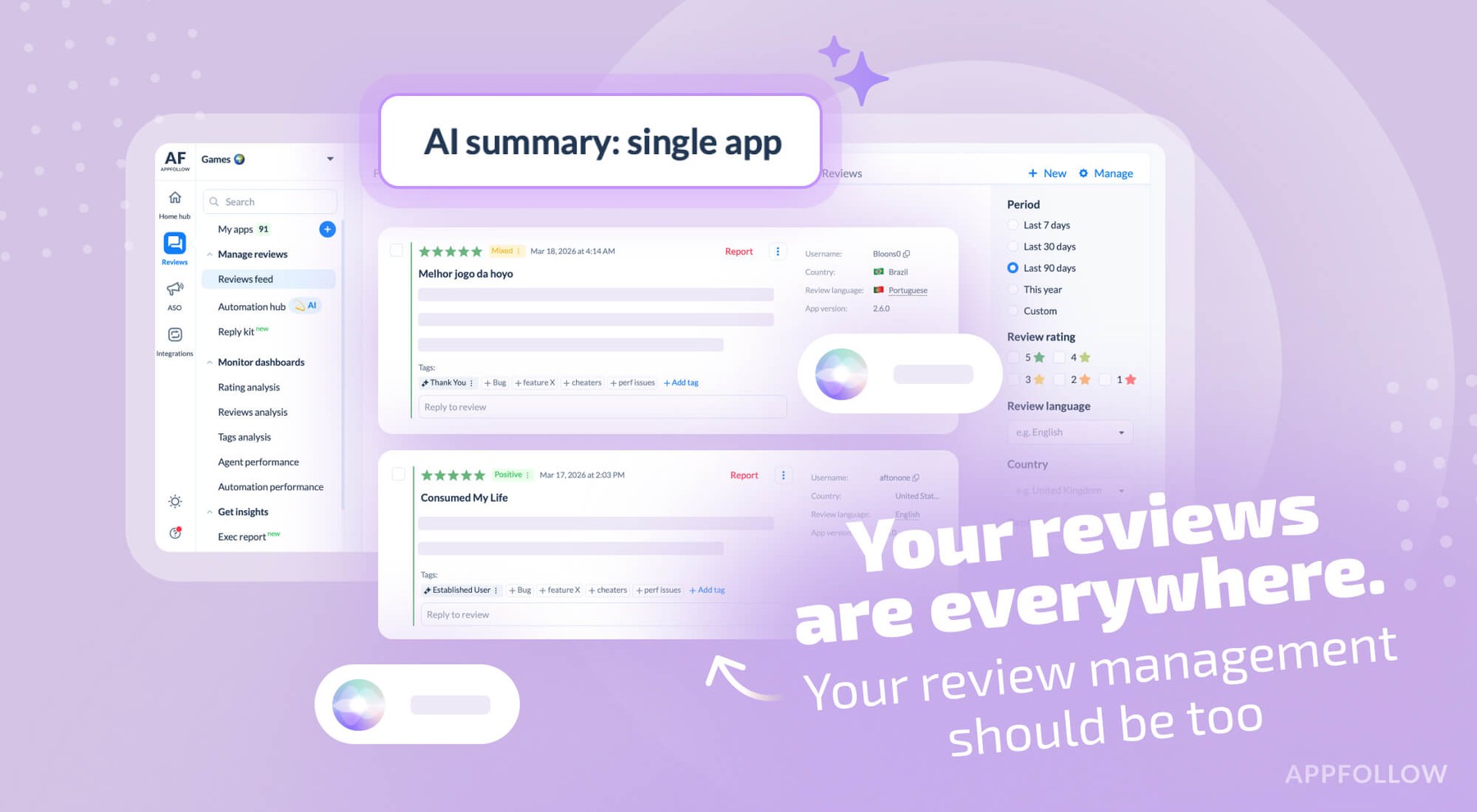
AI summaries let you spot patterns in seconds. No more reading hundreds of reviews manually. You pull up the last 200 reviews and generate a summary. It's going to tell you that 80 reviews mention login failures, 45 complain about energy systems, 30 praise new characters, and 25 look like generic spam with no specific complaints. You'll know immediately which reviews deserve investigation.
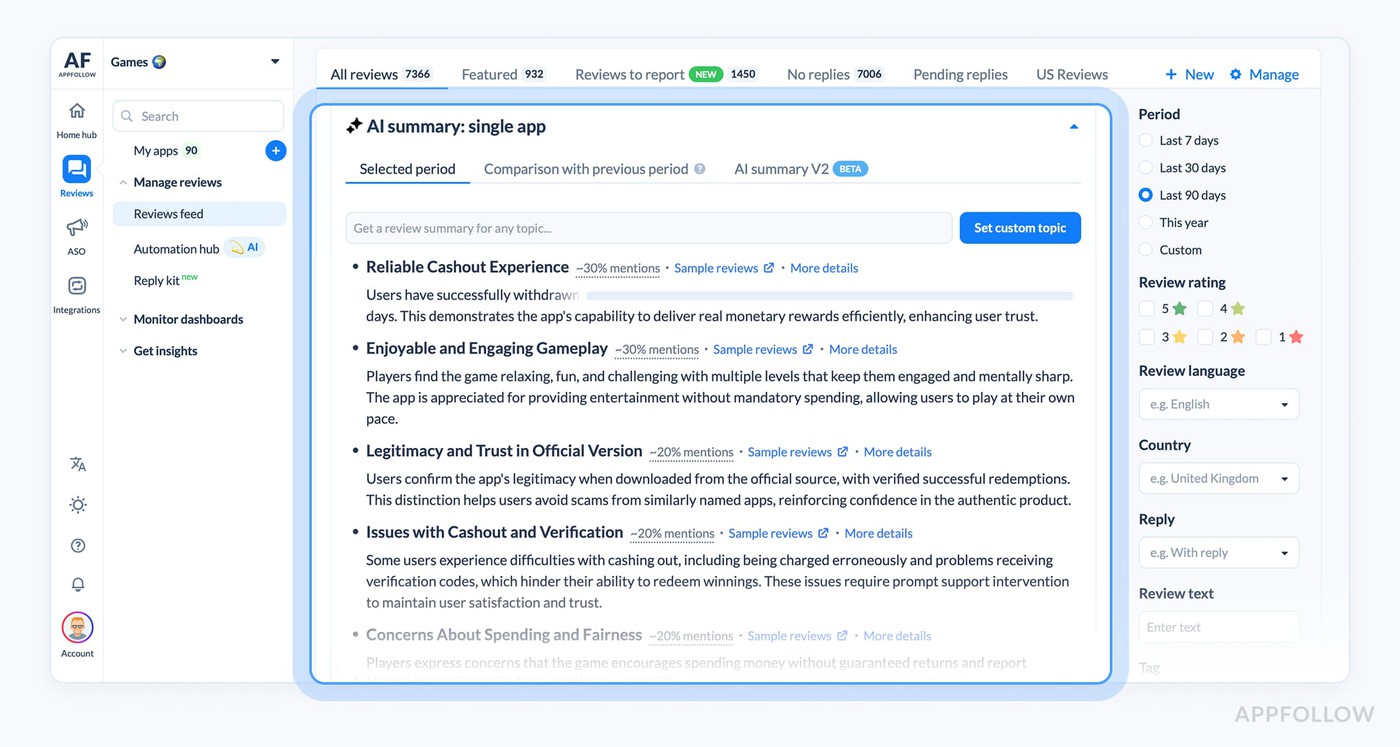
Semantic analysis goes deeper than keyword matching. It understands that "this game is killer" and "this game kills my battery" both contain "kill" but mean completely different things. It caught context and sentiment, not just words.
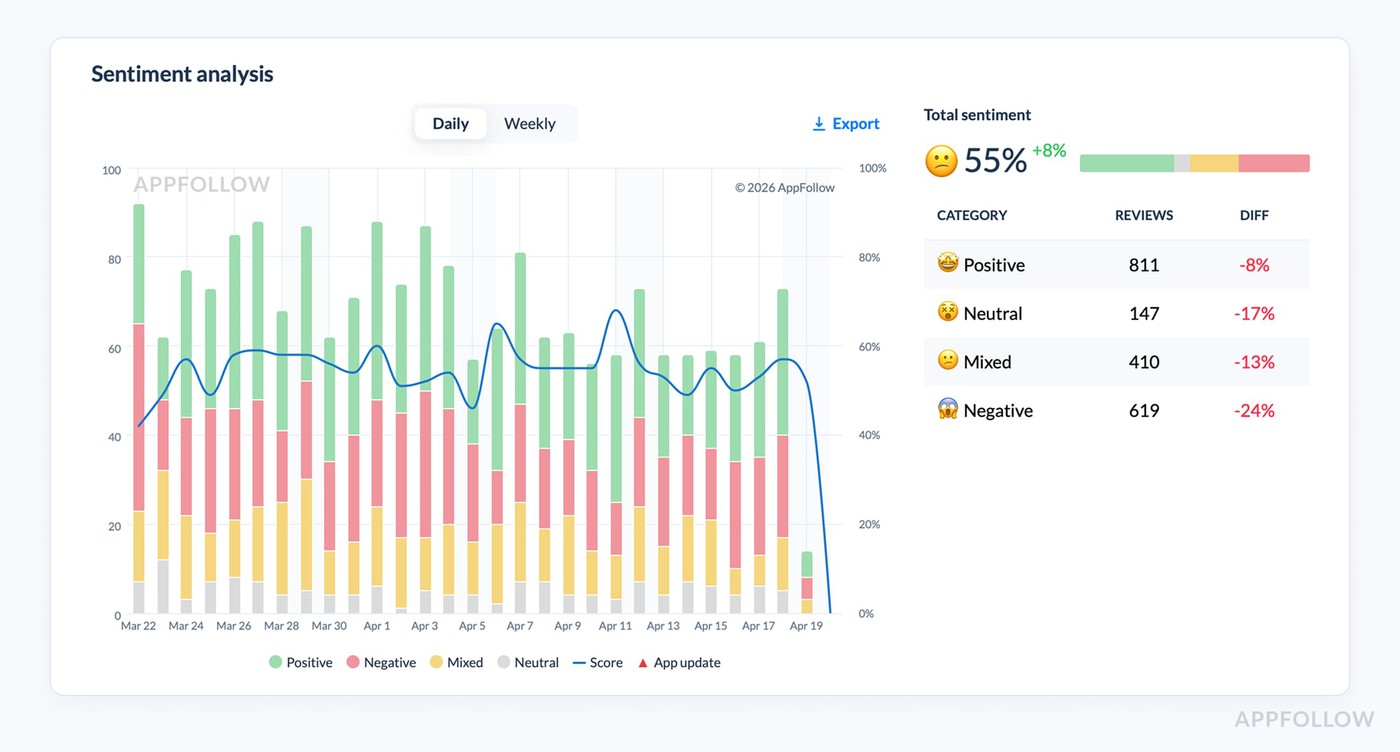
Auto-tagging categorizes everything as it comes in. Reviews get tagged as bugs, crashes, payment issues, feature requests, monetization complaints, positive feedback, or spam. When you suddenly had 100 reviews tagged as spam in six hours, you knew something was wrong.
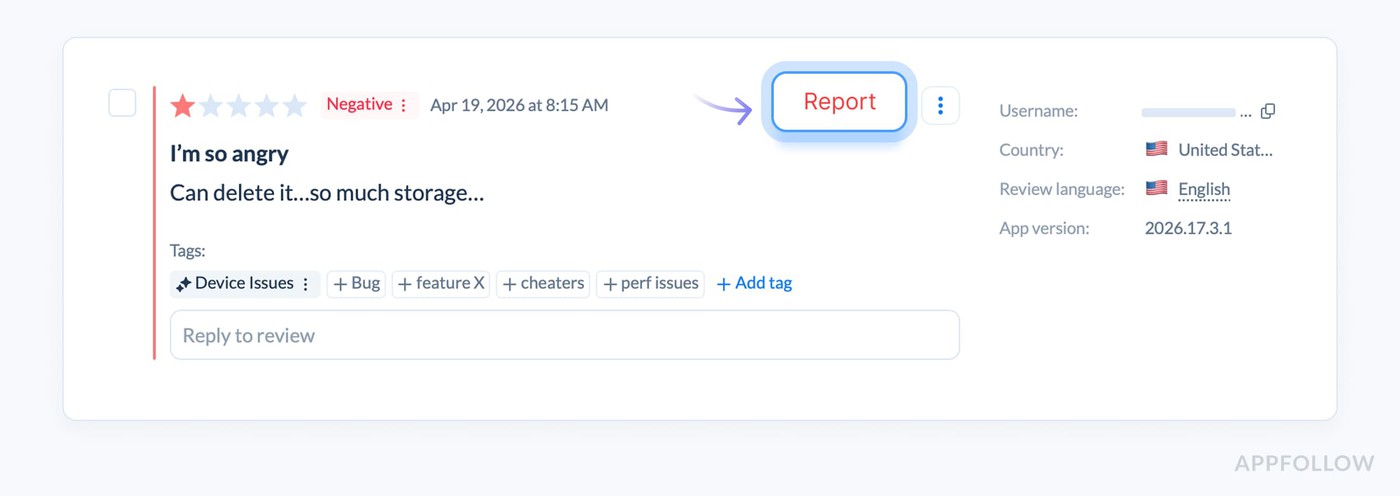
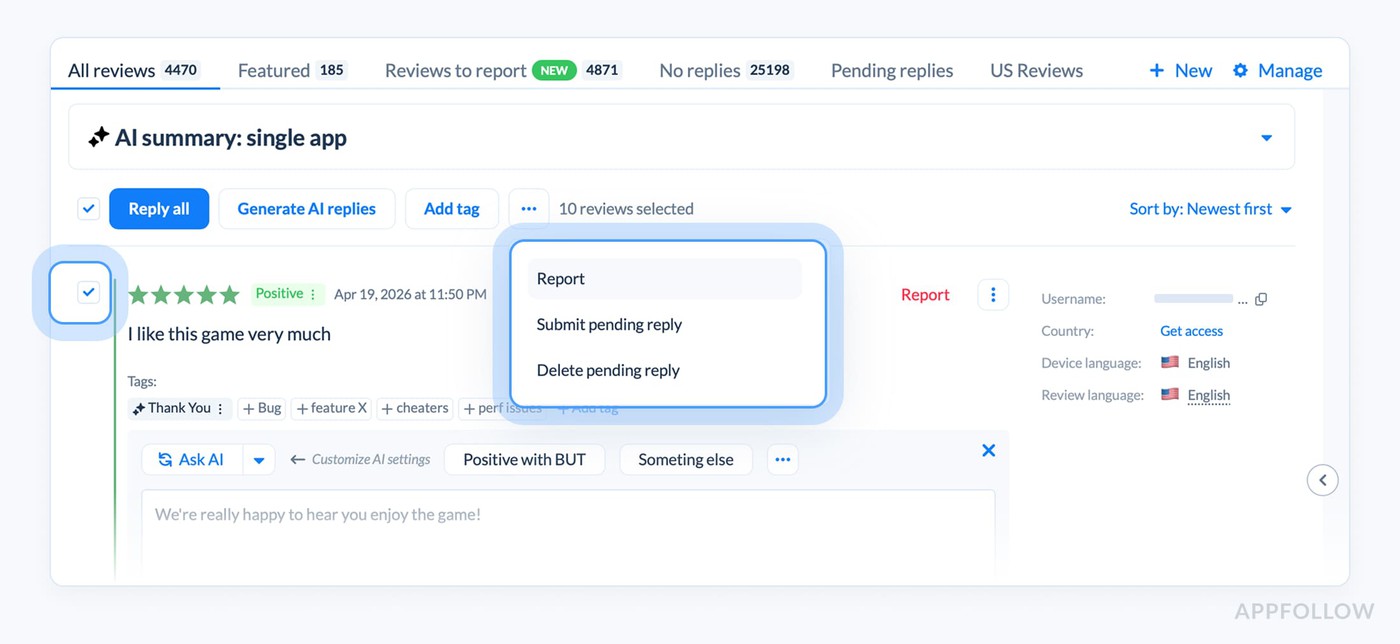
The spam tags feed directly into the report-a-concern workflow. Instead of manually reporting each fake review one by one, you filtered by the spam tag, selected all suspicious reviews, and bulk reported them from AppFollow. The system sends reports to the app stores and tracks the status.
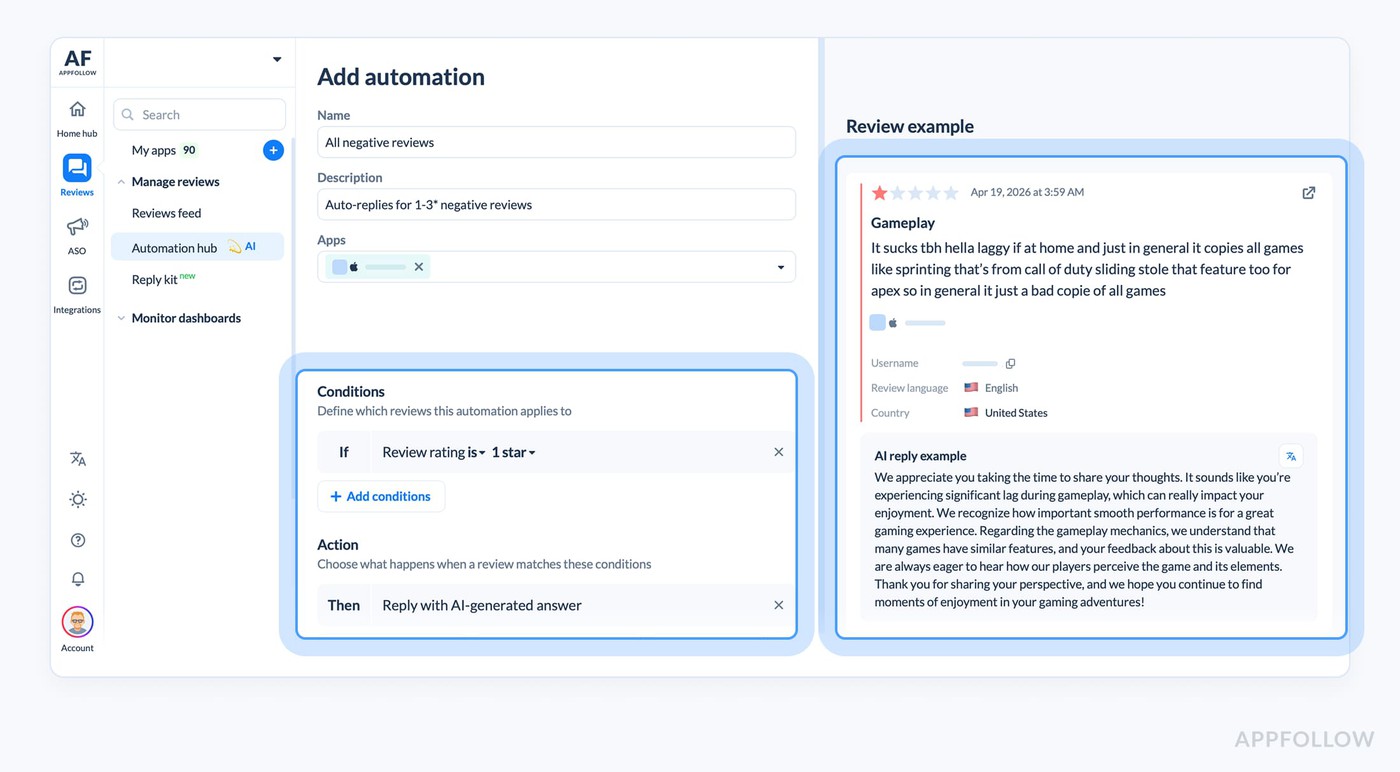
Bulk replies let you respond to legitimate concerns while fakes get reported. Auto-replies handle routine stuff while you're focusing on the attack. Someone writes a real bug report and gets an automatic response asking for device details. Someone writes generic spam and it gets flagged for review.
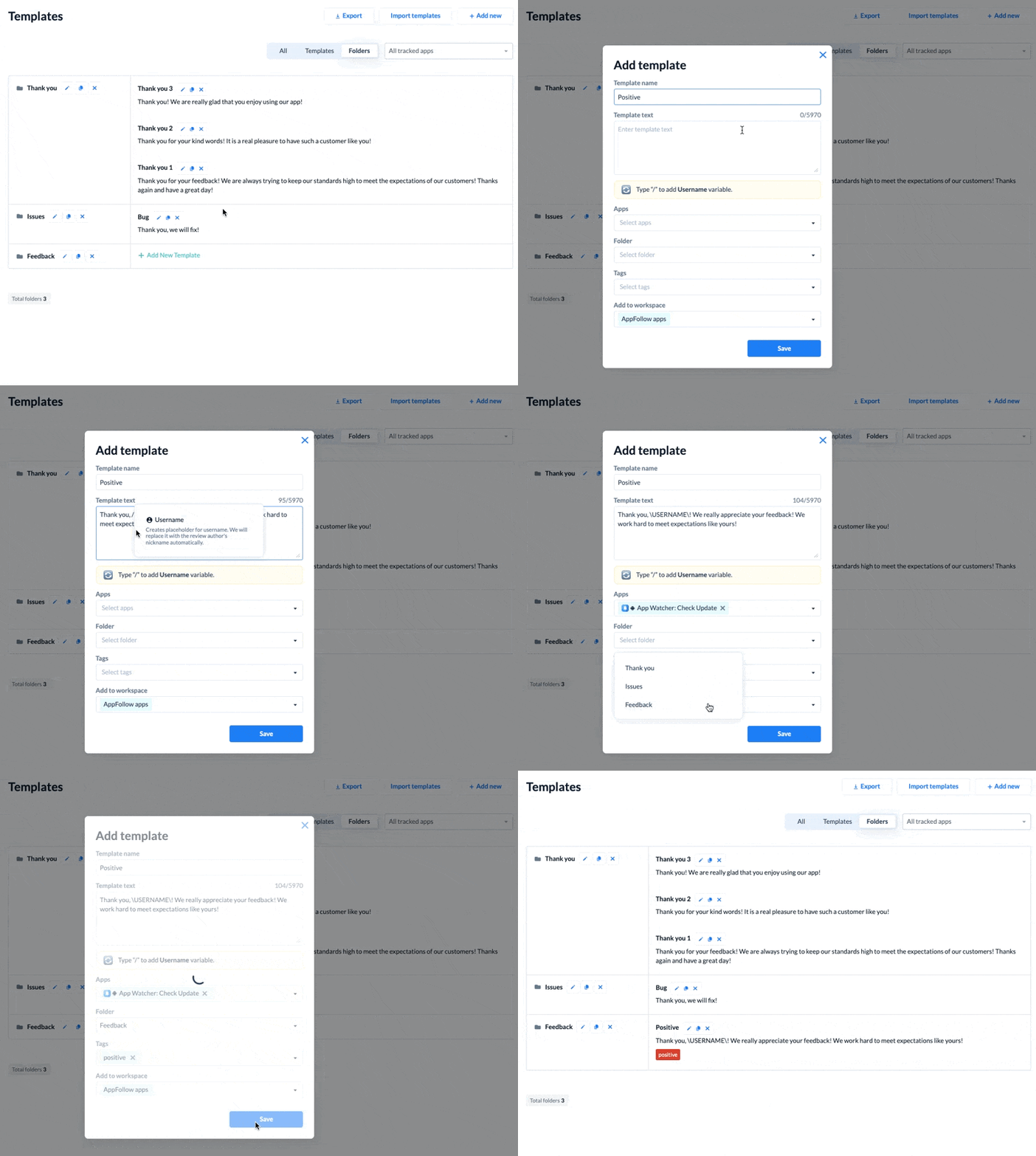
Review templates with AI variations prevent responses from looking copy-pasted even when handling volume. The system takes your template, adapts it to the specific review content, and generates a unique response.
Catching coordinated attacks early
The key is noticing the spike before it does too much damage. AppFollow alerts will notify you when review volume jumps above thresholds. You set a rule for "alert me if negative reviews exceed 20 per hour" and you're getting notified immediately when an attack starts. No more finding out three days later.
Pattern matching across time windows helps. Compare this week's review distribution to last week. Normally, you got 60 percent five-star, 20 percent four-star, 10 percent three-star, 8 percent two-star, 2 percent one-star. Suddenly you have 40 percent one-star.
Pull up all one-star reviews from accounts created in the last week. If there are 50 and your normal baseline is 5, someone is running bots. You can report all of these at once. Kick the tires on the data before you assume it's legit.
The report-a-concern feature tracks removal rates. You reported 100 suspicious reviews, and the stores removed 65. Your removal rate is 65 percent which tells you that you were flagging the right stuff. If your removal rate is 10 percent, you might be reporting legitimate reviews by mistake.
What good looks like
You get hit with 150 fake reviews over eight hours. AppFollow alerts you within the first hour because negative review volume spiked. You generate an AI summary and see that 120 use generic language with no specific complaints. You filter by spam tags and see the cluster clearly.
You then bulk-select suspicious reviews and report them to App Store and Google Play from AppFollow. You set up auto-replies for remaining legitimate negative reviews. Within 12 hours you contained the attack and your team is focused on real feedback.
The app stores start removing fakes over the next few days. Your removal rate is 70 percent which confirms your pattern detection was solid. Your rating climbs back up. Total time to recovery is about two weeks because you caught it early. Without early detection, you're looking at..much longer than that.
Why manual approaches fail here
Reading reviews one by one to spot fakes is impossible at any real volume. If you get 500 reviews per day, spending 30 seconds per review means 4 hours of work daily just for detection.
Reporting reviews individually through app store consoles is slow. Find a fake, open the console, navigate to the review, click report, fill out the reason, submit. That is 2 to 3 minutes per review. Reporting 100 fakes takes 4 hours.
Without pattern detection tools you rely on gut feeling. "This review seems fake" is not reliable when bots use AI to write natural text. You need data on account age, posting patterns, linguistic markers, and timing. The lag time kills you. By the time someone notices the attack and starts reporting reviews one by one, days will pass.
Setting up detection that works
Configure alerts for abnormal review spikes. Set thresholds based on your normal volume. If you get 50 reviews per day, alert at 100. The exact number matters less than having a tripwire that catches unusual activity early.
Enable auto-tagging for spam detection. Let the system categorize reviews as they come in. When spam-tagged reviews jump from 5 per day to 50, investigate immediately. This gives you early warning before the attack is obvious in your rating.
Use AI summaries weekly at minimum. Generate summaries to see what themes are showing up. This helps you spot subtle shifts before they become critical. Five minutes per week catches problems that might take days to notice otherwise.
Set up the report-a-concern integration with your app store accounts before you need it. Trying to set up integrations during a crisis wastes time. Train your team on fake review patterns. Show them examples of bot language, coordinated attack timing, review farm accounts. The more people who know what to look for, the faster you catch attacks.
You can't afford to ignore this anymore
Fake reviews directly affect your revenue by tanking your rating, hurting your search ranking, and scaring away potential players. The longer they sit there, the more damage they do. Teams that treat fake review detection as optional will end up scrambling to recover from attacks they could have stopped early.
The tools exist to catch this stuff before it spirals. AI pattern detection, automated reporting, bulk workflows. You're either setting these up and monitoring them or you're accepting that fake reviews will periodically crater your rating and cost you thousands in lost downloads.
Most teams only started paying attention after they got hit hard. Set up detection now while your rating is healthy so you'll catch the next attack in the first hour.
cta_get_started_purple
FAQ
How can you tell if app reviews are fake?
Fake reviews show patterns like generic language without specific details, accounts with no review history, reviews posted in tight time windows, identical phrasing across multiple reviews, and complaints that don't match your game features. AI detection tools analyze these patterns plus metadata like account age and IP addresses to identify fakes that humans might miss.
What is review bombing and how do you stop it?
Review bombing is when coordinated groups flood your app with negative reviews in a short time window, often unrelated to gameplay. It happens from competitor sabotage, political backlash, or organized campaigns. Stop it by detecting the spike early with alerts, bulk reporting fake reviews to app stores, and using AI summaries to distinguish real feedback from coordinated attacks.
Can app stores detect and remove fake reviews automatically?
App stores catch some fake reviews automatically but a lot slip through. Apple and Google use detection algorithms but sophisticated fakes written by AI often pass initial screening. Developers need to report suspicious reviews. Removal rates typically range from 60 to 80 percent for clearly fake reviews.
How does AppFollow help detect fake reviews?
AppFollow uses AI summaries to show review themes in seconds, auto-tagging to categorize spam, semantic analysis to understand context beyond keywords, alerts for abnormal review volume spikes, and report-a-concern features that let teams bulk report suspicious reviews to app stores from one dashboard. This catches attacks early and speeds up the removal process.