

What is ranking history?
Table of Content:
Ranking history shows how an app’s position in app store search results, category charts, or keyword rankings changes over time. In ASO, teams use it to see when visibility improved, when it dropped, and what may have caused the movement.
For example, your app may rank #4 for “cheap flights” on Monday, fall to #17 after a competitor update, then climb back to #6 after your metadata or conversion rate improves.
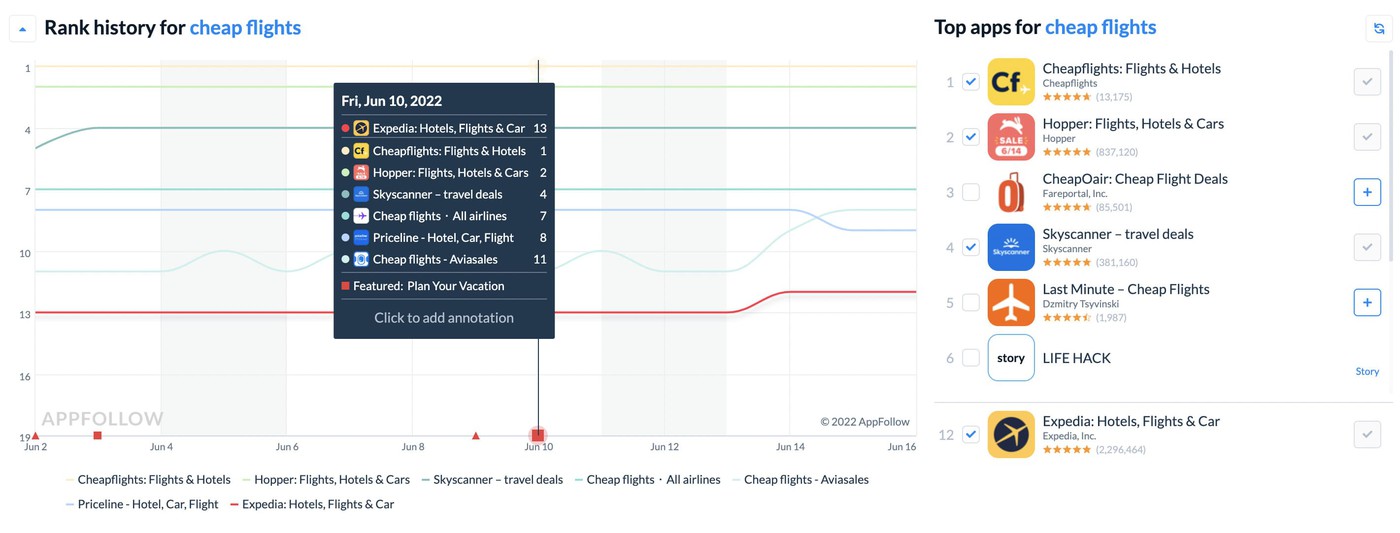
That movement is your ranking history.
A single ranking position tells you where the app is today. App ranking history shows how your visibility got there.
Why ranking history matters
App store visibility is too competitive to manage from screenshots and one-off ranking checks.
In 2026, users were still downloading apps at massive scale across the App Store and Google Play, but discovery became harder. More apps compete for the same search terms, more teams run paid campaigns to influence early traction, and store listings are tested more aggressively with icons, screenshots, previews, and localized assets.
That makes ranking history useful for one very practical reason: it separates signal from noise.
- If a keyword moves from #12 to #10 for one day, that may mean nothing.
- If it moves from #27 to #9 and holds for two weeks after a metadata update, that is a real ASO signal.
- If your app drops from #6 to #23 in one market while a competitor climbs at the same time, you need to know when it started, not just where you rank today.
Ranking history helps app developers, publishers, and marketers answer questions that directly affect installs:
- Did our metadata update improve keyword visibility?
- Did our screenshot test improve conversion enough to support ranking growth?
- Did a competitor take our position after changing its title, subtitle, or creatives?
- Are we losing visibility in one country or across several locales?
- Is this ranking spike stable, seasonal, or campaign-driven?
- Which keywords are worth defending because they already bring visibility?
Without historical ranking data, ASO reporting becomes reactive. Someone notices installs dropped. Then the team tries to reconstruct what happened. Ranking history gives you the timeline before the damage is buried inside blended traffic reports.
Ranking history vs. app ranking history
Term | What it tracks | Best used for | Example |
Ranking history | Ranking movement over time for a keyword, category, or app position | Understanding visibility trends | “The app moved from #18 to #7 for ‘budget planner’ over 30 days.” |
App ranking history | Historical ranking data for one app across keywords, categories, countries, and stores | ASO analysis, reporting, competitor comparison | “The app gained visibility in Spain but lost rankings in the US.” |
Keyword ranking history | Position changes for specific search terms | Measuring metadata and keyword strategy | “The app improved for ‘meal planner’ after updating the subtitle.” |
Category ranking history | Movement in app store category charts | Tracking broader market performance | “The app entered the top 20 in Health & Fitness.” |
Competitor ranking history | Ranking changes for competing apps | Finding competitive pressure and market shifts | “A competitor climbed after launching new screenshots and paid traffic.” |
Current ranking gives you a snapshot.
Ranking history gives you the pattern.
App ranking history gives you the operating context.
That context matters because ASO is rarely changed by one factor. Rankings can move because of metadata, conversion rate, reviews, ratings, paid campaigns, localization, competitor activity, seasonality, or store-side changes.
How app ranking history works
App ranking history is usually tracked by monitoring selected keywords, categories, countries, and competitors over time.
A practical ASO workflow looks like this:
- Choose the keywords that matter for acquisition.
- Track your app’s position for each keyword by country and store.
- Monitor ranking changes daily or weekly.
- Mark important ASO events, such as metadata updates, screenshot changes, app releases, campaigns, or localization launches.
- Compare your ranking movement against competitors.
- Decide which keywords, markets, or listing assets need attention.
For example, a fitness app may track “home workout,” “step counter,” and “calorie tracker” across the US, UK, Germany, and France.
If rankings improve in Germany after localized metadata goes live, that is worth investigating. If rankings fall in the US while a competitor climbs, the ASO team can check whether that competitor changed its title, screenshots, rating score, or acquisition push.
That is where ranking history becomes useful. It turns app store visibility into a timeline you can actually analyze.
App ranking history example
Let’s say a language learning app tracks the keyword “learn Spanish.”
In March, the app ranks #24.
After a title and subtitle update, it moves to #14.
Two weeks later, new screenshots go live and the app reaches #9.
Then a large competitor starts a campaign and the app drops to #16.
A basic ranking report shows today’s #16 position.
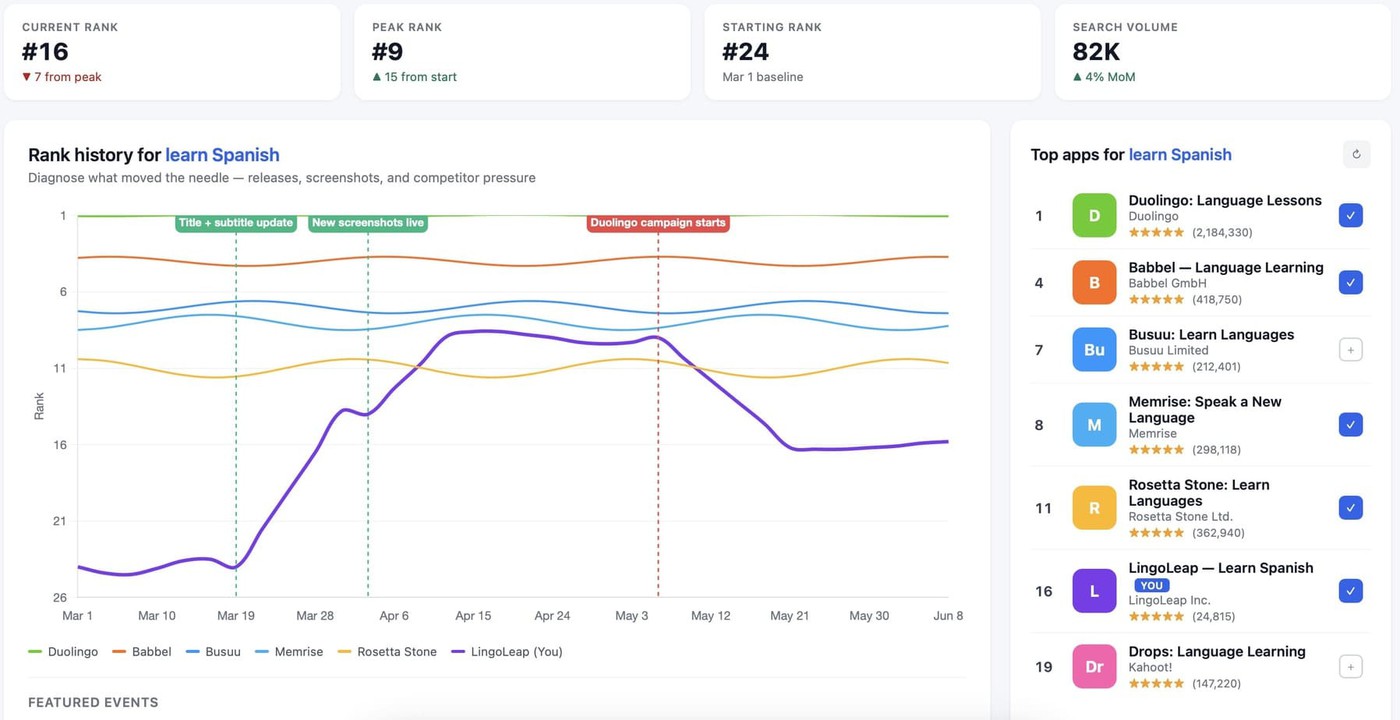
App ranking history shows the full story: which changes helped, where the app gained traction, and when competitive pressure started affecting visibility.
That is the difference between reporting and diagnosis.
What can affect app ranking history?
- Metadata changes. App title, subtitle, short description, long description, and keyword fields can influence search visibility. A strong metadata update can improve rankings for relevant terms. A weak one can remove important ranking signals or spread relevance too thin.
- Conversion rate. If users see your app in search results but do not install it, ranking growth may stall. Icons, screenshots, videos, ratings, and reviews all affect the decision before the install.
- Ratings and reviews. A lower rating score can hurt trust before users even open the product page. Review velocity, review sentiment, and rating changes can also explain why rankings move differently across countries.
- Competitor movement. Your app may lose positions even when your own listing stayed the same. A competitor may have updated metadata, improved creatives, launched paid traffic, received featuring, or gained stronger user engagement signals.
- Localization. Ranking history often looks different by market. A keyword that works in the US may not behave the same way in Germany, Spain, Brazil, or Japan. Localized metadata and screenshots can shift visibility country by country.
- Seasonality. Some ranking changes follow demand. Fitness apps often move around New Year. Travel apps may rise before holidays. Education apps may change before school periods. Without historical data, seasonal lifts can look like ASO wins when they are really market timing.
How to use ranking history in ASO
Ranking history is most useful when it is tied to decisions.
Use it to:
- validate metadata updates
- catch keyword drops before they affect installs
- compare your movement against competitors
- find markets where localization is working
- separate temporary spikes from stable growth
- identify keywords worth defending
- understand whether conversion work is supporting visibility
Do not react to every small movement. App rankings shift constantly.
The useful question is not “Did we move today?”
The useful question is “Did the movement hold, and what changed around it?”
Related terms
Keyword Effectiveness Index (KEI)
App Store Visibility
App Visibility
What is App Store Browse?
FAQs
What is ranking history in app stores?
Ranking history is the record of how an app’s position changes over time in search results, keyword rankings, or category charts. It helps app marketers and developers understand whether visibility is improving, declining, or reacting to metadata updates, competitor moves, reviews, seasonality, or conversion changes.
What is app ranking history?
App ranking history shows how an app’s rankings have changed across keywords, categories, countries, and stores over a selected period. Teams use it to analyze visibility trends, measure ASO impact, compare competitors, and catch ranking drops before they become install problems.
Why is ranking history important for ASO?
Ranking history helps ASO teams connect ranking movement with real changes: metadata updates, screenshot tests, localization, reviews, ratings, competitor campaigns, or store algorithm shifts. Without historical data, teams only see today’s position and miss the timeline behind visibility gains or losses.
How often should app ranking history be checked?
Most teams should review app ranking history weekly, with closer monitoring after metadata updates, app releases, campaigns, competitor changes, or localization launches. Daily checks help during active ASO tests, but weekly trend analysis is better for avoiding overreaction to normal ranking noise.
What causes app ranking history to change?
App ranking history can change because of metadata updates, conversion rate shifts, ratings and reviews, competitor activity, paid acquisition, localization, featuring, seasonality, or app store algorithm changes. Strong analysis compares ranking movement with several signals instead of blaming one metric.
How can I track app ranking history?
You can track app ranking history with an ASO platform that monitors keyword rankings, category positions, countries, app stores, and competitors over time. AppFollow helps teams see ranking trends in one place and connect visibility changes with ASO work, reviews, ratings, and competitor movement.
