

App Store Visibility
Table of Content:
- What is App Store visibility?
- Where App Store visibility happens (the five iOS surfaces)
- How App Store visibility is measured
- The main drivers of App Store visibility
- App Store visibility vs. Google Play visibility
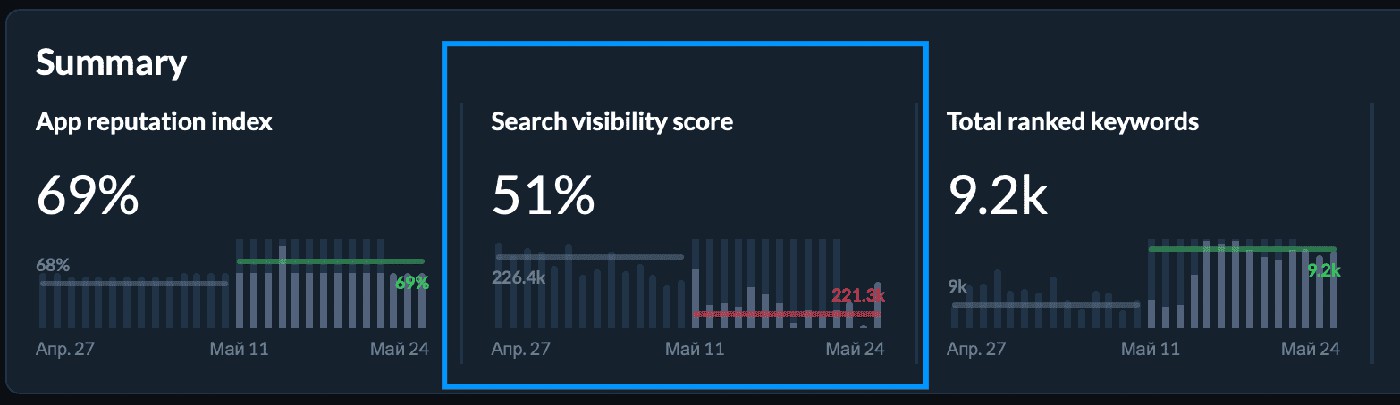
- How AppFollow measures App Store visibility
- Frequently asked questions
- Related glossary terms
App Store visibility is the degree to which an app can be seen by potential users inside Apple's App Store — across search, the Today tab, Top Charts, category browse and Apple Search Ads. It is the leading indicator of every iOS install funnel: no impression on any of those surfaces, no install.
App Store Optimization (ASO) teams measure App Store visibility as a single composite score and use it as the top-line health metric for the iOS storefront.
What is App Store visibility?
App Store visibility is the practical answer to one question on iOS: how many of the right people can actually see your app inside Apple's App Store? It is not the same as a single keyword ranking (one coordinate) and not the same as impressions (a confirmation that someone saw you).
App Store visibility is the cumulative result of where your app appears across every Apple App Store surface, how often, and how relevantly.
Because every iOS install starts with an impression and every impression starts with visibility, ASO teams treat App Store visibility as their leading growth indicator.
ASO platforms like AppFollow report a 0–100 App Store visibility score for any tracked iOS app, which makes the concept measurable and trackable like any other product metric.
Where App Store visibility happens (the five iOS surfaces)
Apple's App Store is not one place — it is five distinct surfaces, each with its own ranking logic and conversion behavior. App Store visibility is the sum of presence across all of them.
App Store Search
App Store Search is the largest single surface in iOS: roughly 65% of organic App Store installs originate in search results. App Store visibility here is the product of keyword relevance (does your title, subtitle and keyword field match the query?) and ranking position (do you appear in the first five results?).
Most ASO investment is concentrated on this surface because the return is the highest.
Today tab and editorial featuring
The Today tab is Apple's curated front page — Stories, App of the Day, Game of the Day, themed collections. Editorial selection is human, not algorithmic, and cannot be optimized for like search.
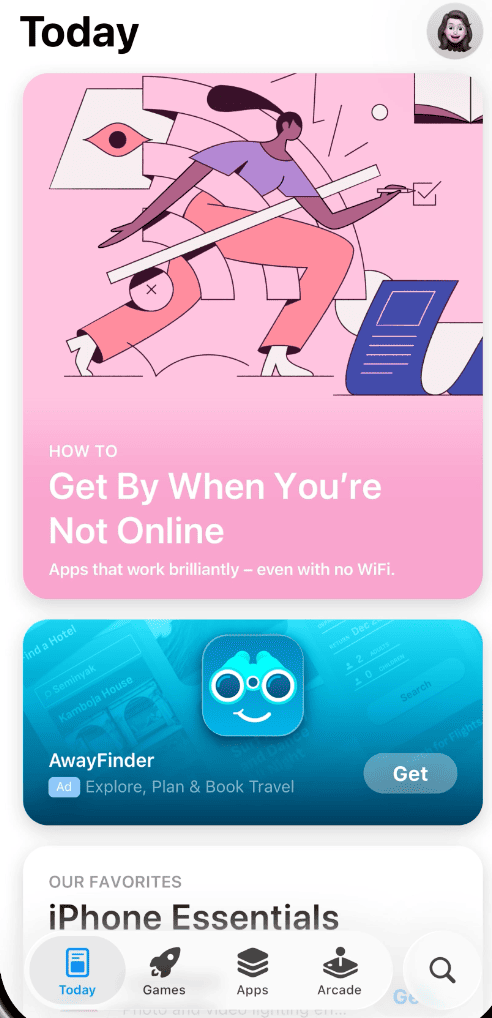
Apps become eligible through originality, recent updates, in-app events and clear product polish; visibility from a Today feature is short-lived but high-quality.
Top Charts (Free, Paid, Grossing)
Top Charts rank apps by recent download velocity (Free and Paid) and revenue (Grossing), both cross-category and per primary category.
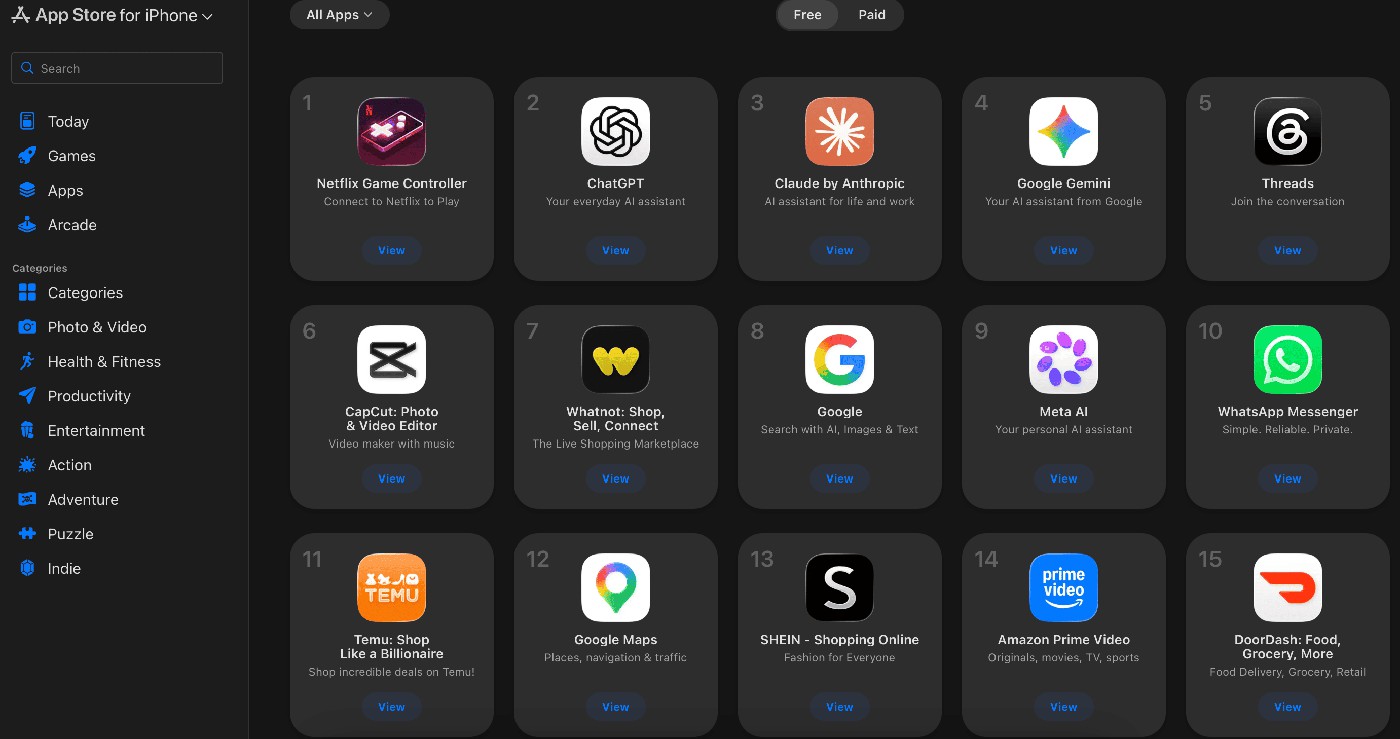
App Store visibility on the charts is volatile — driven by the last 24–72 hours of installs — but a top-100 placement materially shifts category visibility for as long as it holds.
Categories and "You Might Also Like"
Category browse and the algorithmic cross-sell modules on product pages ("You Might Also Like") give visibility to apps that share metadata patterns and co-installation behavior with neighboring apps.
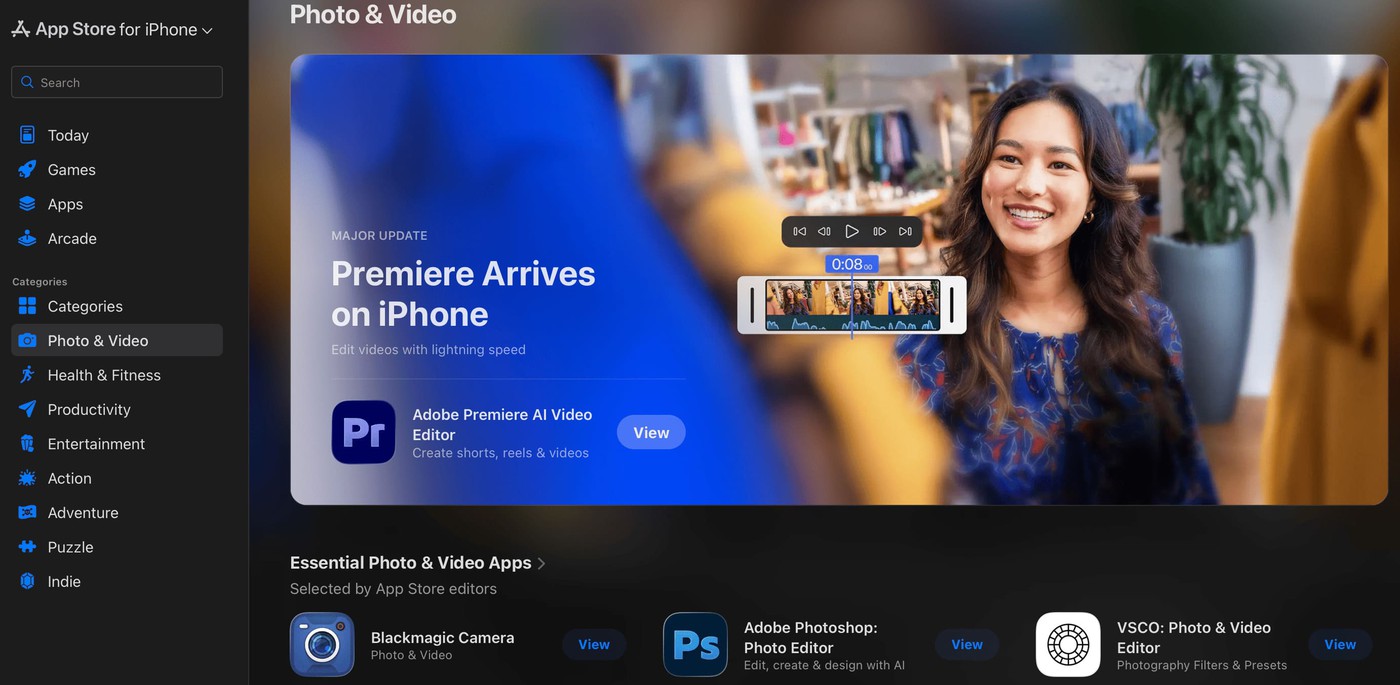
Primary category assignment, subtitle wording and consistent keyword coverage all influence which neighbors you land next to.
Apple Search Ads
Apple Search Ads is the paid surface inside App Store Search. Visibility from ASA is rented, not earned, but it feeds the organic flywheel: paid downloads contribute to velocity, branded search lift and Apple Search Ads popularity — the popularity index Apple itself surfaces inside the keyword research workflow.
How App Store visibility is measured
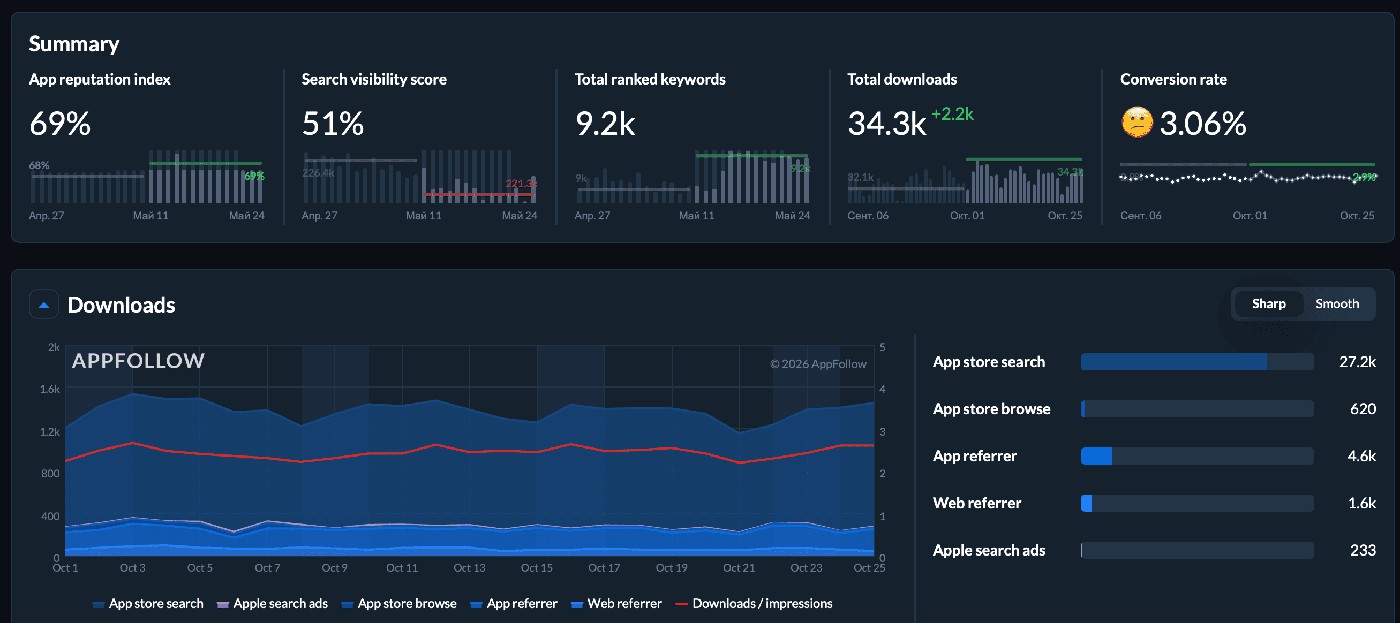
Because App Store visibility spans five surfaces, no single number tells the whole story. iOS ASO teams use four measurement signals together: a composite visibility score, keyword rankings combined into share of voice, first-party impressions from App Store Connect and chart and category positions.
The App Store visibility score
Most ASO platforms — AppFollow, AppTweak, Mobile Action, ASOdesk — report an App Store visibility score: a 0–100 composite that blends keyword rankings across the iOS App Store, weighted by Apple Search Ads popularity per keyword. Higher score, more keywords ranking well for popular terms.
Vendor methodologies differ slightly, so always compare a score to its own trend over time rather than across tools.
Keyword rankings and share of voice (iOS-only)
Underneath the composite score sit the raw keyword rankings on iOS: for each tracked keyword, what position does the app hold today in the App Store?
Share of voice aggregates those rankings against a defined competitive set to answer a sharper question: what percentage of total iOS category visibility do we own?
Impressions in App Store Connect
App Store Connect reports the ground truth that ASO tools can only estimate: impressions, product page views, and taps. These first-party numbers are the only source that confirms App Store visibility translated into eyeballs on iOS.
Cross-check visibility-score movement against Connect impressions to validate that gains are real.
Chart and category position
Top Chart and category positions update daily and lag the other measurement signals — by the time an app moves on the charts, the underlying installs have already happened. Treat chart position as a confirmation metric, not a leading indicator.
The main drivers of App Store visibility
App Store visibility is the output of a small set of inputs the team actually controls. Five drivers do most of the work on iOS.
iOS metadata: title (30), subtitle (30), keyword field (100)
Metadata is the only direct lever for keyword relevance on iOS. The 30-character title, 30-character subtitle and 100-character keyword field tell Apple which queries the app should appear for. The keyword field is iOS-only and invisible to users, which makes it the most underused asset in App Store visibility. Every other driver below is amplification of how well these three slots are configured.
Conversion rate and Apple Search Ads popularity
Conversion rate (CVR) — taps that become downloads — lifts ranking, which lifts visibility, which produces more impressions: a flywheel. Apple Search Ads popularity, the per-keyword index Apple itself uses, is the closest thing to an official search-volume signal on iOS; tracking it is how teams discover which keywords are worth metadata real estate.
Ratings, reviews and the version-update reset
Ratings and reviews directly affect tap-through on the product page and indirectly affect ranking. Worth noting: Apple lets developers reset summary ratings with a new version — useful after a major UX overhaul, but it temporarily reduces App Store visibility on rating-weighted surfaces, so plan the timing.
Download velocity (and product launch spikes)
Recent download velocity is one of the strongest ranking signals on iOS. Marketing pushes, paid UA spikes and feature launches produce visibility gains within days — but the gains decay just as fast if velocity drops. Sustained, not spiked, velocity wins long-term App Store visibility.
Localization across App Store territories
Each Apple App Store territory is a separate visibility universe — different competitors, different search patterns, different popularity scores. Apps that localize iOS metadata properly into a target market (not just translate, but adapt to local search behavior) routinely see 20–80% App Store visibility lifts in that territory. Visibility you do not measure per territory is visibility you do not understand.
App Store visibility vs. Google Play visibility
App Store visibility and Google Play visibility share the same concept — cumulative presence across store surfaces — but the surfaces, metadata fields and signals differ enough that they should be measured and worked separately. The table below highlights what matters when you cross the boundary.
Dimension |
Apple App Store |
Google Play |
Metadata fields |
Title (30), subtitle (30), keyword field (100, invisible) |
Title (50), short description (80), long description (4,000) |
Search popularity signal |
Apple Search Ads popularity (Apple-published index) |
Modeled by ASO tools; no official Google-published index |
Editorial surface |
Today tab (App of the Day, Stories) |
Editorial collections |
Paid surface inside the store |
Apple Search Ads |
Google App Campaigns (cross-network, not store-only) |
First-party impression data |
App Store Connect → Impressions, Product Page Views, Taps |
Google Play Console → Store Listing Acquisitions |
Metadata effect timing |
Ranking moves typically within 3–7 days |
Ranking moves typically within 1–3 days |
If you also operate on Android, see the broader concept page on app visibility — it covers both stores in one place. [link: /glossary/app-visibility]
How AppFollow measures App Store visibility
AppFollow reports App Store visibility as a 0–100 score, updated daily, calculated from the iOS app's ranking across its tracked keywords, weighted by Apple Search Ads popularity per keyword in each App Store territory. The Visibility Report surfaces the score, its 30-day trend and which keywords are contributing the most movement up or down.
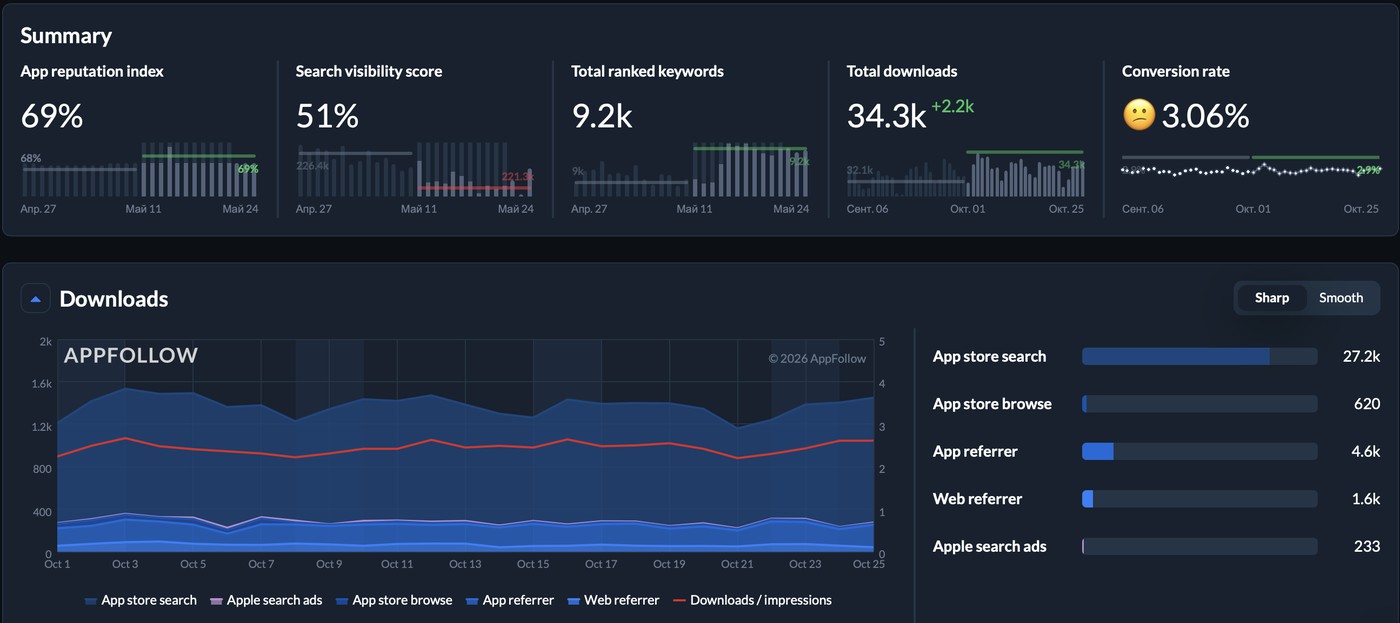
Below the score, the Keyword Dashboard exposes the raw inputs filtered to iOS only: rank per keyword per territory, Apple Search Ads popularity, keyword difficulty and the share of voice against a competitive set the team defines.
Because AppFollow tracks data for any public iOS app — not only yours — the same dashboards work for competitor benchmarking: pick three competitors, watch your App Store visibility share move against the category.
Frequently asked questions
What is App Store visibility?
App Store visibility is how easily potential users can find your iOS app across the five surfaces of Apple's App Store: Search, the Today tab, Top Charts, category browse and Apple Search Ads. It is the leading indicator of every iOS install funnel and the top-line metric ASO teams use to track iOS storefront health.
How do I increase visibility in the App Store?
Increase visibility in the App Store through a four-step ASO cycle: audit your current iOS visibility and keyword coverage, rewrite the title, subtitle and keyword field to cover high-popularity keywords, improve the product page creatives to lift conversion rate, then track and iterate on a 2–4 week cadence. Localize the cycle per App Store territory.
How do I check visibility in the Apple App Store?
Use an ASO tool such as AppFollow to pull a daily App Store visibility score plus keyword rankings and share of voice for your iOS app. Cross-check with App Store Connect for first-party impressions, product page views and taps. Filter all reports to iOS and to the App Store territory you care about — visibility data must be measured per storefront.
What is a good App Store visibility score?
On the 0–100 scale most ASO tools use for iOS, 0–20 is low, 20–40 is moderate, 40–70 is strong and 70+ is excellent. The right benchmark depends on category competition: a 50 in finance is harder-won than a 70 in a niche utility. Compare the score against its own trend, not absolute numbers across categories.
How long does it take to improve App Store visibility?
Metadata changes typically move iOS keyword rankings within 3–7 days after the new build is approved by App Store review. Visibility-score movement follows on a 2–3 week horizon as rankings stabilize. CVR improvements compound over 4–8 weeks; localization gains land in the territories you ship the update to, as the App Store re-indexes.
