

App Visibility
Table of Content:
App visibility is the degree to which an app can be seen by potential users across the iOS App Store and Google Play. It covers every surface where the app can appear — keyword search, category browse, top charts, featured placements, suggested apps and external referrals — and it sits at the top of every install funnel: no impression, no install.
App Store Optimization (ASO) teams measure and grow visibility as their primary lever for organic mobile growth.
What is app visibility?
App visibility is the practical answer to one question: how many of the right people can actually see your app in the stores? It's not the same as discoverability (the theoretical possibility of being found), and it's not the same as ranking position (a single coordinate).
Visibility is the cumulative result of where your app shows up, how often, and how relevantly across the App Store and Google Play.
Every install starts with an impression, and every impression starts with visibility. That is why ASO teams treat app visibility as the leading indicator of organic growth — well before downloads, retention or revenue show movement.
ASO tools like AppFollow report visibility as a single composite score on a 0–100 scale so teams can track it like any other product metric.
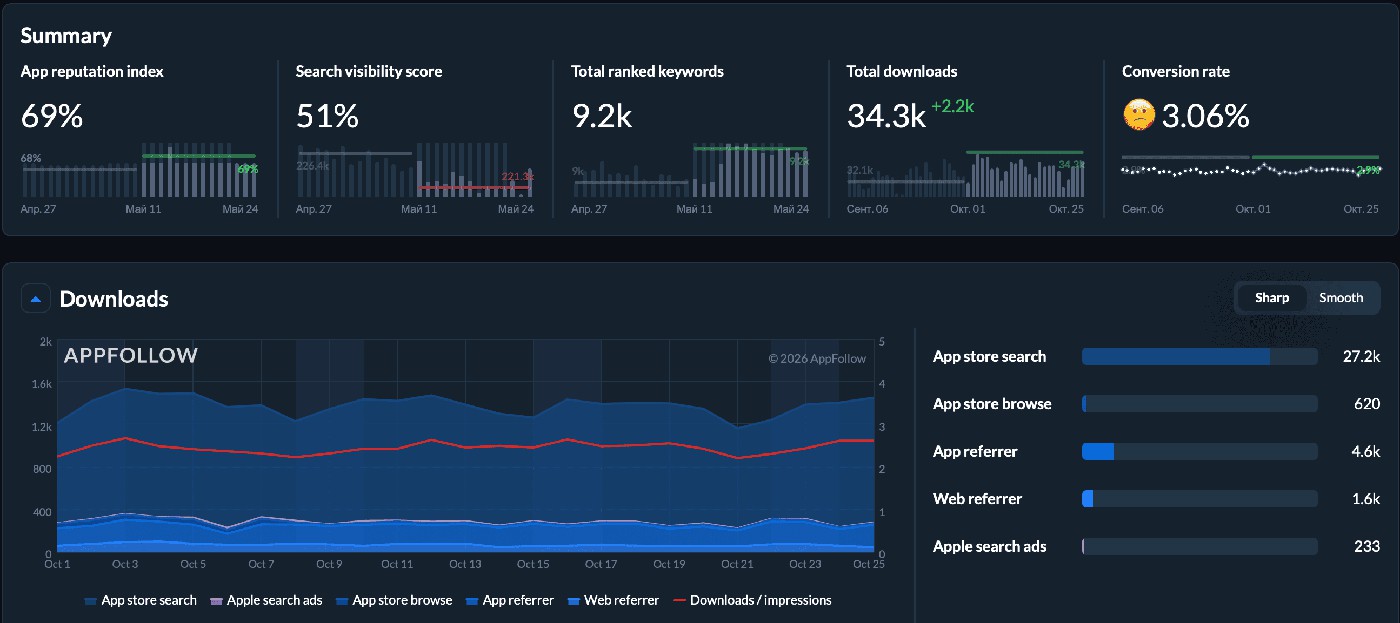
Where app visibility happens (visibility surfaces)
App visibility is not one place. Both the App Store and Google Play expose multiple surfaces where users can encounter an app, and each surface has its own ranking logic and conversion behavior. A complete view of app store visibility means looking at all of them.
App Store and Google Play search
Keyword search is the largest visibility surface in both stores, responsible for 60–70% of organic impressions on iOS and a similar share on Google Play. Visibility here is a product of keyword relevance (does your metadata match the query?) and ranking position (do you appear in the top 5 results?). Most ASO investment is spent on this surface because the return is the highest.
Category and chart rankings
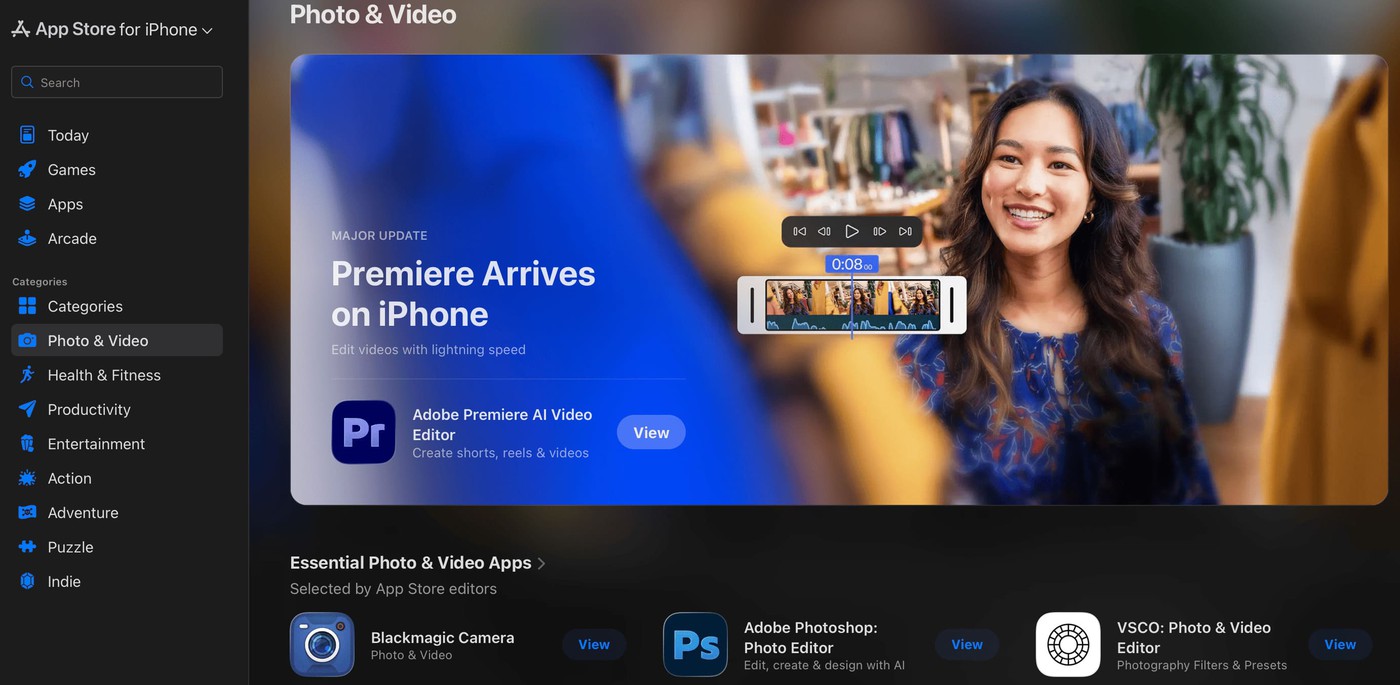
Top Charts (Free, Paid, Grossing) and category browse drive a smaller share of installs but a high-quality one: users who arrive via browse are often in discovery mode and convert well. Visibility on these surfaces requires sustained download velocity and a correctly assigned primary category.
Featured and editorial placements
The Today tab on iOS and Google Play's editorial collections are curated, not algorithmic. Visibility on these surfaces depends on editorial selection — quality of product, originality, current relevance, platform-fit. They cannot be optimized for like search, but apps can be made eligible by maintaining strong creatives, recent updates and a clear story.
Suggested apps, similar apps and bundles
Both stores cross-sell apps to users browsing other apps. Visibility on these algorithmic surfaces depends on category overlap, metadata similarity and user co-installation patterns. The competitive set matters more here than any single optimization.
External visibility (web, social, paid)
App store presence is amplified by paid user acquisition, Apple Search Ads, web links to product pages (App Store Connect-indexed and Google Play-indexed), deep links from partner apps, and social referrals. External visibility feeds store visibility through download velocity and brand-search signals.
How app visibility is measured
Because app visibility spans multiple surfaces, no single number tells the whole story. ASO teams rely on four measurement signals, used together: a composite visibility score, keyword-level rankings combined into share of voice, first-party impressions from App Store Connect and Google Play Console, and category and chart positions.
- The app visibility score. Most ASO tools — AppFollow, AppTweak, ASOdesk, Mobile Action — report an app visibility score: a 0–100 composite that blends the app's rankings across its tracked keywords, weighted by the popularity of each keyword. Higher score, more keywords ranked well for high-volume terms. Methodologies differ between vendors, so always compare a score to itself over time, not across tools.
- Keyword rankings and share of voice. Underneath the score sit the raw keyword rankings: for each tracked keyword, what position does the app hold today? Share of voice (SoV) aggregates these rankings against the competitive set to answer a sharper question: what percentage of total category visibility do we own?
- Impressions in App Store Connect and Google Play Console. The platforms themselves report the ground truth: how many unique users actually saw the app's product page or search result. App Store Connect calls them impressions; Google Play Console calls them store listing acquisitions. These first-party numbers are the only source that confirms visibility translated into eyeballs.
Category and chart positions
Chart and category positions update daily and lag the other signals — by the time you move on Top Charts, the underlying installs have already happened. Treat them as a confirmation metric, not a leading one.
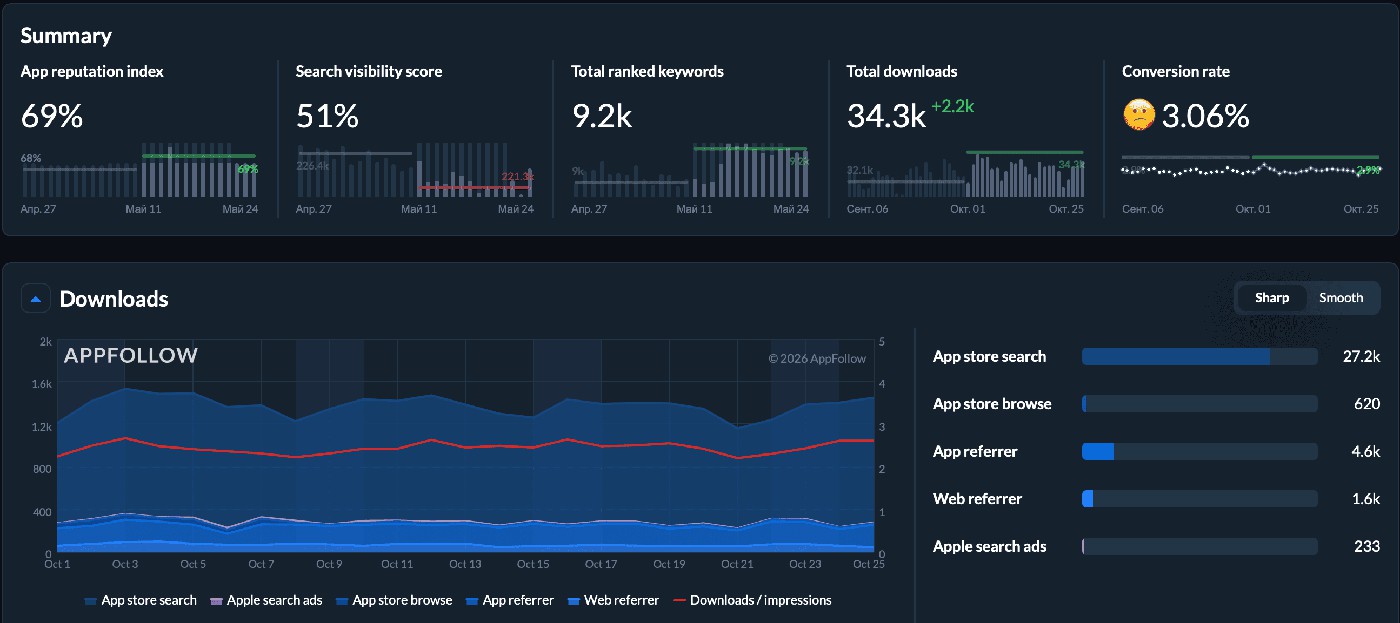
The main drivers of app visibility
App visibility is the output of a small number of inputs the team actually controls. Five of them matter most.
Metadata: title, subtitle, keyword field and descriptions
Metadata is the only direct lever for keyword relevance. The iOS title (30 chars), subtitle (30 chars), keyword field (100 chars) and Google Play title (50 chars) + short description (80 chars) + long description (4,000 chars) are the slots that tell the algorithm which queries the app should appear for. Every other driver is amplification of how well metadata is configured.
Conversion signals: CVR, ratings, retention
Both stores reward apps that convert impressions into installs and installs into engaged users. A high conversion rate (CVR) lifts ranking, which lifts visibility, which produces more impressions — a flywheel. Ratings and reviews directly affect tap-through and indirectly affect ranking. Retention matters more in Google Play, but neither store ignores it.
Velocity: downloads and recent installs
Recent download velocity is one of the strongest ranking signals on both stores. A spike — from a marketing push, a feature launch, paid UA — produces visibility gains within days. Velocity is volatile, though: if it drops, visibility follows.
Off-store signals: paid UA, web links, social, deep links
Visibility is not only an in-store affair. Paid user acquisition pumps velocity. Web pages and partner apps that deep-link to the product page improve indexing. Social shares and Apple Search Ads campaigns lift branded search, which the stores weight heavily.
Localization and storefront coverage
Each country storefront is its own visibility universe with its own competitors and search behavior. Apps that localize metadata properly into a target market — not just translate, but adapt — typically see 20–80% visibility lifts in that storefront. Visibility you do not measure per locale is visibility you do not understand.
How to increase app visibility
How to increase app visibility comes down to a repeatable four-step workflow that turns the measurement framework into action. Each step has a deliverable; together they form one ASO cycle.
- Audit current visibility. Pull the visibility score, top-ranked keywords, share of voice and impressions across every storefront you sell in. Identify the largest gaps between your ranked keywords and the ones with real volume in the category.
- Fix metadata for relevance and weight. Rewrite title, subtitle and keyword field to cover high-opportunity keywords from the audit. Repeat for every priority locale. Push the changes through App Store Connect and Google Play Console.
- Improve creatives and CVR. Test screenshots, app icon, preview video and short description. A 10–20% lift in CVR feeds the ranking flywheel within two to three weeks.
- Track, iterate, defend. Monitor the visibility score daily, set alerts on competitor moves, and re-run the cycle on a 2–4 week cadence. Visibility decays without maintenance.
App visibility vs. related ASO concepts
App visibility is often used interchangeably with three other terms. They are not the same. The table below is the practitioner's shorthand.
Term |
What it actually is |
When to use it |
App visibility |
Cumulative presence of the app across all store surfaces |
Top-line health metric for ASO; track over time |
App discoverability |
Theoretical possibility of being found (do the right surfaces exist?) |
Strategic question about category and product-market fit |
Keyword ranking |
App's position for one specific keyword |
Tactical optimization; daily decisions |
Impressions |
Actual eyeballs on the listing (first-party data) |
Validating that visibility produced views |
Visibility vs. discoverability
Discoverability is a question of architecture: can users plausibly find this app in the categories and queries that fit it? Visibility is a question of execution: once they could find it, do they? An app can be highly discoverable (right category, clear value prop) and still have low visibility because metadata is weak. Discoverability is strategy; visibility is operations.
Visibility vs. rankings
Rankings are coordinates — one position for one keyword. Visibility is the aggregate over all positions weighted by traffic. A jump from #15 to #3 on a high-volume keyword is a visibility win; a jump from #95 to #80 on a long-tail keyword is barely a flicker.
Visibility vs. impressions
Visibility is the potential to be seen. Impressions are the confirmation that someone was. The two diverge when seasonality, paid UA or store layout changes reshape user behavior; treat impressions as the ground truth and visibility as the leading indicator.
How AppFollow measures app visibility
AppFollow reports app visibility as a 0–100 score, updated daily, calculated from the app's ranking across its tracked keywords, weighted by the popularity (search volume) of each keyword in each storefront.
The Visibility Report shows the score, its 30-day trend, and which keywords are contributing the most movement up or down.
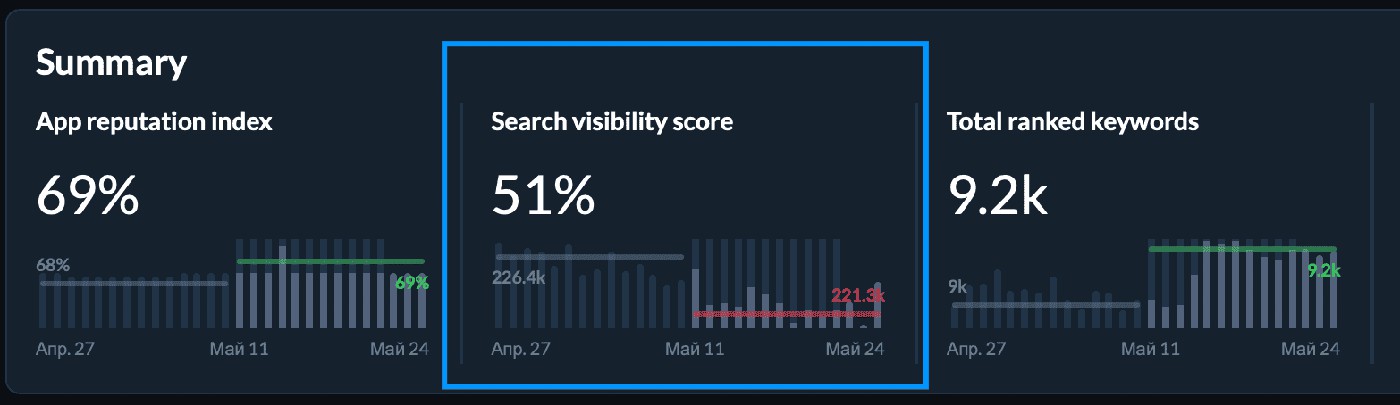
Below the score, the Keyword Dashboard shows the raw inputs: rank per keyword per country per store, plus difficulty, search popularity, and the share of voice against the competitive set the team defines.
Because AppFollow tracks data for any public app, not just yours, the same dashboards work for benchmarking — point them at three competitors and see how your visibility share moves relative to the category.
Frequently asked questions
What is app visibility?
App visibility is how easily potential users can find an app across all surfaces of the iOS App Store and Google Play: keyword search, category and chart rankings, featured and editorial placements, suggested-app modules and external referrals. It is the leading indicator of every install funnel.
What is a good app visibility score?
On the 0–100 scale most ASO tools use, 0–20 is low, 20–40 is moderate, 40–70 is strong and 70+ is excellent. The benchmark depends on category competition: a 50 in fintech is harder-won than a 70 in a niche utility category. Compare the score to its own trend, not to absolute numbers across categories.
How is app visibility different from app discoverability?
Discoverability is whether an app could be found in the right categories, keywords and surfaces given its product. Visibility is whether it actually is being found there — the result of executing on metadata, creatives, velocity and localization. Discoverability is a precondition; visibility is the outcome.
How do I check my app's visibility?
Use an ASO tool such as AppFollow to pull a daily visibility score plus keyword-level rankings and share of voice. Cross-check with first-party impressions in App Store Connect and Google Play Console to confirm that visibility is producing views. Track per country and per store separately.
How long does it take to increase app visibility?
Metadata changes typically move keyword rankings within 1–3 days on Google Play and 3–7 days on iOS. Visibility-score movement follows on a 1–3 week horizon as the rankings stabilize. Larger changes — driven by CVR improvements or paid-UA velocity — usually compound over 4–8 weeks.
