

Featured Apps
Table of Content:
Featured apps are apps highlighted by the App Store or Google Play in high-visibility store placements, such as the Today tab, Apps and Games tabs, Editor’s Choice, editorial collections, seasonal lists, or promotional content areas.
In ASO, featured apps matter because they can get discovery traffic from users browsing the store, not just from people typing a keyword into search.
Apple describes App Store featuring as curated, localized, and regionally selected, while Google Play says users can discover apps through homepages, navigation pages, search, app detail pages, and editorial selections.
In plain English, the featured apps meaning is simple: the store decided your app deserves extra attention. Maybe because the product is polished. Maybe because your update fits a seasonal moment. Maybe because your screenshots, ratings, UX, localization, and story all say, “Yep, this is worth showing to more people.”
Why featured apps matter
Featured apps get something most app teams fight hard for: store visibility without relying only on paid traffic or keyword rankings.
That does not mean a featured placement automatically turns into a download storm. A weak product page can still leak users. Poor ratings can still scare people off. A beautiful feature in the wrong country may create a traffic bump, then fade by Monday.
But when the store puts your app into a curated placement, you get a clean ASO signal worth studying.
- Did impressions rise?
- Did installs move with them?
- Did conversion hold?
- Did your category ranking climb after the feature?
- Did review volume change?
- Did users mention the same feature Apple or Google highlighted?
That is where featuring becomes more than a nice screenshot for the team Slack. It becomes market feedback.
Where featured apps appear
Featured apps can show up in several places across app stores.
On the App Store, Apple highlights apps through Today tab stories, collections, In-App Events, App of the Day, Game of the Day, lists, pre-orders, personalized recommendations, and Editors’ Choice placements. Apple says Editors’ Choice apps can appear on product pages, Today tab stories, Apps and Games tab collections, and other areas across the App Store.
On Google Play, app discovery can happen through the homepage, sub-navigation pages, search, app detail pages, and editorial selections. Google Play also separates curated editorial recommendations from paid ads, which are marked as ads or sponsored placements.
For app marketers, that distinction matters. A featured app is not the same thing as a paid app ad. It is also not the same thing as ranking number one in Top Charts. Featuring is a store discovery placement, usually driven by editorial, quality, relevance, or merchandising logic.
Featured apps vs top charts vs paid ads
Term | What it means | Why app teams track it |
Featured apps | Apps promoted in curated or high-visibility store placements | Shows when the store gives your app extra discovery exposure |
Top charts | Apps ranked by popularity, installs, revenue, or category performance | Helps measure competitive momentum |
Paid ads | Sponsored store placements bought through ad platforms | Shows paid acquisition visibility |
Keyword rankings | Your app’s position for a specific search query | Helps measure search visibility and ASO performance |
A featured placement can influence the rest of the funnel. More browse traffic can lift installs. More installs can affect category movement. More users can trigger more reviews. If the product page converts well, one feature can turn into a short but very useful growth window.
How do apps get featured?
There is no magic checklist. Annoying, yes. Also true.
Apple says its team considers factors like user experience, UI design, innovation, uniqueness, accessibility, localization, product page quality, compelling screenshots, app previews, descriptions, and positive ratings and reviews.
Developers can also submit Featuring Nominations in App Store Connect, with Apple recommending at least two weeks’ notice and up to three months for wider consideration.
Google Play talks about discovery through relevance, app quality, editorial value, ads, and user experience. Its app quality signals include technical performance, good UX, icon, title, screenshots, videos, descriptions, links, and customer support. Google also says editorial and merchandising teams may manually select content for featuring and promotion based on quality, novelty, design, usefulness, breadth of appeal, timeliness, and local relevance.
So, what can you actually control?
- Start with the store page. Your icon should make sense at tiny size. Screenshots need to explain the value before the user has to think. Ratings should not look like a warning sign. Reviews need a response workflow, especially after a major launch. Metadata should match the app’s real use case. Localization should feel written for that market, not copied through a machine and left there.
- Then add the story. A new feature. A seasonal challenge. A market launch. A content drop. A product moment editors can understand in five seconds.
A “we fixed bugs” update rarely gives anyone a reason to care. A finance app launching a shared budget mode before the holidays has a sharper hook.
How to track featured apps
Getting featured is exciting. Missing the data around it is painful.
You need to know where the feature happened, when it started, which country or storefront showed it, and what changed afterward. Otherwise, the team ends up with a vague celebration and no learning.
In AppFollow, Featured Timeline shows how your app is featured in app stores around the world. It tracks non-personalized public featured data and shows when your app was featured on different AppFollow graphs.
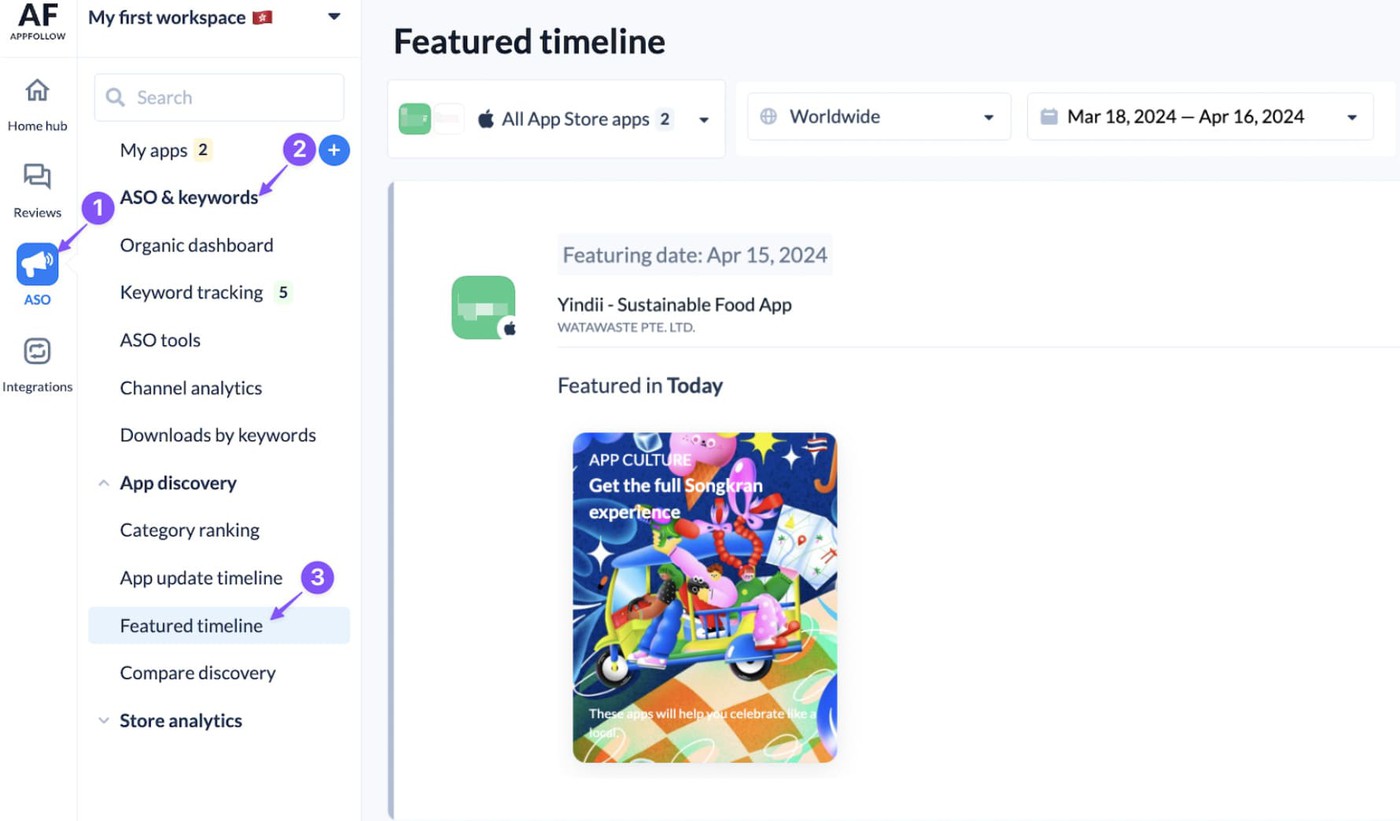
So teams can connect the placement with performance changes instead of guessing why installs or reviews moved.
That is the practical workflow:
- Mark the feature date.
- Check the country and store section.
- Compare installs before, during, and after.
- Watch conversion rate, not only traffic.
- Look at rating movement and new review topics.
- Check whether competitors appeared in nearby collections.
- Save the creative angle that got attention.
The best ASO teams treat featuring like a lab result. Nice if it brings installs. Even better if it tells you what the store, the market, and users are responding to.
Example of featured apps in practice
Say a fitness app launches a “7-minute January reset” challenge.
The team updates screenshots, localizes the product page for France and Germany, adds fresh app preview messaging, and times the release around New Year intent. A few days later, the app appears in a wellness collection.
Traffic rises. Great. But the smarter question comes next.
Was the lift stronger in France or Germany? Did users install from the featured collection or bounce on the product page? Did reviews mention the challenge? Did rating stay stable after new users arrived? Did category rank move after the feature?
That is the difference between “we got featured” and “we know why this worked.”
How to improve your chances of being featured
No one can guarantee featuring. Anyone who promises that is selling fairy dust.
Still, you can make your app easier to choose.
Build a clean product page. Keep technical quality strong. Make screenshots specific. Localize properly. Respond to reviews before they become a rating problem. Give editors a timely story, not a generic update. Track competitors already getting featured, because their placements show what the store is rewarding in your category right now.
The quiet advantage is preparation. If a featuring opportunity lands and your screenshots are outdated, ratings are sliding, or the app crashes on a new OS version, the window gets smaller fast.
FAQs
What is featured apps?
“Featured apps” means apps promoted by an app store in curated or high-visibility placements, such as App Store Today tab stories, Editor’s Choice, Google Play editorial collections, seasonal lists, or promotional content areas.
What is the featured apps meaning in ASO?
In ASO, featured apps meaning usually refers to apps that receive extra store visibility through editorial or curated placements. It matters because featuring can increase browse traffic, product page views, installs, category movement, and brand recognition.
Are featured apps paid placements?
Usually, no. Featured apps are generally editorial, curated, or merchandising placements. Paid app store ads are separate and should be marked as ads or sponsored placements.
Can any app become a featured app?
Yes, but featuring is not guaranteed. App stores usually look for app quality, strong UX, clear value, polished creative assets, positive ratings, localization, technical stability, and a timely reason to promote the app.
Does being featured improve ASO?
It can help ASO by increasing visibility, installs, review volume, and category momentum. Still, featuring works best when the product page is already ready to convert that extra attention into installs.
Related terms
What Is an App Title? Meaning, Definition & Best Practices
What Is an App Icon?
What Is an ASO Report?
App installs
