Your players are about to quit and AI knows it first. How?

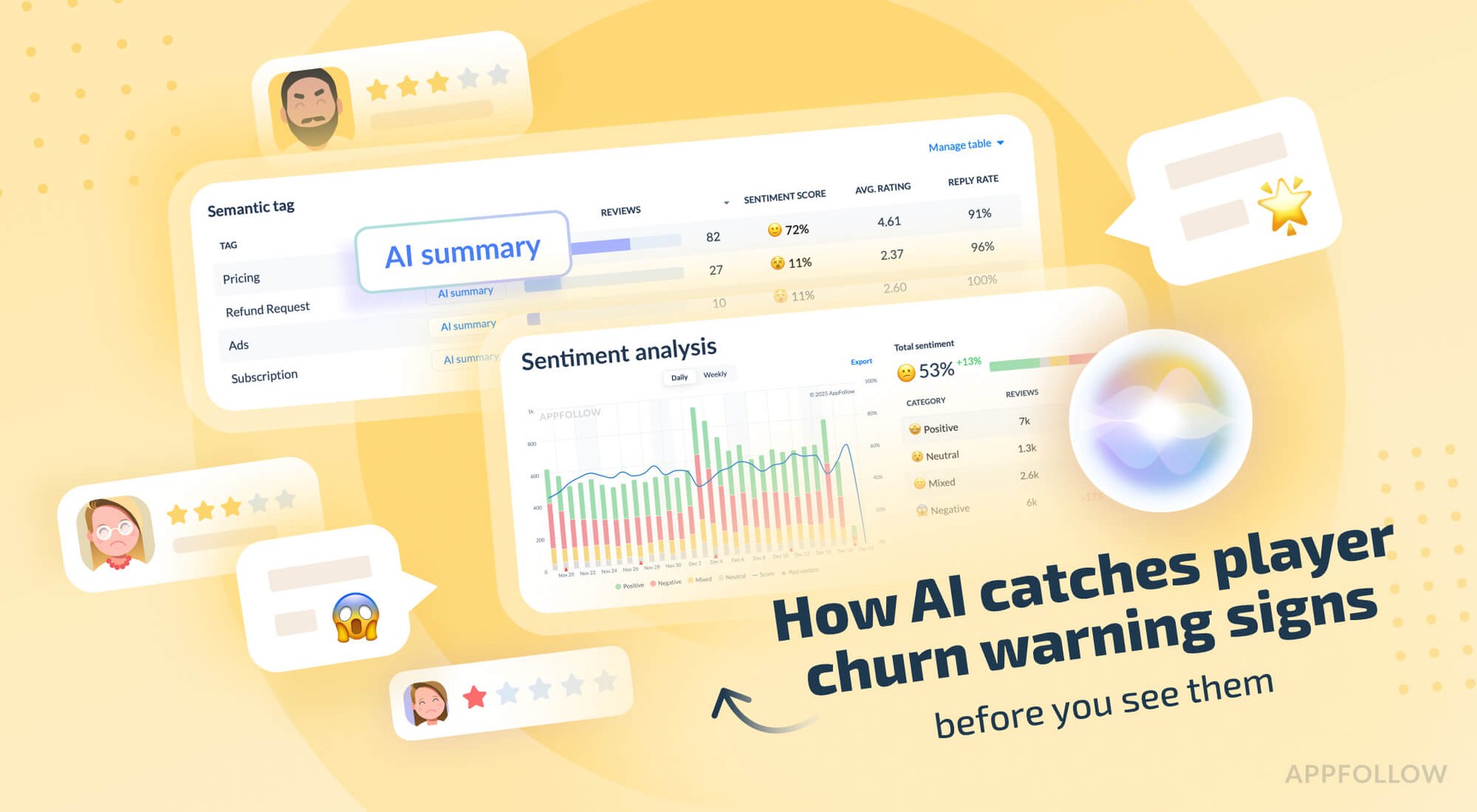
Table of Content:
Your game just got a spike of 1-star reviews, oh no! By the time you notice them, read them, and figure out what's wrong, hundreds of players already uninstalled. You care about fixing problems, but just finding out too late.
AI sentiment analysis changes that. It reads every review the second it hits the app store: spots patterns that mean players are about to leave and flags retention-killing problems before they spread. Companies using it are seeing results.
Why AI catches churn before you see it
Few reasons, mainly:
AI reads every review instantly
As an example, our own clients! Huuuge Games processes thousands of player reviews across multiple titles. They set up AI tagging that automatically sorts 80% of incoming feedback. Reviews mentioning crashes, lag, or paywall friction get routed straight to the right product manager or QA lead.
The system helps them know what's breaking before it kills retention.
Their system flags when the app drops below internal rating thresholds. It sends Slack alerts when low-star reviews start mentioning issues like monetization problems. The team can spot retention-killing issues and fix them before they turn into trends.
Without AI doing this work, you're reading reviews manually. You're seeing "the game crashes" three times and thinking maybe there's a pattern. By the time you notice, the algorithm already tanked your visibility, and your CAC has gone up. Oops.
The patterns that predict churn
Research on sentiment analysis and churn prediction in gaming (though this research was looking into Steam instead, relevant nonetheless) shows AI can forecast which players will leave based on their review sentiment. One study achieved 89% accuracy using sentiment scores embedded in time series data.
In essence, AI reads what players say.
It also tracks how sentiment changes over time. A player who loved your game two months ago but now complains about grinding probably won't stick around much longer. The warning signs show up in reviews first. Crash mentions spike after an update, players who paid for features complain the most when technical issues appear, and then comments about difficulty spikes or paywall complaints cluster together.
Sentiment analysis tools can detect these shifts and quantify how many users feel negatively about specific features. When 40% of your recent reviews mention the same login bug, that's your retention leaking.
Traditional analytics tell you retention dropped. AI sentiment analysis tells you why before the drop happens.
Why RPGs are bleeding players
Another interesting insight into this is what’s happening to this particular genre. Mobile RPGs used to dominate monetization, but now they're struggling. How come? The decline is striking. RPGs are faltering under their own weight. Too many mechanics, too much grind, too high marketing costs. Too much time?
Players are telling you this in reviews. "The grind is insane." "I can't progress without paying." "I spent three hours and got nowhere." These are patterns that AI can flag as retention risks.
Strategy games simplified their presentation while keeping depth. They use arcade-style ads to attract users, then filter into complexity later. RPGs kept adding systems and grind, and players started leaving.
If you're running an RPG and you're tracking sentiment around progression systems, AI can tell you exactly which mechanics are frustrating which player segments.
How it works in practice
Auto tagging basics
AI tagging is pattern recognition at scale.
The system reads every review and assigns tags based on content. "Crash" goes to technical issues. "Paywall" goes to monetization. "Tutorial" goes to onboarding. Most platforms can tag 70 to 80% of reviews automatically.
The real value comes from cross-referencing tags with other data. Reviews tagged "crash" that also mention Android 13 tell you about a device-specific bug. Reviews tagged "too expensive" from new players mean your monetization hits too early. Reviews tagged "boring" after level 20 mean your mid-game content needs work.
Gameloft saw this when they integrated review automation. They went from 30 days to respond to reviews down to 3 days. 62% of users who got responses updated their ratings higher.
Response time and prioritization both matter. AI handles both.
The lifecycle stage problem
New players have different complaints than veterans. A tutorial that veterans think is too long might be too short for new players. Monetization that seems fair after 50 hours feels aggressive in the first session.
Most review management tools don't distinguish between these groups automatically. You can tag reviews manually by looking at what they say. "Just downloaded" probably means new player. "Been playing for months" probably means veteran.
AI can go further by analyzing the complaints. Reviews mentioning tutorial or onboarding almost always come from new players. Reviews discussing endgame content or competitive balance come from veterans. You don't need users to tell you how long they've played. Their complaints tell you.
This matters because solutions are different. If new players complain about crashes during login, that's an install flow problem. If veterans complain about crashes during raids, that's a scaling problem. Same tag, different fixes, different urgency.
What the 70% reduction means
That mobile game developer who cut negative reviews by 70% did it by fixing problems proactively.
AI flagged which bugs were getting mentioned most. The team prioritized fixes based on review volume. They pushed updates that addressed the exact issues players cared about most.
The 45% retention increase came from addressing UX feedback that AI sorted by frequency and sentiment intensity. Not every piece of feedback matters equally. AI helps you focus on what drives churn.
The 3x daily active user growth happened because fixing retention problems compounds. Better ratings improve visibility. Better visibility brings more users. More users who stick around because the problems that drove away the first group are already fixed.
Companies are running this playbook right now and seeing results.
The reality check
AI sentiment analysis won't save a bad game. If your core loop is broken or your monetization is predatory, catching problems faster just means you'll know why players hate your game in real time.
The tool works when you're willing to act on what it tells you. Huuuge Games set up their whole workflow around AI insights. Reviews get tagged, routed to the right teams, and tracked until issues are resolved. That's why it works for them.
Setting up AI tagging without changing how you respond to feedback is pointless. You'll just have better organized complaints that you still ignore.
The other limitation is data volume. AI gets better with more reviews. If you're getting 20 reviews a month, manual reading probably works fine. If you're getting 500 reviews a day across multiple regions and platforms, manual reading means you're always reacting late.
Setting up AI review analysis
What to do first
Start by looking at your current review response time. How long does it take from when a player posts a complaint to when someone on your team even sees it? If the answer is more than a day, you're losing players who could have been saved.
Set up automated tagging for the obvious categories. Crashes, paywalls, difficulty, performance, bugs. Most review management platforms can do this without custom setup.
Track which tags correlate with rating drops. If crash mentions go up 50% and your rating drops 0.3 stars in the same week, that's your signal to prioritize crash fixes over new features.
Route tagged reviews to the teams that can fix them. Don't send everything to customer support. Technical issues go to QA. Monetization complaints go to product. Onboarding confusion goes to UX. Measure how fast you can close the loop from complaint to fix. That mobile game developer hitting 70% fewer negative reviews probably cut their fix time dramatically too.
How AppFollow does this
AppFollow's AI Summary reads hundreds of reviews and gives you the main themes instantly. You see what players are complaining about without reading every review individually. The summary updates automatically when you change filters. Want to see only negative reviews from Japan? The AI summarizes those specifically.
The Semantic Analysis tracks your overall sentiment score. It shows you the percentage of positive versus negative reviews. You can see how sentiment changed over time. If your score drops suddenly, you know something broke.
Auto tags sorts reviews into categories automatically. Bugs, monetization, user feedback, concerns. The system groups complaints so you can see patterns. When 50 reviews mention the same crash, AppFollow shows you that as a trend.
Phrase analysis spots what words keep popping up. If "login error" appears in 30 reviews this week versus 5 last week, that's a spike you need to see. The system tracks these automatically.
You can tell the AI to focus on specific topics you care about. Enter "checkout issues" or "payment problems" and get a summary of just those reviews. Instead of reading everything to find payment bugs, you get them filtered and summarized.
Slack alerts fire when sentiment shifts or ratings drop. Your team gets notified the moment problems spike. You're not checking dashboards hoping to catch issues. The system tells you when something needs attention.
AppFollow works across App Store, Google Play, Amazon, Samsung, and other stores. All your reviews in one place. All your sentiment tracking in one dashboard. You can compare how different regions feel about your app. Japanese players might love a feature that US players hate.
Afteword
Most teams that set up AI review analysis find problems they didn't know existed. A bug that only affects one Android version. A paywall that feels too aggressive to new players. A grind spike at level 30 that kills retention.
The companies getting results started small. Let AI tag reviews for a week. Look at what themes emerged, then fix the biggest problems first.
You don't need a perfect system. You need to start seeing what players are saying before more of them leave.
cta_get_started_purple
FAQ
How does AI predict player churn from app reviews?
AI sentiment analysis reads every review and tracks how player sentiment changes over time. It identifies patterns like crash mentions spiking after updates, paywall complaints clustering together, or positive reviews starting to mention problems. Research shows AI can predict churn with 89% accuracy by analyzing sentiment scores embedded in player behavior data. The system flags which issues are getting mentioned most frequently so teams can fix problems before they spread.
What retention killing patterns does AI catch in mobile game reviews?
AI catches several patterns that predict churn. Crash mentions that spike after an update signal technical problems. Reviews from paying players complaining about bugs mean your monetization is at risk. Difficulty spike complaints or excessive grind mentions show progression problems. Paywall complaints appearing in clusters indicate monetization friction. These patterns show up in reviews before they appear in your retention metrics.
How much can AI driven review management improve game retention?
One mobile game developer reduced negative reviews by 70% through proactive bug fixing based on AI alerts. They increased player retention by 45% after addressing UX feedback that AI tagged as urgent. Their daily active users grew 3x. Gameloft reduced review response time from 30 days to 3 days and saw 62% of users update their ratings higher after getting responses. Results vary but companies using AI to catch problems early see measurable improvements.
Why are mobile RPGs losing players?
RPGs are struggling because they got too complicated. Too many mechanics, too much grind, too high marketing costs, and they take too much time to play. Players tell you this in reviews with complaints like "the grind is insane" or "I can't progress without paying." Strategy games adapted by simplifying their presentation while keeping depth. RPGs kept adding systems and grind. AI can track sentiment around progression systems and tell you which mechanics frustrate which players.
What is auto tagging and how does it work for game reviews?
Auto tagging is when AI reads reviews and automatically assigns categories based on content. Crash mentions get tagged as technical issues. Paywall complaints get tagged as monetization. Tutorial mentions get tagged as onboarding. Most platforms can tag 70 to 80% of reviews automatically. The system cross references tags with other data to find patterns. Crash reviews mentioning Android 13 mean device specific bugs. Too expensive tags from new players mean early monetization problems.
Can AI tell the difference between new player and veteran complaints?
AI can analyze complaints to figure out player experience level without users saying how long they've played. Reviews mentioning tutorial or onboarding almost always come from new players. Reviews discussing endgame content or competitive balance come from veterans. This matters because solutions are different. New players complaining about crashes during login means install flow problems. Veterans complaining about crashes during raids means scaling problems. Same tag but different fixes.