

What is keyword popularity?
Table of Content:
Keyword popularity is an ASO metric that shows how often users search for a keyword in an app store. In plain English, it tells you whether people actually type a term like “budget planner,” “photo editor,” or “sleep sounds” into the App Store or Google Play often enough to make it worth tracking.
The catch? Keyword popularity is not exact search volume. App stores do not disclose the real number of searches behind a keyword. AppFollow treats it as a relative score, where 0 means the keyword is rarely used and 100 means the keyword gets a substantial number of daily searches. Keywords with a score under 20 are usually not recommended as primary targets.
Keyword popularity meaning
Keyword popularity tells you how much search demand exists behind a term.
Not how easy it is to rank.
Not how relevant it is to your app.
Not whether it will convert.
That last part matters because this metric gets misused all the time. A CEO sees a keyword with a score of 90 and says, “Great, let’s target that.” The ASO manager opens the ranking data and quietly dies inside because the term is too broad, too competitive, or too far from what the app actually does.
A fitness app might look at “workout” and see huge demand. Lovely. Brutal keyword. Everyone wants it. Now compare that with “home workout planner” or “pilates for beginners.” Lower keyword popularity, yes. Better intent, probably. More realistic ranking path, very likely.
That is how you should read the metric: demand first, decision later.
Why keyword popularity matters
App stores are search engines with a purchase button attached.
Apple says keywords are critical to app discovery because they determine how ads are matched to searches on the App Store. Apple also recommends focusing on relevance and popularity because users come to the App Store with the intention of discovering and downloading apps, and their search terms are one of the strongest intent signals available.
That is the business case.
Users are not browsing politely through every app in your category. They search. They compare. They scan the icon, title, screenshots, rating, and reviews. Then they either install or leave.
The market is too big to guess your way through this. AppTweak estimated that the global app economy generated about 112.1 billion downloads in 2025, while global app revenue grew around 10.5% even as downloads declined by roughly 4.1%.
The same report says the top 10 countries account for about 60% of all app downloads.
That should change how app teams choose keywords.
If installs are harder to win and revenue is growing faster than raw volume, chasing the biggest keyword is not enough. You need terms that bring the right users into the store page. A popular keyword can fill the top of the funnel. A relevant popular keyword can help revenue, retention, and subscription growth.
How keyword popularity works
Keyword popularity is usually shown as a score, not a raw number.
In AppFollow, the score runs from 0 to 100. A higher number means the keyword is searched more often.
For iOS apps, AppFollow collects popularity data directly from App Store Connect and displays it without changes. The Apple Search Ads score and AppFollow’s Popularity Score use the same values for iOS.
For Android apps, and for iOS countries where Apple does not provide popularity scores, AppFollow calculates the score using more than 15 parameters, including input language recognition and search hint relevance detection.
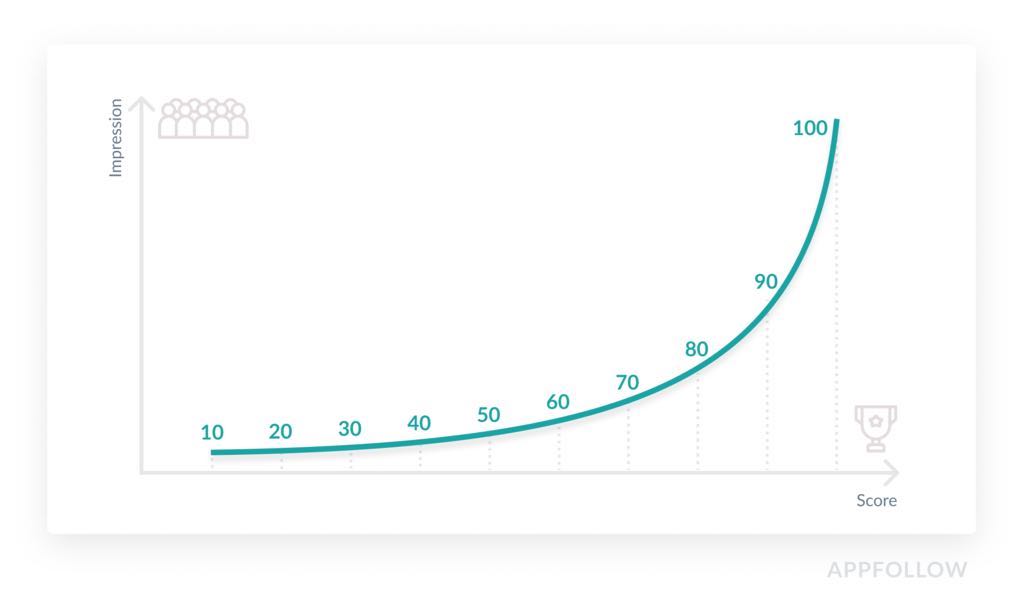
One more detail people miss: the score is not linear.
A keyword with popularity 80 is not simply “twice as searched” as a keyword with popularity 40. AppFollow explains that popularity grows exponentially, so the gap between 90 and 80 can be much larger than the gap between 30 and 20.
That is why a tiny-looking score difference near the top can matter. A move from 82 to 88 may signal a much bigger demand gap than it appears at first glance.
Keyword popularity vs keyword difficulty vs relevance
You should never choose ASO keywords by popularity alone. Here’s the clean way to separate the metrics.
Metric | What it tells you | What it does not tell you | Best use |
Keyword popularity | How much search demand a keyword has | Whether your app can rank or convert for it | Finding terms with real user demand |
Keyword difficulty | How hard it may be to rank for a keyword | Whether the keyword is worth ranking for | Avoiding impossible battles or planning long-term targets |
Keyword relevance | How closely the keyword matches your app, feature, or user intent | Search size or ranking difficulty | Protecting conversion and retention quality |
Keyword ranking | Your app’s current position for the keyword | Whether the term has enough demand | Tracking ASO progress after optimization |
Conversion rate | How well the store page turns visitors into installs | Search demand behind the keyword | Checking whether the keyword and listing match user expectations |
A smart ASO shortlist needs all of them. High popularity plus low relevance is a trap. High relevance plus zero demand is a dead end. Medium popularity, strong relevance, and realistic competition? That is often where early ASO wins live.
Example of keyword popularity in ASO
Let’s say you manage a habit tracker app.
You are choosing between these keywords:
Keyword | Popularity | What the team should think |
habit tracker | 82 | Strong demand, likely competitive, probably worth tracking |
daily routine planner | 54 | Smaller audience, clearer intent, possible conversion win |
goal checklist app | 31 | Niche, but may attract users who know what they want |
self improvement daily ritual tracker | 8 | Too narrow for a main keyword, maybe useful in content or long-tail testing |
The lazy answer is “pick habit tracker.”
The better answer is “track all four, but use them differently.”
“Habit tracker” may belong in your core ASO monitoring set because it defines the category. “Daily routine planner” might be better for screenshots, subtitle testing, or localized positioning. “Goal checklist app” could become a supporting term if ranking competition is manageable. The last one is too low-demand for a main target unless you see strong conversion from another channel.
Keyword popularity gives you the demand signal. Your ASO strategy decides what to do with it.
How to use keyword popularity without fooling yourself
Start with your actual app use case, not the biggest term in the category.
For a language learning app, “language” may look beautiful in popularity data. It is also vague. A user could want translation, vocabulary, grammar, Spanish lessons, Japanese practice, or kids’ learning. A more specific keyword may bring fewer searches but better store page intent.
Then check ranking feasibility. AppFollow recommends looking at Popularity Score alongside the number of apps using that keyword. The fewer apps using a high-popularity keyword, the better your chance of getting a higher rank.
After that, watch the business outcome. Did product page views increase? Did conversion rate hold? Did installs grow? Did ratings stay healthy? Did the cohort retain?
That is the part a keyword spreadsheet cannot answer alone.
cta_get_started_purple
Related terms
- What Is an App Subtitle?
- Featured Apps
- What are app reinstalls?
- What Is App Size?
- What Is Keyword Density?
- What Is App Store Connect?
FAQs
What is keyword popularity in ASO?
Keyword popularity in ASO shows how often users search for a keyword in an app store. It helps app teams estimate demand before choosing which keywords to target in metadata, tracking, localization, and competitor research.
Is keyword popularity the same as search volume?
No. Keyword popularity is usually a relative score, not the exact number of searches. App stores do not disclose the precise number of search requests for a keyword, so ASO tools use scores to compare terms against each other.
What is a good keyword popularity score?
In AppFollow, scores range from 0 to 100. A higher score means stronger demand. AppFollow says it does not recommend using keywords with a Popularity Score below 20 as priority targets, but the best score depends on your app’s category, country, competition, and relevance.
Should I always choose the most popular keyword?
No. The most popular keyword is often the hardest to rank for and may be too broad to convert well. Strong ASO teams balance keyword popularity with relevance, difficulty, current ranking, competitor density, and store page conversion.
Why does keyword popularity change by country?
Search behavior changes by language, market maturity, device mix, culture, and app category. A keyword that is popular in the United States may be weak in Germany, Brazil, or Japan. That is why ASO teams track keyword popularity by country, not only globally.
