

What Is an App Publisher?
Table of Content:
Publisher is an operational and legal designation. It can be a solo developer, a startup, a media company, or a third-party agency publishing on behalf of a brand. The app store doesn't care about org charts. The main focus here is which account submitted the app and who answers for it.
Here is an example of how it works in real life based on our clients workflows:
It's 9am and the publisher has three things open:
- App Store Connect,
- a review queue with six new one-star ratings from users hitting a checkout bug,
- and a release candidate that needs to go live before a weekend campaign.
App publisher responds to the reviews first — two of them are actually feature requests she can route to product — then approves the build for staged rollout.
By noon they are checking keyword rankings after last week's metadata update and flagging a competitor that just launched with nearly identical screenshots.
That's a normal Tuesday.
App Publisher vs App Developer
These two roles often belong to the same person, especially in small teams. But they're not the same thing, and the distinction matters more as organizations grow.
A developer builds the app. They write the code, manage the codebase, and ship builds. Their work lives inside Xcode, Android Studio, or whatever stack the team runs on. | A publisher takes that build and puts it into the world. They own the store account, manage the listing, handle submissions, respond to reviews, and own the relationship with the platform. |
One person can do both, and many indie developers do. At larger companies though, the developer team and the publishing function are completely separate. An agency might build apps for clients and hand them over for the client to publish under their own account. Or a single publisher manages 40 apps across multiple developer teams, acting as the one accountable entity across all of them.
App Developer | App Publisher | |
Primary role | Builds and maintains the code | Owns and manages the store listing |
Where they work | IDE, version control, staging | App Store Connect, Google Play Console |
Store account ownership | Not necessarily | Yes |
Responsible for metadata | No | Yes |
Handles review responses | No | Yes |
Accountable to the store | No | Yes |
App Publisher vs Brand
A brand is a marketing identity. The publisher is the accountable entity behind the listing. They're related, often overlapping, but not the same.
Consider Calm.
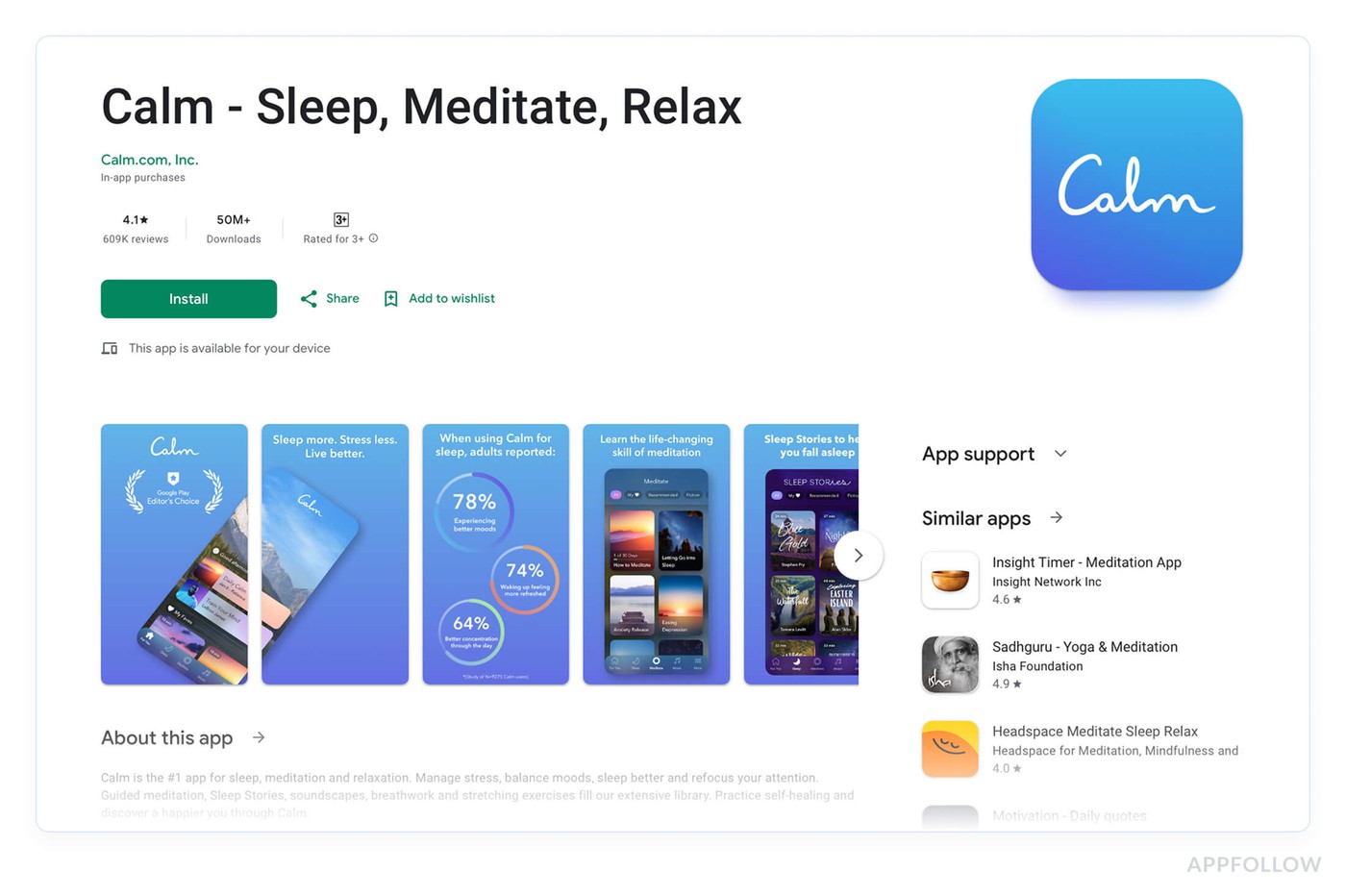
The brand is Calm. The publisher of record listed in the Google Play store is "Calm.com, Inc." Users see "Calm." The store sees the legal publishing entity, which carries the compliance and policy weight.
That gap between brand name and publisher name shows up constantly in app stores, and users rarely notice it until something goes wrong.
Acquisitions make this especially visible. When a company buys an app, the brand identity on the listing might stay intact for continuity, while the publisher account transitions behind the scenes on a separate timeline.
White-label products work similarly: a fintech company publishes an app branded entirely for a banking partner, but the publisher of record might be the tech vendor running the infrastructure.
Brand | App Publisher | |
What it is | Marketing identity and public-facing presence | Legal and operational account behind the listing |
Visible to users | Yes, prominently | Sometimes (often differs from the brand name) |
Accountable to the store | No | Yes |
Can differ from the other? | Yes | Yes |
Example | "Calm" | "Calm.com, Inc." |
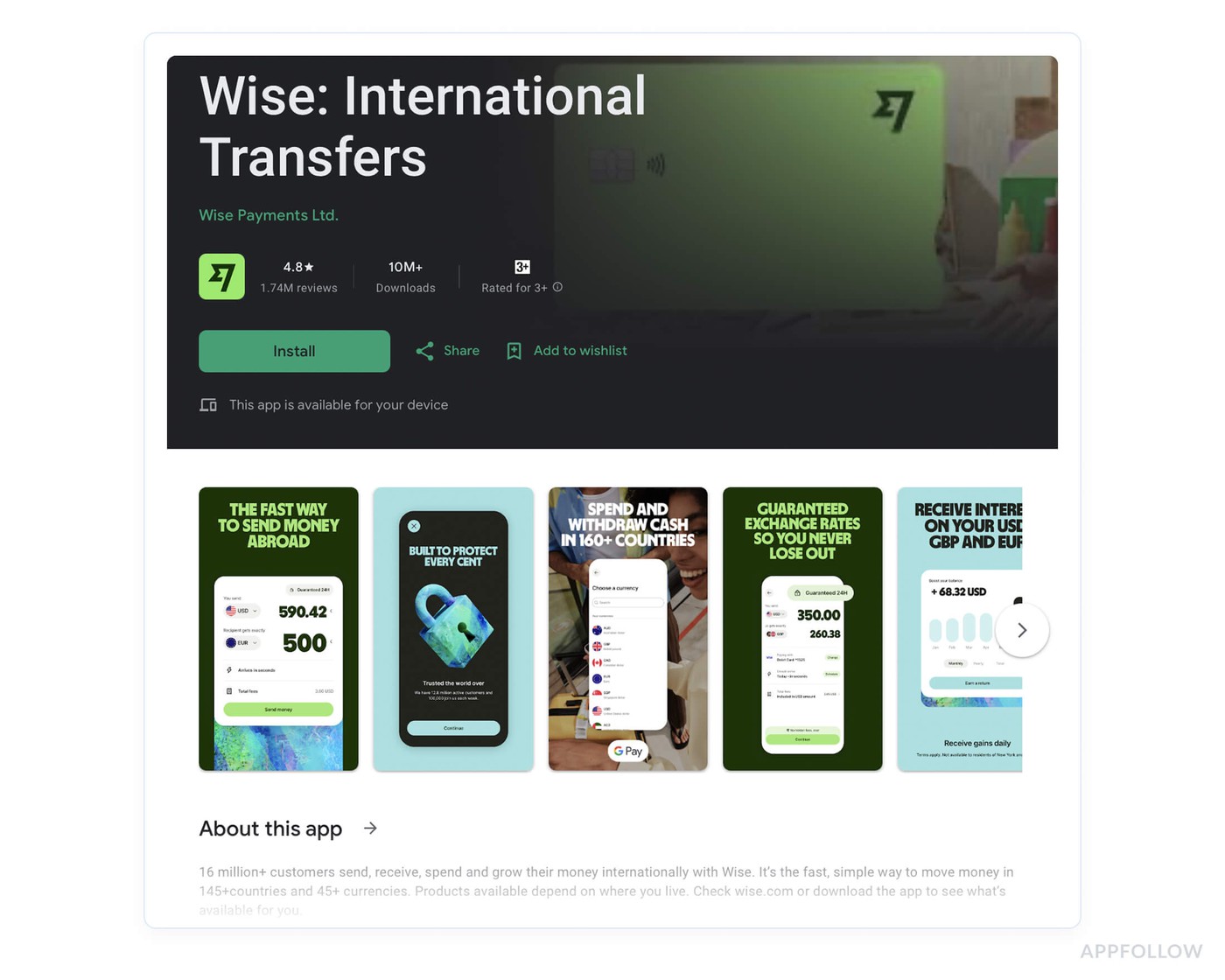
What the app publisher controls in app stores
The publisher account is the control layer for everything that happens outside the app's code. Once a build is submitted, what users see, how it's priced, and how feedback gets handled — all of that belongs to the publisher.
Here's what sits under direct publisher control:
- Store listing ownership. App name, subtitle, description, screenshots, preview videos, feature graphic, keywords, and all localized versions of any of the above. This is the core ASO surface. Every word and asset here affects discoverability and conversion rate on the listing page.
- Releases and updates. Submitting builds, managing version rollouts, setting release timing (immediate or scheduled), and handling phased rollouts on Google Play or staged releases on the App Store.
- Monetization setup. Pricing tiers, in-app purchase configuration, subscription groups, free trial parameters, and regional pricing. Developers implement the purchase flow in code; the store-side setup and management is publisher territory.
- Review responses and reputation signals. Both stores let publishers respond publicly to user reviews. That response is visible to every future user reading the listing before they decide to install. It's one of the few direct reputation levers a publisher controls in real time.
- Policy compliance. Age ratings, privacy policy URLs, data safety forms (Google Play), App Privacy details (App Store), and any store-specific requirements. The publisher account is on the hook if something violates guidelines.
Contact and legal information. Support URLs, developer contact details, and any required disclosures. The stores surface these to users and check them during review.
Why app publisher matters for ASO and growth
Considering industry reports and what we see in practice, the app publisher is still one of the most important personas in mobile growth in 2026 because this is the role that controls the levers that actually move ASO, conversion, ratings, and release speed.
- Search visibility still starts with the listing, and the publisher owns that surface. Apple has stated that over 65% of App Store downloads happen after a search. That means metadata, keyword mapping, screenshots, previews, and page structure are not static admin fields. They are core growth assets. The publisher is the persona with access to change them, test them, localize them, and ship updates without waiting for another team.
- The publisher controls experimentation, which means the publisher controls conversion learning. On Apple, publishers can run up to 3 alternate product page treatments in Product Page Optimization. On Google Play, publishers can run store listing experiments to improve install conversion rate and test localized variants. In other words, the publisher is not just maintaining the page. They are running the conversion lab.
- Review operations are not support hygiene anymore. They are ranking and conversion work. Google Play states that responding to a negative review can increase that rating by an average of +0.7. That is a very practical ASO signal. Better ratings improve store trust, and better trust improves conversion. The publisher is usually the team with the workflow, permissions, and regional coverage to respond at scale, route issues, and keep review backlog from turning into conversion drag.
- The publisher also owns localization depth, and that matters more in 2026 than it did a few years ago. Apple’s product page optimization can be localized by supported language, while Google Play supports localized experiments for different markets. That means publishers decide whether one app presents the same story everywhere or adapts by audience, market, and intent. In a more competitive store environment, that operational control matters a lot.
- Release speed is another reason the publisher remains a key persona. Google Play’s release tools are built around helping teams understand how their latest releases are performing and improve quality before the next one. The publisher is usually the function closest to that loop: update, monitor, react, ship again. In real ASO work, the teams that win are rarely the ones with the prettiest strategy doc. They are the ones that can publish, test, measure, and iterate faster than competitors.
- That is why the publisher matters so much in 2026. Not because they “own the app” on paper, but because they own execution across discoverability, testing, ratings, localization, and release operations. Strategy can come from ASO managers, PMs, growth leads, or agencies. But the publisher is still the persona that turns those ideas into live store changes that affect traffic and installs.
Everything app publishers need to grow apps in the App Store and Google Play
Monitor visibility, improve ratings, and optimize conversion. Keep ASO, reviews, and competitive insights in one place.
Start 7-days free trial in AppFollow
FAQs
Is app publisher the same as developer?
Not necessarily. A developer builds the code. A publisher owns the store account and manages the listing. One person can be both, and often is in small teams. At larger organizations they're distinct functions, and in agency or white-label setups, they're almost always different entities entirely.
Can one publisher publish multiple apps?
Yes, and many do at scale. Large publishers like Voodoo or Miniclip manage portfolios of dozens to hundreds of apps under one publisher account or a set of related accounts. The store places no hard limit on how many apps a publisher account can hold.
Can you change the publisher name on a listing?
It's possible but not instant. On Google Play, updating the developer name shown publicly goes through a review process. On the App Store, changing account details or transferring an app to a different publisher account involves additional steps and Apple review. Transfers between accounts are especially involved and carry their own requirements.
Why do some apps show a different brand name vs publisher?
Because brand identity and publisher account are separate things. A company publishes under a legal entity name while branding the app differently. Acquisitions add another layer: the app keeps its brand identity while the publisher of record changes behind the scenes on its own timeline.
How do I research a competitor publisher's portfolio?
Search the publisher name directly in the App Store or Google Play to pull all apps listed under that account. Tools like Sensor Tower, data.ai, or AppFollow let you filter apps by publisher, view their ranking history, keyword footprint, and update cadence across the whole portfolio — which is considerably more useful than looking at individual apps one by one.
Related terms
Mobile Advertising: Definition, Formats & How It Works
What Is an In-App Notification? Definition & Examples
What Is an App Session? Definition & Meaning in Analytics
What Is Install? Definition, Store Metrics, and How to Measure
What Is Apple Search Ads? Search Popularity & Impression Share
