

App Personalization: What It Is & How It Works | AppFollow
Table of Content:
- What is app personalization?
- Why app personalization actually moves the needle
- 4 types of app personalization
- How mobile app personalization works, technically
- App personalization and ASO: the connection most teams miss
- App personalization examples worth studying
- Frequently asked questions
- Related glossary terms
What is app personalization?
App personalization is the practice of dynamically adjusting what a user sees, hears, or does inside an app based on who they are and how they behave. Mobile app personalization covers everything from a customized onboarding flow to personalized push notifications, recommended content, and in-app messaging.
The goal is to reduce friction, increase relevance, and give each user a reason to keep opening the app.
Why app personalization actually moves the needle
Personalization earns its place because mobile attention is fragile. If an app feels generic, users leave fast. If it feels relevant, they stay longer, come back more often, and are more likely to convert.
The retention problem is steep. Based on Quettra data cited by Andrew Chen, the average app loses 77% of its daily active users within the first three days after install, 90% within 30 days, and more than 95% within 90 days.
Targeted messaging significantly outperforms generic blasts. Branch, citing Localytics, reports that users are almost 3x more likely to open the app when a push notification is dynamic and segmented instead of broadcast to everyone.
The commercial case is strong too. Twilio reported that consumers spend an average of 54% more with brands that personalize experiences. In a separate Twilio personalization report, 89% of leaders said personalization is crucial to business success over the next three years.
4 types of app personalization
Mobile app personalization isn't one thing. There are four distinct approaches, and most high-performing apps use at least two of them in combination.
- Behavioral based on what users do. Tracks in-app actions: screens visited, features used, time spent, content consumed. Netflix's recommendation engine is the classic example where every watch reshapes what surfaces next.
- Demographic based on who users are. Age, location, language, and device type. A fitness app might show weight-loss content to a 45-year-old in the UK and muscle-gain content to a 22-year-old in Brazil, based purely on profile data.
- Contextual based on current conditions. Time of day, location, weather, and network speed. Starbucks surfaces the "order ahead" feature during morning rush hours because contextual data tells them when it's needed.
- Predictive based on likely future actions. Machine learning models predict what a user will want before they ask. TikTok's For You Page is predictive personalization at its most extreme, it adapts within a single session.
REAL-WORLD EXAMPLE
Airbnb uses contextual + behavioral personalization together. Your search history shapes home recommendations (behavioral), while the app adjusts for your travel dates and local events nearby (contextual).
The result: listings that feel hand-picked, not algorithmically generated.
How mobile app personalization works, technically
At its core, personalization is a data pipeline. Here's how the pieces connect.
- Data collection. Apps collect first-party signals: in-app events (taps, scrolls, purchases), session metadata (duration, frequency, device), and explicit preferences (onboarding answers, notification settings). Third-party data — demographics, location, contextual signals — fills in the gaps.
- User segmentation. Raw data gets clustered into segments. Simple segmentation is rules-based ("users who opened the app 5+ times in 7 days"). Advanced segmentation uses ML to create dynamic cohorts that update in real time. The more granular the segments, the more relevant the experience — but also the more infrastructure required to maintain them.
- Content and flow adaptation. Once segments are defined, the app serves different experiences. A/B testing tools like Firebase Remote Config let teams serve different onboarding flows, paywall positions, or feature orderings to different segments simultaneously. The winning variant gets rolled out, the losing one gets archived, and the learning feeds back into the next experiment.
- Personalized messaging. Push notifications, in-app messages, and emails get triggered by user behavior rather than being broadcast on a schedule. There are automated platforms triggering a re-engagement push when a user goes 72 hours without opening or surfacing an upsell message the moment a free-tier user hits a usage limit.
App personalization and ASO: the connection most teams miss
Here's where most app personalization content stops — at the in-app layer. But personalization now starts before the install, at the app store listing level, and that's where ASO gets interesting.
Custom Product Pages (iOS) and Custom Store Listings (Android)
Apple now lets developers publish up to 70 additional Custom Product Pages per app, not 35. Each page can use different screenshots, app previews, promotional text, unique URLs, and even its own keyword set, so teams can align a page to a specific audience, feature, season, or campaign.
Apple also says developers see an average 2.5 percentage point conversion lift when traffic is sent to a Custom Product Page instead of the default product page.
Google Play’s Custom Store Listings work in a similar way, but the targeting options are broader than your draft suggests. Google officially documents targeting by country, URL, search keyword, Google Ads campaign, and user state. That user-state targeting includes cases such as pre-registration and inactive users.
Google also says you can create up to 50 custom store listings.
The point for ASO is solid: store-page conversion rate is a core acquisition metric in both stores. Apple defines App Store conversion rate as the ratio of downloads to unique impressions and explicitly recommends using App Analytics to see how product-page changes affect conversion.
Google’s Conversion Analysis and store listing experiments are built around the same idea: improve visitors-to-installs performance on the listing itself. So the line about a small CVR lift affecting every traffic source is a reasonable inference from how both stores measure acquisition.
The review angle needs softer wording. Apple does say that ratings and reviews influence search ranking and can encourage users to engage from search results. Apple also says that responding to reviews can improve an app’s rating.
ASO IN PRACTICE
A language learning app running Apple Search Ads for "Spanish lessons" and "Japanese for beginners" can serve each keyword audience a custom product page with screenshots in that language. Instead of a generic "learn any language" visual, Spanish learners see Spanish UI. Conversion rates on keyword-specific custom pages routinely run 15–30% higher than a default listing.
App personalization examples worth studying
Spotify — playlist personalization at scale
Discover Weekly and Daily Mix are the most-cited personalization examples in mobile for a reason. Spotify combines listening history, skip behavior, playlist additions, and collaborative filtering (what similar users listen to) to generate a playlist that refreshes every Monday.
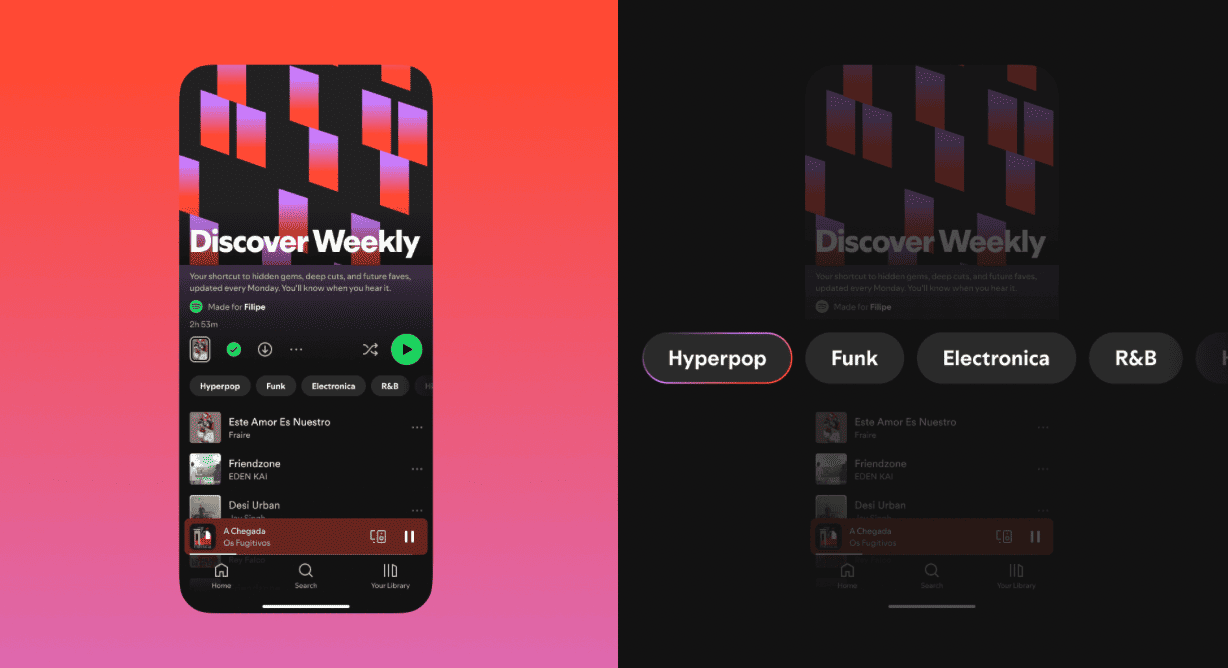
Discover Weekly refreshes every Monday with 30 personalized recommendations, while Daily Mix blends familiar tracks with new suggestions based on listening history and feedback.
Spotify reported in 2016 that Discover Weekly had already reached 40 million users and generated nearly 5 billion streams, which helps explain why it became such a visible example of personalization at scale.
Duolingo — behavioral personalization through streaks
Duolingo’s streak mechanic is a clear example of behavioral personalization. The app treats streaks as a motivation feature designed to help learners build a daily habit, and Duolingo has publicly shared that habit-focused reminder copy increased notification opt-ins by 5%.

Its push reminders are personalized using factors such as the learner’s current streak and the language they’re studying, and the company has published a KDD paper showing how it uses machine learning to optimize recurring notifications at scale.
Duolingo’s research reports that this notification system lifted daily active users by 0.5% and improved new-user retention by 2% over a strong baseline. That makes Duolingo a strong example of how personalized reminders, streak framing, and habit design can work together to keep users coming back.
Amazon Shopping — contextual + predictive combined
The Amazon app surfaces personalized product recommendations using signals like browsing history, past purchases, ratings, wish lists, and cart behavior. Amazon has also published research showing that its recommender systems scale across hundreds of millions of users and tens of millions of items.
While Amazon has not publicly shared the revenue impact of a single recommendation rail such as “Inspired by your browsing history,” outside analyses and older published figures suggest recommendation systems play a major role in both product discovery and sales on the platform.
Frequently asked questions
What is app personalization?
App personalization is the practice of dynamically adjusting the content, features, and experience within a mobile app based on individual user data — including behavior, preferences, demographics, and context. Rather than showing every user the same interface, personalized apps adapt in real time to show each person what's most relevant to them.
How does mobile app personalization work?
Mobile app personalization works by collecting user data (in-app events, session data, explicit preferences), segmenting users into cohorts, and then serving different content, messaging, or flows to each segment. Tools like Firebase Remote Config handle content variation; platforms like Braze handle personalized messaging. The most sophisticated implementations use machine learning to update segments and predictions in real time.
What are examples of app personalization?
Strong examples include Spotify's Discover Weekly (playlist personalization based on listening behavior), Duolingo's streak-based push notifications (behavioral trigger messaging), Airbnb's personalized home recommendations (behavioral + contextual), and Amazon's product recommendation rails (predictive personalization). On the ASO side, Apple's Custom Product Pages let apps serve personalized store listings to different ad audiences before install.
Why does app personalization matter for ASO?
Personalization affects ASO in two ways. First, personalized store listings (Custom Product Pages on iOS, Custom Store Listings on Android) improve conversion rates at the app store level — keyword-specific pages routinely convert 15–30% higher than default listings. Second, apps that deliver personalized experiences post-install tend to generate better reviews and higher ratings, which are direct ranking signals in the App Store and Google Play.
What data do you need to personalize a mobile app?
The minimum viable dataset for personalization is first-party behavioral data: what users tap, how long they stay, which features they use, and when they return. That alone is enough for basic behavioral segmentation and triggered messaging. Richer personalization layers in demographic data (age, location, language), contextual signals (time of day, device type), and eventually ML-generated predictions based on usage patterns across your full user base.
Related glossary terms
Topics that connect directly to app personalization and often come up together in ASO and mobile growth work.
- What Is a Push Notification? Meaning & Uses
- What is Retention Rate: Meaning & Benchmarks for Apps
- What Is Conversion? App Conversion Meaning, Definition & Benchmarks
- What is App Tracking Transparency (ATT) & Why It Matters
- What Is Churn? Churn Rate Definition & Formula for Apps
Track how personalization affects your app's store performance
AppFollow surfaces ratings, reviews, and ranking signals in one place — so you can see what's actually driving store visibility.
