

Gaming App Reputation Benchmarks 2026
We went through 51.5 million reviews across 22,800 gaming apps so you don't have to. This is the 2026 edition of our gaming benchmarks report, covering everything from global genre trends to how the top featured games on Google Play and the App Store handle their reviews (spoiler: a third of them don't reply at all).
Whether you run one game or fifty, this report gives you the numbers you need to figure out where you stand and what you should be doing differently. We also compared our own client base against the global market, and the results are pretty hard to argue with.
Short summary
51.5M
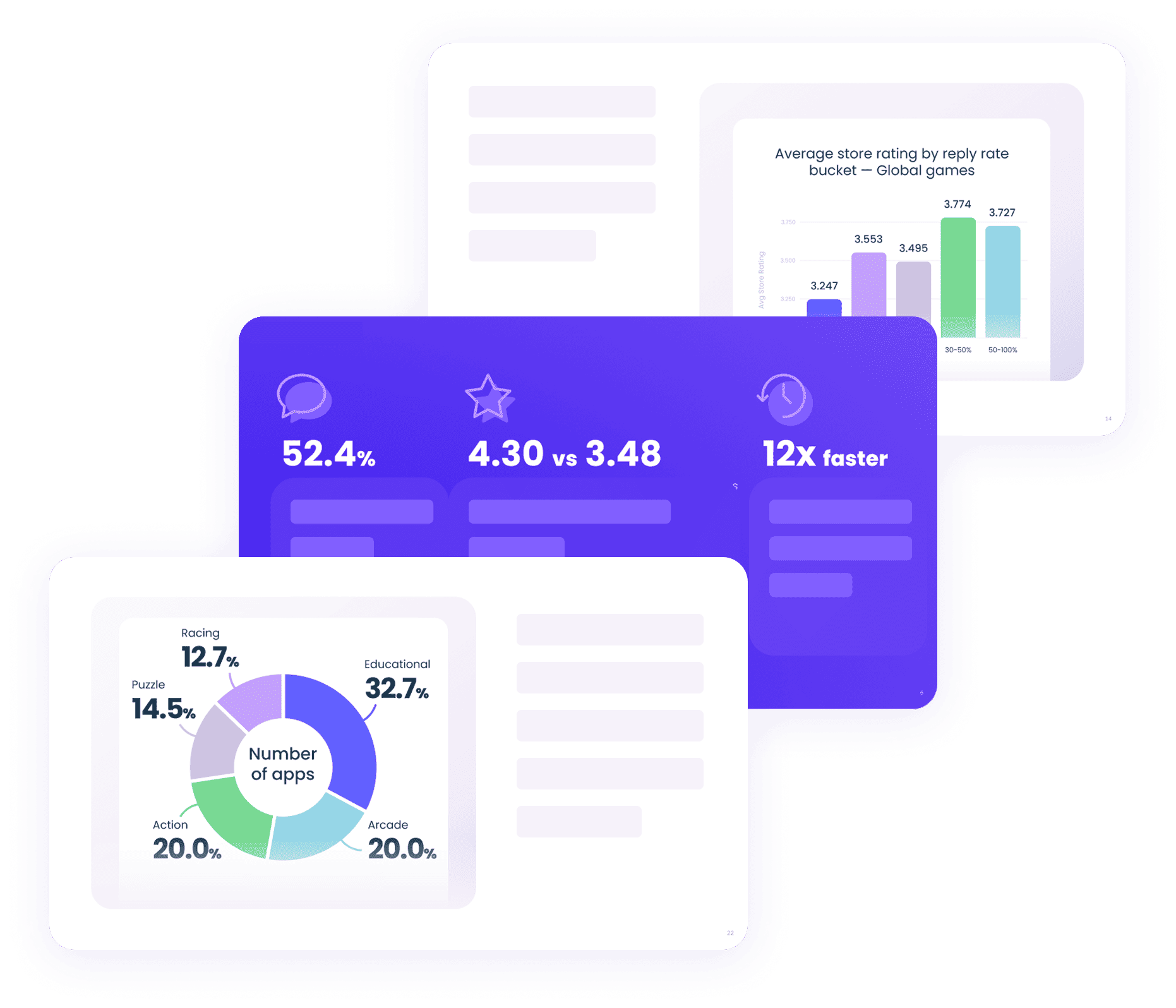
Reviews analysed across both stores, Jan 2025 to Jan 2026
12x faster
AI reply time vs manual replies among top performers
+0.42
Store rating lift for apps that reply to reviews vs apps that stay silent
29%
Of gaming apps don't reply to a single review
4.30 vs 3.48
Average store rating for AppFollow clients vs the global average
52.4%
Reply rate among AppFollow clients, more than double the industry average
What you'll find inside
The report covers global genre data across 15 gaming categories on both platforms, individual app data for over 2,000 games, a deep dive into the top 100 featured games of 2025, and a full breakdown of how AppFollow clients compare to everyone else.
There are side by side comparisons for Google Play and the App Store, because they behave quite differently and treating them as one market is a mistake we see a lot of studios make.
We also looked at what separates the top 10% of apps from the bottom 10%, and the answer is not what most people assume. It is less about reply speed and more about whether you reply at all, and how consistently you do it across star ratings.
If you are building your review management strategy for 2026 or trying to convince someone on your team that it matters, the data in here will help you make that case.
Key takeaway
Most gaming studios are leaving a lot on the table when it comes to review management. The ones that invest in it, whether through AppFollow or just through dedicated effort, end up with measurably better store ratings and sentiment scores.
The gap between apps that reply and apps that don't is real, consistent, and big enough to affect your visibility in the stores. Doing so is harder in the App Store, as opposed to Google Play. Automation helps a lot, too.
Download the report and see where your app sits.
FAQ
What is App Reputation management?
It is the practice of monitoring and responding to how users perceive your app. That means tracking ratings, reviews, and sentiment across app stores, and in some cases beyond them into places like Reddit, Discord, and social platforms where players talk about your game.
How can I use AppFollow to improve my app reputation?
AppFollow lets you track reviews, ratings, and sentiment in one place across both stores. You can automate replies, use AI to handle volume at speed, and monitor how your team's responses affect your ratings over time. The report shows that our clients reply to 52.4% of reviews on average vs 24.8% globally, and their store ratings reflect that.
What are the most important metrics to track?
Store rating, review rating (they are different and the gap between them matters), sentiment score, reply rate by star rating, and reply speed. The report breaks all of these down by genre and platform so you can benchmark against your specific category.
Is the data split by Google Play and App Store?
Yes. We found meaningful differences between the two platforms on almost every metric, from sentiment scores (Google Play averages 65.5 vs 46.4 on the App Store) to reply behavior among featured games. The report covers both separately and in combined views.
What is new in the 2026 edition?
This year we added the top 100 featured games analysis, cross-platform comparisons for every metric, a full three-tier comparison (AF clients vs featured vs global), and genre level breakdowns for both stores. We also looked at AI reply speed vs manual reply speed for the first time, and the 12x difference is one of the more striking findings.
