The ReviewTrackers alternative for app stores rather than storefronts
ReviewTrackers watches Google, Yelp and the rest for businesses with physical locations, and it does that job well. It was never built for App Store and Google Play, and it has no ASO tooling. If your reviews arrive through app stores and somebody has to sort, answer and report on them, that is what AppFollow does.
Features | AppFollow | ReviewTrackers |
|---|---|---|
Built for The job each platform was designed around. This row decides most of the others | App publishers Reviews and ASO across app stores | Multi-location businesses Reputation across physical locations |
ASO and keyword work Keyword discovery, rank tracking, category positions, and featuring monitoring | ✓ 45M+ keyword database | ✗ No ASO tools |
App store coverage App Store, Google Play, plus Galaxy Store, Huawei AppGallery, Amazon Appstore, and Microsoft Store | ✓ | ✗ Local review sites, not app stores |
AI semantic tagging and taxonomy Classify reviews against a structured taxonomy of bugs, monetization, user feedback, and concerns | ✓ 30+ pre-built categories | Limited Topic and sentiment analysis tuned to local businesses |
Custom AI semantic tags Train tags on your own product so the system catches issues specific to your app | ✓ | Not publicly stated |
Auto-tagging rules Rule-based tagging that runs every 10 minutes across untagged reviews from the last 14 days | ✓ | Not publicly stated |
Knowledge base support for AI replies Upload your docs and FAQs so replies are grounded in your product, not guesswork | ✓ | Not publicly stated |
Automated Report a Concern Flag spam, offensive, and fraudulent reviews to the app stores at scale | ✓ | ✗ |
Reply effect tracking Count the rating updates that followed a reply, within a 3-month window | ✓ | Not publicly stated |
Helpdesk routing Send reviews to Zendesk, Salesforce, Helpshift, Intercom, Front, Help Scout, and MS Teams | ✓ | Limited CRM and BI integrations aimed at location data |
MCP server for AI assistants Ask Claude, ChatGPT, Gemini, or Codex for live review and rating data without opening a dashboard | ✓ Google OAuth or SSO, no API keys to manage | ✗ No published MCP server |
Packaged AI workflows Ready-made analyst workflows that return the same report shape every time, run as slash commands | ✓ /feedback-analysis and /aso-analysis, open source | ✗ |
Pricing model How the bill grows as you add apps, locations, or people | From $19/mo Per plan, unlimited users; Essential $179/mo | From $89/mo per location Scales with location count |
Free plan Start using the product without a card or a sales call | ✓ Free plan + 10-day trial, no credit card | Free trial only |
Reply from one inbox Monitor and respond to reviews across sources in one place. Both platforms do this | ✓ | ✓ |
Sentiment analysis and reporting Track sentiment over time and export reports for stakeholders. Both platforms do this | ✓ | ✓ |
Google, Yelp, Facebook and local review sites Monitor the review sites customers use to judge a physical business | ✗ Trustpilot only | ✓ Broad local review site coverage |
Location-level rollups and benchmarking Compare branches, regions, and franchisees against each other on rating and response time | ✗ | ✓ Core platform capability |
Review request campaigns Ask customers for a review by email or SMS after a visit or purchase | ✗ | ✓ |
G2 rating Average score from verified G2 reviewers | 4.6/5 | 4.6/5 |

85% of teams see faster response times in week one
Teams handle 3x more reviews without hiring more people
$50K saved annually with automation and AI on average
Why teams switch from analytics to action
Built for app stores
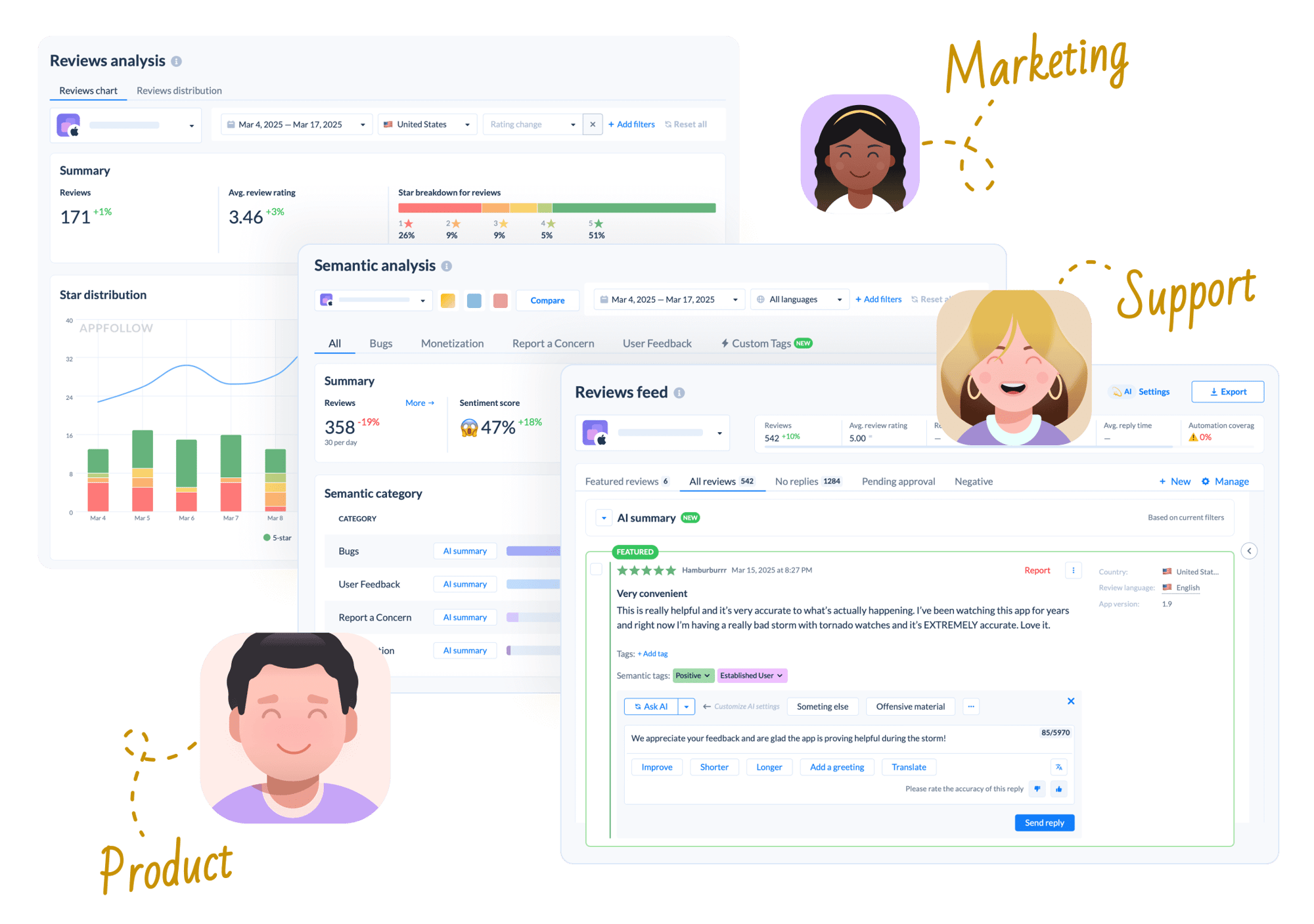
App Store and Google Play reviews, plus Galaxy Store, Huawei AppGallery, Amazon Appstore, Microsoft Store and Trustpilot, all in one feed. Replies push back to the store without a second login, and Report a Concern flags spam and fraudulent reviews at scale.

ASO in the same subscription
Keyword discovery across a 45M+ database, competitor tracking, category rankings and featuring monitoring sit next to the review feed. ReviewTrackers has no ASO layer, so that work needs a second tool and a second bill.
Tagging that runs itself
Auto-tagging rules run every 10 minutes across the last 14 days of untagged reviews, with semantic tags covering bugs, monetization and feature requests across 30+ categories. Reviews then route on to Zendesk, Salesforce, Helpshift, Intercom, Front or Help Scout.

Priced per plan, not per location
ReviewTrackers starts at $89 a month for one location, so the bill tracks how many sites you run. AppFollow opens at $19 for the ASO plan and $179 for Essential, with unlimited users on every tier. (If you genuinely have hundreds of storefronts, their model is the one that fits.)
Built for teams, not just analysts
Customer success needs teamwork.
AppFollow has automated tagging, bulk reply actions, team performance dashboards, and workflow integrations that help support, product, and marketing teams work together.


FAQ: AppFollow as a ReviewTrackers alternative
What is the main difference between AppFollow and ReviewTrackers?
They solve different problems. ReviewTrackers is reputation management for businesses with physical locations, pulling Google, Yelp, Facebook and similar sites so a chain can see how each branch is doing. AppFollow is for app publishers: App Store and Google Play reviews, ASO, and the automation around replying at volume.
Does ReviewTrackers cover App Store and Google Play reviews?
Their coverage is built around local review sites rather than app stores, and they publish no ASO tooling at all. If your feedback arrives through app store reviews and your job includes keyword rankings, that is the gap. If it arrives through Google and Yelp for fifty branches, ReviewTrackers is the right shape.
Which is cheaper, AppFollow or ReviewTrackers?
The pricing models differ more than the numbers. ReviewTrackers starts at $89 a month per location, so the bill scales with how many sites you run. AppFollow starts at $19 a month for the ASO plan and $179 for Essential, priced per plan with unlimited users. For one app the maths is simple; for two hundred restaurants it is not a fair comparison.
Can I use either one inside Claude or ChatGPT?
AppFollow ships an MCP server, so Claude, ChatGPT, Gemini, and Codex can read your live reviews, ratings, and keyword data, signing in with Google OAuth or SSO. ReviewTrackers publishes no MCP server.
Which one handles high review volume better?
For app stores, AppFollow: auto-tagging rules run every 10 minutes, semantic tags sort across 30+ categories, and reviews route on to Zendesk, Salesforce, Helpshift, Intercom, Front, or Help Scout. For location review sites, ReviewTrackers is purpose-built and AppFollow does not cover those sources.
Can I run both?
Plenty of companies do, and it is often the honest answer. A retailer with an app and three hundred stores has two different feedback problems. Running one tool for the app stores and another for the locations usually beats stretching either one to cover the other.
What is the best ReviewTrackers alternative?
It depends which half of the job you mean. For app store reviews and ASO, AppFollow. For local reputation across locations, look at Birdeye or Yext rather than at us, because that is not what AppFollow is built for.